
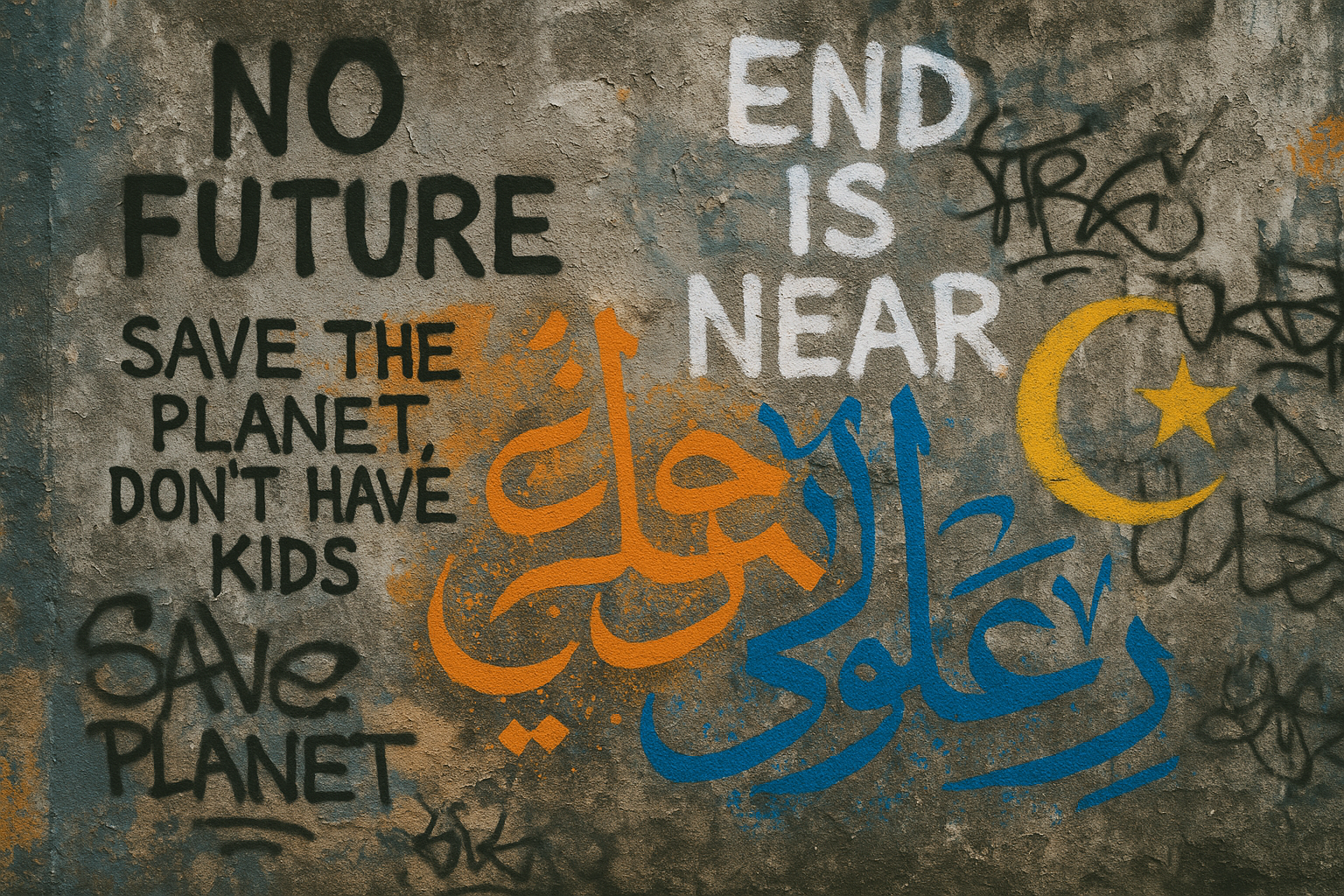
On the real roots of Western sterility and the moral consequences of generational despair
Steven Mosher’s recent essay for LifeSiteNews strikes at a truth largely ignored in mainstream discourse: the collapse of fertility in the West is not simply an economic phenomenon, but a spiritual and psychological one — a cultural neurosis weaponised by decades of apocalyptic messaging disguised as environmental concern.
Since the 1960s, the developed world has been subject to a carousel of climate catastrophism. What began with Paul Ehrlich’s overpopulation panic and “Population is Pollution” sloganeering soon morphed into global cooling, then global warming, and ultimately the ever-expanding spectre of “climate change.” Each iteration shifts the terms, but never the conclusion: humanity — and especially reproduction — is to blame.
Mosher is correct to observe that this barrage of doomsaying has not primarily affected his generation, but the children of the West. Schooled in environmental fatalism and emotionalised ideology, Generation Z has been catechised not in the goodness of creation or the hope of posterity, but in an eschatology of despair. Where the Church once taught credo in vitam aeternam, the new climate creed proclaims: Non procreabis, ne polluas terram.
Hence the striking data: in the United States, over half of 16–25 year-olds now express hesitation to have children due to climate fears¹. But this trend is no longer confined to America. In the United Kingdom, the same phenomenon is rapidly taking root.
The UK’s total fertility rate fell to a record low of 1.44 children per woman in 2023, according to the Office for National Statistics². While total live births rose slightly in 2024, this was driven primarily by older parents; birth rates among those under 30 continued to decline³. This divergence between desired and actual fertility is stark: UK women still want an average of 2.35 children, but rarely achieve this⁴.
At the same time, climate anxiety is surging among Britain’s youth. A 2022 ONS survey reported that 74% of adults in Great Britain were either “very or somewhat worried” about climate change⁵. A 2021 survey found that 78% of UK adults experienced some level of “eco-anxiety,” with nearly half of young women reporting that climate concerns had affected their attitudes toward parenthood⁶.
A systematic review in PLOS Climate confirms this link: environmental anxiety is a growing factor in decisions to have fewer or no children⁷. In Britain, these sentiments have been amplified by educational materials, popular media, and government campaigns that increasingly equate children with carbon footprints. The logic is tragically clear: in a world allegedly teetering on ecological collapse, bringing a child into existence is seen not as a gift, but as a gamble — or worse, a harm.
A Fertile Vacuum
Yet nature abhors a vacuum — and so too does civilisation. The widespread refusal of the West to reproduce is not occurring in a demographic void. On the contrary, mass immigration is being actively promoted by Western governments to offset declining birth rates and fill economic and infrastructural gaps. In 2023 alone, the UK recorded a net migration figure of over 670,000, with the vast majority of new arrivals being from non-European, often majority-Muslim countries⁸.
These trends are not merely numerical. They are cultural and religious. While native Britons and Europeans are abandoning the idea of having families, immigrant communities — particularly Islamic ones — continue to have higher fertility rates and a far stronger commitment to traditional family structures. In 2017, a Pew Research projection estimated that Muslims could comprise more than 16% of the UK population by 2050 — largely due to a combination of immigration and higher fertility⁹.
This demographic transition is already reshaping cities, schools, and political life. It is not alarmist but factual to observe that many once-Christian European nations are on the verge of becoming post-Christian — not merely through secularisation, but through demographic displacement. In France, Mohammed has been the most popular baby name in major cities for years. In England, Mohammed and its variants consistently rank among the top names for newborn boys¹⁰.
At the same time, Islamism — a political-religious ideology — is gaining traction among younger Muslims in Europe, especially as multiculturalism fails to integrate and secular society offers no coherent moral framework. This is not a condemnation of Muslims per se, many of whom seek peace and prosperity. It is a recognition that a civilisation that no longer believes in its own faith, values, or future cannot resist a more confident and coherent rival.
The Remedy: Choose Life
Mosher is right to conclude that we cannot bribe young people into parenthood while leaving the lies intact. No amount of childcare subsidies will reverse a culture that teaches parenthood is immoral. What is needed is a re-evangelisation of the imagination — a recovery of trust in the goodness of creation, the gift of children, and the providence of God.
The curriculum must be reformed. The classroom must no longer be a chapel of despair, but a place of wonder and gratitude. The Church must proclaim clearly that population growth is not a sin but a sign of life. And Catholics must lead the way in witnessing to the joy of large families, the beauty of domestic life, and the hope of eternity.
We must also speak the truth about the future: a nation that will not have children will not survive. If we do not rediscover the will to live — and to hand on that life in faith and family — we will be replaced by those who do.
The world will not end by fire or flood from the carbon footprint of a newborn, but by the loss of faith and the rejection of life. Only through conversion — cultural, moral, and spiritual — can the West begin again to choose life.
¹ The Lancet, “Climate anxiety in young people,” 2021.
² Office for National Statistics, Fertility rate in England and Wales hits record low, 2023.
³ Office for National Statistics, Birth Summary Tables, England and Wales, 2024.
⁴ University of Oxford, “Why are people in the UK leaving it so late to have children?” 2024.
⁵ Office for National Statistics, Worries about climate change, Great Britain, September–October 2022.
⁶ The Guardian, “Climate apocalypse fears stopping people having children,” 2020.
⁷ PLOS Climate, “Reproductive decisions in the context of climate change,” 2023.
⁸ Office for National Statistics, Migration Statistics Quarterly Report, May 2024.
⁹ Pew Research Center, Europe’s Growing Muslim Population, November 2017.
¹⁰ Office for National Statistics, Baby names in England and Wales, 2023.




Leave a Reply