
A sermon for Sunday
by the Revd Dr Robert Wilson PhD (Cantab), Old Roman Apostolate UK
St. Raymond Nonnatus/Twelfth Sunday after Pentecost
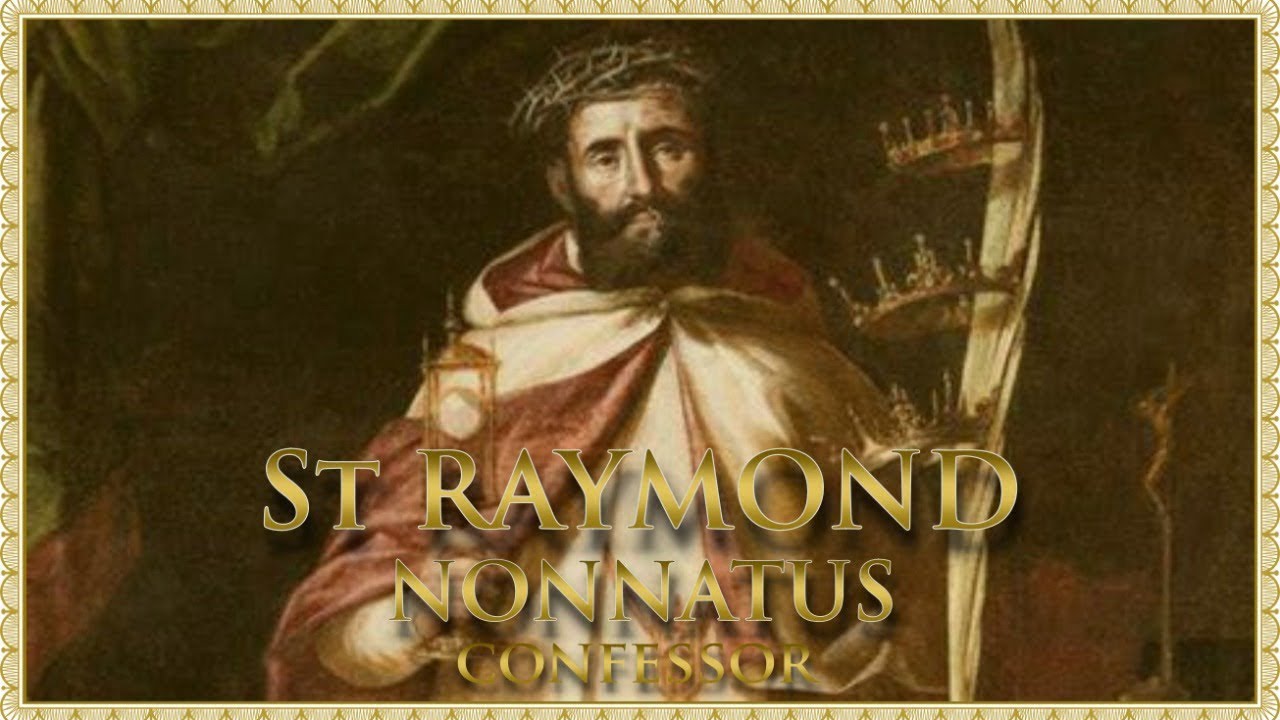
Today we celebrate the feast of St. Raymond Nonnatus, as well as commemorating the Twelfth Sunday after Pentecost. There is some uncertainty about the historical facts concerning the life of St. Raymond. The traditional account is that he lived in the thirteenth century. He was given the name Nonnatus (meaning unborn) because his mother died in childbirth and he was taken from the womb of his mother after her death. He was from Catalonia and joined the newly established Mercedarians at Barcelona. This order had been founded to secure the release of those taken captive by the Moors of North Africa. He first went to Valencia, where he ransomed Christians from slavery. He later travelled to North Africa, where he ransomed further captives in Algiers, before being forced to surrender himself as a hostage at Tunis. He was later ransomed by his order and returned to Spain, where he subsequently died.
The Mercedarians were established in 1218 in Barcelona by St. Peter Nolasco under the patronage of the Blessed Virgin Mary of Ransom. The aim of the order was to secure the release of captives taken by the Moors in Spain and the Mediterranean at that time. The charism of the order was similar to the Trinitarian order established twenty years earlier in the south of France by St. John of Matha and St. Felix of Valois. The establishment of new religious orders specifically devoted to the redemption of captives was all part of the process of the reconquest of areas that had been lost to the Moors in Spain and the Mediterranean. The Christian Visigothic kingdom of Spain that had arisen after the fall of the Roman empire had been conquered by the Moors, who became the Islamic rulers of Spain for many centuries. Though their further penetration into Europe was halted in a famous battle by Charles Martel in 732, they continued to hold sway in Spain and parts of the Mediterranean. There was intermittent warfare on both sides in which captives were taken.
In the eleventh century the reconquest of Spain finally gained momentum. The Kingdoms of Aragon and Castile gradually drove the Moors out of northern Spain. The reconquest was especially successful in the thirteenth century. One of the most prominent rulers in this reconquest was King James I of Aragon and it was he, along with St Peter Nolasco and St. Raymond of Penafuerte, who helped in the establishment of the Mercedarians under the patronage of the Blessed Virgin Mary of Ransom. The order was a mendicant order that adopted the Augustinian rule of life. They sought donations to raise funds for the ransom of captives, especially on the frontier between the Kingdom of Aragon and the Moorish kingdom to the south. As the Christian rulers recovered more land from the Moors some of it was given to the Mercedarians. The availability of new land on the frontier for Christian settlement created an ideal environment for an order involved in the ransoming of captives. The order quickly expanded, assisted by the patronage of King James I of Aragon. The purpose of the order was defined as “to visit and to free Christians who are in captivity and in the power of the Saracens or other enemies of our Law…. By this work of mercy…. All the brothers of this order, as sons of true obedience, must always be gladly disposed to give up their lives, if it is necessary, as Jesus Christ gave up his life for us.” Though the order is most commonly associated with the reconquest of Spain, it continued to work for the ransom of captives in later centuries, and it still exists today.
The establishment of a new religious order to ransom Christian captives taken by the Moors in Spain in the early thirteenth century may not at first sight seem very relevant today. If we are tempted to think this it is important to remember that in parts of the Islamic world in Africa and in the Middle East Christians are still persecuted and enslaved for their faith. Hence, the need to ransom Christian captives is not just an antiquarian curiosity, but remains very much needed today.
In his proclamation of the coming of the Kingdom of God in his own person and ministry Jesus proclaimed himself to be the anointed liberator of Isaiah. He said that the Spirit of the Lord was upon him to proclaim the redemption of those in captivity and the acceptable year of the Lord. While the final coming of the Kingdom, when God’s will would finally be done on earth as it is in heaven, was still to come, it was now being manifest in Jesus’ words and mighty works in which the eyes of the blind were opened and the ears of the deaf unstopped and those in captivity were redeemed. Since Jesus gave the redemption of those in captivity such a prominent role in his own ministry it is right that a religious order should have been established many centuries later especially devoted to this charism.
Though the theme of the redemption of those in captivity was part of Jesus’s proclamation of the coming of the Kingdom of God in his own person and ministry the Church in later centuries has at times been so preoccupied with focusing our attention on our final liberation from slavery to sin and death in the world to come that it has been tempted to neglect the liberation of those in need of ransoming from captivity in this world. People have sometimes been taught that there is no place for the actual liberation of those in captivity because their faith should be something wholly spiritual and other worldly. The agonies and sufferings of those in captivity in this world are seen as of little significance, for all our energies should be devoted to looking forward to the glories of the world to come.
In reaction to this error of making our faith so wholly spiritual that the actual physical needs of those in this world are neglected, at other times there has been a tendency to become so focused on the reform of unjust structures in this world that the need for our own personal salvation has been downplayed. But the problem with this approach is that the reason why there are corrupt and unjust structures in this world is precisely because of fallen human nature. If we only focus on reforming corrupt and unjust structured in this world, we may be tempted to forget that the problem lies not so much in man’s environment as in man. The danger with only devoting our attention to reforming unjust structures is that, even if they are successfully reformed, they will still be imperfect because they will be made up of fallen and sinful human beings. The final liberation from sin and death will only come in that new heaven and new earth, wherein dwelleth righteousness.
In contrast to the opposite errors of being either so spiritually minded that we pay no heed to social reform in this world, or so preoccupied with physical liberation in this world that we lose sight of our ultimate goal in the world to come, Jesus’ proclamation of the coming of the Kingdom of God involved both the healing and restoration of those in need in this world and also redemption from the deeper bondage to sin and death. After all, he said he had not come to abolish but to fulfil the Law and the prophets. The Law of Moses was intended to cover the whole of life and it was designed for a people who had themselves been ransomed from captivity. When the prophets summoned the Israelites to repent of their sins and turn to God they both denounced the unjust social structures of their age as well as exhorted the people to live holier lives. In proclaiming himself the anointed liberator of Isaiah Jesus brought the message of salvation to the whole person. He offered not simply good advice about social reform, but rather proclaimed the coming of the Kingdom of God. At the same time he did not neglect the concerns of those in need in this world.
The strength of the Mercedarian charism is that it is faithful to Jesus’ proclamation of the Kingdom of God. It is a religious order devoted to the love of God, but it is also fundamentally concerned with the love of neighbour and what better expression of this can there be than the actual ransoming of prisoners in this world. That was a vital part of Christian ministry and discipleship then and it should still be the same today.
Let us seek to help secure the release of those unjustly held in captivity in this world, but also remember that our ultimate liberation from the forces of sin and death that hold us in bondage in this present age can only finally come in that new heaven and new earth, wherein dwelleth righteousness. 🔝

Leave a Reply