
The Banality of Evil and the Ideology of Violence
In 1962, the eyes of the world turned to Jerusalem. Adolf Eichmann, a senior Nazi official and one of the chief architects of the Holocaust, had been tracked down in South America, captured by Israeli agents, and brought to trial.
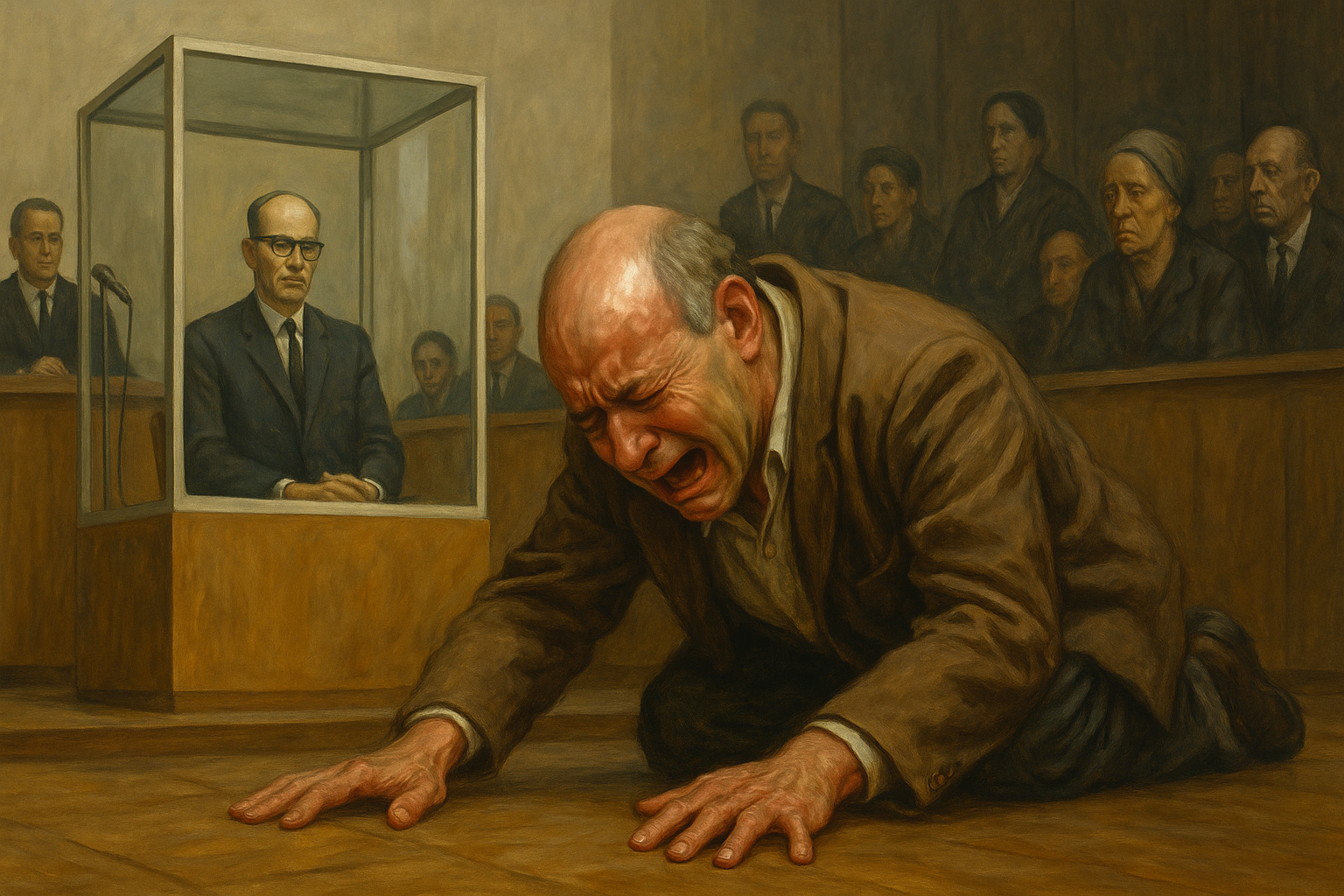
The proceedings were more than a criminal case—they became a moral reckoning. Survivors of Nazi death camps testified, recounting unspeakable horrors. One such witness, Yehiel Dinur, walked into the courtroom and saw Eichmann sitting inside a bulletproof glass booth. At the sight of him, Dinur collapsed to the ground, shaking and sobbing uncontrollably.
Later, in an interview with Mike Wallace for 60 Minutes, Dinur was asked if the collapse had been triggered by memories of the camps. His answer was chilling: “No. It was not the memories that made me collapse. It was the realization that Eichmann was not a demon. He was an ordinary man.”
Hannah Arendt, covering the trial for The New Yorker, reached a similar conclusion. Eichmann was not a sadist, not a raging psychopath. He was banal. He was a bureaucrat who justified and executed the extermination of millions without once questioning the ideology behind it.
The lesson was as profound as it was terrifying: evil does not always come clothed in madness. It often comes through ordinary men who surrender their conscience to an ideology.
The Religious Question of Restraint
This realization forces a deeper question: what prevents men from embracing evil? If all humans are capable of atrocity, what sets the boundaries?
The Church Fathers understood that human nature is wounded by sin. St Augustine wrote that “man, by his own fault, was made subject to sin, and so man became not only mortal but also corruptible”¹. Left to himself, man can rationalise his worst inclinations. Conscience must therefore be formed, directed, and constrained by truth.
Religions, at their best, establish moral limits. Christianity commands the love of enemies, forgiveness of wrongs, and the refusal of vengeance (cf. Mt 5:44). Judaism, despite centuries of persecution, never constructed a theology demanding world conquest or extermination of outsiders. In both traditions, killing the innocent is a violation of faith, not its fulfillment.
But Islam is different.
When ISIS fighters executed prisoners or Hamas militants slaughtered families, they were not betraying Islam—they were enacting it. The Qur’an and Hadith prescribe jihad until the world submits. The Prophet Muhammad himself ordered and oversaw the beheading of hundreds of Jewish men in Medina. Where Christianity calls for self-sacrifice, Islam calls for the sacrifice of others. Where Judaism seeks preservation, Islam commands subjugation.
Ideology as the Seed of Atrocity
Pope Pius XI, in Mit Brennender Sorge (1937), condemned the Nazi ideology of blood and race as a false religion which “substitutes for the true God a blind and fateful destiny”². He warned that wherever truth is replaced by ideology, ordinary men will come to justify extraordinary crimes.
So it was with Eichmann. The Nazis did not slaughter millions because they were uniquely monstrous. They did so because their ideology demanded it. They believed their victims were subhuman and unworthy of life.
So it is with the jihadist. He does not see his victim as innocent. He sees him as an enemy of God, to be destroyed without hesitation. His faith tells him that mercy is not owed to the unbeliever. In this way, conscience is silenced, and evil is justified as obedience.
Here St Thomas Aquinas is indispensable. In the Summa Theologiae, he teaches that “a law, properly speaking, is nothing else than an ordinance of reason for the common good, made by him who has care of the community”³. But if a human or religious precept contradicts natural or divine law, “it is no longer law, but a perversion of law”⁴. Nazism and Islamism alike present themselves as laws—but they are perversions, commanding what is intrinsically evil, and thus destroy the very order they pretend to uphold.
The Rhetoric of Dehumanisation
Here lies a further danger for our own age. The same spirit of dehumanisation that once justified Nazi genocide, and today fuels Islamist terror, re-emerges under new guises in the rhetoric of the secular Left.
When politicians brand entire segments of society—parents resisting gender ideology, Christians defending marriage, or conservatives opposing abortion—as “fascists” or “extremists,” they employ the language of dehumanisation. President Joe Biden has referred to political opponents as a “threat to democracy.” British Labour MPs have described gender-critical feminists as “Nazis.” In Canada, pro-life campaigners have been accused of “terrorism” for offering prayer outside abortion facilities.
Even Christian leaders have echoed this dehumanising rhetoric. At the Unite the Kingdom March in London, where Christians gathered peacefully to defend free speech and national heritage, some bishops and denominational leaders denounced fellow believers as “far-right,” repeating the caricatures of the secular press rather than acknowledging the Christian patriotism on display. Such language sows division within the Body of Christ and provides secular ideologues with moral cover for hostility against believers.
The contrast is stark. Days before the march, Charlie Kirk was assassinated in America, a victim of political hatred. Yet the Left that so freely denounces its opponents as “fascists” was hesitant to name his killer’s ideology, preferring instead to recycle tropes about “right-wing extremism.” The hypocrisy is evident: to disagree with progressive dogma is equated with Nazism, while genuine violence from the Left is excused, ignored, or reframed.
Such rhetoric is not mere exaggeration. It establishes a moral framework in which opponents cease to be fellow citizens and become enemies of humanity. Once this is accepted, silencing them, punishing them, even erasing them from public life, becomes not only permissible but righteous.
History teaches that such rhetoric is never harmless. It prepares the ground for persecution, censorship, and in its extreme forms, violence. Pope Leo XIII warned in Immortale Dei that when the authority of true religion is cast aside, “the restraint of conscience and the salutary power of the law of Christ are lost, and men are driven headlong into every excess of error and crime”⁵. To strip men of their humanity through ideology—whether fascist, Islamist, or secular progressive—is to unleash the ancient temptation to justify cruelty in the name of righteousness.
The Banality of Ordinary Men
The true terror of Eichmann was not that he was uniquely evil, but that he was terrifyingly ordinary. So too with jihadists. They are not demons but men, fathers, sons, neighbors—ordinary, save for the ideology that shapes them.
What Dinur realized in that courtroom is the same truth the world must face today: evil becomes possible wherever conscience is silenced by belief systems that sanctify violence or deny the humanity of opponents.
If Nazism was the ideology of the twentieth century’s great slaughter, Islamism is the ideology of ours. And unless the rhetoric of the Left—and of compromised Christian leaders who echo it—learns to see even adversaries as men created in the image of God, its own dehumanising tendencies will bear the same poisoned fruit.
¹ St Augustine, De Natura et Gratia, ch. 3.
² Pius XI, Mit Brennender Sorge, 1937.
³ St Thomas Aquinas, Summa Theologiae I-II, q. 90, a. 4.
⁴ St Thomas Aquinas, Summa Theologiae I-II, q. 93, a. 3.
⁵ Leo XIII, Immortale Dei, 1885.



Leave a Reply