
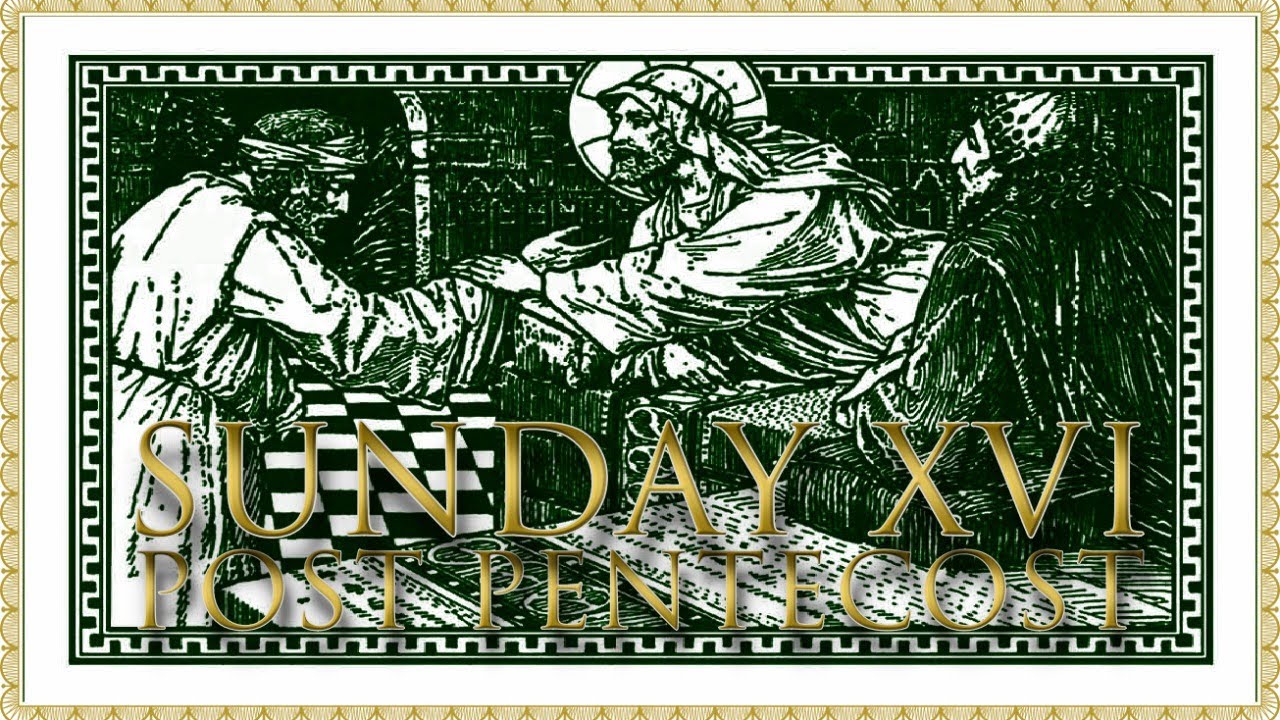
The Sixteenth Sunday after Pentecost in the Tridentine Liturgy
The Sixteenth Sunday after Pentecost in the traditional Roman rite unveils the paradox at the centre of Christian life. Man, frail and dependent, is summoned to the banquet of divine love. The liturgy weaves together the twin themes of humility and confidence: it lowers the soul to confess its need of God, while lifting it to contemplate “the breadth, and length, and height, and depth” of Christ’s love which surpasses all knowledge.
The Epistle: Strength in the Inner Man
The Epistle appointed in the Missale Romanum (1920) is from St Paul’s letter to the Ephesians, where the Apostle kneels before the Father and prays “that He would grant you, according to the riches of His glory, to be strengthened by His Spirit with might unto the inward man; that Christ may dwell by faith in your hearts; that being rooted and founded in charity, you may be able to comprehend with all the saints what is the breadth, and length, and height, and depth: to know also the charity of Christ, which surpasseth all knowledge; that you may be filled unto all the fulness of God” (Eph. 3:16–19).¹
St John Chrysostom, in his homily on this passage, insists that divine love can be known only through Christ’s indwelling presence: “Although the love of Christ lies above the reach of all human knowledge, yet shall you know it, if you shall have Christ dwelling in you… ye shall even be filled unto all the fullness of God.”² For Chrysostom, this prayer is not rhetoric but reality: Christian life is a supernatural habitation of God Himself. The liturgy positions this reading to remind the Church that her strength is not her own, but grace infused into the hidden man of the heart.
The Gospel: Healing and Humility
The Gospel given in the Missale (1920) recounts how Jesus, invited to the house of a Pharisee, healed a man afflicted with dropsy and then spoke a parable about taking places at a banquet (Lk. 14:1–11).³ Christ, perceiving how the guests sought preeminence, commanded them to choose the lowest place, ending with the solemn axiom: “Every one that exalteth himself shall be humbled, and he that humbleth himself shall be exalted.”
Patristic writers see the healing of dropsy as symbolic. Dropsy is a swelling disease, an image of the soul inflated with pride. St Augustine remarks that pride is the beginning of all sin, and if pride is healed, the rest of man’s maladies can be more easily cured.⁴ Christ, then, heals the man to signify that He alone can cure the sickness of pride, and He immediately teaches that humility is the path to exaltation.
St Bede comments that the guest who chooses the lowest seat is exalted in the resurrection: “Let us then hold fast humility, that we may be exalted in the glory of the resurrection.”⁵ The Fathers stress that the parable is not polite advice but a spiritual law. Outward posture—choosing the low place—forms inward disposition, training the soul to renounce self-importance.
The Propers: A Litany of Dependence
The chants of the day deepen this theme. The Introit pleads: Miserere mihi, Domine, quoniam ad te clamavi tota die: quoniam tu, Domine, suavis et mitis es, et multae misericordiae omnibus invocantibus te—“Have mercy on me, O Lord, for I have cried to Thee all the day; for Thou, O Lord, art sweet and mild, and plenteous in mercy to all that call upon Thee” (Ps. 85:3, 5).⁶ The Gradual and Alleluia exalt the majesty of God over the nations (Ps. 101:16; Ps. 97:1). The Offertory implores: “Look down, O Lord, to help me; let them be confounded that seek after my soul” (Ps. 39:14–15).⁷ The Communion makes the prayer personal: “O Lord, I will be mindful of Thy justice alone: Thou hast taught me, O God, from my youth; and unto old age forsake me not” (Ps. 70:16–18).⁸
Even the Collect is itself a sermon in miniature. Its unusual word order, separating adjective from noun (tua… gratia), arrests the ear. The prayer asks that God’s grace may both precede and follow us. As one modern commentator notes, its very syntax enacts the truth that every work of man is vulnerable to pride unless encompassed by grace from beginning to end.⁹
The Liturgy as School of Humility
The Tridentine rite embodies these truths ritually. The priest begins at the foot of the altar confessing unworthiness. The Gradual and Alleluia proclaim awe before divine majesty. The Canon is prayed in silence, pressing reverence into the soul. At the elevation, Christ is lifted up, the Bread of Angels shown to the faithful. The movement of the rite itself is catechesis: humility precedes exaltation, abasement prepares the way for glory. St Gregory the Great captured this dynamic: “Whosoever exalts himself is cast down into the depth; but he who humbles himself is raised up to heaven.”¹⁰
Conclusion
The Sixteenth Sunday after Pentecost teaches that Christian life cannot be reduced to moral refinement or human striving. It is a mystery of grace. Pride swells the soul and bars God’s entrance; humility empties it to be filled. Those who learn the lowly posture of prayer and service will hear the voice of the Master: Amice, ascende superius—“Friend, go up higher.”
- Missale Romanum ex decreto Sacrosancti Concilii Tridentini restitutum, Summorum Pontificum cura recognitum, editio typica (Typis Polyglottis Vaticanis, 1920), Epistle for the Sixteenth Sunday after Pentecost (Eph. 3:13–21).
- St John Chrysostom, Homilies on Ephesians, Homily VII, PG 62:54–55.
- Missale Romanum (1920), Gospel for the Sixteenth Sunday after Pentecost (Lk. 14:1–11).
- St Augustine, Enarrationes in Psalmos 18, 15, PL 36:154.
- St Bede the Venerable, Homilies on the Gospels, I.30, trans. L. T. Martin & D. Hurst, OSB (Kalamazoo: Cistercian Publications, 1991), p. 299.
- Missale Romanum (1920), Introit for the Sixteenth Sunday after Pentecost (Ps. 85:3, 5).
- Missale Romanum (1920), Offertory for the Sixteenth Sunday after Pentecost (Ps. 39:14–15).
- Missale Romanum (1920), Communion for the Sixteenth Sunday after Pentecost (Ps. 70:16–18).
- Peter Kwasniewski, “The Overstepping Collect of the Sixteenth Sunday after Pentecost,” New Liturgical Movement, September 2020.
- St Gregory the Great, Homiliae in Evangelia, 38.2, PL 76:1287.



Leave a Reply