
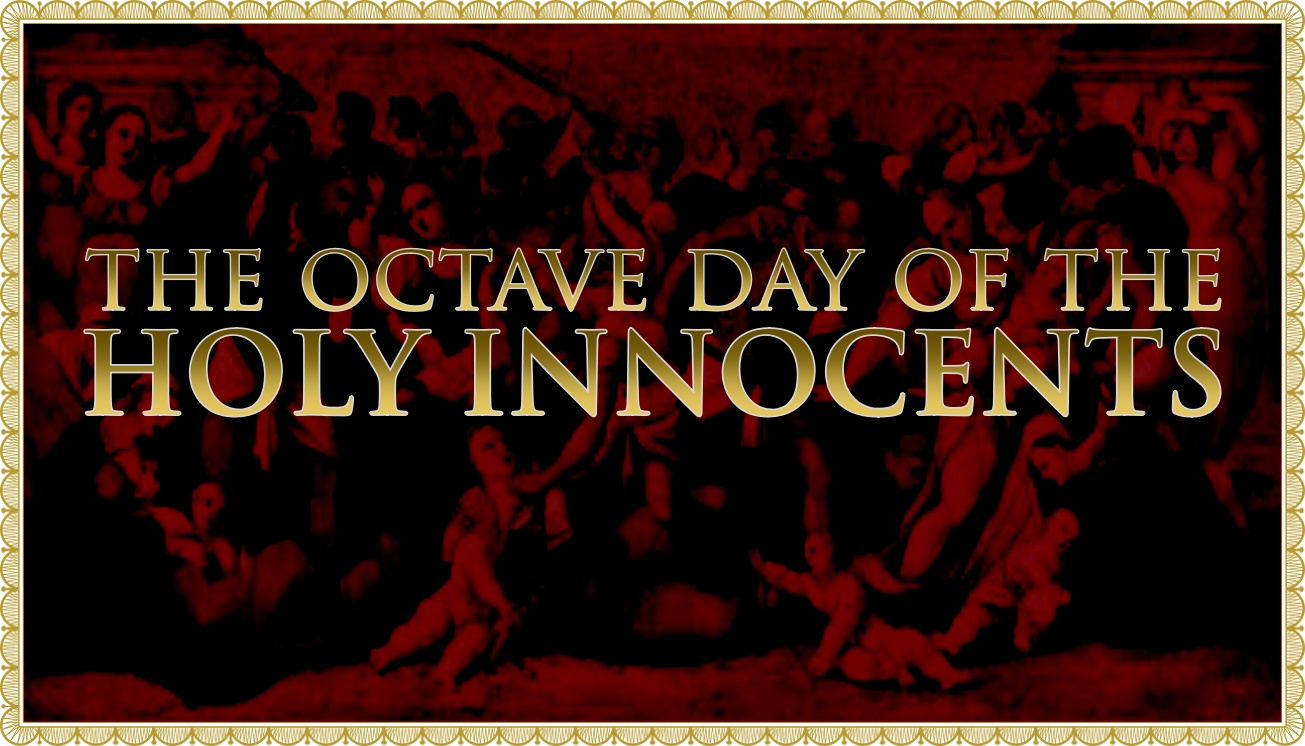
Octave of Holy Innocents (4 Jan)
by the Revd Dr Robert Wilson PhD (Cantab), Old Roman Apostolate UK
In those days I saw upon Mount Zion a Lamb standing, and with him an hundred forty four thousand, having his name and the name of his Father written on their foreheads. And I heard a voice from heaven, as the noise of many waters and as the voice of great thunder: and the voice I heard was the voice of harpers harping on their harps.
Today is the Octave of the feast of the Holy Innocents. Last week we considered the account of their massacre in St. Matthew’s Gospel. Today we will focus on the epistle from the Book of Revelation. St. John sees a Lamb standing on Mount Zion and with him an hundred and forty four thousand. “And they sung as it were a new canticle before the throne and the four living creatures and the ancients.” No man could sing this song save the hundred and forty four thousand. “These are they who are not defiled with women, for they are virgins. These follow the Lamb whithersoever he goeth. These were purchased from among men, the first fruits of God and to the Lamb: and in their mouth there was found no guile: for they are without spot before the throne of God.”
The Book of Revelation is based on visions given to St. John on the isle of Patmos. It gave assurance to the faithful who were suffering from persecution of the ultimate triumph of the rule of the saints, who follow the Lamb wherever he goes, and now rest on another shore and in a greater light. St. Irenaeus states that the vision was given to St. John towards the end of the reign of the Emperor Domitian, though there is some evidence to suggest that at least part of it, if not the whole book, may reflect the earlier persecution under the Emperor Nero. The story of the escape of St. John in Rome from a cauldron of burning oil reported by Tertullian (which we celebrate on the Feast of St. John before the Latin gate) was thought by St. Jerome to refer to the time of Nero (though St. Jerome believed on the basis of what St. Irenaeus says that Revelation itself belongs to the time of Domitian). The exact dating of the book can probably never be known with certainty. What is clear is that it offers a powerful message of hope to the persecuted Church, that the kingdom of this world would ultimately become the kingdom of our Lord and of his Christ.
The interpretation of the Book of Revelation was the subject of controversy in the early Church, and it remains a matter that is disputed to this day. Some of the early Church Fathers such as St. Justin Martyr and St. Irenaeus deduced from the twentieth chapter of the book the doctrine of the thousand year reign of Christ with his saints on earth before the final coming of the new heaven and the new earth, wherein dwelleth righteousness. Other early Christian writers disputed this doctrine and consequently questioned the place of the Book of Revelation in the Canon of Scripture. However, the place of Revelation within the Canon of Scripture was championed by St. Augustine, though he opposed the doctrine of the thousand year reign of Christ with his saints on earth as too this worldly. Instead, he interpreted the passage as referring to the present era of the Church on earth before the final coming of the Kingdom, when God’s will would finally be done on earth as it is in heaven.
However, whatever may be the truth of the matter regarding the detailed interpretation of Revelation, the central importance of the book lies in the conviction that despite the apparently triumphant power of evil in this world, good will triumph in the end.
In this it is the heir of the hope of the Hebrew prophets that the present conflict between what is and what ought to be will one day be overcome. The wolf would live with the Lamb and the earth would be filled with the knowledge of the glory of God, as the waters cover the sea. As time passed, and the conflict between the Kingdom of God and the suffering of his people in this present world only became more apparent, a new form of literature called apocalyptic developed. The word apocalypse means unveiling, and it refers to the unveiling of the ultimate significance of the events in this world, when seen from the perspective of the heavenly world (the world which is disclosed in symbolic visions to the seer). In the short term the conflict between good and evil will be brought to a head and there will be increased persecution and suffering for the faithful. They are exhorted to endure under persecution and are given the assurance that, despite the present appearance to the contrary, the truth will ultimately prevail. For example, in the Book of Daniel, the reign of the beasts (the pagan rulers of this world) will be eventually replaced by the reign of the kingdom of the saints of the most high (the faithful remnant of the people of God) who will inherit the kingdom and possess it for ever.
The Book of Revelation is a Christian apocalypse. It clearly belongs to the apocalyptic genre of literature. However, it not only looks forward, like the Jewish apocalypses to the final triumph of good over evil at the end of this present age. It also proclaims the good news that in the coming of Christ into this world, and especially through his death and resurrection, the decisive victory in the battle between good and evil has already been won. The saints do not only cry “How Long” for the final coming of the kingdom. They already belong to the new Jerusalem that will finally be revealed in God’s new heaven and new earth at the end of the age. They already share in the triumph of the Saviour over sin and death. Their victory comes not through their own strength, but through the blood of the Lamb.
But, we might say, this was all a product of an earlier age when the Church was facing persecution and the idolatrous deification of the civil power. Surely we have moved beyond that now? On the contrary, persecution is not simply something from the past but also a reality in the present for Christians in many parts of the world, not least in Islamic areas of the Middle East and Africa. If we do not face such overt opposition in contemporary western societies there is an increasing climate of hostility beneath the surface that could easily erupt at any time into more open persecution. We have our own massacre of the innocents today in widespread abortion, the modern resurgence of the ancient practice of infanticide. Children are now encouraged to question whether they are male or female and to create their own virtual reality. The powers that be may not yet demand overt worship like that of the pagan Roman Emperors, but the ever expanding power of the State is increasingly seen as the answer to every problem. The Chinese Government may be the most extreme example of this tendency, but contemporary western societies seem to be moving in the same direction.
Let us pray for grace to persevere in these troubled times, and make our own the words of today’s Collect:
O God, whose praise the martyred innocents confessed this day, not in speech, but by death: mortify within us all vices: that thy faith which our tongues profess, our lives also by their actions may confess.



Leave a Reply