
St. Polycarp
by the Revd Dr Robert Wilson PhD (Cantab), Old Roman Apostolate UK
“Eighty six years I have been his servant and he has done me no wrong. How can I blaspheme my King who saved me?”
Today we celebrate the feast of St. Polycarp. He was one of the great figures of the Church of the second century. St. Irenaeus, Bishop of Lyons in the late second century, recalled (writing to an old childhood friend called Florinus) his early memories of the “place where the blessed Polycarp sat and discussed, his entrances and exits and the character of his life, the appearance of his body, the discourses he made to the multitude, how he related his life together with John and with others who had seen the Lord, and how he remembered their words, and what he heard about the Lord from them, about his miracles and teaching- how Polycarp received this from the eyewitnesses of the life of the Word and proclaimed it all in accordance with the Scriptures.” In his later great work against the Gnostic heresy (those who believed in salvation by superior knowledge) St. Irenaeus recalled “Polycarp, who not only was taught by the apostles and conversed with many who had seen the Lord, but also was established by the apostles in Asia in the Church in Smyrna. We ourselves saw him in our early youth, for he lived long and was in extreme old age when he left this life in a most glorious and most notable martyrdom. He always taught the doctrine which he had learned, which he delivered to the Church, and it alone is true.” This is very important historical evidence. St. Irenaeus could claim that his strongest link with tradition was his own childhood memories in Asia Minor of the aged bishop Polycarp, who had himself in his youth in the first century actually known St. John, who had been an eyewitness of the Word made flesh.
Earlier in his life St. Polycarp had been a friend of St. Ignatius of Antioch, who had written one of his epistles to him on his journey to martyrdom in Rome. St. Polycarp had written an epistle of his own to the Philippians at around the same time. It shows that St. Polycarp was not an original thinker like St. Ignatius or later St. Irenaeus. His strength lay in the character of his life and his own living witness to his childhood memories of the apostolic age, most notably his personal recollections of St. John.
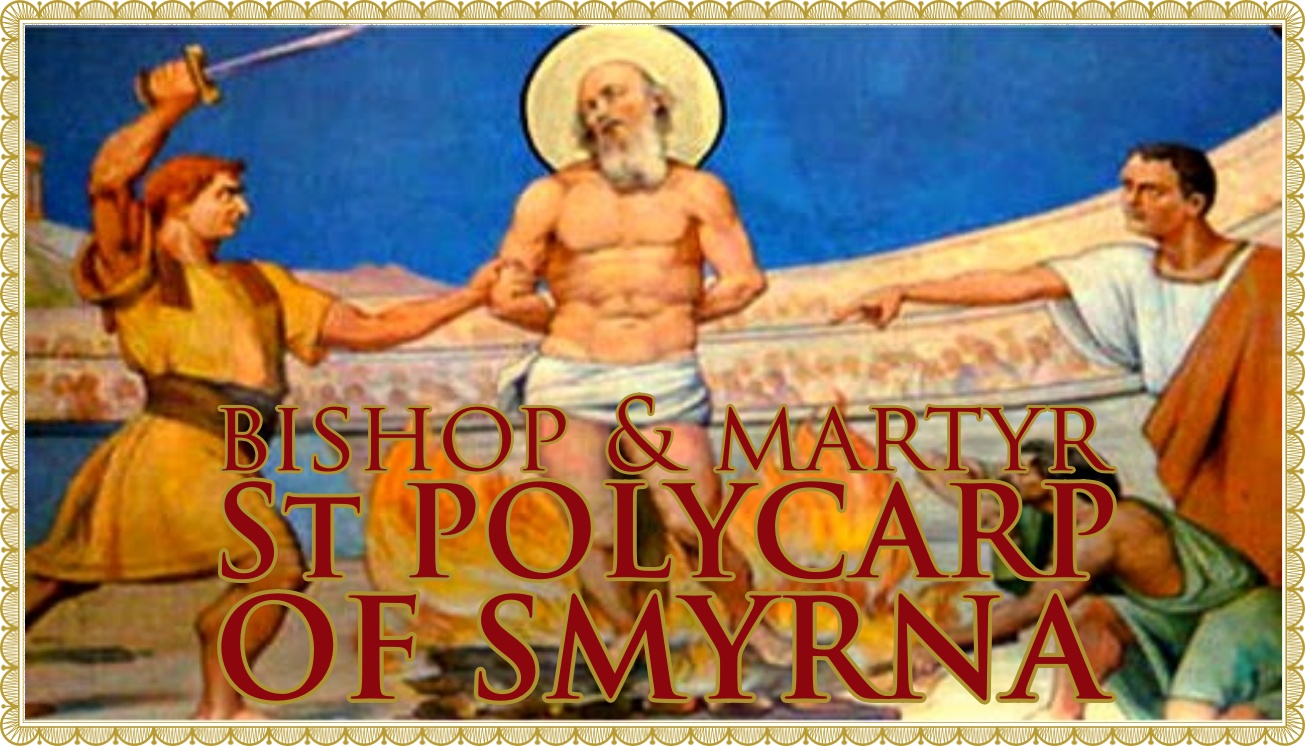
It seems clear that St. Polycarp was a widely respected figure in Smyrna, where he was bishop. This makes the account of his martyrdom all the more striking. It is of great historical value because it is based on contemporary eyewitness evidence. It tells of how at a time of persecution St. Polycarp had no desire to flee, but was persuaded by his flock to withdraw to a farm near the city. It was there that he was finally apprehended and brought to the arena. The proconsul “tried to persuade him to deny his faith, urging “Have respect to your old age”, and the rest of it, according to the customary form, “Swear by the genius of Caesar; change your mind; say “Away with the atheists!” Then Polycarp looked with a stern countenance on the multitude of lawless heathen gathered in the stadium, and waved his hands at them, and looked up to heaven with a groan and said, “Away with the atheists.” The Proconsul continued insisting and saying, “Swear and I release you; curse Christ.” And Polycarp said, “Eighty six years have I served him and he has done me no wrong: how then can I blaspheme my King who saved me?” The Proconsul continued to persist and say, “Swear by the genius of Caesar;” he answered, “If you vainly imagine that I would swear by the genius of Caesar, as you say, pretending that you are ignorant who I am, hear plainly that I am a Christian.” It was determined that Polycarp would be burnt at the stake, rather than thrown to the wild beasts in the arena. It was said that “this is the teacher of Asia, the father of the Christians, the destroyer of our gods, the man who teaches many not to sacrifice or to worship”. But for the Christians he was “the most admirable Polycarp, who in our times was an apostolic and prophetic teacher, bishop of the holy Church in Smyrna”.
The account continues that some suspected that the desire to “have fellowship with holy flesh” would lead them to “abandon the crucified and begin worshipping this one”. On the contrary, “it will be impossible for us ever to forsake the Christ who suffered for the salvation of the whole world of the redeemed- suffered for sinners though he was faultless-or to worship any other. For him, being the Son of God, we adore, but the martyrs as disciples and imitators of the Lord we cherish as they deserve for their matchless affection to their King and Master. May it be our lot also to be found partakers and fellow disciples with them…. And so we afterwards took up his bones, which are more valuable than precious stones and finer than refined gold, and laid them in a suitable place; where the Lord will permit us to assemble together, as we are able, in gladness and joy, to celebrate the birthday of his martyrdom for the commemoration of those that have already fought in the contest and for training and preparation of those that shall do so hereafter…. Having by his endurance overcome the unrighteous ruler and so received the crown of immortality, he rejoiceth in company with the apostles and all righteous men, and glorifieth the almighty God and Father, and blesseth our Lord Jesus Christ, the Saviour of our souls and the pilot of our bodies and the shepherd of the catholic church which is throughout all the world.”
The ancient world, both Jewish and pagan, paid great respect to the dead. Roman law protected the tombs and it was the custom for the family to visit the tomb of the deceased on their birthday and hold a meal in their honour. By contrast, the early Christians met on the day of the martyr’s death, which was now regarded as their true birthday, their entry into eternal life. The faithful met annually to celebrate the liturgy at the tomb of the martyrs. The account of the martyrdom of St. Polycarp clearly shows how the practice of the veneration of the saints originally arose in connection with the actual bodies of the martyrs. It was thus originally a local cultus and each church paid especial reverence to the tombs of the martyrs in that particular place.
Let us remain stedfast to this witness today. Let us continue to worship Christ alone, but also venerate those great martyrs like St. Polycarp, who were his faithful followers and imitators, both in their lives and above all in their deaths.




Leave a Reply