
Easter Thursday
by the Revd Dr Robert Wilson PhD (Cantab), Old Roman Apostolate UK
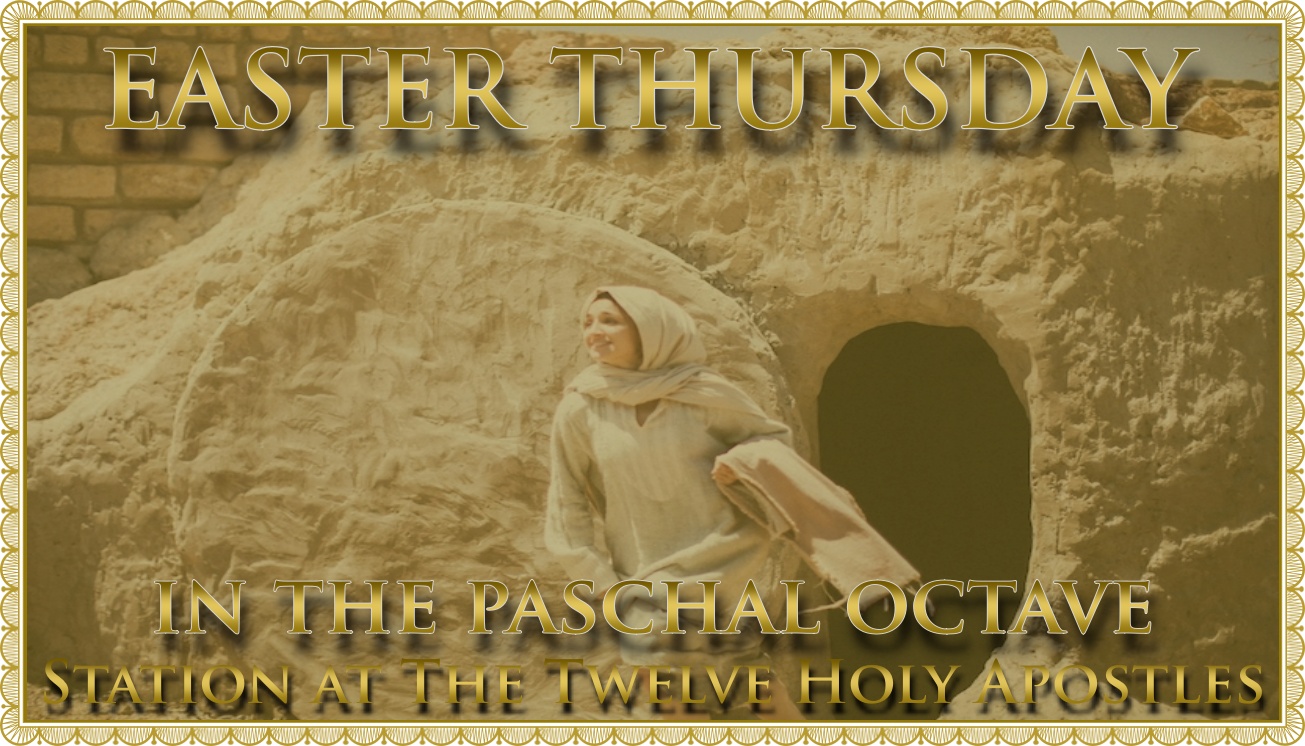
Today’s Gospel from St. John records that Mary Magdalene stood outside the sepulchre weeping. She looked down into the sepulchre and saw two angels in white, one sitting at the head and the other at the foot of where the body of Jesus had been laid. They asked her why she was weeping and she said because her Lord had been taken away and she did not know where they had laid him. She turned back and saw Jesus standing, but did not recognise him. “Jesus saith to her: Woman, why weepest thou? Whom seekest thou? She thinking it was the gardener, saith to him: Sir, if you have taken him hence, tell me where thou hast laid him; and I will take him away. Jesus saith to her: Mary. She turning saith to him: Rabboni (which is to say Master). Jesus saith to her: Do not touch me, for I am not yet ascended to my Father; but go to my brethren and say to them: I ascend to my Father and to your Father, to my God and your God.” She therefore went and told the disciples that she had seen the Lord and that he had said these things to her.
The Gospel has recorded how Mary Magdalene came to the sepulchre where Jesus had been laid by Joseph of Arimathea and Nicodemus. Inexplicably she found that the stone had been rolled away from the sepulchre and the tomb was empty. She had therefore ran to tell Peter and John, the beloved disciple, that the body of Jesus had been taken away and she did not know where he had been laid. They had gone to the tomb and found it as she said, but she had remained weeping there after they had left. At this point she saw a strange figure whom she at first did not recognise and took to be the gardener. Perhaps he knew where the body of Jesus had been removed to. It was when he then called her by name that she recognised that it was Jesus. She went and told the other disciples the good news of the resurrection.
It is important to emphasise the historical value of this scene. Women were not regarded as reliable witnesses in the ancient world and there would be no reason for it to be reported in the gospels that it was the women who had first discovered the empty tomb unless the story had been true. It is all the more striking that it was not only women who initially found the tomb empty, but also one of their number, Mary Magdalene, who was the first to see the resurrected Jesus. Whereas Jesus’ male followers had deserted him in the Garden of Gethsemane, some of his female disciples had remained to witness his crucifixion. Though Jesus included only men among the Twelve he had many prominent women followers, most notably Mary Magdalene, from whom St. Luke states he had exorcised seven devils. It is therefore fitting that Jesus’ first resurrection appearance should be to her.
It should also be noted that there was both discontinuity and continuity between the body of Jesus before and after his resurrection. It was not simply a return to his previous body like the raising of Lazarus, but it was still recognisably physical, although now incorruptible. It was not merely Jesus’ survival of death, but his defeat of it. This helps to explain why Mary Magdalene did not initially recognise Jesus (thinking that he was the gardener who had removed the body to another place), before the good news finally dawned on her when he addressed her by name. As G. K. Chesterton put it, “The world had died that night, and God walked again in the garden, not in the eve of the cool of the day, but of the dawn.”
The Acts of the Apostles records an occasion when an angel of the Lord had told Philip to travel on the road from Jerusalem to Gaza. He met an Ethiopian eunuch, a prominent official under the queen of that country, who was returning from Jerusalem, where he had gone to worship. He was reading from the prophet Isaiah. He told Philip that he did not understand the passage he was reading, which was about one who had been led like a lamb to the slaughter, but had opened not this mouth. He asked Philip whether the prophet was referring to himself or someone else. Philip then explained to him how Jesus had fulfilled the message of the prophet. When they came to a place where there was water the eunuch asked Philip to baptise him. “Philip said: If thou believest with all thy heart, thou mayest. And he answering said: I believe that Jesus is the Son of God. And he commanded the chariot to stand still: and they went down into the water, both Philip and the eunuch, and he baptised him.” The Ethiopian continued on his way rejoicing, while Philip, after preaching the gospel in other cities, eventually settled in Caesarea.
The Philip who features in the Acts of the Apostles should not be confused with the apostle Philip, who was one of the twelve. He was one of the seven, who are usually considered to be the first deacons, who had been chosen to assist the apostles in their work. He became an effective evangelist who helped the gospel proclamation to spread rapidly. The Ethiopian eunuch was presumably a proselyte to Judaism, but he needed to be properly instructed about how Jesus had fulfilled the role of the suffering servant of Isaiah, who was despised and rejected by men, a man of sorrows and acquainted with grief. It was this that Philip was successfully able to do and the Ethiopian eunuch came to believe and be baptised. Philip would later settle in Caesarea and it was presumably there that he later met St. Luke, who had been with St. Paul when he was imprisoned there. It must have been then that St. Luke heard this story from Philip about the conversion of the Ethiopian eunuch.
Mary Magdalene had been the first to see the resurrected Jesus and proclaimed the good news. Philip had later preached the gospel to the Ethiopian eunuch of how Jesus had fulfilled the message of the suffering servant of Isaiah. Let us pray for grace that we may be enabled to proclaim in our own time and place that same message of good news of salvation through the life, death and resurrection of Jesus.




Leave a Reply