
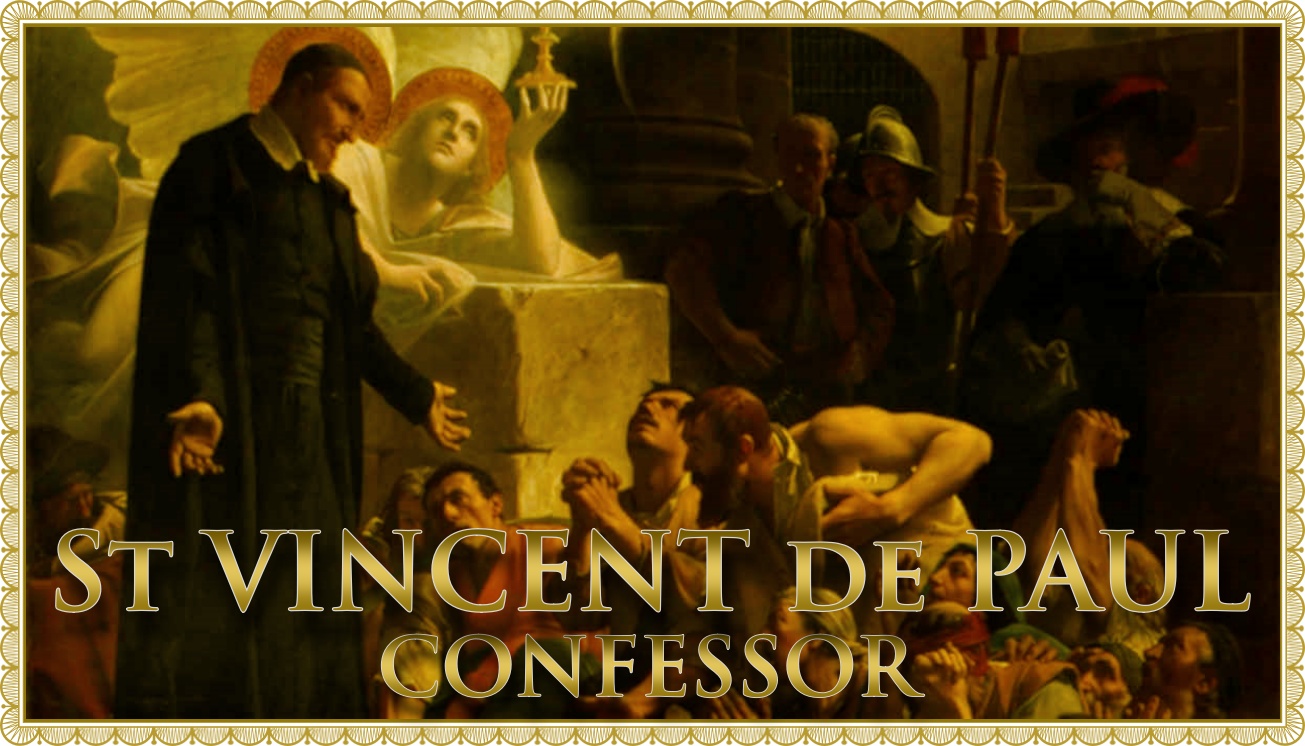
St. Vincent de Paul/Eighth Sunday after Pentecost
Today we celebrate the feast of St. Vincent de Paul, as well as commemorating the Eighth Sunday after Pentecost. St. Vincent de Paul was born in Pouy, a village near Dax in Gascony in 1576. His father placed him under the care of the Franciscan Recollects at Dax. He later studied at the University of Toulouse and was ordained to the priesthood at the age of twenty. He did not initially show any particular signs of sanctity, but gradually he began to grow in holiness. He moved to Paris, where he came under the influence of Peter de Berulle. He became tutor to the children of Philip de Gondi, Count of Berulle. In 1617 he became pastor of Chatillon les Dombres, before returning to Paris, where he began ministering among the galley slaves in the Conciergerie. He was appointed chaplain to the galleys and in 1622 gave a mission for the convicts in them at Bordeaux.
In due course a new community was established. They pledged to renounce ecclesiastical preferment, devote themselves to the smaller towns and villages, and live from a common fund. St. Vincent subsequently joined this new congregation. In 1633 the prior of the canons regular of St. Victor gave to the institute the priory of St. Lazare, and this became the chief house of the congregation. Hence, they came to be called Lazarists. They were a congregation of secular priests who made vows of poverty, chastity, obedience and stability. They were especially involved in missions in the countryside and the direction of seminaries. St. Vincent himself lived to see twenty five houses established. He also established confraternities of charity to attend to poor sick persons in each parish. This became the institute of Sisters of Charity. He also directed the foundation of several hospitals for the sick, foundlings and aged. He collected alms in Paris for the relief of those affected by the wars in the Lorraine. He sent missionaries for the relief of the suffering in Poland, Ireland and Scotland. He was sent for by Louis XIII as he lay dying. He died on 27th September, 1660.
The Breviary states that “there was no kind of misery which he did not strive with fatherly tenderness to relieve. Christians groaning in Mohammedan slavery, foundlings, deformed children, young maidens exposed to danger, houseless men, fallen women, convicts sent to the galleys, sick foreigners, disabled workmen, lunatics and beggars without number, all these he relieved, and devoutly housed in divers charitable institutions… Amid all these and other most anxious business matters, he remained always looking simply to God, kind to all, true to himself, plain, upright and lowly. From all honours, riches and pleasures he ever shrank, and was heard to say that nothing gave him any pleasure, except in Christ Jesus, Whom it was his wish in all things to follow.”
The life of St. Vincent de Paul is an example of one whose life was motivated by divine charity, and of the principle that a good tree is known by its fruits. He lived in an age of bitter religious conflict, in which whole countries had become divided according to whether they were Catholic or Protestant. He saw, like his contemporary St. Francis de Sales, that the best form of evangelism was not through writing polemics against theological opponents, but in charitable endeavours towards others. Hence, his name has continued to be remembered, whereas many of his contemporaries who wrote polemical tracts have long been forgotten. Actions speak more powerfully than mere words, as the epistle of St. James emphasises and as St. Vincent exemplified in his life.
It is appropriate that today’s Gospel is from St. Luke’s account of the sending out of the seventy two into the towns and villages, since St. Vincent took this example as his model. The disciples were sent out as sheep among wolves. The harvest was plentiful, but the labourers were few and they were the pray the Lord of the harvest to send out labourers into his harvest. They were to travel light and not to waste time. They were to be entirely devoted to the proclamation of the Kingdom. The Kingdom of God, future in its fullness, when God’s will would finally be done on earth as it is in heaven, was now present in the person of Jesus himself, in his words and mighty works. His coming was the coming of the Kingdom of God to men, whether they would hear or whether they would forbear, as the prophet Ezekiel had put it. To accept him was to accept God, to reject him was to reject God. Consequently the same applied to the disciples who were sent out in his name. To receive them was to receive Jesus, to reject them was to reject Jesus. Time was short and eternity pressed near. Their response to the coming of the Kingdom of God in the person of Jesus would determine their eternal destiny.
Let us pray for grace to follow the example of St. Vincent in our own time and place, that the Holy Spirit may pour into our hearts that most excellent gift of charity, the very bond of peace and of all virtues, that we may be faithful in our proclamation of the Gospel, not only in our words, but also in our actions.
by the Revd Dr Robert Wilson PhD (Cantab), Old Roman Apostolate UK



Leave a Reply