
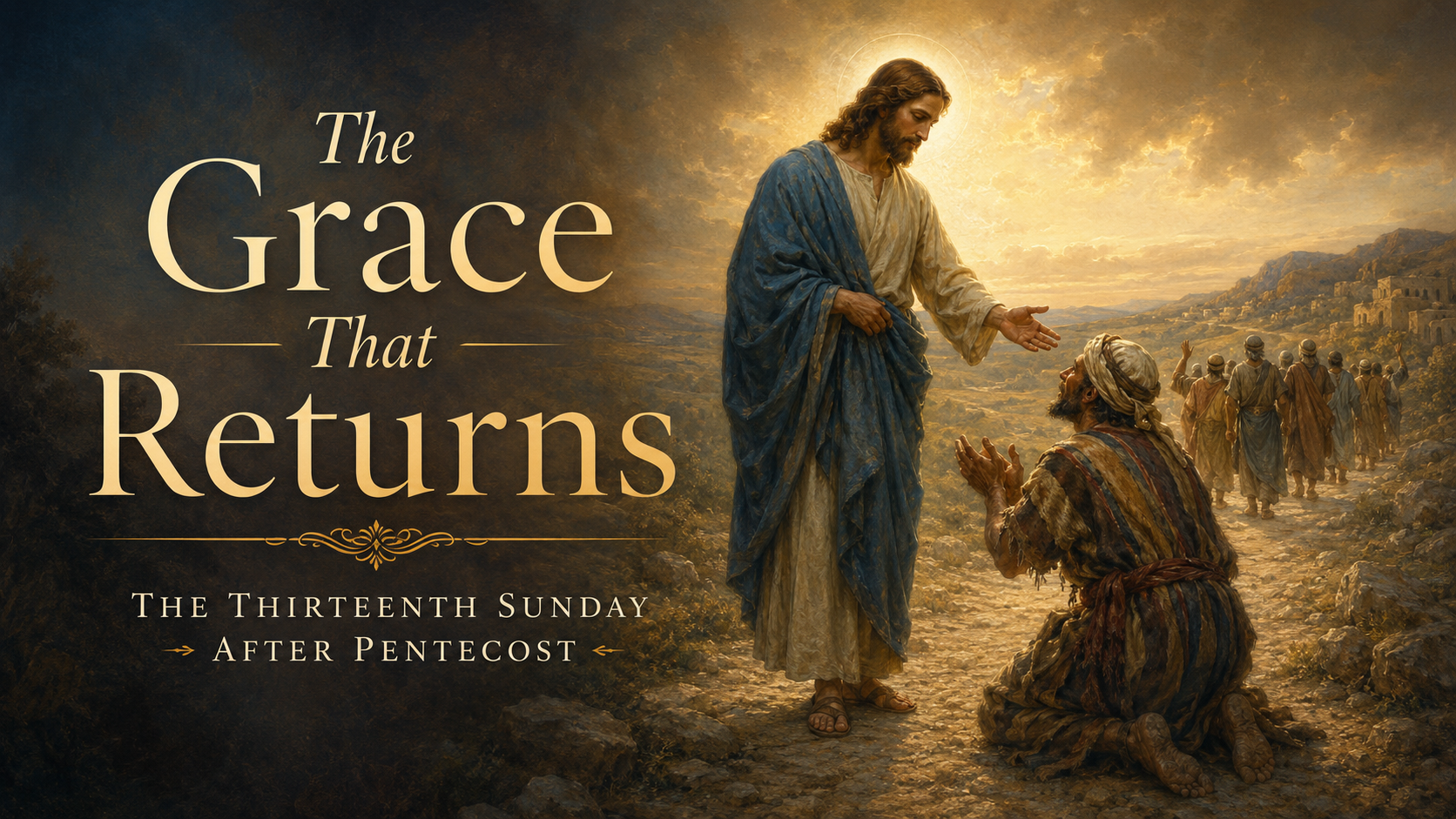
The Grace That Returns: The Thirteenth Sunday after Pentecost
The ancient Roman Mass of the Thirteenth Sunday after Pentecost moves with remarkable theological precision from covenant to promise, from promise to mercy, from mercy to obedience, and from obedience to thanksgiving. God remembers His covenant; Christ fulfils the promise made to Abraham; ten lepers trust sufficiently to obey; but only one understands that the gift must lead him back to the Giver. Read with the Fathers, St Thomas Aquinas, the great Catholic exegetes, the mystical tradition and the classic commentators upon the Roman liturgy, the Sunday reveals something considerably deeper than a lesson in gratitude. It discloses the whole movement of grace: freely given, obediently received, sacramentally fruitful, and perfected in a soul which returns to God.

The Thirteenth Sunday after Pentecost is remembered above all for the Gospel of the ten lepers, yet the Roman Church does not begin her Mass with the lepers. She begins with the covenant. Réspice, Dómine, in testaméntum tuum — “Have regard, O Lord, to Thy covenant.” From Psalm 73 she cries that God should not abandon the souls of His poor, that He should arise to defend His cause, and that He should not forget the voices of those who seek Him. The Gradual deliberately takes up the same words after the Epistle: Réspice, Dómine, in testaméntum tuum. The plea is heard twice. Before the Gospel asks why nine men forgot their Benefactor, the liturgy has twice appealed to God as the One Who does not forget His covenant.¹ This is the theological architecture of the Sunday. God remembers; fallen man forgets. God is faithful to His promise; man can receive its fruits and still lose sight of the Giver. The terrible question, “Were not ten made clean? and where are the nine?” is therefore already latent in the first notes of the Introit.
Dom Prosper Guéranger understood the danger with particular clarity. The Christian stands in a position incomparably more privileged than the patriarchs who waited for the fulfilment of the promise. Christ has come. Redemption has been accomplished. The sacraments have been given. The Church possesses the mysteries which Israel approached in figure and hope. Yet Guéranger sees precisely in this abundance a spiritual danger: what is constantly possessed can cease to be consciously received. Familiarity becomes forgetfulness, and forgetfulness produces ingratitude.² The nine lepers are consequently not merely examples of discourtesy towards Christ. They represent a spiritual condition in which grace has genuinely been received but has ceased to be recognised as grace. Their bodies have been cleansed, but their attention has already moved elsewhere.
The Epistle, Galatians 3:16–22, establishes the doctrinal foundation. St Paul takes the Church back to Abraham and to the divine promise: “To Abraham were the promises made and to his seed. He saith not, And to his seeds, as of many: but as of one, And to thy seed, which is Christ.” The Law given centuries afterwards does not revoke what God had promised. “For if the inheritance be of the law, it is no more of promise. But God gave it to Abraham by promise.” St Thomas Aquinas explains the Apostle’s argument with characteristic precision: inheritance proceeding from promise manifests gratuitous beneficence, whereas an inheritance proceeding from law might appear as something obtained through legal claim. Paul’s purpose is not to denigrate the Mosaic Law, but to demonstrate that the supernatural inheritance reaches man because God first promised and ultimately fulfilled that promise in Christ.³ Grace precedes achievement. Man’s salvation begins not with the assertion of a right before God but with God’s sovereign generosity towards man.
The Alleluia confirms the same perspective from another direction: Dómine, refúgium factus es nobis a generatióne et progénie — “Lord, Thou hast been our refuge from generation to generation.” The God of Abraham is not a passing religious enthusiasm or an expedient discovered in crisis. He is the refuge of the generations. The covenant remembered in the Introit, the promise proclaimed by St Paul, and the refuge confessed in the Alleluia all declare the constancy of God. The instability in this Mass will not be found in Him. It lies in us. God remembers across generations; man can forget within the hour of his deliverance.⁴
Between the covenant and the promise stands the Collect, and it is one of the most theologically concentrated prayers in the Roman Missal: Omnípotens sempitérne Deus, da nobis fídei, spei et caritátis augméntum: et, ut mereámur ássequi quod promíttis, fac nos amáre quod præcipis — “Almighty and everlasting God, give unto us an increase of faith, hope and charity; and that we may merit to obtain what Thou dost promise, make us love what Thou dost command.” The Church does not ask merely that faith should survive, but that it should increase; not merely that the commandments should be obeyed, but that they should be loved. God promises the end, and God supplies the grace by which man is enabled freely to move towards it. So exact is the prayer as an expression of Catholic doctrine that the Council of Trent quotes it explicitly in Chapter X of its Decree on Justification when teaching that the justified, “faith cooperating with good works,” may increase in the justice they have received through the grace of Christ.⁵
The Collect therefore destroys two opposite errors at once. Salvation is not self-manufactured, for the very increase of faith, hope and charity is begged from God; yet neither is grace conceived as leaving man inert, for the purpose of that divine increase is that the Christian should love, obey, merit and advance. Grace precedes, accompanies and enables the act without abolishing the reality of the act. The same structure will appear visibly in the Gospel. Christ heals the lepers, but He commands them to go. They do not heal themselves by walking, yet the healing becomes manifest “as they went.” Their obedience does not create grace; it is the response by which grace becomes fruitful in them.
The Gospel begins with separation: “There met him ten men that were lepers, who stood afar off.” The literal condition of the leper under the Mosaic law already provides a formidable spiritual image. Disease excludes him from ordinary society; uncleanness marks him; restoration must be examined and certified. Yet the Fathers saw something still more penetrating in leprosy itself. St Augustine notes that leprosy disfigures by an unhealthy mixture of colours, and from this draws an analogy with false doctrine. Error is rarely composed of pure falsehood. Its danger lies in the admixture of truth and falsity, in which something recognisable remains while the integrity of the whole is corrupted.⁶ The Venerable Bede takes up the same interpretation: those who have not the true knowledge of faith, but profess contradictory teachings as though they possessed truth, display spiritually the varied colouring of the leper.⁷
There is a perennial importance in this patristic image. Catholic truth is not secured merely because Catholic words continue to be used. One may retain the language of grace while emptying grace of the supernatural; speak of resurrection while treating it as metaphor; invoke conscience while detaching conscience from objective moral truth; speak of pastoral charity while separating charity from conversion; invoke development while contradicting what supposedly develops. The leprous appearance is precisely a mixture. Some healthy colour remains, but it has ceased to possess integrity. Augustine’s interpretation therefore penetrates a danger common to every ecclesial age: falsehood is often most persuasive when enough truth remains within it to make it seem familiar.
Yet the ten lepers know themselves to be afflicted. Their first wisdom is that they do not pretend to be whole. Standing afar off, they lift their voices: “Jesus, master, have mercy on us.” Bede and the patristic commentators notice the title Master.⁸ The diseased men begin their recovery by submitting themselves to One Who can teach and command them. This is a profound spiritual principle. The man who insists upon defining his own disease, determining his own truth and prescribing his own cure has not yet reached the humility of these lepers. They acknowledge misery and authority together: Master — have mercy. Their need does not make them arbiters of the remedy.
Christ gives no immediate visible cure. He says simply, “Go, show yourselves to the priests.” They set out still leprous. St Luke then gives the crucial detail: “And it came to pass, as they went, they were made clean.” Their feet move before their eyes possess proof. Faith has become obedience. Dom Gaspar Lefebvre rightly emphasises this active character of their trust: believing the word of Christ, they act upon it, and the cure is manifested on the road.⁹ The Roman Collect has already prepared us to understand the event. God gives faith; faith obeys; grace produces its fruit through the obedient movement which grace itself has made possible.
The command to show themselves to the priests has an immediate historical meaning. Under the Mosaic law the priest did not cause the healing but examined the leper’s condition and, where cleansing was established, enabled his restoration to the religious community. Yet this very structure naturally acquired an ecclesial significance for Catholic commentators. The cure comes from Christ, but restoration is not treated as a purely private affair. Haydock, following the older exegetical tradition, sees here an analogy with sacramental confession: those defiled by the leprosy of sin are likewise directed under the New Law towards the ministry established by Christ.¹⁰ The analogy should not be pressed into a crude identification of every detail, but neither should its Catholic logic be evaded. Christianity knows nothing of a purely self-certifying reconciliation in which a man privately declares himself spiritually restored. Christ heals; Christ also establishes a visible order in which reconciliation returns the healed sinner to communion.
Then comes the decisive moment: “And one of them, when he saw that he was made clean, went back, with a loud voice glorifying God. And he fell on his face before his feet, giving thanks: and this man was a Samaritan.” Every verb matters. He sees. He turns back. He glorifies. He falls upon his face. He gives thanks. The cure becomes contemplation before it becomes thanksgiving: he sees what has happened to him and sees it as gift. The nine also presumably see that their flesh is cleansed; what distinguishes the Samaritan is that perception passes beyond the effect to its cause. He does not merely notice that his circumstances have improved. He recognises Who has acted.
And he turns back.
This is the spiritual centre of the entire Mass. Grace has reached its proper human response when the gift turns the recipient towards the Giver. The nine received the same bodily cleansing, but continued along the road. The Samaritan understands that the journey commanded by Christ cannot ultimately lead away from Christ. Obedience to the command has brought healing; recognition of the healing now brings him back to the feet of the One Who commanded. Grace received becomes grace acknowledged, and grace acknowledged becomes worship.
The fact that the man is a Samaritan sharpens the rebuke. The outsider recognises what the covenant people fail to recognise. Patristic commentators repeatedly dwell upon the contrast. Theophylact sees the gratitude of the stranger set against the ingratitude of those who might have been expected to know better, while Augustine discerns in the one who returns an image of unity over against the incompleteness of the nine.¹¹ Religious privilege has not guaranteed spiritual perception. Indeed, privilege can become part of the problem when what has been inherited ceases to be experienced as gift. The Samaritan knows he has received mercy; the nine behave as though the miracle can now simply be incorporated into ordinary life.
Christ makes the distinction explicit: “Were not ten made clean? and where are the nine? There is no one found to return and give glory to God, but this stranger.” He then says to the Samaritan: “Arise, go thy way; for thy faith hath made thee whole.” Catholic exegetes have long noticed that the final declaration goes beyond what has been said of the nine. Haydock, citing Maldonatus, distinguishes the bodily cleansing received by all ten from the fuller saving effect implied when Christ tells the Samaritan that his faith has made him whole. Cornelius a Lapide likewise sees the returned leper as receiving something beyond physical restoration.¹² All ten receive a benefit; only one receives the commendation attached to faith perfected in gratitude.
The point is not that the nine were insufficiently polite. Their failure is theological. They accept the effect while losing sight of the cause. They want cleansing and receive it, but the gift does not become a new relationship to the Giver. This is why ingratitude is so spiritually destructive. It permits a man to live among the effects of divine generosity while gradually constructing an imagination in which he is autonomous. Health becomes normality rather than gift; forgiveness becomes entitlement rather than mercy; the Faith becomes possession rather than inheritance; the sacraments become routine rather than encounter; providential preservation becomes luck; vocation becomes achievement. The divine benefaction remains objectively real, but subjectively the soul has ceased to interpret reality according to grace.
St Thomas Aquinas gives this instinct of the Samaritan scholastic precision in his treatment of gratitude in the Summa Theologiæ. The ultimate source of every good is God, whom he calls the first principle of all our goods. Thanksgiving offered to God therefore rises beyond ordinary gratitude and belongs to the virtue of religion itself.¹³ To give thanks is to acknowledge the truth about causality: I possess what I did not originate. Gratitude is thus an act of metaphysical realism as well as virtue. The grateful man understands that his existence, redemption, faith, opportunities for good, preservation from evil and final hope are not self-generated possessions.
Aquinas then asks a question particularly illuminating in the light of the ten lepers: who owes God greater thanks, the innocent man preserved from sin or the penitent restored after sin? His answer refuses the obvious simplification. Absolutely considered, preservation in innocence is the greater gift; but from the perspective of the penitent, mercy is more gratuitously received because grace is bestowed upon one who had merited punishment. Aquinas invokes Augustine’s striking confession that even the sins a man has not committed must be attributed to divine mercy, since no one may confidently ascribe his innocence merely to his own strength.¹⁴ The result is devastating to spiritual pride. The penitent must thank God for having raised him; the innocent must thank God for having preserved him. The sinner has no grounds for despair, and the apparently righteous man has no grounds for self-congratulation.
The mystical writers take this truth beyond moral obligation into contemplation. St Teresa of Avila repeatedly warns against receiving divine favours as though the favours themselves were the end of prayer. Authentic graces should produce humility, obedience, charity and a more complete surrender to God. She remarks that a supernatural favour cannot be manufactured or prolonged by our own efforts; it can only be received with thanksgiving, and its genuineness is eventually known by the transformation it produces in the life of the recipient.¹⁵ This is precisely the contrast between the Samaritan and the nine. A gift has not yet achieved its deepest spiritual purpose simply because it has been received. Its authenticity in us is manifested by what it makes us become.
St Gertrude the Great gives thanksgiving an explicitly contemplative form. Conscious that no human act could adequately correspond to the generosity of God, she repeatedly places her thanksgiving within the thanksgiving of Christ Himself, asking the Son to render to the Father the praise which the creature cannot adequately offer.¹⁶ Here the mystery moves unmistakably towards the altar. The Christian does not merely thank God for Christ; he learns to thank the Father through Christ, and ultimately in union with Christ’s own perfect oblation. Gratitude reaches its highest Catholic expression when the creature’s inadequate response is taken into the worship of the Son.
The Gospel itself almost seems to prepare the ear for this movement. St Luke says that the Samaritan fell at the feet of Jesus, εὐχαριστῶν αὐτῷ — giving Him thanks. The verb is eucharistein. One should not convert a verbal resonance into an exegetical claim that St Luke is secretly describing the Mass; nevertheless, when this Gospel is proclaimed within the Eucharistic Sacrifice, the resonance becomes spiritually luminous. The leper returns to Christ in eucharistia. The Church does the same. The Mass is the supreme act of thanksgiving because humanity brings back to the Father, through Christ, what it first received from Him.
The Offertory makes this return possible by deepening the attitude of trust: In te sperávi, Dómine; dixi: Tu es Deus meus; in mánibus tuis témpora mea — “In Thee, O Lord, have I hoped; I said: Thou art my God; my times are in Thy hands.” The man who truly gives thanks also relinquishes possession. His past is mercy, his present is providence, and his future rests in God’s hands. The Offertory therefore answers the illusion exposed by ingratitude. My times are not finally mine. My life is not finally mine. The good which I return to God was His gift before it became my offering.¹⁷
The Secret makes the sacrificial dimension still clearer: Propitiáre, Dómine, pópulo tuo, propitiáre munéribus: ut hac oblatióne placátus, et indulgéntiam nobis tríbuas et postuláta concédas — “Be appeased, O Lord, towards Thy people; be appeased towards our gifts, that, being appeased by this offering, Thou mayest grant us pardon and give us what we ask.” The liturgy does not imagine that thanksgiving eliminates man’s continuing need of mercy. The cleansed leper remains a recipient. The worshipper bringing gifts remains a suppliant. Even at the altar, where man appears to offer something to God, he is asking God for pardon and assistance. The Catholic sacrificial instinct is therefore the opposite of self-sufficiency. What is offered comes from God; the possibility of offering comes from God; the efficacy of the Sacrifice rests in Christ.
Then comes the Communion: Panem de cælo dedísti nobis, Dómine, habéntem omne delectaméntum, et omnem sapórem suavitátis — “Thou hast given us bread from heaven, O Lord, having in it all that is delicious, and the sweetness of every taste.” The Sunday which began by asking God to remember His covenant reaches its sacramental summit by remembering what God has given. The language is no longer merely “Have mercy upon us,” but “Thou hast given us.” The Christian who receives Holy Communion stands in a position immeasurably more privileged than the cleansed Samaritan: not merely healed by Christ, but fed with Christ.¹⁸ If the man cured of leprosy returned and fell upon his face, what should be the interior posture of one who receives the Bread from Heaven?
The Postcommunion completes the entire theological movement in a single sentence: Sumptis, Dómine, cæléstibus sacraméntis: ad redemptiónis ætérnæ, quǽsumus, proficiámus augméntum — “Having received the heavenly Sacraments, we beseech Thee, O Lord, that we may advance towards the increase of eternal redemption.”¹⁹ The word augméntum returns us to the Collect’s fídei, spei et caritátis augméntum. The Mass began by asking for increase and ends by asking for increase. Sacramental reception is not treated as a completed transaction. The heavenly mysteries have been received precisely so that something may grow. Grace seeks development, maturation and transformation. Communion demands consequence.
Here the liturgical genius of this Sunday becomes fully visible. The Collect asks for an increase of faith, hope and charity. The lepers exercise faith by obeying Christ. The Samaritan reveals charity by returning to Him. The Offertory expresses hope: “My times are in Thy hands.” The Communion gives the heavenly Bread by which supernatural life is sustained. The Postcommunion asks that what has been sacramentally received should advance us towards eternal redemption. The theological virtues are not presented as abstractions. They become the interior movement of the Mass itself.
Dom Gaspar Lefebvre therefore sees in this Sunday faith working through charity and manifested in good works; Goffine emphasises the necessity of gratitude for the fulfilment of God’s promises; Guéranger warns against the forgetfulness which becomes ingratitude.²⁰ Their interpretations converge because the liturgical texts themselves converge. The promise made to Abraham becomes Christ; Christ gives mercy; mercy calls forth faith; faith becomes obedience; obedience receives cleansing; cleansing awakens recognition; recognition turns back; return becomes thanksgiving; thanksgiving becomes worship; worship culminates in Eucharistic reception; and reception must become increase in holiness.
This has a particularly searching application for those who have inherited Catholic tradition. It is possible to possess sacred things so continuously that one ceases consciously to receive them. The danger does not belong only to the irreligious or the doctrinally indifferent. One may defend the traditional Mass fiercely and cease to be astonished by it. One may insist upon the integrity of Catholic doctrine while forgetting that supernatural faith itself is an undeserved gift. One may lament the loss of Catholic culture while scarcely thanking God for having inherited any part of it. One may know the ancient prayers by heart while allowing familiarity to obscure the tremendous realities they express.
Indeed, defenders of Tradition have a particular reason to hear the question “Where are the nine?” To preserve an inheritance is not yet the same as to be transformed by it. Orthodoxy without gratitude can become hard; liturgical exactitude without adoration can become aestheticism; moral clarity without remembered mercy can become self-righteousness. None of these defects argues against orthodoxy, liturgical fidelity or moral clarity. They reveal why these goods must be continually referred back to the Giver. Truth itself is received. The Mass itself is received. The Faith itself is received. We do not create Tradition; we receive it and hand it on. The proper posture before an inheritance of grace is therefore neither embarrassment nor pride, but thanksgiving.
The Samaritan offers the corrective. He does not despise the gift by pretending that the cure is unimportant. He sees it fully. St Teresa would recognise the spiritual movement: true humility does not deny God’s favours; it recognises them more clearly precisely so that the soul may love the Giver more. But the Samaritan does not stop with the gift. He turns back. Gratitude is therefore a form of contemplation because it trains the soul to pass from created effect to divine cause. Food leads to Providence; forgiveness to Mercy; beauty to the Creator; doctrine to Truth; sacramental grace to Christ.
That is why ingratitude is so much more dangerous than ordinary discourtesy. It arrests this ascent. The ungrateful man remains among gifts but no longer sees through them. He lives in a world saturated with divine beneficence while experiencing it as merely his world. He receives life without worshipping the Author of life, pardon without loving the Forgiver, truth without adoring Truth, and grace without returning to the source of grace. The nine are thus frightening precisely because nothing outwardly disastrous happens to them. They are healed. They proceed. Life continues. It is possible to walk away from Christ carrying the evidence of His mercy upon one’s own body.
The Roman Church refuses to let her children do that. She calls them back at every Mass. Sursum corda. Lift up your hearts. What we have received must be raised again towards God. The bread and wine offered came first from His creation. The faith with which we approach Him came from His grace. The priesthood through which the Sacrifice is offered came from Christ. The Victim upon the altar is the Son given by the Father. Even our thanksgiving is insufficient until it is joined to His. The entire Eucharistic mystery therefore destroys the fantasy of autonomous possession. Everything is gift, and the supreme response to gift is return.
This is the difference between the nine and the one. All ten knew how to ask. All ten knew how to obey. All ten received the cure. Only one knew how to return.
The Christian life must therefore be more than a succession of benefits received from God. It must become one great movement back towards Him. Baptism must lead to holiness. Absolution must lead to amendment. doctrine must lead to worship. Preservation must lead to humility. Suffering must lead to trust. The Eucharist must lead to transformation. Every grace contains, as it were, a direction written within it: back to the Giver.
The Thirteenth Sunday after Pentecost begins by asking God to remember: Réspice, Dómine, in testaméntum tuum. It ends by asking that those who have received the heavenly mysteries should advance towards eternal redemption. Between those prayers stands the Samaritan, turned around upon the road and lying at the feet of Christ. He is the living commentary upon the Mass. God has remembered His covenant; the question is whether man will remember His mercy.
“Were not ten made clean? and where are the nine?”
The question is addressed not chiefly to those who have received nothing, but to those who have received much. Where are the baptized? Where are the absolved? Where are those who have been taught the Faith? Where are those who possess the Mass? Where are those preserved from sins into which others fell? Where are those whose prayers have been answered, whose lives have been sustained, whose souls have been repeatedly fed with the Bread from Heaven?
The tragedy of the nine is not that Christ withheld His mercy.
The tragedy is that mercy came — and they continued on their way.
The Church places the Samaritan before us so that grace may produce a different movement in us: that we recognise what we have received, remember from Whom we received it, turn back, fall at the feet of Christ, and allow every gift to accomplish its final purpose by carrying us home to the Giver. Then the whole Christian life becomes what the Mass itself already is: one continuous Eucharistia, one act of thanksgiving offered through Christ, with Christ and in Christ, until faith gives way to sight, hope to possession, and charity remains for ever.
¹ Missale Romanum, Dominica XIII post Pentecosten; Graduale Romanum, propers Réspice Dómine, Dómine refugium, In te sperávi and Panem de cælo.
² Dom Prosper Guéranger, OSB, The Liturgical Year, Thirteenth Sunday after Pentecost.
³ St Thomas Aquinas, Super Epistolam B. Pauli ad Galatas, cap. III, on Galatians 3:16–22.
⁴ Graduale Romanum, Alleluia for the Thirteenth Sunday after Pentecost, Psalm 89:1.
⁵ Council of Trent, Session VI, Decree on Justification, ch. X; Missale Romanum, Collect for the Thirteenth Sunday after Pentecost.
⁶ St Augustine, Quaestiones Evangeliorum, I, 40, on Luke 17:11–19.
⁷ Venerable Bede, In Lucae Evangelium Expositio, on Luke 17:11–19.
⁸ St Thomas Aquinas, Catena Aurea in Lucam, Luke 17:11–19, collecting Bede, Theophylact, St Cyril of Alexandria, St Ambrose, St Augustine and others.
⁹ Dom Gaspar Lefebvre, OSB, St Andrew Daily Missal, commentary for the Thirteenth Sunday after Pentecost.
¹⁰ George Leo Haydock, Catholic Bible Commentary, Luke 17:14.
¹¹ St Thomas Aquinas, Catena Aurea in Lucam, Luke 17:15–19; St Augustine, Quaestiones Evangeliorum.
¹² Cornelius a Lapide, Commentaria in Scripturam Sacram, Luke 17:11–19; George Leo Haydock, Catholic Bible Commentary, Luke 17:19, citing Maldonatus.
¹³ St Thomas Aquinas, Summa Theologiæ, II-II, q.106, a.1.
¹⁴ St Thomas Aquinas, Summa Theologiæ, II-II, q.106, a.2; St Augustine, Confessions, II.
¹⁵ St Teresa of Avila, The Way of Perfection, especially her treatment of divine favours, thanksgiving and the fruits of authentic contemplation.
¹⁶ St Gertrude the Great, Legatus Divinæ Pietatis and the Gertrudian prayers of thanksgiving.
¹⁷ Graduale Romanum, Offertory In te sperávi, Psalm 30:15–16.
¹⁸ Missale Romanum, Communion Panem de cælo, Wisdom 16:20.
¹⁹ Missale Romanum, Postcommunion, Dominica XIII post Pentecosten.
²⁰ Dom Gaspar Lefebvre, OSB, St Andrew Daily Missal; Rev. Leonard Goffine, The Church’s Year; Dom Prosper Guéranger, OSB, The Liturgical Year, commentaries for the Thirteenth Sunday after Pentecost.
related articles


Latest articles
- Today’s Mass: October 08 St Bridget of SwedenSaint Bridget of Sweden, born around 1302, was a noblewoman renowned for her piety and prophetic revelations. After marrying Prince Ulpho and raising eight children, she led a life of austerity and charity, founding the Order of the Holy Saviour. She died in Rome in 1373 and was canonised in 1391.
- Today’s Mass: October 07 Pope St Mark, ConfessorSt Mark’s brief pontificate teaches that God measures fidelity, not duration or worldly achievement. Christ alone possesses the everlasting priesthood; His servants are stewards of what they have received. With the commemorated martyrs, St Mark reminds us to persevere faithfully, so that when the Lord comes, He finds us “so doing.”
- Omnia autem probate: quod bonum est tenete ~ Prove all things; hold fast that which is good: Spiritual Conference for Nuntiatoria CXXVIThe conference reflects on St Paul’s assertion to “prove all things” in relation to self-judgement and the Church. It explores themes of synodality, ecumenism, and the importance of discernment, emphasising the need for humility in understanding truth and the challenge of maintaining genuine holiness in the midst of contemporary ecclesiastical crises.
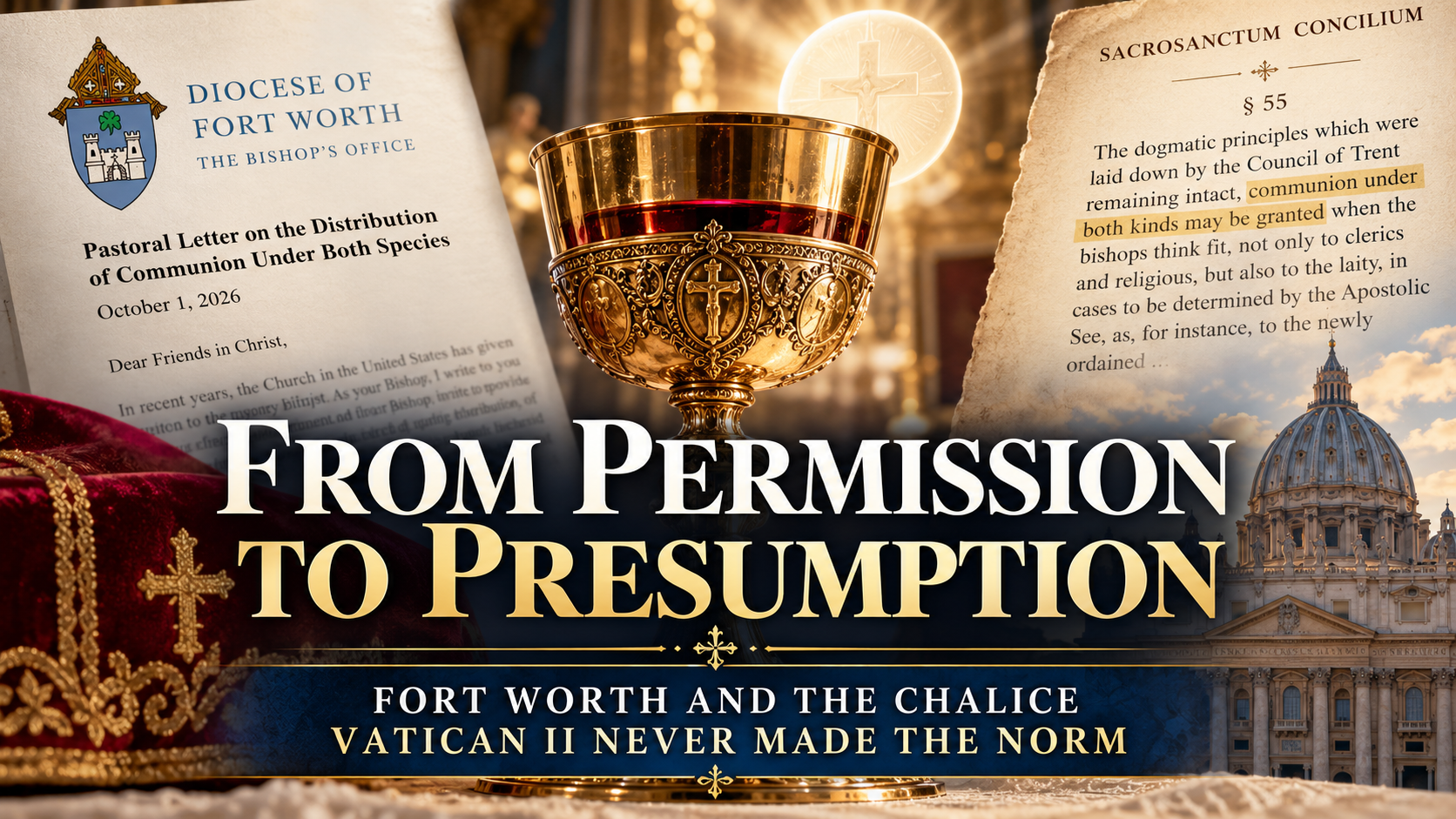
- FROM PERMISSION TO PRESUMPTION: Fort Worth and the Chalice Vatican II never made the NormBishop Michael Olson has implemented strict limitations on the distribution of Communion under both species in the Diocese of Fort Worth, prompting a discussion on the historical evolution of liturgical practices following Vatican II. This decision aims to reaffirm the doctrine of the Eucharist, emphasising that Christ is fully present under either species, while addressing misconceptions surrounding modern practices.
- AUGSBURG 2030: Can Rome commemorate a Confession it once confuted?Pope Leo XIV aims to revitalise the ecumenical spirit of the Augsburg Confession for its 2030 anniversary. However, historical responses from Rome highlight significant doctrinal differences between Catholics and Lutherans. True reconciliation must acknowledge these unresolved issues, as merely celebrating commonality risks glossing over critical theological distinctions that led to the Reformation.



Leave a Reply