
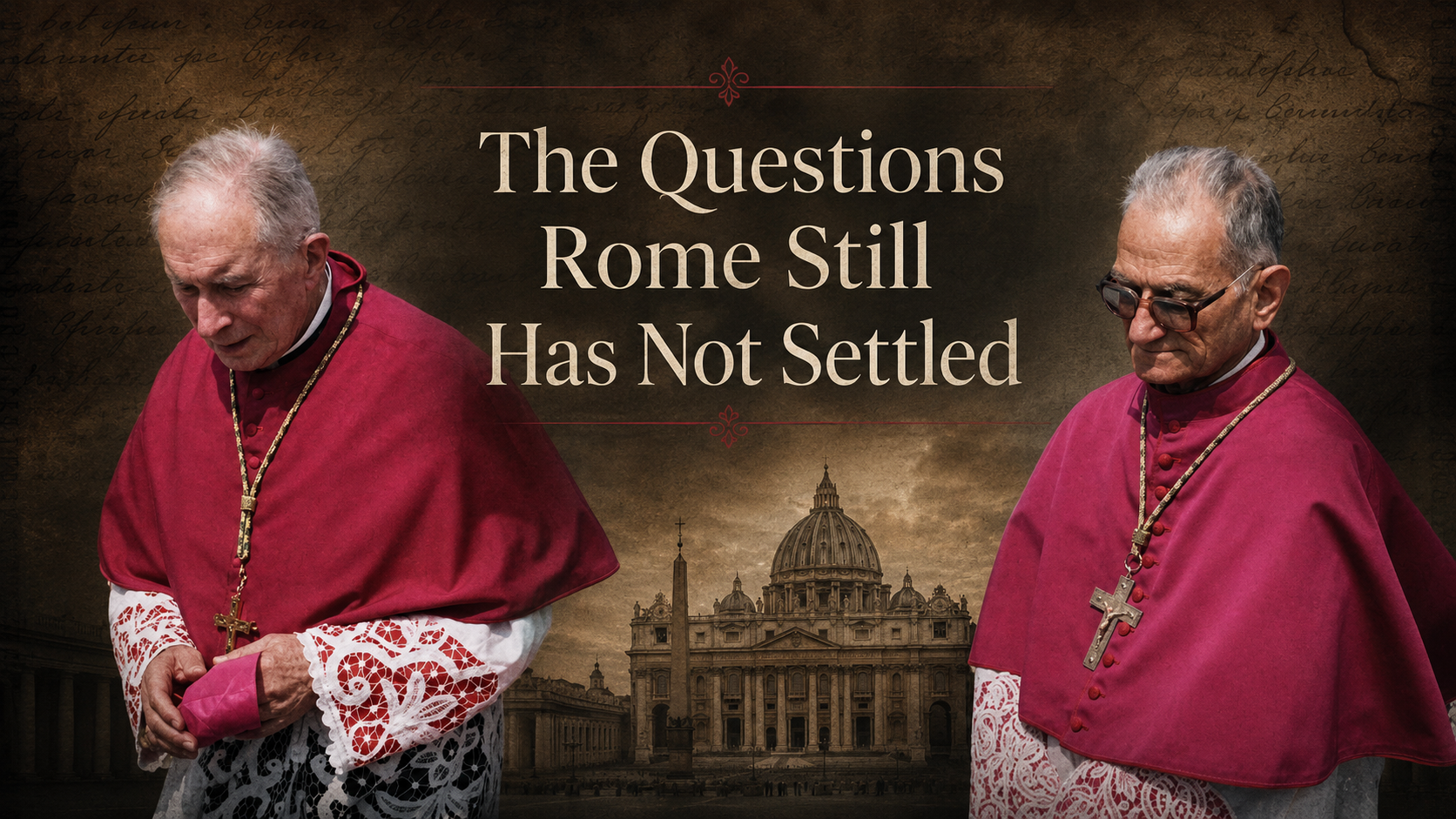
The Questions Rome Still Has Not Settled
In November 1983, five years before the Écône consecrations, ✠Marcel Lefebvre and ✠Antônio de Castro Mayer placed before Pope John Paul II a doctrinal indictment of the post-conciliar settlement. Rome would later condemn acts arising from that conflict, negotiate with those who inherited it, and insist upon a “hermeneutic of continuity”. Yet forty-three years later, the remarkable thing about the letter is how many of its fundamental questions remain the questions.

On 21 November 1983, ✠Marcel Lefebvre and ✠Antônio de Castro Mayer addressed an open letter from Rio de Janeiro to Pope John Paul II. Its opening image was deliberately arresting: during the preceding twenty years, they wrote, the situation of the Church had become such that she resembled “an occupied city”. Clergy and faithful were experiencing anguish and perplexity amid what they called the “self-destruction of the Church”; errors, post-conciliar reforms, liturgical changes, false notions disseminated through official documents and abuses of ecclesiastical authority had, they alleged, produced confusion precisely among Catholics most determined to remain attached to the Church, the papacy and the traditional Magisterium.¹
The date is essential. This was November 1983, not June 1988. There had been no illicit episcopal consecrations at Écône. No decree of excommunication had been issued. The controversy had not yet acquired the canonical event through which the entire history would subsequently be interpreted. Lefebvre and de Castro Mayer approached John Paul II as Catholic bishops appealing to the Successor of Peter. They called him “Holy Father”, spoke of their “filial devotion”, promised their prayers and explicitly invoked Our Lord’s command to Peter: “confirm thy brethren”. Their contention was not that Rome possessed no authority. It was that Roman authority existed precisely to guard what the Church had received.
Attached to the letter was a summary of six alleged errors: an ecumenical and latitudinarian conception of the Church; a collegial and democratic conception of ecclesiastical government; a false understanding of natural religious rights; an erroneous conception of papal power; a Protestant tendency in the reformed liturgy; and the freer diffusion of theological error within Catholic life.¹ Some of the language is severe. Some formulations require qualification. Yet dismissing the document because its authors were Lefebvre and de Castro Mayer is no substitute for answering the propositions they raised.
Indeed, one correction illustrates precisely how the document ought to be read. It speaks of the “suppression of the Holy Office”. Strictly speaking, Paul VI did not abolish the Church’s doctrinal dicastery. In Integrae Servandae of 7 December 1965 he reorganised the Sacred Congregation of the Holy Office as the Congregation for the Doctrine of the Faith, retaining responsibility for safeguarding faith and morals while explicitly altering its methods and disciplinary culture.² The historical shorthand in the 1983 text can therefore be corrected. But the substantive observation survives the correction: there had been an intentional change from a predominantly condemnatory model of doctrinal discipline towards one emphasising the promotion of doctrine and the correction of error by different means. The real question is what that change produced.
That distinction — between correcting an imprecise formulation and actually answering the underlying argument — is indispensable throughout the document.
Take ecclesiology. Lefebvre and de Castro Mayer objected to the post-conciliar language of the “People of God”, imperfect communion, separated Christian communities and ecumenical engagement. Their argument can easily be caricatured as though they objected to cordial relations with non-Catholics or denied that grace could operate outside visible Catholic structures. That is not the serious question. The serious question is whether the Catholic Church possesses in herself the unity Christ bestowed upon her, so that those separated from that unity are objectively called into it, or whether Christian unity has subtly been reconceived as something the divided Christian communities must together discover or construct.
The difference is enormous. It determines whether ecumenism remains ordered towards conversion and full Catholic communion or whether conversion becomes vaguely embarrassing — “proselytism” in the pejorative sense — because denominational plurality has effectively become a legitimate form of Christian diversity. The Church may properly recognise truth, baptism, Scripture and other goods among separated Christians without ceasing to proclaim that the fullness of the means of salvation subsists in the Catholic Church and that visible unity matters. The question raised in 1983 was whether the pastoral practice that followed the Council continued to make that final proposition unmistakable.
Forty-three years of ecumenical encounters have not made the question absurd. They have made it more urgent.
The same is true of collegiality. Here the 1983 memorandum itself can be challenged if it is read as suggesting that Lumen Gentium simply established two autonomous supreme authorities in the Church. The conciliar constitution explicitly teaches that the episcopal college possesses no authority except together with the Roman Pontiff as its head, while affirming that the Pope possesses “full, supreme and universal power” which he is always free to exercise.³ Any fair criticism must begin there.
But it cannot end there.
For what Lefebvre and de Castro Mayer perceived was not simply a disputed paragraph in a conciliar constitution but an emerging ecclesiastical mentality: episcopal conferences, councils, commissions, committees, secretariats, pastoral assemblies, national structures and processes of collective discernment through which episcopal authority could become simultaneously bureaucratised and diffused. The individual bishop remained theoretically the shepherd of his diocese while increasingly behaving as a regional administrator of collective policy.
The contemporary enthusiasm for “synodality” makes that concern more, not less, pertinent. Consultation is not the problem. The Church has always consulted. Nor is there anything revolutionary about bishops acting together. The danger comes when consultation acquires quasi-doctrinal authority; when consensus is confused with the sensus fidelium; when the sensus fidelium is detached from the Faith which constitutes it; or when prolonged “discernment” seems capable of producing conclusions that Revelation itself does not permit.
The Church listens in order to discern how faithfully to transmit what she has received. She does not listen in order to discover what Christianity ought now to become.
Accipere, non fingere.
Receive, do not invent.
Religious liberty remains still more difficult. Dignitatis Humanae expressly says that the religious freedom of which it speaks concerns immunity from coercion within civil society and “leaves untouched traditional Catholic doctrine on the moral duty of men and societies toward the true religion and toward the one Church of Christ”.⁴ That sentence matters. It prevents any serious critic from pretending that the Council simply announced that every religion is equally true or that man possesses a moral right to religious error.
Yet Lefebvre’s question did not disappear merely because the Council asserted continuity. The pre-conciliar Magisterium had taught not only that nobody may be compelled to embrace the Catholic Faith, but also that societies themselves possess duties towards God and the true religion. Dignitatis Humanae, meanwhile, articulated a civil right to religious immunity extending even to those who fail in their obligation to seek and adhere to religious truth, subject to the requirements of just public order.⁴ The disputed question is therefore highly specific: precisely how does that juridical right stand in continuity with the earlier teaching concerning the duties of states, the rights of the true religion and the Social Kingship of Christ?
There are Catholic theologians who have offered sophisticated answers. There are distinctions between moral and civil rights, between immunity from coercion and a positive right to error, between immutable principles and contingent political applications. Those arguments deserve serious treatment. But the traditionalist complaint has always been that too often the official response stopped one sentence too soon: there is no contradiction because the Council says there is no contradiction.
That is not enough.
Catholic theology has never feared distinctions. If two formulations appear contradictory, the answer is to identify the distinction by which both may be true — or acknowledge where a contingent judgement has changed. One cannot make contradiction disappear by ecclesiastical fiat. The Magisterium exists to illuminate truth, not to suspend the law of non-contradiction.
This brings us to the most important portion of the 1983 intervention: papal authority.
Paradoxically, it is here that the document most clearly exposes the inadequacy of the claim that Lefebvre’s fundamental position was simply anti-papal. His argument was the opposite. He affirmed the Pope’s supreme authority and then insisted that its supremacy does not mean arbitrariness. The Pope is not sovereign over Revelation. He is sovereign under Revelation. He does not own the deposit of faith. He receives an office whose purpose is to guard it.
Nothing could be more consonant with Vatican I. Pastor Aeternus declares that the Holy Ghost was not promised to the successors of Peter so that, by His revelation, they might disclose some new doctrine, but so that by His assistance they might “religiously guard and faithfully expound” the Revelation or deposit of faith transmitted by the Apostles.⁵
There, in one sentence, is the answer both to Protestant rejection of the papacy and to an exaggerated ultramontanism which reduces Catholic fidelity to obedience to the latest papal initiative.
The Pope is not an oracle whose every judgement rewrites Catholicism. Neither is he merely the chairman of a federation of local churches. He is the visible principle of unity and the supreme pastor of the universal Church, possessing a real jurisdiction conferred by Christ for a defined supernatural purpose: guarding, teaching and governing the Church in the Faith received from the Apostles.
That means Catholic obedience is neither democratic nor totalitarian. A Catholic does not obey because whatever an authority commands thereby becomes good. He obeys legitimate authority because legitimate authority serves an objective order of truth which neither superior nor subject created.
Without that principle, Catholicism becomes temporally schizophrenic. What yesterday’s Catholic was commanded to defend may tomorrow be treated as an embarrassment; what one pontificate encourages another restricts; what one generation calls sacred another may attempt to marginalise. Fidelity then ceases to mean constancy in received truth and begins to mean permanent adaptation to ecclesiastical immediacy.
Benedict XVI understood at least part of this problem with exceptional clarity. In his celebrated address to the Roman Curia in December 2005, he acknowledged the battle between a “hermeneutic of discontinuity and rupture” and a “hermeneutic of reform” in continuity with the Church’s identity through history. The Council, he argued, could not be treated as though it were a constituent assembly empowered to create a new Church, because the Church’s essential constitution comes from Christ and is received rather than invented.⁶
That was an enormously important admission. Benedict was not endorsing Lefebvre’s conclusions. But he was acknowledging that rupture was not a fantasy manufactured at Écône. It was a real hermeneutical possibility — indeed one sufficiently widespread to have caused profound confusion in the implementation of the Council.
His liturgical judgement two years later was equally significant: “What earlier generations held as sacred, remains sacred and great for us too.”⁷ Again, the importance lies beyond the immediate regulation of the old Mass. A principle had been stated. Catholic worship cannot be treated as though the sacred inheritance of one generation becomes poisonous to the next.
And this returns us to the fifth charge of 1983: the liturgy.
The strongest traditional criticism of the post-conciliar reform has never required the claim that every celebration of the reformed Mass is invalid, irreverent or doctrinally Protestant. Such exaggerations actually weaken the case. The deeper question concerns what a rite habitually communicates through the totality of its prayers, gestures, silences, orientations, language, ceremonial hierarchy and ritual structure.
The Roman liturgy inherited by the Council had developed organically across many centuries. The post-conciliar reform altered it on a scale unprecedented in modern Roman liturgical history. The offertory changed. The lectionary changed. The calendar changed. The prayers changed. The ceremonial changed. Latin largely disappeared in practice. Celebration facing the people became almost ubiquitous despite never having been mandated by the Council. Communion in the hand, extraordinary ministers, widespread vernacularisation and the transformation of sanctuary arrangements compounded the experiential rupture.
One may defend each change individually. The cumulative effect still requires judgement.
Lex orandi, lex credendi is not an antiquarian slogan. Catholics learn what the Mass is partly from what the Mass causes them repeatedly to do. A liturgy saturated in genuflections, silence, signs of the Cross, sacrificial language and differentiation between sanctuary and nave forms the imagination differently from one whose dominant experiential register is communal participation around an altar facing the people. The question raised by traditionalists is not simply whether Catholic doctrine remains somewhere in the books. It is whether the reform communicates that doctrine with the same ritual density.
Here again, the subsequent history cannot prove causation but neither may it simply be excluded as irrelevant. The collapse of Mass attendance, sacramental practice, vocations, catechetical literacy and belief in fundamental Catholic doctrines across much of the Western Church occurred during the same post-conciliar period in which the older forms of Catholic worship, discipline and instruction were rapidly dismantled. A serious Church ought to want to know why.
The final 1983 charge concerned the diffusion of error. And perhaps nowhere is the contrast identified by Lefebvre and de Castro Mayer more visible today. The Church did not abandon doctrinal authority after Vatican II; the Congregation for the Doctrine of the Faith continued to investigate and condemn errors. But ecclesiastical culture unquestionably changed. Dialogue, accompaniment, process and pastoral sensitivity increasingly displaced explicit condemnation as the instinctive vocabulary of authority.
Yet the tolerance was strangely asymmetric.
For decades Catholic academics, priests and occasionally prelates have publicly challenged settled teaching concerning sexual morality, sacramental discipline, marriage, priesthood and other questions while remaining comfortably within institutional Catholic structures. At the same time, Catholics attached to inherited liturgical practice have repeatedly been investigated, restricted or treated as though their very attachment represents an ecclesiological danger.
This does not prove every traditionalist correct. It does reveal a difficulty.
A Church capable of extraordinary patience with theological dissent ought to possess at least comparable patience with Catholics whose principal offence is excessive attachment to what their fathers received.
The issue became impossible to regard as merely historical this summer.
On 24 June 2026, the Society of Saint Pius X addressed Pope Leo XIV and the College of Cardinals with another extensive Profession of Catholic Faith. It explicitly presented the Church’s two-thousand-year Tradition as the remedy for the present crisis and expressed the hope that its doctrinal text might become the basis of an honest discussion with the Holy See.⁸ On 1 July four priests were consecrated bishops at Écône without pontifical mandate; on the following day the Dicastery for the Doctrine of the Faith issued its decree concerning the canonical consequences.⁹ Then, on 21 July, the SSPX itself explicitly placed the interventions of 1974, 1983 and 2026 in one line: Semper idem — always the same.¹⁰
One need not accept the Society’s entire narrative to recognise the force of the chronology.
1983 came before 1988.
The doctrinal dispute came before the canonical rupture.
And in 2026, once again, the doctrinal dispute came before the consecrations.
That does not resolve the canonical questions surrounding Écône. It does mean that canonical penalties cannot themselves constitute an answer to theological arguments. Rome may judge whether an episcopal consecration was lawful. It may determine canonical status. It may impose or declare penalties according to law. But none of those acts demonstrates the continuity of Dignitatis Humanae with Quanta Cura, explains the precise limits of legitimate ecumenism, establishes why the older Roman liturgy became an object of restriction, or resolves how doctrinal development is distinguished from doctrinal mutation.
Those questions must be answered on their own terms.
Rome certainly has responded to Lefebvre over the decades. John Paul II’s Ecclesia Dei argued in 1988 that the root of Lefebvre’s action lay in an “incomplete and contradictory notion of Tradition”, particularly because authentic Tradition cannot be opposed to the universal Magisterium of the Church.¹¹ Benedict XVI pursued reconciliation, addressed the hermeneutical problem and restored substantially greater liberty to the traditional Roman liturgy. The Holy See and SSPX conducted years of doctrinal discussions.
It would therefore be inaccurate to say that Rome has said nothing.
The more disturbing conclusion is that, after all that has been said, the argument remains.
The Church cannot live indefinitely by insisting that continuity exists while generations of Catholics continue to perceive rupture. If there is continuity, demonstrate it proposition by proposition. If a traditionalist argument misrepresents a conciliar text, identify the misrepresentation. If an older statement concerned contingent circumstances rather than an immutable principle, explain the distinction. If abuses rather than the Council itself caused the damage, name the abuses and correct them. If practical reforms produced consequences nobody intended, possess the humility to reconsider them.
But do not answer an argument about Tradition merely by invoking authority, because the nature and limits of authority are themselves part of the argument.
And do not imagine that suppressing the symptoms settles the disease.
That is why the 1983 letter remains so unsettling forty-three years later. Not because every accusation in it must be accepted without qualification. Not because Lefebvre was incapable of error. Not because every act undertaken subsequently in the name of Tradition was wise or justified.
It remains unsettling because its central question has survived virtually everything subsequently done to contain it:
Can the Catholic Church teach, worship and govern today in a manner recognisably continuous with the Catholic Church of yesterday?
There can ultimately be only one Catholic answer.
She must.
For the Church did not begin in 1962. She did not begin in 1970. She did not begin at Écône in 1988. She did not begin with Francis, Leo XIV or any other pontificate. Pope, bishops, priests and faithful alike are recipients before they are administrators. Revelation precedes them. Tradition precedes them. The Faith judges their fidelity; they do not judge whether the Faith remains convenient.
The most genuinely Petrine response to the crisis would therefore not be the defeat of traditionalists.
It would be their redundancy.
Make clear beyond reasonable dispute that what the Church believed before the Council she believes now; that what was sacred remains sacred; that doctrinal development deepens rather than contradicts; that synodality cannot manufacture revelation; that pastoral practice cannot nullify doctrine; that papal authority guards rather than creates the Faith; and that Catholic Tradition belongs not to a faction but to the whole Church.
Do that, and the “traditionalist problem” begins to disappear — because Catholics no longer need a movement to defend what the Church herself unmistakably defends.
Until then, the document written at Rio de Janeiro on 21 November 1983 will continue to make uncomfortable reading.
Not because Rome never replied.
But because the questions are still waiting to be settled.
¹ ✠Marcel Lefebvre and ✠Antônio de Castro Mayer, “Open Letter to Pope John Paul II”, Rio de Janeiro, 21 November 1983; text supplied in the source document. ; Society of Saint Pius X archival text.
² Paul VI, Integrae Servandae, 7 December 1965.
³ Second Vatican Council, Lumen Gentium, §22.
⁴ Second Vatican Council, Dignitatis Humanae, §§1–3.
⁵ First Vatican Council, Pastor Aeternus, Chapter IV.
⁶ Benedict XVI, Address to the Roman Curia, 22 December 2005.
⁷ Benedict XVI, Letter to the Bishops accompanying Summorum Pontificum, 7 July 2007.
⁸ Society of Saint Pius X, “Open Letter to His Holiness Pope Leo XIV and to the Cardinals of the Holy Church”, 24 June 2026.
⁹ Society of Saint Pius X, “A Timeline of the Society of Saint Pius X’s July 1, 2026 Episcopal Consecrations”, recording the consecrations and the Dicastery’s decree of 2 July 2026.
¹⁰ FSSPX News, “1974–1983–2026: Semper Idem”, 21 July 2026.
¹¹ John Paul II, Ecclesia Dei, 2 July 1988, §§3–5.
RELATED ARTiCLES


LATEST ARTICLES
- Bishop Suetta Orders Traditional Benedictines to Abandon French Monastery Over SSPX LinksTwo priests face disciplinary action after leaving their diocese to preserve a traditional Benedictine vocation and liturgy. While their canonical compliance and association with the SSPX require examination, the article argues that necessity, ecclesiastical responsibility and the wider postconciliar liturgical crisis must also be considered. Obedience cannot replace justice or proper inquiry.
- When Music Becomes the Measure of Worship: Why Gregorian Chant Meets ResistanceThe article argues that Gregorian chant’s marginalisation resulted not from Vatican II alone, but from changing pastoral priorities, musical education, publishing and cultural preferences for personal expression and emotional engagement. Despite repeated papal and conciliar support, local practice often substituted contemporary repertoire. The author calls for renewed formation, faithful liturgical music and recovery of the Church’s musical inheritance.
- Today’s homily: St John of the CrossThe homily on St John of the Cross explores loving God above all things through detachment, faithful prayer and obedience. True contemplation remains rooted in Scripture, the sacraments, charity and everyday duties. Spiritual dryness may purify rather than signify God’s absence. Christians are encouraged to persevere, resist worldly attachments and seek holiness through sacramental life and selfless service.
- Today’s Mass: November 24 St John of the CrossTradition tells us that Cecilia was a Roman girl of a patrician family who had been brought up as a Christian. She fasted often and wore a coarse garment beneath her rich clothing. Although she had consecrated her virginity to God, her father betrothed her to a young pagan named Valerian.
- Sermon for St. John of the CrossSt Clement of Rome, commemorated today, offers an early account of Church order through his epistle to the Corinthians. Defending apostolic succession, ecclesial hierarchy and unity, he appeals to the examples of Saints Peter and Paul, orderly worship, and perseverance. His writing illuminates the developing ministries of bishops, presbyters, deacons and laity.
CURRENT EDITION


Today’s Mass Propers
- Today’s Mass: November 24 St John of the Cross
 Tradition tells us that Cecilia was a Roman girl of a patrician family who had been brought up as a Christian. She fasted often and wore a coarse garment beneath her rich clothing. Although she had consecrated her virginity to God, her father betrothed her to a young pagan named Valerian.





Leave a Reply