
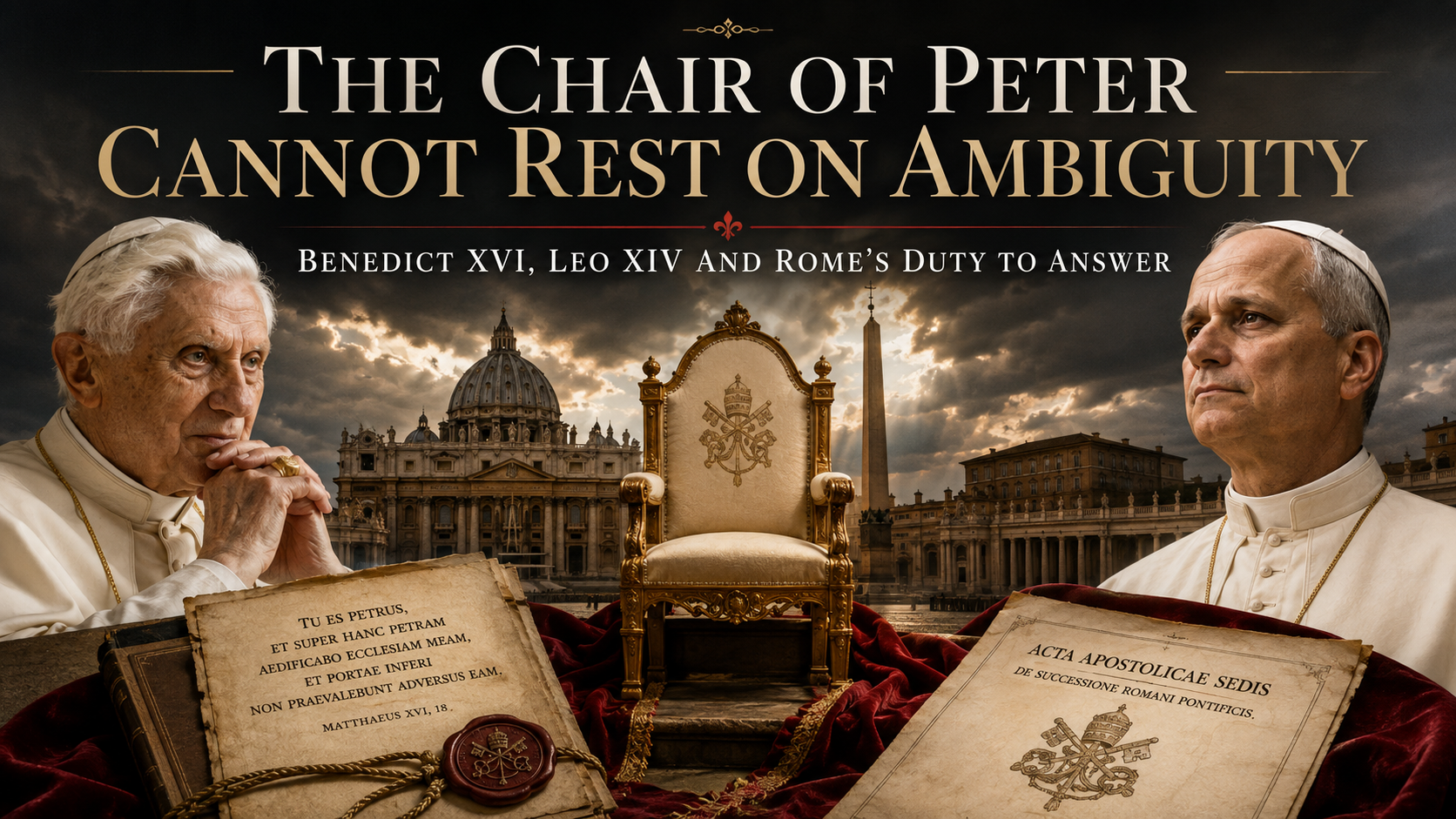
The Chair of Peter Cannot Rest on Ambiguity: Benedict XVI, Leo XIV and Rome’s Duty to Answer
Andrea Cionci has not proved that Benedict XVI remained Pope. Angelo Giorgianni has not proved that Leo XIV was invalidly elected. But that is no longer sufficient reason simply to dismiss the questions. A Vatican City judicial file arising from Cionci’s complaint remains open; he has reportedly undergone a second formal hearing and submitted further material; and separate objections have been raised concerning the conduct of the 2025 conclave. When the questions touch the identity of the Roman Pontiff himself, institutional silence is not an adequate substitute for juridical certainty.

There are controversies which the Church can afford to leave to theologians. The validity of the occupation of the Chair of Peter is not one of them. Catholics may endure considerable uncertainty about the prudence of a pope’s government, the wisdom of his appointments, the orthodoxy of particular formulations, the interpretation of disciplinary acts and even the direction of an entire pontificate. But the visible constitution of the Church depends upon something more fundamental: that Catholics can know who the Pope is. Once a serious question is raised about whether a pope validly ceased to be pope, or whether his successor was validly elected, it cannot indefinitely be left suspended between internet polemic and Roman silence.
That is why the latest development in the Andrea Cionci affair matters, although not necessarily for the reasons suggested by some of its more enthusiastic advocates. LifeSiteNews reports that Cionci was summoned on 3 August for a second formal hearing before Alessandro Diddi, Promoter of Justice of Vatican City State; that the meeting lasted approximately two hours; and that Cionci deposited a further petition of some fifty pages containing additional material. Cionci further reports that Diddi indicated an intention to conclude the investigations in the relatively near future and to treat the matter seriously.¹ Those are significant claims, but they remain, as regards the latest hearing, reported principally through Cionci himself. They are not a Vatican declaration that Benedict XVI’s resignation was invalid, nor evidence that Diddi has reached such a conclusion.
Indeed, the distinction is essential. The existence of an investigative file does not establish the truth of the allegations contained within it. Earlier this year Diddi’s office declined a request for access to the file on the ground that investigations were continuing and that their conclusion could not yet be predicted.² Critics of the Cionci thesis have reasonably observed that the Promoter of Justice performs the function of a public prosecutor within the judicial system of Vatican City State and that receiving a complaint, questioning its author and examining evidence can belong perfectly ordinarily to the preliminary investigative process.³ An investigation is therefore not a verdict. But neither is it nothing. The Vatican judicial authorities have not endorsed Cionci’s thesis, yet neither has the file been disposed of, and that alone is sufficient to make the matter worthy of serious attention.
At the heart of the case lies Canon 332 §2, which provides that if the Roman Pontiff resigns, validity requires that the resignation be made freely and properly manifested. In the authoritative Latin text the object renounced is the papal munus.⁴ Benedict XVI’s Declaratio of 11 February 2013 famously stated instead that he renounced the ministerium of the Bishop of Rome and Successor of Saint Peter.⁵ Upon that distinction Cionci and others have built an elaborate thesis: that Benedict relinquished only the active exercise of the Petrine ministry while retaining the Petrine munus, thereby rendering the See not vacant but impeded and making the conclave which elected Francis incapable of electing a legitimate successor.
The textual question is real, but the conclusion is not thereby proved. The same Declaratio which employs ministerium also states unequivocally that, from 8 p.m. on 28 February 2013, “the See of Rome, the See of Saint Peter” would be vacant and that a conclave should be convoked by those competent to elect a new Supreme Pontiff.⁵ Those words present an obvious and formidable difficulty for any theory according to which Benedict deliberately intended to remain the one true Pope. Benedict subsequently recognised Francis publicly as his successor and repeatedly rejected suggestions that his resignation was invalid. His own conduct after 2013 therefore cannot simply be ignored while isolated expressions are elevated into a secret juridical programme.
Yet this is precisely why an authoritative answer would be so valuable. It is not enough merely to say that everyone understood what Benedict meant, because juridical acts exist precisely so that intention may be expressed in a form capable of producing juridical effects. Nor is it sufficient simply to point to ministerium and pronounce the resignation null. Language has context; juridical acts are interpreted as wholes; and Benedict explicitly manifested his understanding that the Apostolic See would become vacant. The argument must therefore be settled at the level at which it has been raised: canonically, textually and authoritatively.
More importantly, it is far from clear that the Office of the Promoter of Justice of Vatican City State is itself the ecclesiastical authority capable of delivering the definitive canonical determination which the wider controversy demands. The Promoter is investigating a complaint within the Vatican State judicial system. That is not identical to an authoritative ecclesiastical adjudication of who possesses the Petrine munus. If the present proceedings cannot finally settle that question, then the institutional issue becomes more pressing rather than less: what competent authority will? And if Rome considers the canonical question already definitively resolved, why has the reasoning not been set out in a form capable of extinguishing reasonable doubt?
Alongside the Benedict controversy now stands another challenge. On 11 March 2026 former Italian magistrate and former Undersecretary of State Angelo Giorgianni sent Cardinal Pietro Parolin a parere pro veritate questioning aspects of the conclave which elected Robert Francis Prevost as Pope Leo XIV. His objections include the admission of 133 cardinal electors despite the figure of 120 prescribed by Universi Dominici Gregis, together with the reported discovery of a mobile telephone in the possession of an elector after the conclave had been sealed.⁶ Here again, dramatic conclusions have outrun the facts.
Universi Dominici Gregis is explicit that the maximum number of cardinal electors “must not exceed one hundred and twenty”. It is equally explicit that, during the vacancy of the Apostolic See, laws made by Roman Pontiffs may not be corrected, modified, added to, subtracted from or dispensed from, particularly in relation to the procedure for electing the Pope. Yet the same constitution gives the College of Cardinals authority to interpret doubtful or controverted points concerning its provisions, and it states that a cardinal duly created and published possesses the right to elect in accordance with the relevant norms.⁷ Before the 2025 conclave the College confronted the numerical problem directly and, on 30 April, declared that all 133 electors possessed the right to vote, reasoning that Pope Francis, by knowingly creating more than 120 cardinals under the age of eighty, had effectively dispensed from the numerical maximum and that those cardinals had acquired electoral rights upon their creation and publication.⁸
That decision cannot simply be made to disappear because it complicates the argument for invalidity. But neither should the tension within the law be disguised. Paragraph 4 says that the College may not dispense from papal election law during the vacancy; paragraph 5 permits it to interpret doubtful provisions; paragraph 33 establishes the 120 maximum; paragraph 36 establishes the electoral right of duly created cardinals. The General Congregation resolved that tension one way. Giorgianni argues that it lacked authority to do so. That is a genuine legal dispute. It is not resolved merely by repeating “133” as though arithmetic alone establishes nullity, nor by treating the General Congregation’s conclusion as beyond examination merely because it was administratively convenient.
The mobile telephone raises a different question. Reuters reported in March, drawing upon an account by veteran Vatican correspondents Gerard O’Connell and Elisabetta Piqué, that an active mobile signal was detected as the cardinals prepared for the first ballot and that an elderly elector then discovered that he still possessed a telephone and surrendered it. The authors did not allege malign intent, and the Vatican did not respond publicly to Reuters’ request for comment.⁹ If the account is correct, the incident was unquestionably serious. Universi Dominici Gregis forbids cardinal electors from communicating by telephone or other means with persons outside the conclave except in circumstances of grave and recognised necessity, and it imposes stringent measures to prevent external communication.⁷
But here too the distinction between an offence against a rule and the invalidity of an election must be maintained. Paragraph 76 declares an election null where it takes place in a manner other than that prescribed or where required conditions are not observed; yet the constitution itself demonstrates elsewhere that even grave wrongdoing does not automatically invalidate the election, explicitly removing invalidity in the case of simony while retaining the penalty of excommunication.⁷ A forgotten telephone therefore does not, by the mere fact of its existence, prove that Leo XIV was never Pope. One would have to demonstrate that the breach touched a condition whose non-observance invalidated the electoral act itself. That argument may be made, but it has not yet been established.
And this brings us to the real issue. The Church cannot be governed by private conclaves conducted in the minds of individual Catholics. The faithful cannot be expected to adjudicate papal legitimacy for themselves according to whichever canonist, journalist, blogger or cleric they find most persuasive. If that principle is surrendered, the visible Church gives way to a collection of competing private judgments in which every Catholic becomes his own tribunal of last resort. Today Benedict never resigned; tomorrow Francis was never elected; the next day Leo’s conclave was void; after that someone will discover a defect in the cardinalate of the men who elected his successor. Such a process has no natural terminus.
But the answer to private judgment cannot be institutional opacity. Authority earns confidence by exercising itself. If Benedict’s resignation unquestionably accomplished the renunciation required by Canon 332 §2, then Rome should be able to demonstrate why. If the distinction between munus and ministerium is juridically immaterial in this act, explain it. If Benedict’s explicit declaration that the See would become vacant supplies the necessary manifestation, establish that canonically. Likewise with the conclave of 2025: if Francis validly dispensed from the 120-elector limit before his death, identify the juridical basis; if the General Congregation merely interpreted rather than dispensed from Universi Dominici Gregis, explain the distinction; if the telephone incident had no bearing upon the validity of the election, state precisely why. These are not unreasonable demands made against the papacy. They are demands made because the papacy is important.
Nor should those who recognise Leo XIV as Pope be frightened by such scrutiny. The truth cannot damage a valid pontificate. A careful canonical demonstration of Benedict’s valid resignation would strengthen the legitimacy of Francis’s succession. A careful juridical defence of the 2025 conclave would strengthen Leo XIV. What weakens confidence is the impression that questions touching the very constitution of the Church must not be examined because examination itself is somehow disloyal.
There is another danger on the opposite side which must be resisted with equal firmness. Catholics dismayed by the post-conciliar crisis have sometimes become too eager for explanations which transform suspicion into proof. An unusual phrase becomes evidence of a secret plan. A procedural irregularity becomes automatic nullity. An unanswered petition becomes proof that Rome cannot answer it. The argument then becomes circular: every denial is further evidence of concealment, every silence an admission, every investigation confirmation. That is not Catholic reasoning. It is unfalsifiable speculation. Cionci has not established that Benedict XVI remained the Roman Pontiff until his death; Giorgianni has not established that the election of Leo XIV was null; and the Promoter of Justice has not declared either proposition true. Those things should be said without hesitation.
But another proposition should now be stated with equal clarity: questions of this magnitude should not be allowed to remain permanently unresolved merely because some of those raising them have overreached. The Church possesses canonists, tribunals, the documentary record and the testimony of those involved. Above all, she possesses authority. What she should not cultivate is a vacuum in which extravagant theories flourish precisely because no sufficiently authoritative explanation has been offered to extinguish them. If Cionci’s complaint is legally worthless, dismiss it and state the grounds. If his canonical argument is erroneous, demonstrate the error. If Giorgianni’s objections misunderstand Universi Dominici Gregis, answer them. If the 2025 conclave was unquestionably valid, establish the juridical chain by which that certainty is reached.
And if, however remote the possibility may presently appear, an investigation were ever to uncover a defect genuinely touching the validity of a papal resignation or election, then no appeal to inconvenience, precedent or institutional stability could make that defect disappear. The Church is not protected by refusing to know the truth. She is protected by Christ and governed according to truth. That is why neither triumphalism nor panic is appropriate. The proper response is neither “Benedict remained Pope; therefore Francis and Leo were antipopes” nor “Leo is Pope; therefore no question may be asked.” The former substitutes assertion for proof. The latter substitutes authority for explanation.
Rome can do better than either. The Chair of Peter cannot ultimately rest upon rumours, theories, procedural technicalities or assurances that Catholics simply ought not to concern themselves with the matter. It rests visibly upon lawful succession to the office instituted by Christ. Precisely because that office is the principle of visible unity in the Church, its possession should admit of the greatest possible juridical clarity. Let the investigation conclude. Let the evidence be assessed. Let erroneous claims be rejected where they are erroneous and genuine questions answered where they are genuine. Then let Rome speak with sufficient authority and precision that reasonable Catholics no longer have to choose between internet conclavism and institutional silence.
The Church does not need another theory about who is Pope. She needs certainty. And the Chair of Peter is too important for anything less.
¹ LifeSiteNews, “Vatican probe into Benedict’s resignation still live: Cionci faces second hearing”, 20 August 2026.
² Office of the Promoter of Justice of Vatican City State, Alessandro Diddi to Roberto Tieghi, 30 March 2026, Prot. N. 15/25 R.G.P.
³ UCCR, “Ratzinger’s Resignation: Vatican Inquiry Is Merely a Routine Procedure”, 21 April 2026.
⁴ Code of Canon Law, Canon 332 §2.
⁵ Benedict XVI, Declaratio, 11 February 2013.
⁶ Angelo Giorgianni, parere pro veritate concerning the 2025 conclave, 11 March 2026.
⁷ John Paul II, Apostolic Constitution Universi Dominici Gregis, nn. 4–5, 33, 36, 44, 51, 55–56, 76 and 78.
⁸ Vatican News, “Cardinals recognize right to vote of all Cardinal electors in conclave”, 30 April 2025.
⁹ Reuters, “Cardinal found with phone during secret conclave to elect Pope Leo, book says”, 1 March 2026.
RELATED ARTiCLES


LATEST ARTICLES
- Today’s Mass: October 07 Pope St Mark, ConfessorSt Mark’s brief pontificate teaches that God measures fidelity, not duration or worldly achievement. Christ alone possesses the everlasting priesthood; His servants are stewards of what they have received. With the commemorated martyrs, St Mark reminds us to persevere faithfully, so that when the Lord comes, He finds us “so doing.”
- Omnia autem probate: quod bonum est tenete ~ Prove all things; hold fast that which is good: Spiritual Conference for Nuntiatoria CXXVIThe conference reflects on St Paul’s assertion to “prove all things” in relation to self-judgement and the Church. It explores themes of synodality, ecumenism, and the importance of discernment, emphasising the need for humility in understanding truth and the challenge of maintaining genuine holiness in the midst of contemporary ecclesiastical crises.
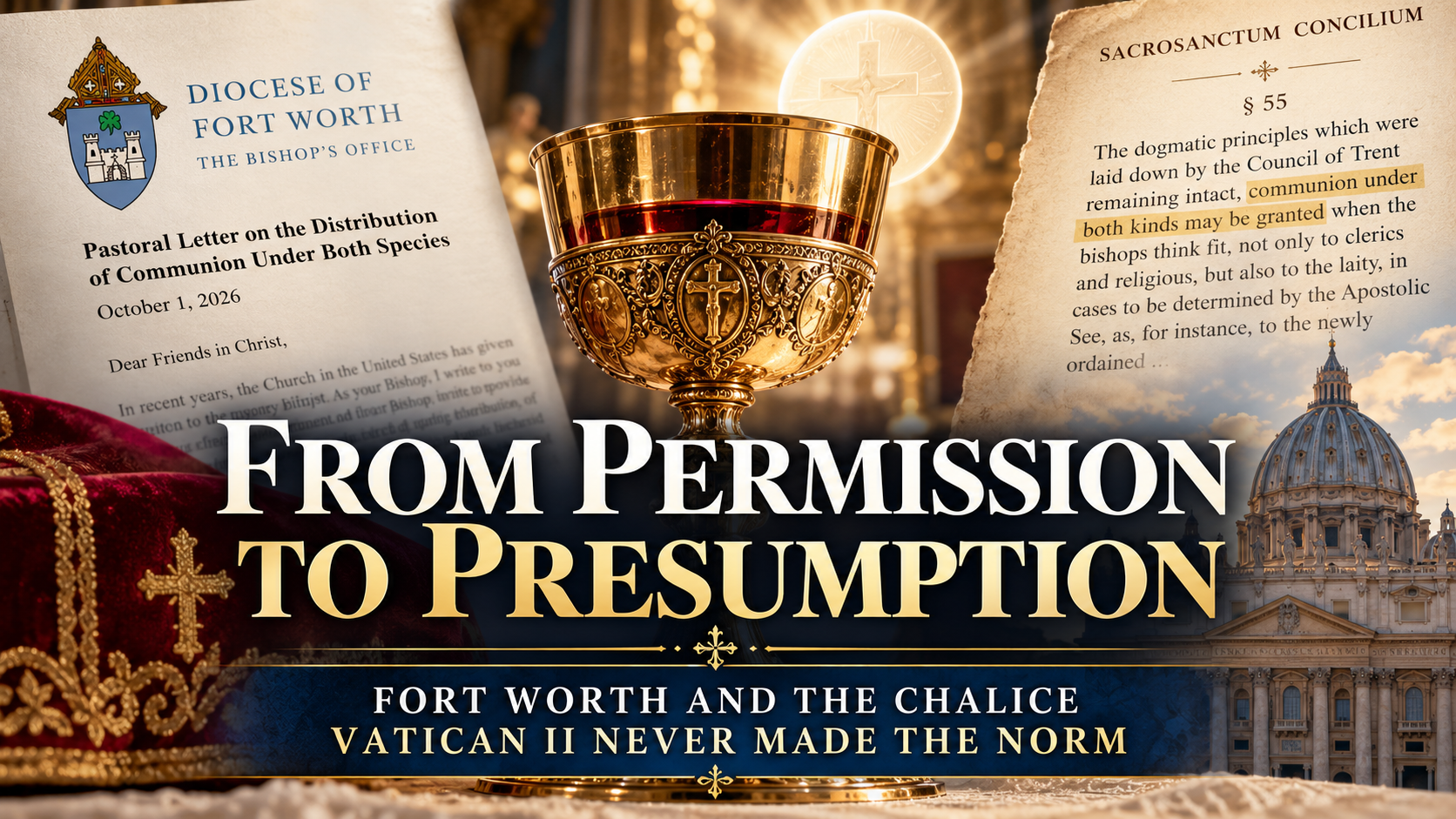
- FROM PERMISSION TO PRESUMPTION: Fort Worth and the Chalice Vatican II never made the NormBishop Michael Olson has implemented strict limitations on the distribution of Communion under both species in the Diocese of Fort Worth, prompting a discussion on the historical evolution of liturgical practices following Vatican II. This decision aims to reaffirm the doctrine of the Eucharist, emphasising that Christ is fully present under either species, while addressing misconceptions surrounding modern practices.
- AUGSBURG 2030: Can Rome commemorate a Confession it once confuted?Pope Leo XIV aims to revitalise the ecumenical spirit of the Augsburg Confession for its 2030 anniversary. However, historical responses from Rome highlight significant doctrinal differences between Catholics and Lutherans. True reconciliation must acknowledge these unresolved issues, as merely celebrating commonality risks glossing over critical theological distinctions that led to the Reformation.
- Today’s homily: St BrunoThe text reflects on Saint Bruno’s journey towards a life of solitude, prayer, and contemplation, emphasising the importance of genuine pursuit of God amidst distractions. It highlights that true spiritual growth requires silence and self-examination, urging believers to reclaim quiet moments for reflection, repentance, and devotion in daily life.
CURRENT EDITION


Today’s Mass Propers
- Today’s Mass: October 07 Pope St Mark, Confessor
 St Mark’s brief pontificate teaches that God measures fidelity, not duration or worldly achievement. Christ alone possesses the everlasting priesthood; His servants are stewards of what they have received. With the commemorated martyrs, St Mark reminds us to persevere faithfully, so that when the Lord comes, He finds us “so doing.”


Leave a Reply