
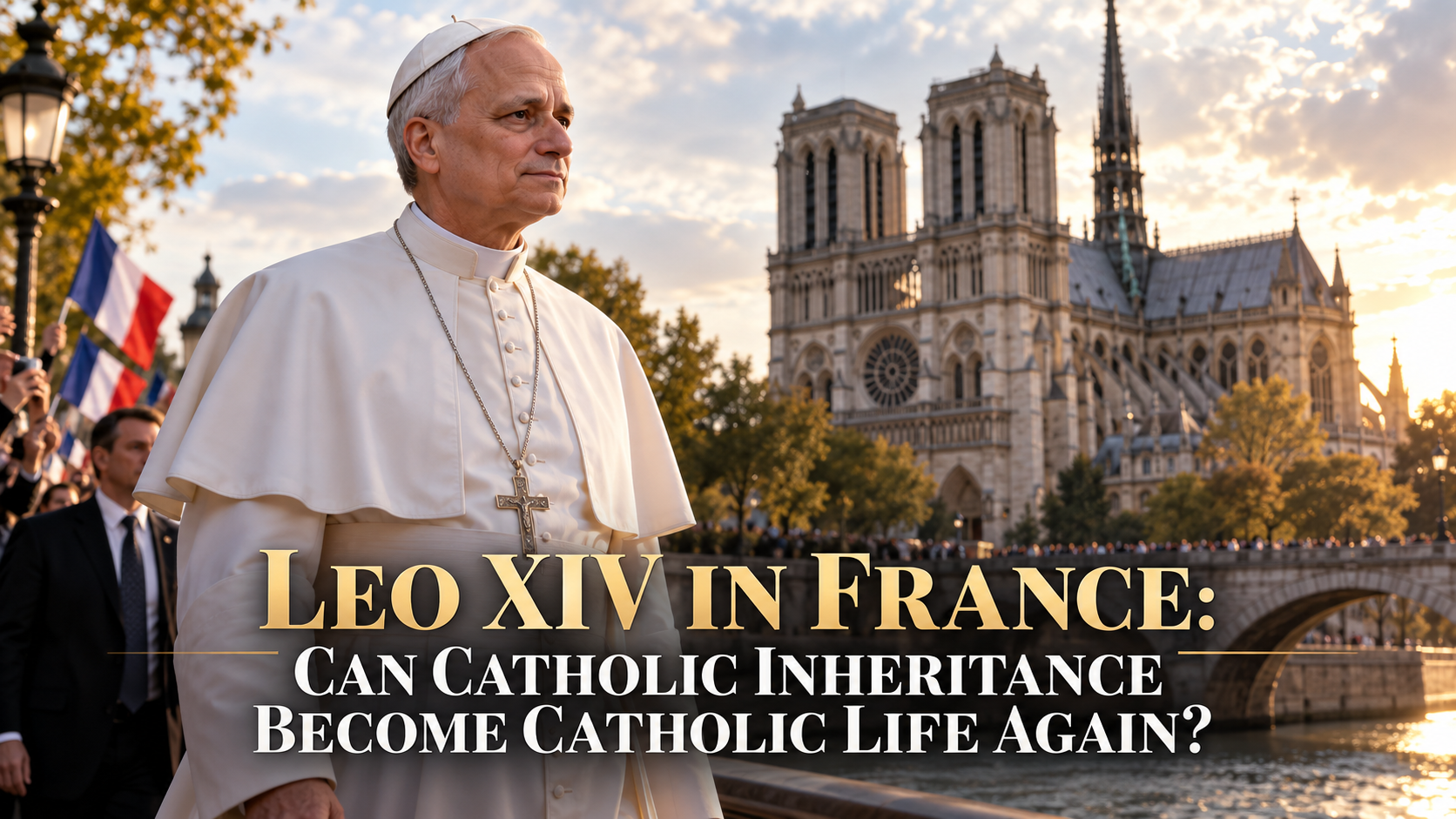
Leo XIV has arrived in France with a strikingly explicit declaration of purpose: he comes “as a follower of Jesus Christ” to proclaim “the peace of Christ”. He finds a nation in which priests, parishes, baptisms and Catholic marriages have collapsed over four decades, yet 13,234 adults were baptised this Easter and nearly 600,000 people registered for his Paris Mass. France has restored Notre-Dame magnificently while legislating an assisted death which contradicts Catholic teaching on the inviolability of life. The governing question of this visit is therefore no longer merely what France remembers of Catholicism, but whether that inheritance can become living faith again.
Before Pope Leo XIV had delivered a diplomatic address, visited UNESCO or entered Notre-Dame, he had already supplied the sentence by which this journey ought first to be understood. Speaking to journalists aboard the aircraft carrying him from Rome to Paris on the morning of 25 September, he said that he was travelling to France, as elsewhere, “as a follower of Jesus Christ” seeking to proclaim “the peace of Christ” throughout the world.¹
That is not the vocabulary of cultural tourism. Nor is it the language of a visiting head of state content to preside decorously over the surviving monuments of European Christianity. It is expressly confessional. Leo has announced himself first as a disciple of Christ, and has defined what he brings as Christ’s peace.
The distinction matters profoundly in France.
When Leo entered the country at Paris-Orly this morning, received on the tarmac by President Emmanuel Macron, he entered a nation whose Catholic inheritance remains almost impossible to escape and whose living Catholic institutions have nevertheless contracted with extraordinary speed. This afternoon he will visit UNESCO. This evening he enters the restored cathedral of Notre-Dame for Vespers with bishops, priests, deacons, seminarians and religious before travelling to the Stade de France to pray with young people. Tomorrow he meets migrants, catechumens and the newly baptised before celebrating Mass in the centre of Paris. Lourdes follows; then the French episcopate, the sick, contemplative religious and the Rosary; finally Metz, interreligious dialogue and the Christian roots of Europe.²
The itinerary almost constitutes an argument in itself. The Élysée represents republican France. UNESCO represents the international culture of education, science and technology. Notre-Dame embodies the Christian civilisation France still recognises as part of itself. The Stade de France gathers the generation repeatedly presumed to have moved beyond organised religion. The catechumens represent men and women entering the Church after inherited Catholic practice has weakened. Lourdes places sickness, suffering, grace and supernatural hope before the modern cult of autonomy. Metz asks what remains of Europe when its Christian genesis is treated as an embarrassment rather than an inheritance.
Yet the most important development immediately before the journey came not from a French politician or commentator but from Cardinal Pietro Parolin. Explaining the papal motto, Ut vitam habeat mundus — “That the world may have life” — the Secretary of State identified three meanings: natural life, spiritual life and the creative life peculiar to the human person. Human life, he said, must be protected “from conception until natural death”. Turning to the remarkable increase in French catechumens, he added that behind “that the world may have life” one may also read: “that the world may believe”.³
There is the argument of this visit in miniature.
Life cannot be reduced to biological existence, still less to autonomy over one’s own biological existence. The body has a soul. Human creativity cannot finally be assimilated to artificial intelligence. A civilisation cannot survive indefinitely by preserving the products of Christian belief while ceasing to transmit the belief which produced them. And a Church cannot measure renewal simply by preserving buildings or reorganising structures. The world must have life; therefore the world must hear the Gospel which the Church believes gives life its ultimate meaning.
Nuntiatoria has approached this journey in stages. “The Pope, the President and the Soul of France” examined the symbolic contest surrounding Notre-Dame and the deeper disagreement between Macron’s France and Catholic anthropology. “France Before Leo XIV: The Numbers Rome Must Face” examined the extraordinary demographic and sacramental contraction documented by Rome itself. “That the World May Have Life” placed the visit beside France’s newly enacted assisted-dying law.⁴ The arrival of the Pope allows those strands now to be seen as parts of one question: what can remain Catholic when Catholicism survives more securely in stone and memory than in sacramental life?
The Holy See’s own statistics make evasion difficult. In 1980 there were 38,876 priests in France. By 2024 there were 12,590, a fall of more than two-thirds. Parishes declined from 38,391 to 10,925. Professed religious women fell from 87,044 to 17,452. Annual baptisms fell from 513,501 to 186,165. Catholic marriages collapsed from 217,479 to 40,678. The number of major seminarians declined from 1,278 to 1,075 despite the enormous reduction in the priestly population which must be replaced.⁵
The same table records 49.72 million baptised Catholics, equivalent to 74.93 per cent of the French population. That figure must not be mistaken for a measurement of weekly practice, doctrinal adherence or present self-identification. It is an ecclesiastical statistic grounded principally in baptism. Yet precisely because of that, it captures one of the peculiar features of modern France: Catholic belonging has survived on registers, in ancestry, in architecture and in cultural memory much more successfully than the ordinary sacramental ecology which once sustained it.
The crisis is therefore greater than declining religious affiliation. The mechanisms of transmission themselves have broken down. Fewer infants are baptised. Far fewer couples marry in church. The parish priest has disappeared from large portions of ordinary social life. Religious communities which once educated, nursed, catechised and prayed within French towns and cities have contracted catastrophically. The child who once encountered Catholicism through household, school, parish, calendar, feast and neighbourhood cannot any longer be presumed to exist.
For the Church this is not merely sociological loss. Catholicism does not understand itself chiefly as the custodian of a civilisation. The Church claims to transmit supernatural life: to preach Christ, administer baptism, absolve sin, offer the Holy Sacrifice, teach revealed truth and prepare human beings for eternity. The collapse of sacramental practice therefore represents something more grave than the erosion of a cultural identity. It represents the failure of the Faith to reach millions through the ordinary channels by which one generation once transmitted it to the next.
Leo has already spoken directly about one element of this failure. Addressing French altar servers in August 2025, he called the shortage of priests in France and elsewhere a “great misfortune” for the Church. He spoke of the seriousness and solemnity of the Mass, of silence and liturgical beauty, and urged young men to ask whether God might be calling them to the priesthood.⁶ Rome’s figures now demonstrate the scale of the problem to which those words referred. France has lost more than 26,000 priests since 1980.
Repeated pastoral amalgamation may be unavoidable when priests and congregations become fewer, but consolidation is not evangelisation. A diocese may learn to administer decline with considerable efficiency. Larger parishes, fewer Mass centres and ever more elaborate structures of lay pastoral co-ordination can mitigate the consequences of scarcity; they do not explain how a civilisation which once produced priests in abundance ceased producing enough even to replace those who die.
Against this background stands the fact which makes simple declinism inadequate. At Easter 2026, 13,234 adults were baptised in France, an increase of 28 per cent in one year and more than three times the 4,124 recorded in 2016. More than 8,000 adolescents were also preparing for baptism. Among adult catechumens, those aged eighteen to twenty-five constitute the largest group, accounting for 42 per cent.⁷
This does not cancel the collapse. Thirteen thousand adult baptisms cannot mathematically compensate for the disappearance of hundreds of thousands of infant baptisms, marriages and regular practitioners. But their significance is not primarily numerical. These converts are appearing after automatic cultural transmission has weakened. Many are encountering Christianity without the reservoir of assumptions which previous generations inherited without conscious effort.
They therefore pose a more demanding question than nostalgia can answer. What happens after baptism?
Leo addressed precisely this problem in May when speaking to the Dicastery for Evangelization. He observed that in some societies transmission of the Faith between generations had almost disappeared. Christianity would not recover its attraction, he insisted, by diluting its content or lowering its demands. The growing numbers of catechumens required Christian communities capable of sustaining the new life begun in baptism.⁸
That gives tomorrow morning’s encounter at the Institut Catholique de Paris particular importance. Leo will not merely meet an encouraging demographic curiosity. He will address people whose existence places the entire post-conciliar pastoral settlement under examination. They have asked for baptism despite the collapse of the inherited Catholic environment. What will the Church give them once they have received it?
They do not need Catholicism reconstructed as heritage tourism. They need doctrine clear enough to believe, worship serious enough to command reverence, moral teaching definite enough to demand conversion, priests confident enough in priesthood to act as priests, communities capable of sustaining Christian life, and an account of man’s supernatural end adequate to explain why any of it matters.
Nearly 600,000 registrations for tomorrow’s outdoor Mass sharpen the paradox still further. The Diocese of Paris closed registration after the number approached that level and obtained permission to establish an overflow zone around the Place de l’Étoile and Avenue de la Grande-Armée. Archbishop ✠Laurent Ulrich described the response as surpassing expectations.⁹
The statistic must not be abused. Six hundred thousand registrations do not equal six hundred thousand recovered Sunday Mass-goers. Some participants will travel considerable distances. Some will be occasional Catholics. Some may attend because a papal visit is historically exceptional. But neither can such a response be reconciled easily with the lazy thesis that France has simply ceased to care about Christianity.
The result is one of the central contradictions of contemporary French Catholicism: fewer than one-third as many priests as in 1980; barely more than one-quarter as many parishes; scarcely one-fifth as many Catholic marriages — yet hundreds of thousands seeking to attend Mass with the Pope and more young adults presenting themselves for baptism than France has seen for decades.
Notre-Dame makes the same contradiction visible in stone.
France’s reconstruction after the fire of April 2019 was an achievement of craftsmanship, finance, organisation and national will. The cathedral mattered sufficiently to the Republic, donors and public that immense resources were mobilised to restore it. Macron understandably took considerable political pride in the achievement and had wanted a papal encounter there with those responsible for the restoration. That proposal did not become part of the final papal programme; the Élysée has publicly played down interpretations of diplomatic tension.¹⁰ Motives beyond the documented facts should not be invented.
The symbolism requires no invention. Notre-Dame can be beautifully restored without the society around it being restored to the Faith which made Notre-Dame intelligible in the first place. A cathedral is not simply a national monument which happens to contain an altar. Its architecture, imagery, orientation and worship presuppose propositions about God, Christ, sin, sacrifice, grace, judgement, heaven and eternal life. Remove those propositions and one may still admire the building, but one no longer understands it as those who built it understood it.
France therefore faces the peculiar possibility of preserving the shell of Christian civilisation more successfully than its animating principle.
It is in this context that the relationship between Pope and President matters. Macron personally received Leo on arrival this morning and receives him formally at the Élysée. Yet the President will attend none of the papal Masses during the visit; the Élysée says this indicates no tension, and he will be represented at the Paris Mass by Prime Minister Sébastien Lecornu, with Brigitte Macron also expected.¹¹ That arrangement should be reported without theatrical interpretations for which evidence does not exist.
The substantive disagreement on human life, however, is not speculation.
France’s Law No. 2026-794, promulgated on 18 August and in force since 20 August, creates a legal droit à l’aide à mourir. The statutory definition permits an eligible person to obtain a lethal substance for self-administration or, where physically incapable of administering it, for administration by a doctor or nurse.¹² Catholic teaching rejects intentional killing as a response to sickness and suffering while equally rejecting therapeutic obstinacy and insisting upon appropriate pain relief, accompaniment and palliative care.
Cardinal ✠Jean-Marc Aveline has said that Leo raised the end-of-life issue with Macron during their April Vatican meeting and afterwards indicated that he had expressed his convictions without knowing whether they had been heard. That account comes from ✠Aveline rather than the official communiqué of the April audience and must remain attributed accordingly.
Parolin’s intervention on the eve of the journey removes any doubt about the doctrinal frame within which Rome sees the issue. Human life, he said, must be welcomed and protected from conception to natural death. Referring directly to legislative changes, he said the Holy See viewed them with deep concern and argued that genuine compassion consists not in bringing life to an end but in refusing to abandon those who suffer.³
The governing disagreement is therefore anthropological before it is political. Is human dignity inherent, or can circumstances render continued existence reasonably disposable? Does compassion require accompanying suffering or making death available as a remedy for it? What obligations fall upon a society when dependency becomes radical? France has supplied one legal answer. Catholic teaching supplies another.
Lourdes will place that disagreement in a setting which no parliamentary debate can reproduce. The Pope will celebrate Mass among pilgrims, meet the sick community of the Accueil Notre-Dame and pray at the Grotto where generations have brought incurable illness, disability, grief and desperation. The Catholic proposition there is not that every sick person will be physically healed. It is that suffering never removes the dignity of the person who suffers, and that a life incapable of independence remains fully human.
The visit’s anthropology extends directly into Leo’s engagement with artificial intelligence. Asked about AI aboard the papal aircraft this morning, he said the Vatican’s commission remained in dialogue with industry leaders and expressed the hope that AI would not “displace or ultimately destroy humanity” but remain an instrument at human service.¹
That remark gives today’s UNESCO visit a much sharper frame. The question is not simply whether artificial intelligence can be regulated effectively. It is whether technological civilisation retains a sufficiently substantial definition of the human person to know what technology must serve.
Parolin explicitly connected this with Notre-Dame. The rebuilt cathedral, he observed, displays the craftsmanship and intellectual creativity peculiar to human beings. In a world increasingly fascinated by artificial systems capable of imitating human outputs, Notre-Dame stands as evidence not merely of technical ingenuity but of intelligence directed towards meaning, worship, beauty and transcendence.³
The connection is profound. A machine may eventually calculate more rapidly, imitate styles more convincingly or generate more efficiently than the craftsman. It cannot thereby become the kind of being for whom Chartres or Notre-Dame was built. Artificial intelligence forces secular modernity to answer a question Christianity has never ceased asking: what, precisely, is man?
Maison Bakhita introduces another aspect of the answer. Leo visits the diocesan centre tomorrow morning before meeting the catechumens. Its work with migrants and displaced people prevents any account of Catholic restoration from collapsing into ecclesiastical self-preservation. If human dignity is intrinsic, the migrant cannot be excluded from it. Catholic renewal which filled churches but became indifferent to the stranger would contradict the Gospel it claimed to recover.
So too with the Church’s own failures. At Lourdes, Leo is due to meet privately with seven survivors of sexual abuse following consultations involving survivor groups. The encounter has already generated criticism from some representatives who question the process by which participants were selected. The French abuse crisis cannot be treated as a hostile footnote imposed upon an otherwise celebratory papal journey. It belongs within the question of Catholic credibility.¹³
The Church cannot call France back to truth while refusing truth about sins committed within the Church. Nor can scandal be repaired merely by rhetorical contrition. Justice to victims, accountability, safeguarding, institutional candour and the purification of clerical culture belong to any authentic renewal. The spiritual authority of the Church is damaged when those exercising ecclesiastical authority betray what they profess.
None of that diminishes the supernatural identity of the Church. Properly understood, it confirms it. Repentance is not an alternative to Catholic identity; it is intrinsic to it.
Leo’s final destination, Metz, then widens the lens from France to Europe. He will take part in the meeting “To the Roots of Europe for Peace and Unity”, in the city associated particularly with Robert Schuman. The French presidency has invited the other European Union leaders to attend.¹⁴ Parolin, in previewing the event, went further than generic appeals to European values: he recalled the “Christian fraternity” which animated Schuman, Adenauer and De Gasperi and argued that modern Europe was born from Christianity as leaven within its political project.³
That assertion deserves attention because modern European rhetoric frequently tries to retain Christian moral vocabulary while severing it from Christian metaphysics. Human dignity, fraternity, equality, solidarity and peace are invoked as self-evident abstractions. Historically, they were not self-created. They arose within particular understandings of man, God, moral obligation, natural law and the common good.
Europe may reject the faith from which those concepts developed. What it cannot reasonably do is pretend the genealogy never existed.
France is consequently an unusually appropriate place for Leo to pose the European question. Few nations display more dramatically the distinction between Christian inheritance and present Christian practice. Its cathedrals remain. Its saints remain embedded within national history. Lourdes receives millions. Christian vocabulary survives. Catholic schools educate vast numbers. Yet the priesthood has shrunk, parishes have disappeared, marriages have collapsed and baptism no longer follows reliably from family identity.
At exactly that point another development has appeared: adults asking consciously for what children were once given almost automatically.
This is why Parolin’s phrase — behind “that the world may have life” one may read “that the world may believe” — is more than a pre-visit slogan. It identifies the decisive transition facing French Catholicism.
The old assumption was that belief would be transmitted because Catholic culture still existed. That assumption has failed. The emerging question is whether Catholic culture may have to be reconstructed because belief is being chosen again.
The sequence is reversed.
The young catechumen does not necessarily possess a Catholic grandmother teaching prayers, a Catholic school teaching doctrine, a parish crowded with families, a calendar ordered naturally around the feasts or a society which understands why Sunday differs from Tuesday. He may encounter Christ first and only afterwards discover the civilisation which Christian belief once made possible.
That changes the pastoral task radically. Such converts need more, not less, doctrine. More liturgical seriousness, not less. More deliberate formation, not vague belonging. More confidence in the claims of Revelation, not embarrassment about their distinctiveness. Christianity cannot be transmitted after cultural Christianity by pretending that Christianity is chiefly culture.
Leo himself has already said as much. Christianity will not become attractive by watering down what it teaches. The catechumen boom therefore cannot be met with a Church too uncertain about its own inheritance to teach what converts have actually requested.
Nor should the crowds expected this weekend tempt anyone into declaring the crisis over. A papal event is not a parish census. Adult baptisms remain tiny beside the scale of sacramental collapse. Twelve thousand priests cannot minister as thirty-eight thousand once did. The continued disappearance of Catholic marriage has consequences which will continue to emerge across generations.
The truthful position avoids both triumphalism and despair.
France has suffered an extraordinary Catholic contraction. That is measurable fact. At the same time there is measurable evidence of renewed religious enquiry and conversion, particularly among younger adults. The two facts coexist.
Leo XIV has now arrived precisely where they meet.
He comes to a country which can restore Notre-Dame while losing parishes; protect medieval Christian art while legislating contrary to Catholic teaching on the end of life; produce fewer priests while producing more adult converts; invoke universal human dignity while wrestling with artificial intelligence capable of blurring the distinction between person and machine.
And before confronting any of those questions in an official address, the Pope told the journalists accompanying him what he believes he is doing.
He comes as a follower of Jesus Christ.
That matters because it establishes the standard against which the journey should now be read. The critical question is not simply whether Leo praises France, rebukes Macron, invokes Europe, discusses AI or draws enormous crowds. It is whether the various themes are gathered into a recognisably Christian proclamation: man created by God; life received rather than possessed absolutely; dignity intrinsic rather than earned; suffering accompanied rather than eliminated by eliminating the sufferer; technology subordinate to the person; civilisation answerable to truth; and the Church existing ultimately to bring souls to Christ.
The remaining speeches must therefore be allowed to speak for themselves. If Leo addresses France’s sacramental collapse explicitly, his words should be quoted exactly. If he challenges the bishops on priesthood, catechesis, liturgy or evangelisation, that should be recorded without euphemism. If he speaks directly about assisted dying, the actual proposition matters more than the press summary. If he does not, silence should be reported as silence without inventing motives. At UNESCO, Notre-Dame, before the young, among the catechumens, at Lourdes and finally at Metz, the texts must govern the judgement.
But the first line of interpretation is already available.
France preserved the stones.
It preserved much of the memory.
What it did not preserve was the reliable transmission of Catholic faith and sacramental life from one generation to another.
Now, after that rupture, thousands are asking for baptism and hundreds of thousands are gathering around the Pope. Leo XIV has arrived among them not presenting himself principally as custodian of an admired civilisation, nor merely as head of a diplomatic state, but “as a follower of Jesus Christ”.
The deepest question of the next four days is whether Catholic France is to remain chiefly something remembered — or whether, after so much has been lost, it might begin again to become something believed and lived.
¹ Vatican News, 25 September 2026, “Pope aboard papal plane: ‘I travel to France to proclaim Christ’s peace’”.
² Holy See Press Office, “Apostolic Journey of Pope Leo XIV to France and Visit to UNESCO — Programme”.
³ Vatican News, 24 September 2026, “Cardinal Parolin: Pope’s visit to France to shine light on life, peace, Europe”.
⁴ Nuntiatoria, “The Pope, the President and the Soul of France”; Nuntiatoria, “France Before Leo XIV: The Numbers Rome Must Face”; Nuntiatoria, “That the World May Have Life: Leo XIV Goes to France”.
⁵ Holy See Press Office, 18 September 2026, “Apostolic Journey of Pope Leo XIV in France — Statistics”.
⁶ Pope Leo XIV, 25 August 2025, “Address to the Altar Servers from France”.
⁷ Conférence des évêques de France, 2026, “Le baptême des adultes: chaque année, un signe de foi fort”; Enquête annuelle 2026: les adultes.
⁸ Pope Leo XIV, 28 May 2026, “Address to Participants in the Plenary Assembly of the Dicastery for Evangelization”.
⁹ Diocese of Paris, 16 September 2026, “Messe du 26 septembre aux Champs-Élysées: fermeture des inscriptions”.
¹⁰ Le Monde, 18 September 2026, “Visite de Léon XIV à Paris: les relations contrariées avec le Vatican d’Emmanuel Macron”; Le Parisien, 22 September 2026, report on the Notre-Dame presentation arrangements.
¹¹ Le Parisien, 22 September 2026, “‘Aucune tension’: pourquoi Emmanuel Macron n’assistera pas aux messes du pape Léon XIV en France”.
¹² Légifrance, Law No. 2026-794 of 18 August 2026, provisions in force from 20 August 2026, “Droit à l’aide à mourir — Code de la santé publique”.
¹³ Associated Press, 22 September 2026, “Pope Leo XIV will meet with French abuse survivors as critics demand action”; Reuters, 22 September 2026, report on the French abuse crisis and papal visit.
¹⁴ Le Monde, 22 September 2026, “Emmanuel Macron a invité tous les dirigeants de l’UE au discours du pape sur l’Europe à Metz”.
¹⁵ Holy See Press Office/Vatican News, 18 September 2026, advance briefing on the journey’s themes of French society, faith, life, culture, AI and Europe, “Pope Leo’s visit to France to focus on faith, culture, Europe”.




Leave a Reply