

24 September — Beata Maria Virgo de Mercede
Born from the medieval rescue of Christians held in captivity, the Feast of Our Lady of Ransom leads directly into the Catholic doctrine of redemption. The chains were once iron, the ransom was once counted in coin, and Mercedarian friars sometimes offered their own liberty for another man’s freedom. Yet the old Roman liturgy deliberately carries the mystery further: from bodily captivity to the bondage of sin, from an earthly ransom to the Precious Blood, and from the merciful intercession of Mary to her Divine Son, who alone paid the price of mankind’s deliverance. In England the story acquired a further significance, for the Ransom devotion became intimately associated with the conversion of the country and with the Catholic restoration of Walsingham itself.
On 24 September the traditional Roman calendar celebrates the Blessed Virgin Mary of Ransom, Beata Maria Virgo de Mercede, as a Double Major in white. The Mass is Salve, sancta Parens; the feast has its own Collect, the Creed is said, and the Preface is that of the Blessed Virgin with Et te in Festivitate.¹ The circumstances which gave birth to the feast belong unmistakably to the Middle Ages, yet its theology reaches to the centre of Christianity. It began with men and women actually held in bondage, with money actually collected for their release, and with religious prepared, if necessary, to surrender their own freedom for the freedom of another. The Church took that history and read it in the light of Calvary.
The Mediterranean world from which the devotion arose knew captivity as an ordinary consequence of war, piracy and raiding. Christians could be seized, transported far from home, imprisoned, enslaved or sold. Muslims likewise became captives in Christian warfare; the medieval world was not divided into one civilisation which captured and another which merely suffered. What especially concerned those Christians who undertook the work of ransom was the condition of their co-religionists held for prolonged periods in circumstances in which suffering, isolation and coercion could place perseverance in the Faith itself in danger.
Into that world came St Peter Nolasco. The Mercedarian Order preserves 1218 as the date of its foundation at Barcelona and holds that the Blessed Virgin inspired Nolasco to establish a religious family dedicated to the redemption of Christian captives. The received tradition associates St Raymond of Peñafort and King James I of Aragon with the foundation. The documentary history requires a little precision: older sources distinguish the Order’s traditional foundation in 1218 from its later legal constitution and from the approval granted by Pope Gregory IX in 1235.² There is no difficulty in preserving both facts. The apparition belongs to the received Mercedarian tradition; the existence of the thirteenth-century community, its connection with Nolasco and Barcelona, and its distinctive mission of redeeming captives belong securely to history.³
Nolasco was not founding an association merely to collect charitable subscriptions. The Mercedarian vocation demanded something far more severe. In addition to poverty, chastity and obedience, the friars embraced the famous fourth vow, placing themselves, even to the surrender of their own liberty and life where necessary, at the service of Christians whose Faith was endangered by captivity. The Order still identifies that willingness to give oneself for the captive as the distinctive expression of its charism.³ It was charity rendered frighteningly concrete: not sympathy with the prisoner at a safe distance, but willingness to occupy his place.
Mercedarian hagiography was shaped accordingly. The saints of the Order are not remembered simply for cultivating an interior devotion to liberation but for entering the physical circumstances of the captive. St Serapion, for example, is remembered in Mercedarian tradition as having remained hostage during a work of redemption and suffered martyrdom when the necessary ransom did not arrive.⁴ Whether in the collection of alms, the negotiation of an exchange, the journey into hostile territory or the ultimate surrender of personal safety, the spirituality of the Order acquired flesh in works of costly mercy.
This is what prevents ransom from becoming a merely picturesque title of Our Lady. The medieval Christian knew exactly what ransom meant. Somebody was held whom another wished to recover. A price was demanded. The prisoner could not release himself. Someone outside his captivity had to act for him. The ransomer supplied what the captive lacked and obtained his liberty. The whole work stood before the Christian imagination as a temporal image of something infinitely greater.
St Thomas Aquinas treats the Passion of Christ precisely under the aspect of redemption. Man is held captive through sin and under the consequences of the disorder he has embraced. Christ’s Passion liberates him by satisfying superabundantly for the sin and debt of the human race. Yet the price is not paid to the devil, as though Satan possessed some legitimate title over mankind. Christ offers Himself in obedience and charity to the Father; the price of the redemption is Christ Himself. St Thomas accordingly teaches that Christ redeemed man by giving what was of greatest price: His own life.⁵
The medieval ransomer therefore enacted, within the limits of creaturely charity, an image of the Redeemer. A captive could not open his own prison; fallen man cannot absolve himself. A friar might give his possessions to obtain another’s liberty; mankind possesses nothing capable of purchasing its reconciliation with God. A Mercedarian might even become hostage in another man’s place; Christ, who owed no debt of sin, freely entered suffering and death for sinners. St Peter’s words supply the Christian meaning of the whole image: we were not redeemed “with corruptible things as gold or silver”, but “with the precious blood of Christ” (1 Peter 1:18–19).
The Marian character of the feast follows from that Christology rather than competing with it. There is one Redeemer, Jesus Christ. Mary does not stand beside Him as an independent source of salvation, nor does the title Our Lady of Ransom imply that the Passion requires supplementation by some separate Marian redemption. She is present because the Redeemer is her Son. From her He received the human nature in which He suffered and shed His Blood. Through her freely given assent the Word entered the world according to the economy willed by God. Her intercession remains entirely dependent upon her Son and entirely ordered towards union with Him.
The patristic tradition gives this an ancient foundation. St Irenaeus places the obedience of Mary deliberately against the disobedience of Eve. What the first virgin bound through unbelief, the Virgin Mary loosed through faith; the “knot of Eve’s disobedience” was undone by Mary’s obedience.⁶ The imagery could scarcely be more appropriate to the Feast of Ransom. The history of fallen mankind begins with a false claim to freedom which ends in bondage; the New Eve answers God with the obedience of faith, and through that obedience receives the Redeemer into the world.
St Thomas develops the point with characteristic precision in his treatment of the Annunciation. It was fitting that Mary’s consent should be sought because she gave that consent, as he says, on behalf of human nature.⁷ This does not make Mary the efficient cause of the Incarnation or the author of redemption. It does show that God did not treat her as an inert instrument. Her fiat was genuinely hers. Grace perfected rather than abolished her creaturely freedom, and the Incarnation entered human history through an act of obedient faith.
Here the old Mass itself provides the surest commentary upon the feast. The Introit does not begin with Peter Nolasco, Barcelona, captive Christians or broken chains. It begins with the Divine Maternity: “Salve, sancta Parens, enixa puerpera Regem” — “Hail, holy Mother, who didst bring forth the King.”¹ The liturgy establishes the order before it develops the devotion. Mary’s dignity is intelligible only because of Christ; the Mother is honoured because of the King whom she bore.
The proper Collect gives the feast its distinctive interpretation. It recalls that God, through the glorious Mother of His Son, raised up a new religious family for the liberation of Christians held in captivity, and then immediately asks that those who honour her may themselves be delivered “a peccatis omnibus et captivitate daemonis” — “from all sins and from the captivity of the devil.”¹ The movement of the prayer is decisive. Historical bondage is not discarded, but it becomes the visible image of a still deeper bondage from which gold, diplomacy and human courage cannot release the soul.
The Collect is therefore the theological key to the whole observance. The historical captivity remains real; the Church has no need to dissolve physical suffering into allegory. Nolasco did not tell chained men that their bodily imprisonment mattered little because spiritual slavery was worse. He acted to free them. Yet the liturgy also refuses to identify political or bodily liberty with the fullness of freedom. The prison which can be opened by money is not the only prison from which man needs deliverance.
The modern imagination tends to define liberty negatively: the fewer restraints upon choice, the freer the man. The older Christian tradition asks a more searching question — whether the man remains master of himself sufficiently to choose the good. The habitual drunkard possesses the civil liberty to drink again, but his appetite may already have conquered his will. The vindictive man is legally free to forgive and yet may discover himself incapable of relinquishing hatred. Lust, avarice, pride, envy, anger and vanity all offer themselves as exercises of autonomy before becoming masters of those who indulge them. Our Lord’s own language is unequivocal: “Whosoever committeth sin is the servant of sin” (St John 8:34).
Seen in that light, Mary’s obedience is not the negation of freedom but its perfection. “Behold the handmaid of the Lord; be it done to me according to thy word” (St Luke 1:38) does not describe a will crushed by divine power. It reveals a creature whose intellect recognises the good and whose will adheres to it without the internal rebellion introduced by sin. Eve claims autonomy against God and discovers bondage; Mary calls herself His handmaid and acts with a freedom uncorrupted by revolt.
The traditional Epistle, Ecclesiasticus 24:14–16, belongs to those Sapiential texts which the Roman liturgy applies to the Blessed Virgin by accommodation. Its literal biblical subject is Wisdom, and that literal sense must remain intact. Its liturgical application to Mary rests upon her singular relationship with Incarnate Wisdom: she is the creature in whom the Word took flesh and from whom the Eternal Son received His human nature. The lesson speaks of dwelling in Sion, of inheritance in an honoured people, and of roots sent down among the elect. On this feast those themes belong naturally with the Church, the people ransomed by Christ and placed beneath the maternal intercession of His Mother.
The Gospel, St Luke 11:27–28, provides an equally important safeguard against a merely sentimental Marian devotion. A woman cries out from the crowd: “Blessed is the womb that bore thee,” and Christ answers that those are blessed who hear the word of God and keep it. The reply does not diminish Mary; it discloses the deepest reason for her blessedness. She who bore the Word according to the flesh had first received God’s word in faith. Her maternity cannot be detached from her obedience.
The remaining Mass texts keep returning to the same centre. The Offertory is the Angelic Salutation; the Communion blesses the womb of the Virgin which bore the Son of the Eternal Father; the Marian Preface praises the Virgin who conceived the Only-begotten by the overshadowing of the Holy Ghost and brought forth the eternal Light to the world.¹ For a feast arising from captive exchanges and ransom money, the liturgy is strikingly reticent about picturesque history. It keeps drawing the faithful back to the Incarnation, because without Bethlehem there can be no Calvary, and without the Word made flesh there is no Blood by which mankind is redeemed.
The traditional iconography makes the historical dimension visible without disturbing that order. Our Lady of Ransom is commonly represented in the white associated with the Mercedarian habit, often with the shield of the Order and sometimes with chains or fetters. In other images she extends her mantle over friars and captives. The symbolism is direct: maternal protection, purity, captivity broken and the religious family placed beneath Mary’s patronage. The image does not depict a distant queen admiring works of mercy performed in her honour; it expresses the Mercedarian conviction that their work of redemptive charity belonged beneath the mantle of the Mother of the Redeemer.
From the Order the celebration gradually entered the wider Church. Proper lessons were approved in the early seventeenth century, the feast was granted to Spain and later France, and in 1696 Pope Innocent XII extended it to the whole Latin Church and fixed its observance on 24 September.² The Mercedarians themselves observed it with greater solemnity as the feast of their own institute. What had begun as the commemoration of a particular religious foundation could become universal because the language of captivity, price and liberation already belonged to the vocabulary of the Gospel.
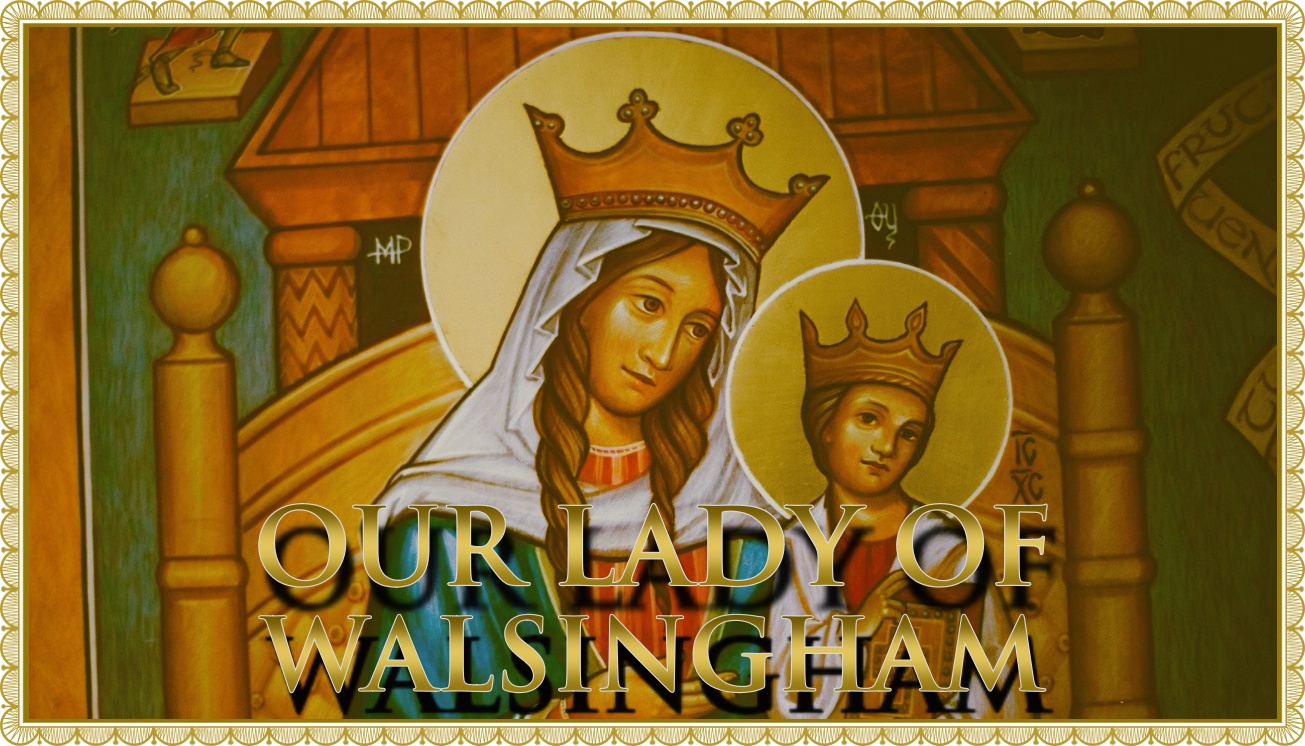
For English Catholics the feast acquired another history, and this is where Our Lady of Ransom and Our Lady of Walsingham must be carefully distinguished but cannot be entirely separated. They are not two names for the same feast. In the pre-1955 Roman calendar, 24 September is the Feast of Our Lady of Ransom, with its Mercedarian history, proper Collect and theology of liberation from captivity. Our Lady of Walsingham is a specifically English Marian title associated with the ancient shrine in Norfolk, the Holy House and the mystery of Nazareth. In the present proper calendar for England, however, 24 September is celebrated as the Feast of Our Lady of Walsingham.¹⁰ The coincidence of date is therefore immediately noticeable to anyone comparing the older and newer calendars, but the devotions are historically distinct.
What joins them is not merely the date but the extraordinary history of the English Guild of Our Lady of Ransom. Fr Philip Fletcher, formerly an Anglican curate in the Diocese of Chichester, was received into the Catholic Church in March 1878. A retreat at Roehampton ended on 24 September that year, and on discovering that it was the Feast of Our Lady of Ransom he wrote the resolution: “I dedicate all my work to Our Lady of Ransom.” After his Catholic ordination in 1882, his first curacy was in Brighton. He subsequently became parish priest at Uckfield, began a crusade of prayer for the conversion of England and, with the convert barrister Lister Drummond, founded the Guild of Our Lady of Ransom in 1887. Its objects were the conversion of England, the restoration of those who had lapsed from the Faith and prayer for those who had nobody to pray for them.⁸
The English Ransom movement then became directly involved in the Catholic recovery of Walsingham. The medieval shrine had been destroyed during the Reformation and pilgrimage had effectively ceased. In 1896 the surviving Slipper Chapel was purchased by Charlotte Pearson Boyd and restored. The following year Fr Fletcher assisted in establishing the Pontifical Shrine of Our Lady of Walsingham at King’s Lynn, while the Guild of Our Lady of Ransom organised the first public pilgrimage to Walsingham since the Reformation on 20 August 1897.⁹ ¹¹ What began as a devotion whose medieval imagery concerned captive Christians had therefore become one of the agencies by which English Catholics recovered the memory, pilgrimage and Marian landscape of their own country.
The connection did not end with that first pilgrimage. During the twentieth century the Guild maintained an intimate association with Walsingham. Monsignor Laurance Goulder gathered the petitions of Ransomers during the novena before the Feast of Our Lady of Ransom and carried them to Walsingham; in 1952 he established the walking pilgrimage from London to the shrine. Monsignor Anthony Stark later assisted the development of the Shrine itself. More recently the Guild supported the Dowry Tour, which carried the image of Our Lady of Walsingham to the cathedrals of England before the Rededication of England as the Dowry of Mary in 2020.⁸ The Guild’s own daily Ransomers’ Prayer now invokes both titles: Our Lady of Ransom and Our Lady of Walsingham.¹²
The relationship is therefore richer than a simple calendrical substitution. It would be historically false to collapse the two titles into one: Walsingham begins with the Holy House, Nazareth, pilgrimage and the ancient English shrine; Ransom begins with Nolasco, the Mercedarians and captive Christians. Yet in the modern English Catholic experience the two streams eventually meet. The Guild which took its name from Our Lady of Ransom became instrumental in restoring pilgrimage to Walsingham, while the present English calendar celebrates Our Lady of Walsingham on the very date on which the older Roman calendar celebrates Our Lady of Ransom. The convergence is historically fitting even where the origins remain distinct.
There is also a deeper theological affinity. Walsingham is the shrine of the Incarnation. Its Holy House recalls Nazareth, the Annunciation and the domestic life into which the Eternal Word entered when He became man. Ransom is the feast of Redemption, the liberation accomplished by the Son who took that humanity from Mary and offered Himself upon the Cross. Nazareth and Calvary are not rival mysteries. The humanity which could be scourged, nailed to the Cross and poured out in Blood was the humanity conceived at the Annunciation. Walsingham contemplates the house into which the Redeemer entered the world; Ransom contemplates the freedom His Incarnation made possible.
The conjunction of the two titles on 24 September in England can therefore be read without confusing their histories. At Walsingham Mary points to the Word made flesh: “Be it done to me according to thy word.” In the Ransom feast the Church asks through the same Mother’s intercession to be delivered “from all sins and from the captivity of the devil”. The first leads us into the Holy House; the second leads us towards the opened prison. Both finally lead to Christ.
For English Catholics, moreover, the connection with national conversion is not incidental. Fletcher did not adopt the title Our Lady of Ransom merely because he admired medieval religious history. He applied the idea of ransom to England itself: the recovery of those estranged from the Faith, the evangelisation of the country, the remembrance of its Catholic past and the restoration of places where that past had been violently interrupted. The first post-Reformation pilgrimage to Walsingham organised by the Guild was therefore almost a visible enactment of the Ransom ideal. A shrine taken from Catholic England was being restored to Catholic memory and prayer.
There is particular resonance in Fletcher’s Brighton connection. His dedication to Our Lady of Ransom was made four years before his ordination, and his first Catholic priestly appointment afterwards was here. From Brighton and then Uckfield the apostolate developed into a national Guild, and that Guild became involved in the restoration of Walsingham. The path from Ransom to Brighton, from Brighton to the conversion of England, and from the conversion of England to Walsingham is not an artificial local embellishment. It belongs to the documented history of the English devotion.
Its spiritual usefulness today nevertheless depends upon refusing to leave the feast safely in either medieval Spain or nineteenth-century England. The old Collect will not permit it. Having recalled Christians delivered from external captivity, the priest asks to be delivered himself from sin and the captivity of the devil. The chains become personal. The examination suggested by the feast is therefore not principally whether society is captive, whether the age is decadent, or whether other people have compromised with evil, but what has acquired mastery within one’s own soul.
Catholic asceticism has always understood that liberation from such mastery ordinarily requires something more substantial than good intentions. The chains of habitual sin are broken through grace received and cooperated with: honest examination of conscience, contrition, sacramental Confession, restitution where justice demands it, avoidance of occasions of sin, prayer, fasting, mortification and persevering reception of the Sacraments. These disciplines appear restrictive only if freedom is defined as the unrestricted ability to indulge every inclination. Under the Christian definition they are instruments by which the will recovers its proper government of the passions and is itself reordered towards God.
The Mercedarian story also corrects any spirituality which becomes so interior that the bodily suffering of one’s neighbour ceases to matter. The Order existed because actual prisoners needed actual liberation. Christian charity did not answer the captive by observing that spiritual freedom was ultimately more important. It gathered money, crossed seas, negotiated releases and accepted danger. Yet neither did the Mercedarian reduce salvation to the improvement of earthly conditions. The captive was rescued as a man made in the image of God and, in the particular circumstances which called forth the Order, as a Christian whose perseverance in the Faith might be imperilled.
The corporal and spiritual works of mercy meet here without confusion. Feed the hungry because hunger is real; instruct the ignorant because truth is real. Visit the prisoner because imprisonment is an evil; call the sinner to conversion because eternal life is greater than temporal liberty. Catholic charity can hold those goods together because the Incarnation forbids contempt for the body while redemption forbids us to imagine that bodily welfare exhausts the purpose for which man was made.
This is also why Our Lady of Ransom remains a profoundly Christocentric Marian feast, just as authentic devotion to Our Lady of Walsingham is inseparable from the mystery of the Word made flesh. Every liturgical road leads back to Mary’s Son. The Ransom Introit honours her because she bore the King. Its Gospel reveals the obedient faith with which she received God’s word. Its Preface praises the eternal Light whom she brought forth. Its Collect asks her intercession for deliverance from a captivity which Christ alone can conquer. Walsingham, meanwhile, sets before England the Holy House and the mystery from which all of this begins. Authentic Marian devotion does not stop at Mary; it learns from her to receive, obey, follow and belong to Jesus Christ.
The medieval prisoner could hear the key turn in the door and know that someone else had paid what he could not pay. The feast retains that image because it describes with extraordinary force the condition of redeemed man. We did not redeem ourselves. We did not manufacture the grace which frees us. The price was not silver or gold, and it was not paid to an equal claimant bargaining with God. The Son offered Himself, and the liberty recovered through His Passion is the liberty for which man was created: not emancipation from God, but release from everything which prevents us from belonging wholly to Him.
On 24 September, therefore, the traditional Roman rite remembers Peter Nolasco and the ransomers, real captives and real chains, the white Mercedarian habit and the dangerous journeys undertaken in works of mercy. In England the date now also calls to mind Walsingham, Nazareth and the Holy House, while the history of the Guild of Our Lady of Ransom joins those otherwise distinct devotions through the work of conversion and the restoration of Catholic pilgrimage. The older Collect still supplies the final examination. The captivity from which each Christian most urgently needs deliverance is the sin he has tolerated, the passion he has ceased to resist, the attachment he has allowed to govern him or the compromise he has renamed necessity. Our Lady of Ransom directs the captive towards her Divine Son, while Our Lady of Walsingham recalls the mystery by which that Son entered our world. The Incarnation makes the Redemption possible; the Redemption breaks the chains. Thus England can fittingly invoke both titles without confusing them: Beata Maria Virgo de Mercede, ora pro nobis. Domina Nostra de Walsingham, ora pro nobis.
¹ 24 September: Our Lady of Ransom — Traditional Mass Propers
² Catholic Encyclopedia — Feast of Our Lady of Ransom
³ Order of the Blessed Virgin Mary of Mercy — Our History
⁴ Order of the Blessed Virgin Mary of Mercy — St Serapion
⁵ St Thomas Aquinas, Summa Theologiae, III, q.48 — The Efficiency of Christ’s Passion
⁶ St Irenaeus, Against Heresies, III.22 — Mary and Eve
⁷ St Thomas Aquinas, Summa Theologiae, III, q.30 — The Annunciation of the Blessed Virgin
⁸ The Guild of Our Lady of Ransom — History
⁹ The Guild of Our Lady of Ransom — Fr Philip Fletcher and Lister Drummond
¹⁰ Liturgy Office of England and Wales — 24 September: Our Lady of Walsingham
¹¹ Catholic National Shrine of Our Lady at Walsingham — Our Story
¹² The Guild of Our Lady of Ransom — The Ransomers’ Prayer




Leave a Reply