
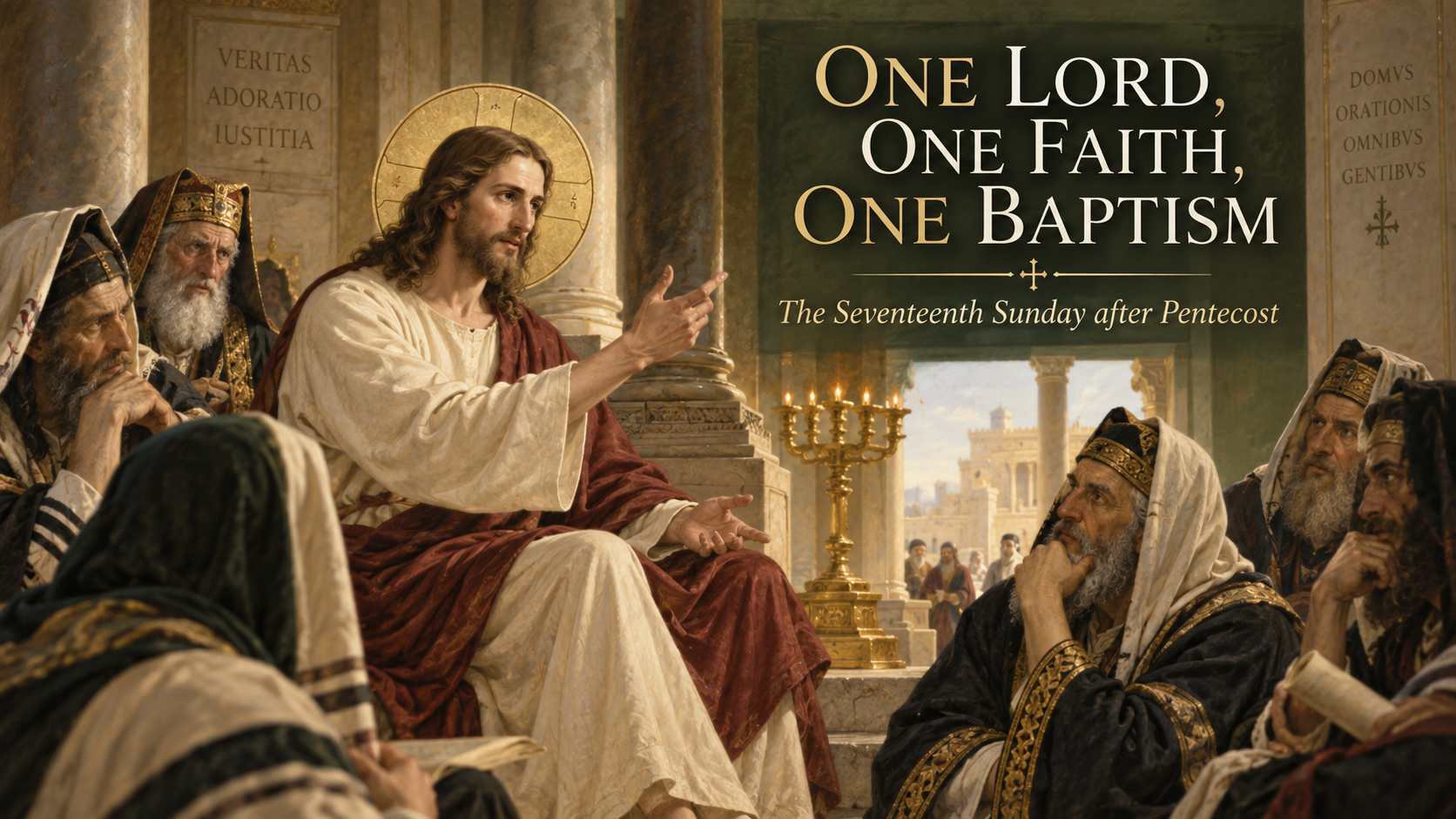
The Seventeenth Sunday after Pentecost is remembered chiefly for Our Lord’s declaration of the two great commandments: the love of God and the love of neighbour. Yet the Roman Mass refuses to reduce charity to sentiment. It begins with the justice of God, asks protection from the contagion of the devil, proclaims one Lord, one faith and one Baptism, and brings the Gospel to the decisive question: “What think you of Christ?” Divine charity, ecclesial unity, purity of faith and the divinity of Christ belong to a single theological movement.
The Seventeenth Sunday after Pentecost belongs to that mature part of the Roman year in which the mysteries celebrated from Advent to Pentecost are being worked out in the Christian soul. The Incarnation has been celebrated, Calvary and Easter have passed before us, the Holy Ghost has descended, and the Church now teaches what the life of grace must become. The Mass Justus es is unusually concentrated. Man must acknowledge the justice of God, escape the contagion of evil, preserve the unity of the Faith, learn the proper order of charity, confess Christ for who He is, and permit sacramental grace to heal what sin has disordered.
Nuntiatoria previously treated this Sunday principally through the theme of unity in charity and truth, drawing attention to St Paul’s insistence upon the virtues required to preserve the bond of peace.¹ The present study broadens that perspective by following the whole architecture of the Mass. The Pauline confession of “one Lord, one faith, one Baptism” cannot finally be separated from the Gospel’s command to love God above all things, nor can that commandment be separated from the question with which Christ Himself concludes the controversy: “What think you of Christ?”
There is also an historical continuity with the preceding Sunday. As noted in our treatment of the Sixteenth Sunday after Pentecost, the Gospel of the man with dropsy and the wedding feast did not always occupy its present position.² Dom Prosper Guéranger explains the corresponding development here: the Gospel now assigned to the Seventeenth Sunday became associated with it when the dropsy Gospel was anticipated by eight days. Before that change, another passage had been read here concerning the Sadducees’ difficulty about the resurrection of the dead.³ The familiar description of this day as the “Sunday of the Love of God” therefore belongs to the mature Roman arrangement of the post-Pentecost cycle rather than to an absolutely fixed primitive sequence.
This does not imply that the Mass itself is a late construction. The Roman Rite grew by the reception, preservation and gradual ordering of ancient prayers, lessons and chants rather than by appearing as a completely assembled book at one moment. The final arrangement of the Sundays may have developed while the individual elements were already venerable. Medieval manuscript evidence witnesses the proper chants of the Seventeenth Sunday centuries before the age of printed Missals, and the received Roman formulary eventually brought those elements into a theological coherence which generations of Catholics knew simply as Dominica XVII post Pentecosten.³
“Justus es, Domine”
The Mass opens with the words of Psalm 118: Justus es, Domine, et rectum judicium tuum: fac cum servo tuo secundum misericordiam tuam — “Thou art just, O Lord, and Thy judgement is right: deal with Thy servant according to Thy mercy.” The accompanying verse declares blessed those who are undefiled in the way and walk in the law of the Lord.⁴ Before the liturgy speaks of love, therefore, it speaks of judgement; before man asks to be consoled, he acknowledges that God is right.
That order is fundamental. Fallen man is constantly tempted to reverse the tribunal, judging Revelation by contemporary opinion, divine law by human appetite, and Providence by whether events have conformed to his wishes. The Introit restores the proper relation between Creator and creature. God is not awaiting our verdict upon His justice. The Christian begins by confessing Justus es, Domine and recognises that whatever requires correction must first be sought in himself.
Yet the same sentence which acknowledges justice immediately appeals to mercy. The Church does not imagine that God must become less just in order to become merciful. She confesses the rectitude of His judgement and then asks Him to deal mercifully with His servant. Mercy has meaning because sin is real; forgiveness is glorious because guilt is not imaginary. A theology which can preserve mercy only by weakening judgement will eventually empty mercy itself of content.
The Introit therefore protects the Gospel from sentimental reduction. When Christ commands man to love God with his whole heart, He does not mean affection for a deity fashioned according to human preference. He speaks of the God whose judgement is right. Supernatural charity begins when the creature ceases making his own approval the condition upon which the Creator may be obeyed.
The Contagion of the Devil
The Collect is one of the most forceful prayers of the post-Pentecost season: Da, quaesumus, Domine, populo tuo diabolica vitare contagia: et te solum Deum pura mente sectari — “Grant, we beseech Thee, O Lord, to Thy people to avoid the contagions of the devil, and with a pure mind to follow Thee, the only God.”⁴ The noun contagia deserves attention because it says rather more than “temptations”. It carries the sense of contamination, something communicated by contact and capable of spreading.
The old prayer therefore possesses a striking understanding of the social character of evil. Sin remains personal and culpability individual, but men do not learn either virtue or vice in isolation. False doctrine passes from mind to mind; vice can become custom; custom may become convention; convention can eventually present itself as morality. Language, companionship, example, fashion and institutions all teach men what they are expected to consider normal long before they formulate a conscious moral theory.
The Church consequently asks not simply for strength against isolated temptations but for a pura mens, a purified mind. Purity here is larger than one particular virtue. It describes an integrity of intellect and will which permits reality to be seen without the distortion produced by disordered appetite. The final words of the prayer make its direction absolute: te solum Deum, Thee alone, God. Before the Gospel has uttered the first commandment, the Collect has already asked for the interior condition necessary to obey it.
The mystical tradition recognises the same problem from within the soul. The divided heart cannot give itself wholly to God because its loves pull in contrary directions. Christian asceticism is therefore not chiefly an exercise in deprivation but an education in order. Created goods remain good, but they cease to be good for us when they are required to occupy the place belonging to the Creator.
One Body and One Spirit
The Epistle is Ephesians 4:1–6. St Paul writes as “a prisoner in the Lord” and beseeches Christians to walk worthily of their vocation “with all humility and mildness, with patience, supporting one another in charity, careful to keep the unity of the Spirit in the bond of peace”. Then comes one of the most compressed statements of ecclesial unity in the New Testament: “One body and one spirit, as you are called in one hope of your calling. One Lord, one faith, one baptism. One God and Father of all.”
St Thomas Aquinas understands the passage explicitly as an exhortation to preserve the unity of the Church. The unity is not created by Christians agreeing among themselves; it precedes their individual preferences because it is received from God. Aquinas compares the Church to a city which, if it is to remain one, requires a common ruler, a common law, common signs of belonging and a common end. The Church has one ruler, Christ; one law of faith; one sacramental incorporation through Baptism; and one final end in God.⁵
The moral dispositions named by St Paul are therefore not substitutes for doctrinal unity. Humility, meekness, patience and charity are the virtues by which received unity is guarded. Paul does not oppose “one faith” to “the bond of peace”, as though doctrine threatened charity. He places both within the same description of the Church because the peace he desires is not a truce between incompatible truths but communion in Christ.
This distinction is easily lost when agreement itself is treated as the measure of unity. Agreement can exist around an error, just as disagreement can arise because someone refuses to surrender a truth. The Church’s unity is supernatural because its source is not collective preference. Christians do not construct Revelation by consensus and then call the result communion; they receive the Faith and are summoned to remain within it.
The earlier Nuntiatoria treatment of the Sunday rightly emphasised the patristic concern with humility, concord and the danger of schism.¹ The present Mass makes clear why the issue is larger than ecclesiastical peacekeeping. The Collect has already prayed against a diabolical contagion which divides man from God; the Epistle shows what that division threatens within the Mystical Body. Peace is not merely the absence of quarrelling but the tranquillity which belongs to members rightly ordered within one Body under one Lord.
The Greatest Commandment
The Gospel, Matthew 22:34–46, begins with another confrontation. The Pharisees have heard that Christ has silenced the Sadducees, and a doctor of the law asks Him which commandment is greatest. St John Chrysostom sees the irony immediately: men acting from envy question Christ about love.⁶ Their words concern the highest commandment while the moral disposition behind the question contradicts the very answer they are about to receive.
Our Lord nevertheless answers plainly: “Thou shalt love the Lord thy God with thy whole heart, and with thy whole soul, and with thy whole mind. This is the greatest and the first commandment. And the second is like to this: Thou shalt love thy neighbour as thyself. On these two commandments dependeth the whole law and the prophets.” The first citation is drawn from Deuteronomy 6:5, the second from Leviticus 19:18.
Christ is not replacing the Law with an easier religion of amiable feeling. He reveals its interior order. Every true moral obligation ultimately concerns the right ordering of man towards God or towards creatures beneath God. The first commandment must therefore remain first. Love of neighbour cannot become an alternative to love of God, nor can love of God be reduced to a religious motive attached to an independent humanitarian ethic.
St Augustine states the principle with remarkable exactness in De Doctrina Christiana. God is to be loved for His own sake; neighbour and self are loved in relation to God. A rightly ordered man neither loves what ought not to be loved, nor loves more what should be loved less, nor loves less what should be loved more.⁷ Charity therefore requires judgement because love itself has an order.
The neighbour’s highest good cannot simply be whatever he presently desires. His bodily welfare matters, his temporal circumstances matter, justice towards him matters, and ordinary human kindness matters; but the final good of a creature made for God is God Himself. A love which assists another person to separate himself from his supernatural end cannot acquire the character of charity merely by adopting a compassionate tone.
Nor does “as thyself” require indiscriminate self-approval. A Christian does not rightly love himself by consenting to every impulse. He loves himself by seeking the true good of his nature and, above all, the supernatural good for which he was created. The neighbour must be loved according to the same rule, with the patience and tenderness which charity demands but also with the seriousness appropriate to an immortal soul.
The Order of Charity
St Thomas develops this patristic doctrine in his treatment of the ordo caritatis. Charity is one virtue because its ultimate object is God, yet it extends to neighbour because the neighbour is capable of sharing in the same beatitude. There must therefore be an order within charity because goods themselves stand in an order.⁸ God is loved above all, the supernatural good of the soul surpasses merely bodily advantage, and human relationships create real obligations which universal charity does not erase.
This prevents Christian charity from becoming an abstraction. A father has particular duties towards his children which he does not possess in the same form towards every child in the world; a priest bears responsibilities towards souls entrusted to his care; friendship, kinship, office and vocation create genuine claims. Universal love does not abolish proximity. It enables particular duties to be understood within a larger order whose final reference is God.
The same principle explains why charity may require correction. Love cannot be measured merely by the avoidance of discomfort. A physician can cause pain while treating a wound; a father may forbid what his child passionately desires because the desired thing is harmful. Christian love sometimes has to contradict because acquiescence can serve a lesser good at the expense of a greater one.
Augustine’s formulation is especially valuable here because it exposes the error beneath much modern talk about “love”. The question is never merely whether one loves, but whether one loves rightly. Human beings are almost always loving something; the moral question concerns the object, measure and order of that love. Holiness is not the destruction of affection but its conversion.
“With Thy Whole Heart”
The command to love God with the whole heart is easy to repeat and difficult to hear. It admits no rival absolute. St Thomas distinguishes the perfection of charity possible in this life from its consummation in heaven. The blessed are wholly and continually absorbed in God; the Christian on earth cannot maintain such uninterrupted actual attention, but his heart may belong habitually to God so that he refuses deliberate consent to whatever contradicts divine charity.⁹
“Whole” therefore means something deeper than emotional intensity. Memory, understanding, will, possessions, ambitions, friendships, sufferings and hopes must progressively acquire a common direction. Christian perfection is not the growth of an unusually intense religious compartment alongside the rest of life. It is the integration of the whole person under the sovereignty of God.
This is why the spiritual writers insist upon detachment. Detachment does not mean that created things are worthless. Family, friendship, country, beauty, learning, craftsmanship and legitimate material goods can all be loved deeply. The problem begins when a finite good is required to supply what only the infinite Good can provide.
The commandment therefore liberates human affection rather than extinguishing it. Created things are loved more truly when they cease to be treated as gods. To possess a whole heart does not mean to possess a heart emptied of natural love, but one in which every natural love has found its proper place.
“What Think You of Christ?”
The traditional Gospel does not end with the two commandments, and that is decisive for the theology of the Sunday. Having answered the lawyer, Our Lord turns to the Pharisees and asks: “What think you of Christ? whose son is he?” They answer, “David’s.”
Christ then invokes Psalm 109: “The Lord said to my Lord: Sit on my right hand, until I make thy enemies thy footstool.” If David, speaking in the Spirit, calls the Messias “Lord”, how can He be merely David’s son? St John Chrysostom is careful to note that Christ is not denying His descent from David. The inadequacy lies in the Pharisees’ reduction of the Messias to a merely human descendant: He is David’s son, but He is also David’s Lord.⁶
The Church would later express with conciliar and scholastic precision what the Gospel contains in concentrated form: the one Christ is truly man and truly God. The placement of the exchange immediately after the commandments consequently prevents the Sunday from becoming a moral essay about kindness. Christianity does not consist of retaining the ethical teaching of Jesus while allowing His Person to become optional.
The Teacher who commands the love of God is Himself the eternal Son. “What think you of Christ?” therefore belongs to the doctrine of charity itself. If Christ is only an admirable rabbi, philosopher or moral reformer, His teaching can be selected, adapted and placed alongside other ethical traditions. If He is David’s Lord, the speaker possesses divine authority and is Himself embraced within the worship and love owed to God.
This is why a purely humanitarian Christianity must eventually become something other than Christianity. Christ cannot indefinitely be retained as the symbol of compassion while His claims upon faith, worship and obedience are set aside. The Pharisees could already say that the Messias would be David’s son; what they could not confess was that David’s son standing before them was also Lord.
The Gradual and the Chosen People
The Gradual takes up Psalm 32: “Blessed is the nation whose God is the Lord: the people whom He hath chosen for His inheritance.” It continues: “By the word of the Lord the heavens were established; and all the power of them by the spirit of his mouth.”⁴ Coming after the Epistle’s confession of one Body and one Spirit, the chant widens the vision from the individual Christian to a people constituted by belonging to God.
The verse concerning creation also prepares the Christological conclusion of the Gospel. The heavens themselves were established by the divine Word. The Christ who asks the Pharisees to explain David’s “Lord” is not simply one religious teacher situated within creation. Christian faith confesses Him as the eternal Word through whom creation itself exists.
The Alleluia, from Psalm 101, turns immediately from cosmic confession to personal supplication: “O Lord, hear my prayer, and let my cry come to Thee.”⁴ The certainty of faith does not make prayer redundant. Precisely because the Church knows who God is, she knows to whom she cries.
Daniel at the Offertory
The Offertory Oravi Deum meum turns to the prayer of Daniel in Daniel 9. Daniel begs God to hear His servant, to cause His face to shine upon the sanctuary, and to look mercifully upon the people over whom His name has been invoked.⁴ The chant is an especially fitting answer to the themes already heard in the Epistle and Gospel.
Daniel prays amid the consequences of Israel’s infidelity. He neither denies the sins which have brought desolation nor turns against the sanctuary because of them. He acknowledges divine justice, confesses guilt and pleads for restoration. His prayer therefore repeats in another key the movement of the Introit: God is just, yet His servant appeals to mercy.
There is an enduring ecclesial lesson here. Love of the Church is not shown by pretending that disorder cannot exist among her members, nor does recognition of disorder permit contempt for the Church herself. Daniel can grieve over devastation, confess the sins of his people and still pray that God’s face may shine upon the sanctuary.
Placed after the Pauline exhortation to preserve unity, the Offertory reminds us that genuine unity has enough confidence in truth to acknowledge what requires healing. Daniel does not seek merely the appearance of an undamaged Jerusalem. He desires Jerusalem restored beneath the face of God.
Sacrifice and Perseverance
The Secret asks that the sacred mysteries free the faithful from past offences and preserve them against future dangers.⁴ The prayer looks in both directions. Grace pardons what has been committed, but Christian life cannot end with pardon for yesterday. The soul requires strength for tomorrow.
The relationship with the Collect is particularly suggestive. At the beginning of Mass the Church asked to escape diabolical contagion; at the altar she asks for protection against renewed sin. Forgiveness and perseverance belong together. The man who has received mercy is not returned to moral neutrality but called to guard the grace which has restored him.
Catholic sacramental life therefore contains no warrant for treating absolution as the clearing of an account after which nothing need change. A person forgiven has more reason, not less, to avoid whatever drew him into sin. Communion with God increases the seriousness of fidelity because the Gift received is greater.
“Vovete et reddite”
The Communion antiphon comes from Psalm 75: Vovete et reddite Domino Deo vestro — “Vow ye, and pay to the Lord your God.”⁴ Its position after the reception of Holy Communion gives the words their full force. God has given Himself; the communicant must answer the Gift with fidelity.
The Christian does not surrender himself in order to persuade God to love him. The whole sacramental order says the opposite. God acts first: He calls, forgives, feeds and sanctifies. The response of the believer is therefore not a purchase price but the proper answer of charity to grace.
Baptismal promises, marriage vows, religious profession, priestly obligations, acts of consecration and resolutions made after confession all contain something of this movement. Grace received demands a life corresponding to it. Holy intentions are not meaningless, but the Psalm refuses to let intention become a substitute for fulfilment.
The commandment of the Gospel has therefore reached the altar. To love God with the whole heart eventually means that nothing in the self may be reserved as an autonomous territory into which God has no claim. The Eucharist makes that surrender possible because the Christian is not asked to give himself to a God who has remained distant. He answers the God who has first given Himself.
Contagion and Medicine
The Postcommunion asks that the operation of the heavenly gift govern the faithful, heal their vices and supply eternal remedies.⁴ The Mass which began by speaking of contagion ends by asking for medicine. The correspondence is more than literary elegance; it expresses the Catholic understanding of salvation.
Sin involves guilt, but it also wounds and disorders. The will acquires habits, appetite becomes trained towards false goods, and the intellect learns to rationalise what the will prefers. Man consequently needs more than the cancellation of a debt. He needs healing.
Sanctifying grace does not merely alter God’s attitude towards an otherwise unchanged sinner. It establishes supernatural life within the soul, while sacramental grace strengthens and repairs. The Catholic doctrine of salvation is therefore more ambitious than acquittal. God intends sanctification.
The old Collect’s medical realism should not be missed. Contagion penetrates, but grace penetrates more deeply. The very faculties disordered by sin can be restored to order until the divided heart is being made capable of loving God more wholly.
St Alphonsus: The One Necessary Love
St Alphonsus Liguori chose this Sunday for his sermon On the Love of God. His argument is characteristically direct: only one thing is finally necessary, to love God. Wealth, honour, position and reputation end with this world; charity alone reaches its object beyond death.¹⁰ Yet Alphonsus does not leave the commandment at the level of exhortation.
The love of God is cultivated through concrete spiritual means: meditation upon the divine goodness, remembrance of Christ’s Passion, prayer, detachment from deliberate sin and sacramental union with Our Lord. The heart learns to love by attending to the One who is loved. Christian spirituality therefore takes seriously both the infused nature of charity and the human habits which dispose the soul to act under grace.
This rescues the Gospel from two opposite misunderstandings. Divine charity is not merely a feeling which appears spontaneously when a religious temperament is sufficiently moved, but neither is it a cold obedience in which the heart remains irrelevant. Grace perfects the will so that man may increasingly desire the God whom he knows and serves.
St Francis de Sales: Affective and Effective Love
St Francis de Sales distinguishes between affective and effective love. By affective love the soul delights in God, desires Him and rests in His goodness; by effective love it obeys His will, performs what He commands and accepts what His Providence permits.¹¹ The two belong together because genuine charity cannot remain merely inward while external obedience without love falls short of the friendship God desires.
This distinction illuminates the Gospel’s demand for the whole heart. Feeling cannot substitute for fidelity, yet fidelity is meant to proceed from charity rather than mere compulsion. The Christian is not simply ordered to perform the duties of religion while his deepest loves remain elsewhere. God asks that the heart itself be converted.
St Francis goes further when he describes God as jealous for the human heart. He is careful to distinguish divine jealousy from human insecurity. God gains nothing from our love as though He lacked something without it; He desires our whole heart because the heart is ruined when it gives itself finally to a lesser good.¹² Divine jealousy is therefore an expression of mercy. God refuses to share the throne of the soul with an idol because the idol cannot save the soul which serves it.
The mystical tradition thus returns us to the Collect’s te solum Deum. God alone is God. Created loves need not be despised, but every one of them must eventually be purified of the demand to become ultimate.
The Traditional Character of the Sunday
The Seventeenth Sunday possesses no universal procession, blessing or popular ceremony comparable with Candlemas, Palm Sunday, the Rogations or Corpus Christi. Its traditional character is overwhelmingly contained within the Mass and Office. The absence of a distinctive external observance does not make the day liturgically poor; rather, its riches lie in the prayers, lessons and Gregorian Propers themselves.
When the Sunday is celebrated in its own right the colour is green, expressing the mature life of grace during the long season after Pentecost. The Gloria and Creed belong to the Sunday Mass, and the traditional Roman Sunday uses the Preface of the Most Holy Trinity.⁴ That Preface is especially apt beside an Epistle which insists upon divine and ecclesial unity and a Gospel which forces the hearer to recognise that David’s son is also David’s Lord.
The absence of a popular custom is almost fitting. The drama of the Sunday is primarily interior. The question is whether the heart remains divided; whether the neighbour is loved according to God or instead of God; whether ecclesial peace is grounded in one Faith or merely in avoidance of disagreement; whether Christ is admired from a safe distance or confessed as Lord.
The Architecture of the Mass
Read as a whole, the Sunday possesses an unusually clear spiritual movement. Man first confesses that God is just and asks for mercy. He then asks to be preserved from the contagion which corrupts his allegiance. St Paul shows the supernatural unity into which Baptism has called him, while the Gospel reveals the hierarchy of love which must govern his heart and concludes by confronting him with the identity of Christ.
The Offertory places him beside Daniel, praying for the sanctuary and people of God. The Secret asks that past sin be cleansed and future sin resisted. Communion demands fidelity to what has been promised, while the final prayer asks that grace enter deeply enough to heal the vices which prevent the whole heart from belonging to God.
The texts consequently describe one process of conversion rather than a sequence of unrelated subjects. False love divides; charity establishes order. Sin wounds communion; grace restores it. Error fragments the mind; one Faith gathers the intellect around revealed truth. Pride places man above the judgement of God; the Introit returns him to the position of a servant asking mercy.
Christ stands at the centre because only in Him can these movements reach their supernatural end. The love of God commanded by the Gospel is not an abstraction, for the eternal Son has entered human history. Ecclesial unity is not an institutional convenience, for the Church is His Body. The medicine of grace is not religious psychology, for it proceeds from His Sacrifice and is communicated through His sacraments.
“What Think You of Christ?”
The Seventeenth Sunday after Pentecost cannot finally be reduced even to the magnificent commandment from which it has taken its traditional title. The Gospel itself will not stop there. The command to love God leads directly to the question of Christ because the God whom Christians love has made Himself known in His Son.
This is why truth and charity cannot be separated without injuring both. If God is the supreme Good, truth about God must matter to love. If the neighbour is destined for God, love of neighbour must desire his genuine supernatural good. If the Church is one Body, the unity of that Body cannot be indifferent to the one Faith by which St Paul describes it.
The Mass asks for something far greater than respectable behaviour. The intellect must believe, the will must love, the passions must be ordered, the neighbour must be loved rightly, ecclesial unity must be preserved, promises must be fulfilled and wounds must be healed. Yet the whole structure of the liturgy prevents this from becoming Pelagian moralism, because man begins not with achievement but with supplication. He asks mercy, receives the Word, approaches the Sacrifice and receives the heavenly Gift before he is summoned to render himself in return.
The first and decisive initiative therefore remains with God, but grace does not abolish the answer of the creature. It makes that answer possible. The Seventeenth Sunday presents the Christian life as a love received and returned, a unity given and guarded, a wound healed and a heart progressively reclaimed for the One who alone may possess it absolutely.
The Roman Mass thus begins with Justus es, Domine — “Thou art just, O Lord”; passes through Unus Dominus, una fides, unum baptisma — “One Lord, one faith, one Baptism”; and reaches Diliges Dominum Deum tuum ex toto corde tuo — “Thou shalt love the Lord thy God with thy whole heart.” Christ then turns upon His hearers with the question which prevents all of those truths becoming abstractions: “What think you of Christ?” The answer determines what we mean by faith, what we mean by unity, and ultimately what we mean by love.
¹ Nuntiatoria, The Seventeenth Sunday after Pentecost: Unity in Charity and Truth.
² Nuntiatoria, Grace Before Us, Christ Within Us: The Sixteenth Sunday after Pentecost.
³ Dom Prosper Guéranger OSB, The Liturgical Year, “Seventeenth Sunday after Pentecost”.
⁴ Missale Romanum, Dominica XVII post Pentecosten, Missale Romanum — Classical Form.
⁵ St Thomas Aquinas, Super Epistolam B. Pauli ad Ephesios lectura, cap. IV, Corpus Thomisticum.
⁶ St John Chrysostom, Homily LXXI on the Gospel according to St Matthew.
⁷ St Augustine, De Doctrina Christiana, I, 22–29, On Christian Doctrine, Book I.
⁸ St Thomas Aquinas, Summa Theologiae, II–II, q.26, The Order of Charity.
⁹ St Thomas Aquinas, Summa Theologiae, II–II, q.44, The Precepts of Charity.
¹⁰ St Alphonsus Maria de Liguori, Sermons for All the Sundays in the Year, Sermon XLVI, Seventeenth Sunday after Pentecost: On the Love of God.
¹¹ St Francis de Sales, Treatise on the Love of God, VI, 1, “Affective and Effective Love”.
¹² St Francis de Sales, Treatise on the Love of God, X, 13, “How God Is Jealous of Us”.





Leave a Reply