

The Knowledge That Became Charity
MASS Miserátio hóminis
LESSON James 2:12–17;
GOSPEL St Luke 12:35–40
HOMILIST Mt Revd Jerome Lloyd OSJV

Beloved in Christ,
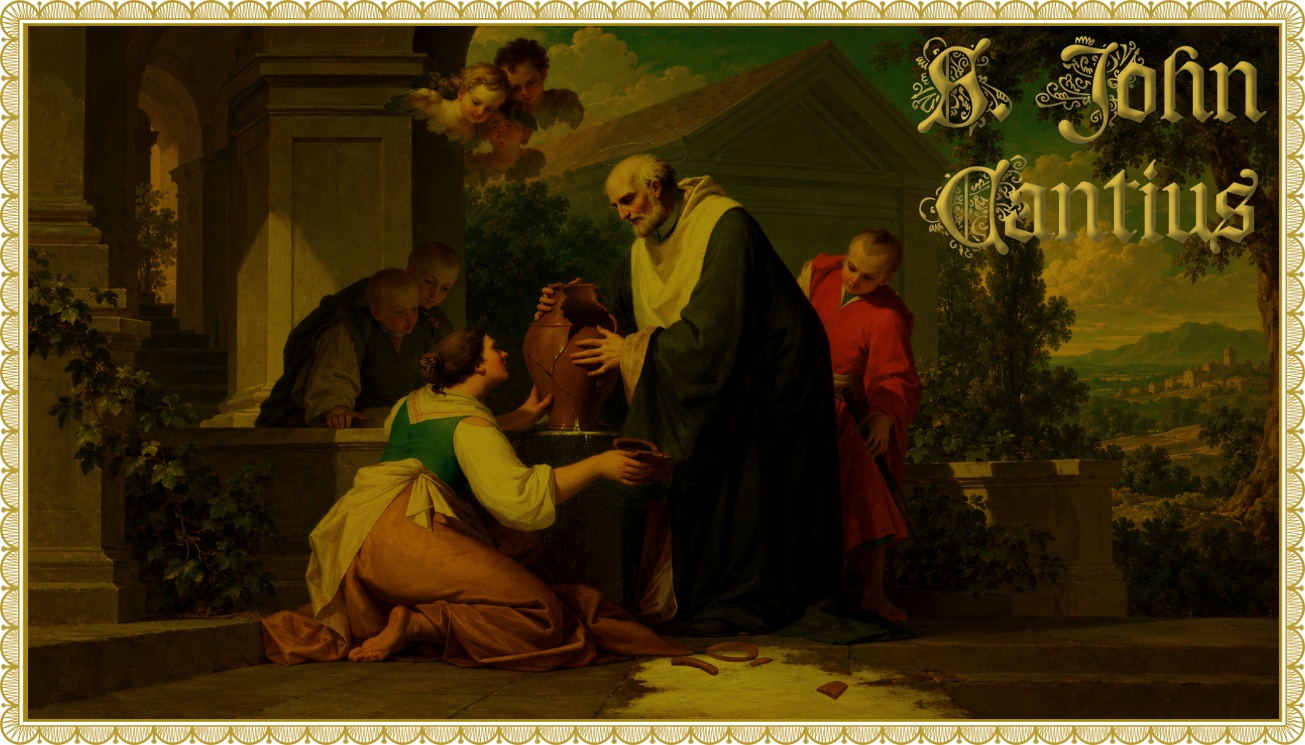
According to the account preserved in his bull of canonisation, St John of Kenty was once walking along a road when he encountered a poor man without shoes. He immediately removed his own and gave them to the stranger, concealing his bare feet beneath his cloak as he continued home. There was nothing theatrical about this act. John was a distinguished professor of theology at the University of Kraków, accustomed to lecturing upon the most profound mysteries of the Catholic faith. Yet when confronted by a man whose immediate need was perfectly obvious, he recognised that the demands of charity took precedence over his own comfort. The incident tells us a great deal about the kind of knowledge which makes a man a saint.
John Cantius, as he is also known, was born at Kęty in southern Poland, traditionally dated to 1390. In 1413 he entered the University of Kraków, obtaining his degree in philosophy in 1418. During the 1420s he taught at the school of the Canons Regular of the Holy Sepulchre at Miechów, returning to Kraków in 1429 to continue his academic career. He subsequently studied and taught theology and Sacred Scripture, acquiring a reputation for considerable learning. For a period he served as parish priest at Olkusz, although the responsibility of answering to God for the souls entrusted to him weighed so heavily upon his conscience that he eventually returned to teaching.
John lived during an age of considerable religious controversy. The Western Schism had divided Christendom from 1378 until 1417, and disputes concerning doctrine and ecclesiastical authority continued to disturb the Church. He understood the necessity of sound Catholic teaching and was an uncompromising defender of orthodoxy. Yet his contemporaries remembered him especially for his humility, gentleness and generosity. He supported poor students, visited those in distress, gave away his possessions and practised considerable personal austerity. He made pilgrimages to Rome and Jerusalem, and devoted long hours to prayer before the Blessed Sacrament. Here was a man whose theological convictions governed the whole of his existence.
Today’s Mass begins with the words Miserátio hóminis, taken from Ecclesiasticus: “The compassion of man is toward his neighbour: but the mercy of God is upon all flesh.” (Ecclesiasticus 18:12.) The Introit continues by describing the merciful man as one who teaches and corrects, as a shepherd guides his flock. This is important, because Christian mercy is concerned with the eternal welfare of the person loved. It certainly embraces the corporal works of mercy, feeding the hungry, clothing the naked and visiting the sick. But it also requires the spiritual works of mercy: instructing the ignorant, counselling the doubtful, correcting the sinner and comforting the afflicted. To love one’s neighbour is to desire his salvation, and therefore to desire that he should know, love and serve Almighty God.
The Collect asks that, following the example of St John, we may advance in scientia Sanctorum, in the knowledge of the saints, and obtain God’s forgiveness by showing mercy to others. There is a distinction here which every Catholic ought to understand. We may acquire considerable knowledge of religion without advancing very far in holiness. We may know the commandments without keeping them faithfully, understand the necessity of forgiveness whilst cherishing resentment, or speak eloquently about charity whilst remaining indifferent to those who need our help. The knowledge of the saints is different. It is truth received into the soul and made fruitful through grace. It changes not merely what a man thinks, but what he loves, what he chooses and how he lives.
St James makes precisely this point in today’s Epistle: “So faith also, if it have not works, is dead in itself.” (James 2:17.) He describes a brother or sister lacking clothing and daily food, to whom someone offers kind words but no practical assistance. What advantage is there in such sympathy? St James does not suggest that good works can replace faith. Rather, he insists that living faith must bear fruit. St Thomas Aquinas teaches that charity is the form of faith, perfecting it by ordering the believer towards God as his final end. The Catholic religion cannot be reduced either to correct beliefs without corresponding conduct or to benevolent activity divorced from revealed truth. Supernatural charity presupposes God’s grace, and it is by that grace that faith becomes fruitful in holiness.
When Pope Clement XIII canonised John on 16 July 1767, he began his decree with an observation which deserves particular attention today. Those charged with defending and teaching Catholic doctrine, he explained, must recommend that doctrine through the integrity and holiness of their lives. He recalled the Israelites rebuilding the walls of Jerusalem, labouring with one hand whilst holding a sword in the other. There is an unmistakable lesson here for Catholics committed to the preservation and restoration of Tradition. The defence of the ancient Roman liturgy, the integrity of Catholic doctrine and the sacred character of the priesthood is a necessary work. Yet those who undertake it must themselves become living witnesses to the truths they defend. Otherwise, they risk knowing the remedies for the Church’s afflictions without applying those same remedies to their own souls.
Consider how easily this contradiction can arise. We may be meticulous about liturgical rubrics whilst neglecting our daily prayers. We may deplore the widespread abandonment of Catholic moral teaching whilst showing insufficient patience with our own families. We may spend considerable time discussing the failures of ecclesiastical authority, yet fail to notice an elderly parishioner living in isolation, a family struggling financially, or a young person who needs someone to explain the faith. None of these obligations diminishes the importance of defending Tradition. They are among the very fruits which fidelity to Tradition ought to produce. The sacred liturgy forms us for the worship of God, and that worship must extend its influence into every part of our lives.
John himself understood that charity also governs the manner in which truth is communicated. One of the counsels associated with him warned against causing needless disturbance and against speaking ill of others, since an injury to another’s reputation cannot easily be repaired. Such advice is especially pertinent in an age when controversy is instantaneous and public denunciation can become almost habitual. There are errors which must be exposed and injustices which must be challenged. But there is a difference between correcting error for the good of souls and indulging the satisfaction of condemning another person. Christian fortitude must be accompanied by prudence, justice and charity. The purpose of defending truth is not the humiliation of an opponent, but the honour of God and the salvation of souls.
Our Lord brings these considerations into their proper perspective in today’s Gospel: “Let your loins be girt, and lamps burning in your hands.” (Luke 12:35.) St Augustine, preaching upon this passage, explains that the girded loins signify abstaining from evil, whilst the burning lamps signify the performance of good works. Both are necessary. The Christian must resist sin and actively pursue virtue, remaining prepared for the coming of his Master. This is no remote possibility. Every day brings us nearer to the moment when we shall stand before Christ and give an account of the manner in which we have used the graces entrusted to us. Our Lord warns that the Son of Man will come at an hour we do not expect. There are acts of charity which cannot safely be postponed, words of reconciliation which may never again be spoken, and opportunities for repentance which we should not presume will return.
On 24 December 1473, after a lifetime of study, prayer and service, John of Kenty died in Kraków. Knowing that his end was approaching, he distributed his remaining possessions to the poor, received the sacraments and prepared to meet his Lord. There is something particularly fitting about his death upon Christmas Eve. While the Church was preparing to celebrate the coming of the Saviour into the world, John was preparing to behold Him in eternity. The vigilance commanded in today’s Gospel had characterised his life, not through spectacular achievements alone, but through decades of ordinary fidelity to his priestly vocation.
And the Gospel promises something extraordinary to those whom Christ finds watching. The Master will gird Himself, make His servants sit down at table and come forth to serve them. Already we receive a foretaste of this astonishing divine generosity in the Holy Eucharist, where Christ gives Himself as the nourishment of our souls. The Postcommunion accordingly asks that, strengthened by His precious Body and Blood, we may imitate John’s charity and share in his glory. We cannot manufacture holiness through our own determination. It is the work of grace, received through prayer, penance and the sacraments, and expressed in our daily fidelity to the commandments of God.
As we honour St John of Kenty, let us therefore examine what our profession of Catholic faith is producing. Are we more prayerful, more patient, more generous and more solicitous for the salvation of others? Are we willing to sacrifice something of our comfort for those who need us? Do our families, neighbours and fellow parishioners encounter in us something of the mercy of Christ? The restoration of Catholic life requires more than the recovery of what has been lost in ecclesiastical practice, indispensable though that recovery is. It requires the restoration of Catholic holiness. John taught the truths of the faith from his university chair, but he demonstrated their power when he gave his shoes to a poor man on the road. May the same faith govern our minds, direct our actions and keep our lamps burning, so that when the Master comes, He may find us ready to receive Him.
In the Name of the Father, and of the Son, and of the Holy Ghost. Amen.
Homilies Archive

Mass Propers


DAILY MASS ONLINE
One of the earliest online apostolates dedicated to the Traditional Latin Mass, Old Roman TV began broadcasting the Holy Sacrifice on the Feast of the Assumption, 15 August 2008. During the COVID-19 pandemic, additional programming — devotions, catechesis, and conferences — was added to support the faithful in prayer and formation.
Support the daily Holy Mass on Old Roman TV by offering a Mass intention — for loved ones, thanksgiving, or the repose of souls. Your intention helps sustain the sacred liturgy and brings grace to those you remember before God’s altar.
SUPPORT THE DAILY MASS ONLINE
Likely the world’s longest-running daily online broadcast of the
Traditional Latin Mass, streaming faithfully since the
Feast of the Assumption 2008.

This apostolate cannot continue without immediate help
Please support us with a contribution toward
chapel rent, sacristy supplies, operating costs, and web-hosting.
Our essential monthly costs reach £1,000.



Leave a Reply