
“I Have Raised Up One Chosen from the People”
MASS “Extuli eléctum”
LESSON 1 Thess. 2:2-8
GOSPEL St John 21:15-17
HOMILIST Mt Revd Jerome Lloyd OSJV

Beloved in Christ,
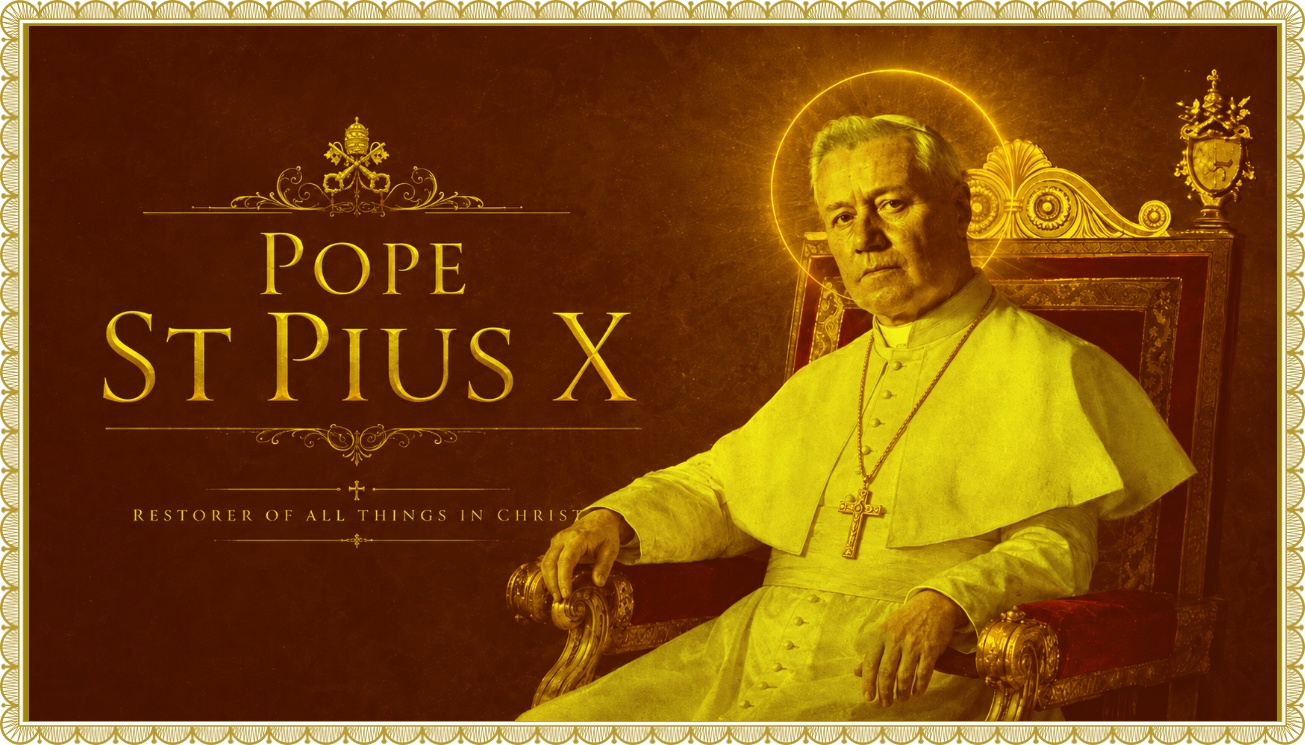
Carissimi, the Church begins today’s Mass with words that seem almost to contain the whole life of Giuseppe Melchiorre Sarto in a single sentence: Extuli eléctum de plebe; óleo sancto meo unxi eum — “I have raised up the chosen one from the people; with My holy oil I have anointed him.”¹ That phrase de plebe matters. Pius X was not born among princes, diplomats, scholars or ecclesiastical grandees. He was born at Riese in the Veneto on 2 June 1835, the son of Giovanni Battista Sarto, the village postman, and Margherita Sanson. His was the world of ordinary Catholic families, modest means, hard work, parish bells, catechism, confession and Sunday Mass. Providence did not erase those origins when He raised him to the Chair of Peter. Rather, He used them. Even in the Vatican there remained something unmistakably of the parish priest about Pius X: direct, practical, unpretentious, generous to the poor, impatient with artificiality, and possessed of the conviction that the Church exists for the glory of God and the salvation of souls.²
After studying at Padua, Giuseppe Sarto was ordained priest in 1858 and sent as curate to Tombolo. For nine years he learned the apostolate from the ground upwards: preaching, catechising, hearing confessions, caring for the sick, teaching the Faith, and continuing his own serious study of St Thomas and canon law. In 1867 he became parish priest of Salzano, where his generosity to the poor became proverbial and where he distinguished himself by his self-sacrificing ministry during an outbreak of cholera. Then came Treviso, where he served as canon of the cathedral, diocesan chancellor and spiritual director of the seminary. In 1884 Leo XIII made him Bishop of Mantua, a difficult diocese in which Sarto concentrated especially upon the formation and discipline of the clergy. In 1893 he became Cardinal Patriarch of Venice. Ten years later, on 4 August 1903, the cardinals elected him Pope. He accepted only with hesitation, conscious not of the splendour but of the terrible burden of Peter’s office.² ³
The Collect of his feast tells us why Providence had raised this man from Riese: God filled St Pius with “heavenly wisdom and apostolic fearlessness” for the defence of the Catholic Faith and the restoration of all things in Christ.¹ Here is the architecture of his pontificate: defence and restoration. His programme was the Pauline phrase Instaurare omnia in Christo — to restore all things in Christ.⁴ It did not mean simply repairing ecclesiastical administration or recovering things because they were old. Instaurare means the restoration of a divinely intended order. Sin disorders; grace restores. Error obscures; truth illuminates. Fallen man places himself at the centre; Christ restores all things by bringing them again beneath His headship. Consequently authentic Catholic reform can never mean remaking the Church according to the preferences of an age. It means removing whatever obscures Christ so that the divine form entrusted to the Church may shine forth more clearly.
This is precisely why Pius X could be at once a great reformer and an uncompromising defender of Tradition. There is no contradiction. The gardener reforms the tree by pruning disease so that the tree may flourish according to its nature; he does not “reform” the oak by requiring it to become another species. Pius understood that the Church is not raw material placed in the hands of successive generations. She is the Bride of Christ, entrusted with a revelation to guard, teach and hand on. Hence his great struggle against Modernism, culminating in the decree Lamentabili⁵ and the encyclical Pascendi Dominici Gregis⁶ in 1907. He recognised that Modernism was particularly dangerous precisely because it could retain Catholic words while altering Catholic realities: revelation reduced to religious consciousness, dogma treated as an evolving expression of experience, Scripture detached from objective divine revelation, immutable truth surrendered to historical flux. The vocabulary of Christianity might remain while the substance of the Faith slowly disappeared.
How perfectly, then, the Gradual becomes the voice of Pius himself: “I announced Your justice in the vast assembly; I did not restrain my lips… Your justice I kept not hid within my heart; Your faithfulness and Your salvation I have spoken of.”¹ A shepherd does not receive authority in order to conceal difficult truths. Peter is not commissioned to discover what the sheep would prefer to hear, but to feed them. Yet the Epistle prevents us from mistaking firmness for severity of temperament. St Paul says, “we speak not as pleasing men, but God, Who proves our hearts”; he rejects flattery, avarice and the seeking of human glory, and then in the same passage describes himself as tender as a nurse cherishing her children, willing to give them not merely the Gospel but his very soul.¹ There is Pius X. His opposition to error was not the opposite of pastoral charity: it proceeded from pastoral charity. The physician names the disease because he wants the patient healed. The shepherd warns of the wolf because the sheep are precious. The father refuses poison because he loves his children.
But St Pius X cannot be understood merely as the Pope who condemned Modernism. His programme was constructive because restoration in Christ must lead souls positively into the supernatural life. Within months of his election he issued Tra le sollecitudini⁷ on sacred music. He sought to remove theatrical and profane influences from divine worship and to restore Gregorian chant to its proper honour as the chant of the Roman Church. Pius stated the principle with remarkable clarity: sacred music participates in the purpose of the liturgy itself — the glory of God and the sanctification of the faithful.⁷ He understood that worship forms the soul. If the sanctuary begins to imitate entertainment, eventually religion itself will be understood as something centred upon human taste. If the sacred is habitually treated as ordinary, the supernatural imagination withers. His liturgical concern was therefore no aesthetic hobby; it belonged to Instaurare omnia in Christo.
The same principle explains his care for seminaries, catechesis and ecclesiastical discipline. Weak formation produces weak priests, and weak priests leave a people vulnerable to error. Ignorance of the Faith cannot be remedied by enthusiasm alone, because one cannot securely love a Christ one has not been taught to know. In 1904 Pius began the enormous labour of gathering the scattered body of canon law into a coherent code, explicitly connecting that work with his programme of restoring all things in Christ.⁸ He reformed the Roman Curia,⁹ promoted sound priestly studies and regional seminaries, strengthened catechetical instruction, and later undertook the substantial rearrangement of the Roman Psalter in the Breviary.¹⁰ These were very different undertakings, but behind them stood the same conviction: every element of ecclesial life must serve the supernatural end for which the Church exists.
Nowhere, however, does the pastoral heart of Pius X appear more beautifully than in his Eucharistic work. In 1905 he encouraged frequent, even daily, Holy Communion for Catholics properly disposed;¹¹ in 1910 Quam singulari insisted that children should not be unnecessarily kept from their First Communion once they had reached the age of reason and possessed the requisite understanding.¹² And suddenly the Propers of today’s Mass become almost biographical. At the Offertory the Church sings: “Come, children, hear me; I will teach you the fear of the Lord.” At Communion Christ Himself answers: “My Flesh is food indeed, and My Blood is drink indeed. He who eats My Flesh and drinks My Blood abides in Me and I in him.”¹ Teach the child, and bring the child to Jesus. Form the mind, and feed the soul. Catechism opens towards the altar.
And notice the profound Catholic balance. Pius X did not encourage more frequent Communion because he regarded the Eucharist as less sacred, but because he believed utterly in Who the Eucharist is. He did not solve distance from the sacred by desacralising the sacred. He sought instead to sanctify the faithful. The child should receive earlier because the child needs Christ; the adult should communicate frequently because without Christ the supernatural life starves. But Communion must be worthy, reverent, prepared for, desired. Pius did not bring God down to the measure of contemporary man. He sought to raise man by grace into more intimate union with God.
Then comes today’s Gospel, and with it the deepest explanation of Pius X. Three times Our Lord asks Peter, “Simon, son of John, do you love Me?” Three times the commission follows: “Feed My lambs… Feed My lambs… Feed My sheep.”¹ Before Peter can govern, he must love Christ. Before he can feed the flock, he must himself belong completely to the Shepherd. The sheep belong to Christ. The doctrine belongs to Christ. The sacraments belong to Christ. The moral law belongs to Christ. The liturgy belongs to Christ. Even Peter belongs to Christ. Papal authority therefore reaches its perfection not in self-expression but in fidelity: “Do you love Me? Feed My sheep.”
That is why Pius X remains so necessary. Every age has its fashionable ecclesiastical vocabulary — reform, renewal, adaptation, relevance, listening, accompaniment — and some of these words can signify legitimate things. But Pius asks the prior question: renewed towards what? reformed according to what measure? adapted for what end? His answer permits no ambiguity: in Christo. In Christ. The criterion is not whether an innovation appears modern, attractive or successful, but whether it brings souls, doctrine, worship and discipline into greater conformity with Jesus Christ and the Faith He entrusted to His Church.
But this cannot remain a judgement upon ecclesiastical history. Instaurare omnia in Christo must finally become an examination of conscience. It is possible to denounce doctrinal Modernism while practising a domestic Modernism in our own souls: professing immutable truth while allowing convenience, appetite, fashion or resentment to decide how we actually live. What remains in me to be restored in Christ? My prayer? My speech? My imagination? My use of time? My home? My friendships? My secret compromises? My preparation for Holy Communion? Christ does not ask for one religious chamber within the house of the soul. He claims the whole house.
In August 1914 Europe descended into war. Pius, already weakened in body, was profoundly stricken by the spectacle of Christian nations preparing to slaughter one another. Benedict XVI later described his final appeal as the anguished cry of a father seeing his children arrayed against each other. Pius died on 20 August 1914.¹³ Forty years later, on 29 May 1954, Pius XII raised him solemnly to the altars of the universal Church.¹⁴ The child of Riese, the curate of Tombolo, the parish priest of Salzano, the reforming Bishop of Mantua, the Patriarch of Venice, the reluctant Pope, had become St Pius X.
And the Postcommunion gives us the grace for which we must finally ask: that through his intercession we may be made “firm in faith and of one mind in Your love.”¹ Firm in faith and united in love. Not truth without charity; not charity without truth. Pius possessed both because both were rooted in Christ.
Extuli eléctum de plebe. God raised up one chosen from the people, anointed him, strengthened him, and gave him to the Church in an hour of danger. He raised Giuseppe Sarto not that Sarto might be great, but that Christ might reign.
And that remains the work: not to invent another Christianity, not to accommodate revelation to every passing age, not to mistake novelty for life, but to permit grace to restore what sin has disordered, truth to correct what error has obscured, reverence to heal what familiarity has cheapened, and Jesus Christ to take possession of everything that already belongs to Him.
Instaurare omnia in Christo.
May He restore all things in His Church. May He restore all things in our homes. And above all, may He restore all things in us.
Sancte Pie Decime, gloriose patrone, ora, ora pro nobis. Amen.
- Pius XII, Address after the Canonisation of St Pius X, 29 May 1954, delivered immediately following the solemn rite of canonisation in St Peter’s.
- Propers for the traditional feast of Pope St Pius X, Missa “Extuli eléctum”: Introit, Collect, Epistle, Gradual, Gospel, Offertory, Communion and Postcommunion.
- Benedict XVI, General Audience, “Saint Pius the Tenth,” 18 August 2010, for the principal biographical outline of Giuseppe Sarto, his priestly and episcopal ministry, simplicity of life, pastoral reforms and election to the papacy.
- Umberto Benigni, “Pope Pius X,” The Catholic Encyclopedia, vol. XII, 1911, for Sarto’s family background, education, ministry at Tombolo and Salzano, work during the cholera outbreak, Treviso appointments, episcopate at Mantua and patriarchate at Venice.
- Pius X, Encyclical E Supremi, 4 October 1903, especially no. 4: “We have no other program in the Supreme Pontificate but that of restoring all things in Christ.”
- Supreme Sacred Congregation of the Holy Office, Decree Lamentabili sane exitu, 3 July 1907, ratified by Pius X on 4 July 1907, condemning sixty-five Modernist propositions concerning Scripture, revelation, dogma, Christ, the sacraments and the Church.
- Pius X, Encyclical Pascendi Dominici Gregis, 8 September 1907, On the Doctrines of the Modernists, analysing Modernism as an interconnected philosophical, theological, historical and critical system and insisting upon the safeguarding of the deposit of faith.
- Pius X, Motu Proprio Tra le sollecitudini, 22 November 1903, on sacred music, its relation to the sanctity of divine worship and the edification of the faithful, and the restoration of Gregorian chant to particular honour in the Roman liturgy.
- Pius X, Motu Proprio Arduum sane munus, 19 March 1904, instituting the work of codifying the Church’s canon law and expressly connecting ecclesiastical discipline with the programme instaurare omnia in Christo.
- Pius X, Apostolic Constitution Sapienti consilio, 29 June 1908, reorganising the Roman Curia; see also Benedict XVI’s summary of Pius X’s curial and administrative reforms.
- Pius X, Apostolic Constitution Divino afflatu, 1 November 1911, De nova Psalterii in Breviario Romano dispositione, concerning the new arrangement of the Psalter in the Roman Breviary.
- Sacred Congregation of the Council, Decree Sacra Tridentina Synodus, 20 December 1905, on frequent and daily reception of Holy Communion by the faithful properly disposed. The text is preserved in the Acta Apostolicae Sedis and explicitly presents daily Communion as the desire of the Church for the sanctification of the faithful.
- Sacred Congregation of the Discipline of the Sacraments, Decree Quam singulari Christus amore, 8 August 1910, approved and ordered promulgated by Pius X, on the admission of children to First Communion at the age of reason. The official text appears in Acta Apostolicae Sedis 2 (1910), pp. 577–583.
- Benedict XVI, General Audience, 18 August 2010: “The last months of his life were overshadowed by the impending war”; his appeal of 2 August 1914 is described as “the anguished plea of a father who sees his children taking sides against each other.” Pius X died on 20 August 1914.
- In the Name of the Father, and of the Son, and of the Holy Ghost. Amen.
Homilies Archive

Mass Propers


DAILY MASS ONLINE
One of the earliest online apostolates dedicated to the Traditional Latin Mass, Old Roman TV began broadcasting the Holy Sacrifice on the Feast of the Assumption, 15 August 2008. During the COVID-19 pandemic, additional programming — devotions, catechesis, and conferences — was added to support the faithful in prayer and formation.
Support the daily Holy Mass on Old Roman TV by offering a Mass intention — for loved ones, thanksgiving, or the repose of souls. Your intention helps sustain the sacred liturgy and brings grace to those you remember before God’s altar.
SUPPORT THE DAILY MASS ONLINE
Likely the world’s longest-running daily online broadcast of the
Traditional Latin Mass, streaming faithfully since the
Feast of the Assumption 2008.

This apostolate cannot continue without immediate help
Please support us with a contribution toward
chapel rent, sacristy supplies, operating costs, and web-hosting.
Our essential monthly costs reach £1,000.


Leave a Reply