
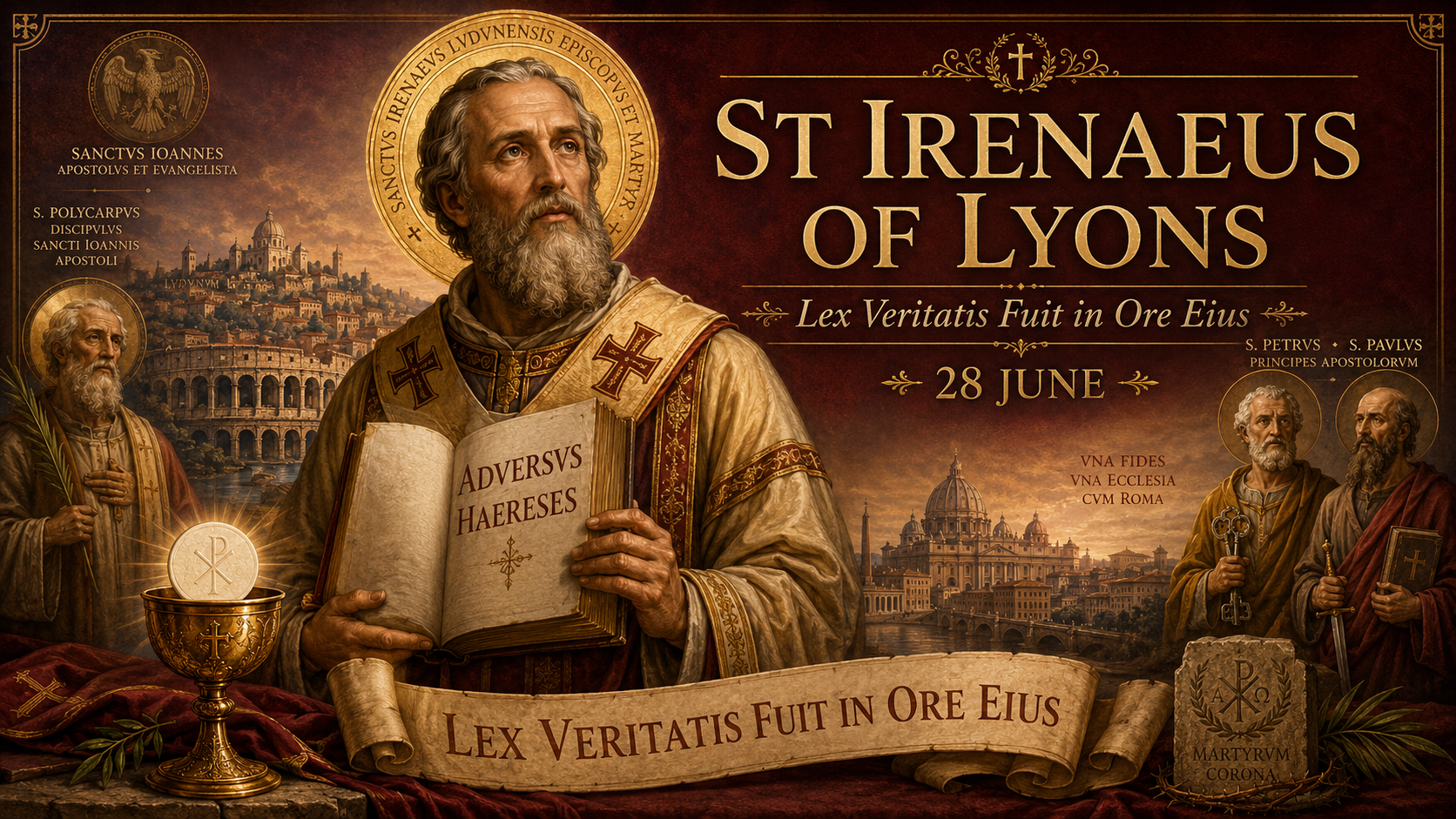
The Law of Truth Was in His Mouth: St Irenaeus of Lyons and the Peace of the Apostolic Faith
On 28 June, at the threshold of the feast of Saints Peter and Paul, the traditional Roman liturgy honours St Irenaeus of Lyons: disciple of the apostolic age, defender of the Incarnation, witness to the Eucharist, teacher of apostolic succession, theologian of Mary as the new Eve, and peacemaker whose charity rested upon uncompromising fidelity to revealed truth.

The Saint of Truth and Peace
The traditional Roman Mass of St Irenaeus opens with the words of the Prophet Malachias: “The law of truth was in his mouth, and iniquity was not found in his lips.”¹ Few liturgical texts could describe him more exactly. Irenaeus belongs to that first generation of Christian teachers who stood close enough to the Apostles to hear the living echo of their preaching, yet late enough to confront the systems of speculation already seeking to replace the Faith they had delivered.
In the pre-1955 Roman calendar, his feast is kept on 28 June as a Double, in red vestments, with commemorations of the Octave of St John the Baptist and of the Vigil of Saints Peter and Paul. The placement is particularly fitting. The disciple of St Polycarp prepares the Church for the feast of the Roman Apostles by bearing witness to the public transmission of their doctrine, the succession of their pastors and the visible communion of the Churches with Rome.
The Collect gathers his entire mission into one sentence. God granted him to overthrow heresies by the truth of his doctrine and happily to confirm the peace of the Church. The Church therefore asks for constancy in holy religion and for peace in her own times. Truth and peace are not treated as rival goods. Peace is the fruit of truth, while falsehood, however conciliatory its language, eventually dissolves communion.
The Greek name Eirenaios means peaceful. Yet Irenaeus was one of the most formidable controversialists of Christian antiquity. There is no contradiction. He did not confuse peace with silence before error, nor charity with indifference to doctrine. His peace was the tranquillity produced when Christians remained faithful to the one revelation received from Christ through His Apostles.
A Voice Still Carrying the Accent of the Apostles
Irenaeus was formed in Asia Minor and, as a young man, heard St Polycarp, Bishop of Smyrna. Polycarp had known St John and others who had seen the Lord. In a letter preserved by Eusebius, Irenaeus recalled not only what Polycarp taught but where he sat, how he entered and left a room, his manner of life and the stories he told of his conversations with the Apostles. These things, Irenaeus wrote, had been preserved not merely on paper but in his heart.²
This is more than an attractive biographical memory. It reveals the structure of the Catholic Faith. Christ taught the Apostles; the Apostles taught men such as Polycarp; Polycarp formed Irenaeus; Irenaeus transmitted the same doctrine to the Church of Lyons. Catholic Tradition is neither anonymous folklore nor the accumulation of changing religious opinions. It is the public handing-on of a determinate revelation through identifiable witnesses and pastors.
Irenaeus was serving as a priest at Lyons during the persecution of 177. While St Pothinus, St Blandina and their companions were imprisoned and put to death, Irenaeus was sent to Rome with a letter for Pope Eleutherius. After the martyrdom of the aged Pothinus, he succeeded him as bishop.
He therefore joined within himself several Christian worlds. He was Greek by birth and intellectual formation, Gallic by episcopal ministry, and Roman in his understanding of ecclesiastical communion. He carried the teaching of the Johannine Church of Asia into the missionary Church of the West. His life itself embodied the unity which his doctrine defended.
The Roman liturgy venerates him as bishop and martyr. The precise circumstances of his death are not recorded in the earliest surviving sources, but the Church received and preserved the tradition of his martyrdom, probably during the persecution associated with Septimius Severus. His Mass presents him as one who both preached the truth and sealed it with blood.
Knowledge Falsely So Called
The great surviving work of Irenaeus is commonly known as Against Heresies. Its fuller title is The Detection and Overthrow of Knowledge Falsely So Called. The title is significant. The opponents of Irenaeus claimed to possess gnosis: a higher knowledge hidden from ordinary Christians and entrusted only to the spiritual elite.
Gnosticism was not one single, consistent organisation. It was a family of competing sects and speculative systems. They multiplied invisible emanations, intermediate beings, secret genealogies and rival creators. Many regarded matter as the consequence of a cosmic fall or defect. The visible world was attributed not to the supreme God but to an inferior maker. Salvation therefore meant the escape of the spiritual element from bodily existence through possession of hidden knowledge.
The result was a religion of unreality. Creation was degraded, the Old Testament rejected or distorted, the true Incarnation denied, the sacraments emptied of their force, and bodily resurrection made impossible. Christ became less the Word made flesh than a messenger sent to awaken a privileged class to its supposed divine origin.
Against this maze of inventions, Irenaeus proclaimed the majestic simplicity of the apostolic Creed. There is one God, the Father Almighty, Maker of heaven and earth. The same God who created Adam sent His Son. The Word truly became flesh. He shed real Blood, died a real death and rose in the same human nature He had assumed. The body is not the prison of a divine fragment. It is God’s workmanship, wounded by sin but destined for redemption and resurrection.
The argument was not merely philosophical. It was biblical and ecclesial. The Gnostics quoted Scripture, but they detached its words from the rule of faith within which Scripture had been received. Irenaeus compares their method to a man who takes apart a beautiful mosaic of a king and rearranges the stones into the image of a fox.³ The individual pieces remain genuine, but their relationship has been falsified and the true image destroyed.
This remains one of the clearest explanations of heretical exegesis. Error does not always begin by discarding the words of revelation. It often retains them while changing their order, context and governing meaning. Biblical language remains on the surface while an alien religion is constructed beneath it.
Scripture Within Apostolic Tradition
The Epistle chosen for the feast begins: “Continue thou in those things which thou hast learned, and which have been committed to thee: knowing of whom thou hast learned them” (2 Timothy 3:14). St Paul then speaks of the divinely inspired Scriptures and charges Timothy to preach the word in season and out of season, because men will eventually refuse sound doctrine and gather teachers according to their own desires.
The liturgy has selected a perfect description of the Irenaean vocation. The Apostle joins Scripture to what has been learned, entrusted and received from known teachers. Timothy does not invent Christianity from a private reading of documents. He inhabits an apostolic inheritance in which the inspired writings are read, preached and guarded.
Irenaeus answers the claims of the Gnostics in the same way. If the Apostles had possessed secret doctrines necessary for salvation, they would surely have entrusted them to the bishops whom they appointed to govern the Churches. Instead, the same rule of faith was taught openly throughout the Christian world. The languages of the Churches differed, but their Faith was one.
Apostolic Tradition, as Irenaeus describes it, is public rather than secret, universal rather than sectarian, and continuous rather than invented. The truth may therefore be tested historically. The Catholic can point to Churches founded by the Apostles, to the succession of their bishops and to the doctrine publicly confessed among them. The Gnostic teacher could provide only a recent master, a private revelation and a system unlike those of his competitors.
Irenaeus appeals in particular to the Church of Rome, founded by the glorious Apostles Peter and Paul. He gives the succession of her bishops and presents her public tradition as a decisive witness to the apostolic Faith.⁴ His argument is not that Rome has created the truth, but that the apostolic truth has been preserved and publicly attested there.
This is why Scripture, Tradition and the Church cannot be divided. Scripture is the inspired Word of God. Tradition is the living transmission of the apostolic deposit. The Church is the visible society commissioned to guard, preach and interpret what she has received. None of the three exists as a rival source of a different religion.
Pope Benedict XVI summarised the Irenaean principle with particular clarity: there is no concealed Christianity for intellectuals above the common Creed of the Church. The true depth of revelation is found not by escaping the Faith delivered to ordinary believers, but by entering more profoundly into it.
Christ Recapitulates All Things
The central theological idea associated with Irenaeus is recapitulation. The word comes from St Paul’s declaration that God purposes “to re-establish all things in Christ, that are in heaven and on earth” (Ephesians 1:10). Christ is not merely one religious teacher within human history. He is its new Head.
Adam’s disobedience disordered human nature at its source. The Son of God therefore assumed that nature and retraced its path in obedience. He sanctified birth, infancy, youth and maturity. He met temptation and conquered where Adam had fallen. He carried human nature through suffering and death into resurrection and glory.
Redemption is thus more than the cancellation of a legal debt considered in isolation from the Incarnation. The Word enters the history of Adam, gathers it into Himself and restores it to the Father. The whole work remains gratuitous, sacrificial and expiatory, but it is also profoundly organic. Humanity is saved through union with its new Head.
St Thomas Aquinas later gives scholastic precision to this patristic vision. Christ is Head of the Church by reason of order, perfection and power. He possesses the fulness of grace and communicates supernatural life to His members. His grace is not confined to His individual humanity but overflows into the Mystical Body.⁵
Aquinas does not replace Irenaeus. He articulates the metaphysical structure already present within the Father’s doctrine. What Irenaeus describes historically as the gathering-up of humanity in the new Adam, Aquinas explains causally as the influence of Christ the Head upon His members.
Recapitulation also guards the unity of the Old and New Testaments. The God who spoke through Moses and the Prophets is the Father of Jesus Christ. The Word who appeared in signs and promises is the Word who became flesh. Abraham, Moses, David and Isaias belong to the same economy of salvation as the Apostles. The Old Testament prepares for Christ; the New manifests Him; both proceed from the same God.
Mary, the New Eve
The theology of recapitulation includes the Blessed Virgin. Irenaeus gives one of the earliest explicit patristic accounts of Mary as the new Eve. The Fall involved the disobedience of a virgin; the restoration begins with the obedience of a Virgin.
“The knot of Eve’s disobedience was loosed by the obedience of Mary.”⁶ What Eve bound through unbelief, Mary released through faith. Eve listened to the fallen angel and turned from the command of God. Mary heard Gabriel and answered: “Behold the handmaid of the Lord; be it done to me according to thy word” (Luke 1:38).
Irenaeus does not place Mary beside Christ as an independent source of redemption. Her entire dignity comes from Him. Yet neither does he reduce her to a passive instrument of no theological importance. Her consent belongs to the divinely ordered reversal of the Fall. The new Adam enters the world through the obedient faith of the new Eve.
This doctrine is already recognisably Catholic. Marian teaching is not a medieval addition imposed upon an originally non-Marian Christianity. Its roots lie in the earliest Christian reading of Genesis, the Annunciation and the Incarnation. Mary appears within the primitive rule of faith because the reality of the Incarnation requires the reality of the Mother from whom the Word took flesh.
The Eucharist and the Salvation of the Flesh
Irenaeus’s defence of the Eucharist follows directly from his defence of creation. If matter is evil, if the body cannot be saved and if the Word did not assume true flesh, the Eucharist becomes impossible. But Christ takes bread and wine, fruits of the created order, and makes them His Body and Blood.
The Eucharist is therefore evidence against Gnosticism. The elements belong to creation; after consecration they communicate the reality of Christ; our mortal bodies receive them; and those bodies are destined to rise. Irenaeus argues that Christ, by giving His true Flesh and Blood in the Eucharist, confers upon our flesh the capacity for salvation.⁷
He also describes the Eucharistic oblation as the pure sacrifice of the New Covenant foretold by Malachias. The Church offers the first fruits of creation to the Creator in thanksgiving, and receives them back as the sacrament of Christ. Creation is neither despised nor discarded. It is taken up into worship and ordered towards glory.
St Thomas would later explain with greater precision the substantial conversion by which the bread and wine become the Body and Blood of Christ, and the sacramental effects by which the Eucharist unites the faithful to Christ, increases charity and gives the pledge of future glory. The scholastic doctrine of transubstantiation supplies the technical clarity; Irenaeus supplies one of its great patristic foundations.
The contemporary temptation is often to spiritualise Christianity into sentiments, values or states of consciousness. Irenaeus refuses such reduction. God created the body. Christ assumed the body. The body is washed in Baptism, anointed in Confirmation, fed with the Eucharist and raised on the last day. Salvation concerns the whole man.
“Fear Not Them That Kill the Body”
The Gospel of the feast is Matthew 10:28–33. Christ sends His Apostles into a hostile world and tells them not to fear those who can kill the body but cannot kill the soul. Divine providence extends even to the fall of a sparrow and to the hairs of the head. Whoever confesses Christ before men will be confessed by Christ before the Father.
The passage explains both the bishop and the martyr. Irenaeus was charged to preserve sound doctrine, but Christian doctrine is never preserved by scholarship alone. It requires confession. There comes a point at which the pastor must risk comfort, position, liberty and life rather than allow fear to silence the Gospel.
In St Thomas Aquinas’s Catena Aurea, St Hilary reads the passage as a command to proclaim openly the knowledge of God without fearing those whose power ends with the body. St John Chrysostom observes that Christ raises His messengers above anxiety, calumny, danger and even violent death by teaching them the greater fear of God.⁸
Cornelius à Lapide develops the same spiritual order. Men can injure reputation, property and bodily life, but they cannot seize the soul that remains faithful to God. The Christian does not become careless about earthly duties; he simply refuses to make temporal survival the highest law. The fear of God liberates him from the servile fear of men.⁹
This is precisely the courage demanded by the Epistle. “Preach the word: be instant in season, out of season; reprove, entreat, rebuke in all patience and doctrine” (2 Timothy 4:2). The pastor is neither a quarrelsome scold nor a diplomatic manager of religious opinion. He must correct patiently, teach accurately and remain vigilant when men prefer fables to truth.
The Mystical Doctrine of the Divine Artist
The controversial writings of Irenaeus contain a profound mystical theology. His famous sentence is often reduced to its first clause: “The glory of God is a living man.” Yet he immediately explains what human life means: “the life of man consists in beholding God.”¹⁰
The maxim does not enthrone autonomous humanity. It destroys that autonomy. Man becomes fully alive only through the vision and possession of God. Separated from his Creator, he does not achieve liberation but death. God is glorified when His creature receives the supernatural life for which he was made.
An even more intimate image appears when Irenaeus compares the soul to moist clay beneath the hand of the Creator. “Offer to Him your heart in a soft and tractable state,” he writes, lest it harden and lose the impression of His fingers.¹¹
This is the opposite of Gnostic self-deification. The Gnostic claims to discover an innate divinity hidden within himself. The Christian receives divine life as grace. He does not fashion God according to his imagination; he permits God to refashion him according to Christ.
The later masters of the interior life develop the same principle. St John of the Cross teaches that the soul must be purified of its disordered attachments so that God may communicate Himself without the resistance created by self-will. Father Reginald Garrigou-Lagrange describes sanctifying grace as eternal life already begun within us and insists that the interior life must grow towards the transforming vision of God.¹²
Irenaeus thus joins dogma to contemplation. The truth he defends is not a collection of external formulae. It is the truth by which the soul is conformed to Christ. Orthodoxy without conversion becomes sterile disputation; spirituality without orthodoxy becomes religious self-invention. In the saint, doctrine and holiness belong to one movement of grace.
Peace Without Compromise
Irenaeus’s conduct during the Paschal controversy displays the true meaning of his name. Pope Victor wished to exclude the Churches of Asia that retained the Quartodeciman practice concerning the date of Easter. Irenaeus agreed with the Roman observance, but urged Victor not to sever communion with Churches following an ancient inherited custom.
He recalled that earlier bishops of Rome and the saints of Asia had differed over the observance while remaining in communion. St Anicetus and St Polycarp had failed to persuade one another, yet they celebrated the Eucharist together and parted in peace.¹³
This incident reveals the precision of Catholic judgement. Irenaeus did not treat Gnostic doctrine as a harmless diversity. It contradicted the identity of God, the Incarnation, the sacraments and the resurrection. It had to be exposed and refuted. The Paschal dispute, by contrast, concerned a venerable disciplinary difference maintained by Churches sharing the same rule of faith.
Peace therefore required neither doctrinal relativism nor indiscriminate severity. Irenaeus could be uncompromising where revelation was denied and conciliatory where the Faith remained intact. He distinguished dogma from discipline, heresy from custom and necessary correction from unnecessary rupture.
This is why the Collect first speaks of overthrowing heresy through truth and then of establishing peace. The order cannot be reversed. Unity is not created by suppressing the truth, because the truth is the principle of ecclesial communion. Yet the truth must be defended for the salvation of souls, not as a pretext for pride, faction or cruelty.
The Liturgy’s Portrait of Irenaeus
Dom Prosper Guéranger understood the sanctoral cycle not as a collection of detached religious biographies but as the Church’s living contemplation of Christ in His members. The Proper of St Irenaeus follows this principle exactly. Every text reveals some part of his participation in the mystery of Christ.
The Introit presents the priest whose mouth guarded the law of truth. The Collect joins doctrine and peace. The Epistle commands fidelity to received teaching and perseverance when sound doctrine is rejected. The Gradual praises the peaceable man. The Alleluia calls the disciple to stand among wise elders and join himself to their wisdom. The Gospel demands fearless public confession. The Offertory sends doctrine abroad like the morning light. The Communion declares that the teacher has laboured not for himself but for all who seek the truth.
The Secret asks that the Christian people may not be shaken by fear and that God’s gift of peace may defend Christian lands. The Postcommunion addresses God as the author and lover of peace, “Whom to know is to live, and Whom to serve is to reign.” The sacramental conclusion gathers together the saint’s entire theology: knowledge of God is life, service is freedom, and peace is secured beneath divine protection.
Pius Parsch frequently urges the worshipper to read a saint’s proper as a unified spiritual portrait rather than as a succession of unrelated texts. Here the portrait is exceptionally coherent. Irenaeus is the bishop who received the apostolic word, interpreted Scripture within Tradition, exposed false knowledge, confessed Christ before men, defended the body’s salvation and laboured for the peace of the Church.
His position immediately before Saints Peter and Paul deepens the meaning. Irenaeus points towards Rome not as the centre of a new doctrine but as a principal witness to the old one. He names her episcopal succession because truth has a history. The Church’s unity is visible because the Incarnation is real; her doctrine is public because the Gospel was preached to all nations; her continuity matters because Christ acts through a body extended across time.
A Father for an Age of Invented Religion
The ancient Gnostic systems have disappeared, but their governing instincts repeatedly return. They return whenever creation is treated as raw material without an order given by God; whenever the body is regarded as an obstacle to the self rather than part of the person; whenever private enlightenment is set above public revelation; whenever Christianity is divided into an elementary religion for ordinary believers and a supposedly higher truth for the initiated.
Irenaeus answers these errors by returning to what is real. There is one Creator. The world He made is good. Man is a unity of body and soul. The Word truly became flesh. Mary truly conceived Him. His Blood was truly shed. His Body is truly given in the Eucharist. The flesh will truly rise. The Apostles truly transmitted a determinate Faith, and the Church truly preserves it.
In 2022, St Irenaeus was declared a Doctor of the Church under the title Doctor unitatis, Doctor of Unity.¹⁴ The title is fitting provided unity is understood as he understood it. His unity was never the administrative management of contradictions. It was the communion created by one Faith, one Eucharist, one apostolic tradition and one Christ.
The feast of St Irenaeus therefore teaches more than the history of an early bishop. It reveals the Catholic form of reality. Revelation is received, not invented. Scripture belongs within the apostolic rule of faith. Doctrine reaches fulfilment in sacramental and contemplative union with God. Pastors defend the flock by teaching the truth. Peace is protected by distinguishing legitimate diversity from contradiction of the Faith.
The Church’s prayer remains urgent: may God grant His people constancy in the holy religion and give peace to our times. St Irenaeus shows why the petitions belong together. Constancy without charity can become faction; peace without truth becomes surrender. Catholic peace is the ordered communion of those who receive, profess and live the truth that came from the Apostles.
The law of truth was in his mouth. He walked with God in peace and equity. He turned many away from iniquity. On the eve of the Apostles, the Church asks that the same truth may remain upon the lips of her pastors, the same courage within her martyrs, and the same apostolic Faith within all her children.
- Missale Romanum, Proper of Saints, 28 June, Mass Lex veritatis: Introit, Malachias 2:6; Collect; Epistle, 2 Timothy 3:14–17; 4:1–5; Gospel, Matthew 10:28–33.
- Eusebius of Caesarea, Ecclesiastical History, V.5 and V.20; Benedict XVI, General Audience, “Saint Irenaeus of Lyons,” 28 March 2007.
- St Irenaeus, Adversus Haereses, I.8.1.
- Ibid., III.3.1–3. See also Benedict XVI, General Audience, 28 March 2007.
- St Thomas Aquinas, Summa Theologiae, III, q. 8, aa. 1–6; III, q. 48, a. 1.
- St Irenaeus, Adversus Haereses, III.22.4.
- Ibid., IV.18.4–5; V.2.2–3. See also St Thomas Aquinas, Summa Theologiae, III, qq. 75 and 79.
- St Thomas Aquinas, Catena Aurea in Matthaeum, chapter 10, on Matthew 10:26–33, citing St Hilary of Poitiers, St John Chrysostom and St Jerome.
- Cornelius à Lapide, The Great Commentary, commentary on Matthew 10:28–33.
- St Irenaeus, Adversus Haereses, IV.20.7.
- Ibid., IV.39.2.
- St John of the Cross, The Ascent of Mount Carmel and The Living Flame of Love; Reginald Garrigou-Lagrange, The Three Ages of the Interior Life, vol. I, part I.
- Eusebius, Ecclesiastical History, V.24.9–18.
- Francis, Decree conferring the title of Doctor of the Church upon St Irenaeus of Lyons, 21 January 2022.
- General Roman Calendar and Proper of Saints as found in editions of the Breviarium Romanum and Missale Romanum preceding the 1960 reform. The feast was extended to the universal calendar by Benedict XV in 1921 on the traditional Lyonese date of 28 June and transferred to 3 July in the 1960 calendar.
- Prosper Guéranger, The Liturgical Year, General Preface and principles governing the sanctoral cycle; Pius Parsch, The Church’s Year of Grace, vol. IV.
related articles


Latest articles
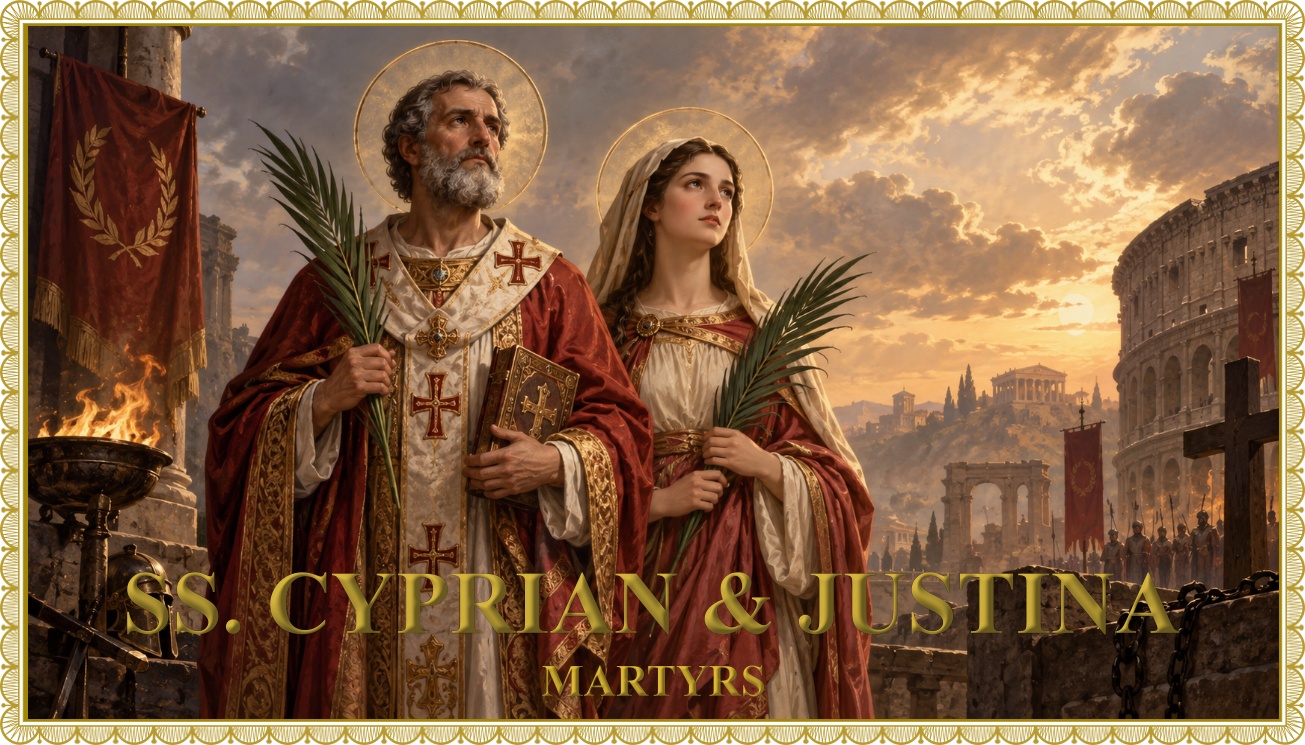
- Today’s Mass: September 26 SS. Cyprian and Justina, MartyrsThe persecution of Diocletian broke out at that time, and Cyprian and Justina were seized and presented to Diocletian himself, who judged them. Justina was scourged and Cyprian was torn with iron hooks. After this they were both sent back to Diocletian in chains. He commanded that their heads be cut off, and they died; martyrs for the Faith!
- 27.09.26 Nuntiatoria CXXV: VERITAS NON MUTATUR CONSENSUThis edition emphasises that truth remains constant, regardless of institutional consensus. It explores how authority should serve existing realities rather than define them, stressing the importance of preserving the Church’s traditions and teachings. The Church’s role is to guard and transmit truth, not to create it through agreement or procedure.
- ORDO w/c 27.09.26The week begins with the Eighteenth Sunday after Pentecost, honouring various saints, culminating in the feast of St Francis of Assisi. Key celebrations include St Wenceslaus, St Michael the Archangel, St Jerome, and St Thérèse of the Child Jesus. The period highlights the call to surrender worldly attachments in devotion to God.
- Rupnik’s accusers appeal to Leo XIV: the women are still outside the doorThe text explores the concept of “spiritual denial” within the Catholic Church regarding serious allegations against church leaders. It argues that this denial, often perceived as loyalty, leads to evasion of uncomfortable truths. The piece emphasises that acknowledging these failures does not undermine the Church’s integrity, urging faithful confrontation of wrongdoing while maintaining justice for all involved.
- TRADITIONIS CUSTODES BY THE NUMBERS: WHAT ROME’S 2025 DECREE REGISTER ACTUALLY SHOWSThe Vatican’s 2025 decree register clarifies the status of the Traditional Roman Mass, detailing 34 decrees concerning 33 jurisdictions and 55 parish churches. While 41 locations have renewed permissions, this system requires repeated authorisation from Rome, indicating administrative dependency on continuous approval for traditional practices rather than expanding opportunities.




Leave a Reply