
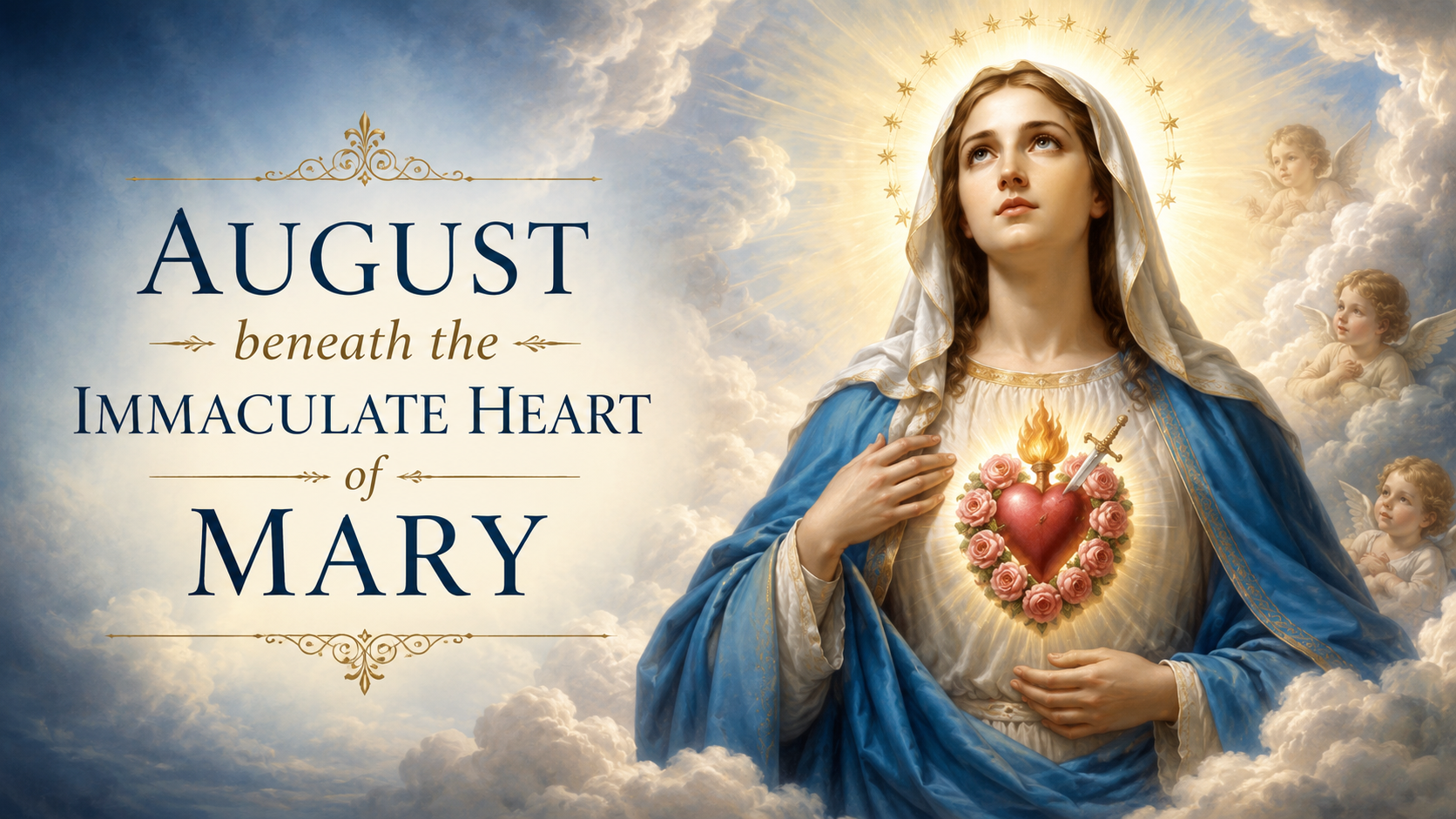
August beneath the Immaculate Heart of Mary
The Church’s devotional tradition places August beneath the Immaculate Heart of Mary. The month is crowned by the Assumption and, in the traditional Roman calendar, by the feast instituted for the universal Church on the octave day, 22 August. To honour that Heart is to contemplate the interior life of the Mother of God: her unbroken purity, her consent at Nazareth, her compassion upon Calvary and the maternal charity by which she continues to lead souls to her divine Son.

On 15 August, the Church looks upwards. The body which gave flesh to the Eternal Word did not remain in the corruption of the tomb. Mary, conceived without stain, Mother of God and faithful companion of the Redeemer, was assumed body and soul into heavenly glory. Seven days later, in the traditional Roman calendar, the Church returns from the glory of the Assumption to the hidden source of Mary’s earthly fidelity: her Immaculate Heart.
The sequence is deliberate and beautiful. Before Mary was crowned in Heaven, she had consented in Nazareth. Before she stood as Queen beside her Son, she had stood as Mother beneath His Cross. Before her body was glorified, her Heart had passed through faith, obscurity, exile, labour, bereavement and the sword foretold by Simeon. August therefore presents not an ornamental picture of the Blessed Virgin, remote from the sorrows of ordinary life, but the full course of a human creature who belonged entirely to God and was brought by Him to the glory for which mankind was created.
The customary dedication of August to the Immaculate Heart is a work of popular Catholic piety rather than a universal liturgical precept. Such monthly devotions are intended to train the attention. They ask the faithful to dwell upon one mystery long enough for it to pass from the lips into the mind, and from the mind into conduct. August should therefore be more than a month in which an image of the Immaculate Heart is displayed or a familiar prayer occasionally recited. It should become a school of Mary’s interior life.
The word heart must be understood in the rich biblical sense. Sacred Scripture does not treat the heart as the place of emotion alone. It is the hidden centre of the person: the sanctuary of memory, thought, judgement, desire, love and decision. “Where thy treasure is, there is thy heart also.” The heart discloses what a person truly worships, especially when outward appearances have become unreliable.
Saint Luke twice opens a window into the interior life of the Blessed Virgin. After the shepherds had come to Bethlehem, spoken of the angels and departed, “Mary kept all these words, pondering them in her heart.” Years later, after the finding of the twelve-year-old Jesus in the Temple, the Evangelist tells us again that “his mother kept all these words in her heart.” She did not receive the mysteries of Christ as passing impressions. She gathered them, preserved them and returned to them before God.
There is patience in that keeping. Mary was not given an immediate explanation of everything she experienced. Simeon spoke of contradiction and of the sword which would pierce her soul. The Child was hurried into Egypt under threat of death. At twelve He answered that He must be about His Father’s business, while the Gospel itself records that Mary and Joseph did not understand the word He spoke to them. She kept even what she could not yet fully comprehend.
This is one of the first lessons of the Immaculate Heart. Faith does not demand that God explain the whole road before we agree to walk it. The modern mind is accustomed to information, instant interpretation and the pretence of control. Mary received light enough for obedience, then carried the remainder in silence. Her pondering was not confusion hardened into doubt, but understanding ripening beneath grace.
Her Heart is called immaculate because Mary herself, by a singular privilege of Almighty God and in view of the merits of Jesus Christ, was preserved from every stain of original sin from the first instant of her conception. Her sinlessness was not independence from redemption. She needed Christ as every child of Adam needs Him, but she was redeemed in the most perfect manner: preserved from falling by the anticipated application of the merits of the Saviour whom she would bear.
The Immaculate Heart is therefore the Heart of one perfectly redeemed. Grace met no culpable resistance in her. Her intellect did not turn away from divine truth; her will did not bargain with a known command; her memory did not cultivate injuries; her affections did not rebel against right order. Every power of her soul was placed at the disposal of God.
This must not be mistaken for a life without effort or pain. Immaculateness did not make Mary less capable of suffering. It made her more capable of love, and therefore of sorrow. Sin often blunts human sympathy. Self-interest limits the suffering we are prepared to share. Mary’s charity was not narrowed by selfishness, and so the sword entered deeply.
The traditional image teaches this without a treatise. Her Heart is shown burning, wreathed with roses and pierced by a sword. The flame signifies the intensity of her charity. The roses signify purity. The sword recalls Simeon and Calvary. Love, purity and suffering are not separate decorations placed around the same emblem; each interprets the others. Mary suffered because she loved, and she suffered without rebellion because her love was pure.
Devotion to the Immaculate Heart must always remain joined to devotion to the Sacred Heart of Jesus, yet the two devotions are not identical and their objects are not equal. The Heart of Jesus belongs to the divine Person of the Word made flesh. It is adored with the worship of latria, for Christ is true God and true man. Mary is a creature, wholly dependent upon God, and her Immaculate Heart receives the singular veneration called hyperdulia, due to the Mother of God above every angel and saint.
This distinction guards the very greatness of Marian devotion. Mary is not honoured as a rival source of salvation, nor as a gentler deity from whom protection must be sought against the justice of Christ. Every grace she possesses comes from Him. Every maternal act of hers serves His redeeming purpose. Her Heart is a refuge because it is the most perfect created refuge within the kingdom of her Son.
Pius XII taught that devotion to the Immaculate Heart should be closely united with devotion to the Sacred Heart. The love of the Mother leads to the love of the Son; her compassion belongs beneath His Passion; her maternal intercession applies nothing apart from His merits. The two Hearts are united, although never confused: one is the Heart of the Redeemer, the other the Heart of the woman who received Him, bore Him, followed Him and consented to the sacrifice in which He alone, as divine High Priest and Victim, redeemed the world.¹
July, dedicated to the Precious Blood, therefore passes naturally into August. In July the faithful contemplate the price of redemption poured from the wounds of Christ. In August they contemplate the Mother who gave Him that Blood from her own substance and stood beneath the Cross while it was shed. She did not flee from the altar of Calvary when the appearance of every promise seemed to have been destroyed.
Her presence there was not passive. She could not add to the infinite value of Christ’s sacrifice, but she could unite herself to it by a unique, dependent and maternal cooperation. She had once placed the Infant in the arms of Simeon and heard the prophecy of the sword. On Calvary she received its fulfilment. The consent first given at the Annunciation was not withdrawn when divine maternity led to the Cross.
The fiat at Nazareth reveals the governing disposition of the Immaculate Heart: “Behold the handmaid of the Lord; be it done to me according to thy word.” Mary did not utter those words in sentimental excitement. She asked the angel how the message would be accomplished, received the divine answer and freely gave herself to the will of God.
She was not shown every consequence. The consent included much that remained concealed: Joseph’s perplexity, the journey to Bethlehem, the flight into Egypt, the long hidden years, the hostility directed against her Son and the desolation of Good Friday. God asked for a real act of freedom, not an agreement dependent upon prior knowledge of every cost.
Our own obedience is commonly less generous. We wish to serve God while retaining the right to revise the terms. We consent provided that the duty remains congenial, the sacrifice is recognised, the uncertainty is brief and the result accords with our judgement. Mary’s Heart teaches another kind of liberty: the freedom of a creature so ordered towards God that obedience is no longer regarded as a threat to the self.
This does not abolish reason, prudence or legitimate enquiry. Mary asked her question of Gabriel. She sought the Child when He was missing. She noticed the need of the wedding household at Cana. Her obedience was intelligent, attentive and active. What it lacked was the inward refusal by which fallen man resists God even while appearing to negotiate with Him.
At Cana we see the maternal Heart in action. Mary perceived an embarrassment before it became a public humiliation: “They have no wine.” She did not command her Son, nor did she draw attention to herself. She placed the need before Him and turned to the servants: “Whatsoever he shall say to you, do ye.”
Those words remain the sure test of every Marian devotion. A devotion which leaves a man habitually disobedient to Christ has failed in its purpose. The Rosary, scapular, consecration and First Saturdays cannot be treated as substitutes for repentance, the keeping of the commandments, attendance at Mass, worthy reception of the sacraments and the fulfilment of one’s state of life. Our Lady does not gather disciples around herself in separation from Jesus. She forms servants who are prepared to do whatever He commands.
The Gospel presents her Heart as contemplative, but never inert. After the Annunciation she went “with haste” to assist Saint Elizabeth. At Cana her observation became intercession. On Calvary her fidelity endured when the Apostles had scattered. In the Cenacle her prayer accompanied the infant Church as it awaited the Holy Ghost. Recollection prepared action; it did not replace it.
This is particularly necessary in a distracted age. Many people consume religious information continuously while giving little time to prayer. They know the latest dispute, statement, scandal and rumour, but cannot remain quietly before the tabernacle for ten minutes. Even concern for the Church may become a species of agitation in which the soul is constantly stimulated yet seldom converted.
Mary kept the words of Christ. We often merely collect them. She pondered; we react. She allowed events to mature within prayer; we hurry to offer an opinion before truth has penetrated us. August beneath her Immaculate Heart should restore something of the lost discipline of silence—not silence in the face of falsehood or injustice, but the inward quiet without which speech becomes shallow and judgement intemperate.
This devotion did not begin at Fatima. Its scriptural root lies in Saint Luke, and Christian writers had long meditated upon the purity, charity and sorrows of Mary’s Heart. It was Saint John Eudes in seventeenth-century France, however, who gave the devotion a more developed theological and liturgical form. The feast of the Holy Heart of Mary was first celebrated with ecclesiastical approval in 1648, and Saint John composed a Mass and Office in its honour.²
His work is significant because he did not isolate the Hearts of Jesus and Mary. The maternal Heart was understood within the immensity of the Heart of Christ. Marian devotion became a way of entering more deeply into the dispositions of the Incarnate Word: charity, mercy, humility, purity, patience and submission to the Father. John Eudes was later remembered by the Church as an indefatigable apostle of both Hearts.³
Fatima gave this already existing devotion renewed urgency in the twentieth century. In the apparitions of 1917, devotion to the Immaculate Heart was associated with prayer, penance, reparation, the conversion of sinners and the dangers threatening the Church and the world. The message did not introduce a new Gospel or add another article to the deposit of faith. Private revelation cannot complete or correct the public revelation entrusted to the Apostles. It may, however, recall with providential force duties which Christians have neglected.
The authentic centre of Fatima is not curiosity about secrets or an appetite for catastrophe. It is conversion. Hell is real; sin has consequences; souls may be lost; prayer and sacrifice matter; history is not sealed against the intervention of grace. Our Lady’s request for the Communion of reparation on the First Saturdays gives devotion to her Heart a definite moral content.⁴
The practice consists of sacramental Confession, Holy Communion, the recitation of five decades of the Rosary and fifteen minutes of meditation upon its mysteries, undertaken on five consecutive First Saturdays with the intention of making reparation. These are not arbitrary devotional hurdles. Each element answers a wound inflicted by sin. Confession restores friendship with God. Communion unites the soul to the sacrificial Heart of Christ. The Rosary keeps the mysteries which Mary kept. Meditation resists the superficiality which allows sacred things to pass through the mind without taking root.
Reparation is sometimes misunderstood. It does not imply that Christ’s sacrifice was deficient and requires human effort to complete its objective value. The merits of Calvary are infinite. Yet God permits the members of Christ’s Mystical Body to unite their prayers, penances and sufferings to the one sacrifice of their Head. Saint Paul could therefore speak of filling up in his flesh “those things that are wanting of the sufferings of Christ” for the sake of His Body, the Church. Nothing was wanting in the worth of the Passion; what remains is its application through the lives of Christ’s members.
Reparation to the Immaculate Heart likewise recognises that offences directed against Mary strike at truths inseparable from Christ: His real Incarnation, His divine Sonship, His sinlessness, the virginal maternity, the supernatural order of grace and the honour which God Himself bestowed upon His Mother. Contempt for Mary rarely remains confined to Mary. It usually reveals resistance to the humiliating fact that God entered history through the consent and flesh of a particular woman.
Yet reparation must begin nearer home than the offences of the world. It is easy to deplore blasphemy, impurity and apostasy in public life while tolerating resentment, vanity, dishonesty or unchastity in oneself. We may speak fiercely about sacrilege while approaching holy things carelessly. We may defend Our Lady’s honour while permitting habits in our homes which contradict her purity.
The Immaculate Heart does not provide a decorative banner beneath which the unconverted may continue unchanged. It exposes disorder by showing us a human Heart in perfect order. Before Mary, evasions become rather feeble. Her purity asks what we permit our eyes and imagination to consume. Her recollection asks how much silence we preserve. Her charity asks whom we have refused to forgive. Her obedience asks which known duty we continue to postpone.
When Pius XII consecrated the Church and the human race to the Immaculate Heart on 31 October 1942, Europe and much of the world were being consumed by war. The act was not performed in a period of Marian sentimentality, but amid military occupation, mass killing, ideological tyranny and the apparent failure of human remedies. The Pope appealed to the maternal Heart of Mary because the catastrophe was ultimately more than political. Nations had attempted to construct peace while rejecting the order established by God.⁵
On 4 May 1944, while the war still raged, Pius XII extended the feast of the Immaculate Heart to the universal Church and assigned it to 22 August, the octave day of the Assumption. The decree explained that the Church honoured beneath the symbol of Mary’s Heart her singular holiness, her ardent love for God and her Son, and her maternal compassion for those redeemed by the divine Blood.⁶
The date joins the Assumption to the Heart which preceded it. Mary’s heavenly glory was not an arbitrary privilege detached from her earthly vocation. She who had received the Word in her Heart and body, remained faithful beside the Cross and preserved her soul free from every sin was brought wholly into the triumph of her Son.
Pius XII’s definition of the Assumption in 1950 made explicit the harmony between Mary’s privileges. The Immaculate Conception concerns the beginning of her earthly life; the Assumption concerns its glorious completion. Both depend entirely upon the victory of Christ. She was preserved from original sin by His merits and preserved from bodily corruption through His triumph over death.⁷
The Assumption also guards devotion to the Immaculate Heart from becoming disembodied. Christianity does not seek the liberation of an inward self from the body. The physical heart matters because the body matters. Mary loved God not as an abstraction but as a whole person. She carried Christ, nursed Him, worked beside Him, followed His footsteps and stood physically near His Cross. The Heart honoured by the Church is neither a poetic fiction nor a detachable spiritual symbol. It is the bodily heart of the Mother of God, inseparably united to her person and expressive of her interior life.
For that reason, August carries an implicit lesson about human dignity. The body is not raw material to be reshaped according to the will. Motherhood is not an accidental social role. Purity is not contempt for the flesh. In Mary, the human body appears according to divine intention: created, sexed, fruitful, sanctified and destined for resurrection. The Assumption is God’s answer to every philosophy which either degrades the body or makes it an idol.
To consecrate oneself to the Immaculate Heart is therefore to surrender one’s whole life to Christ through Mary. It is not a pious transfer of ownership which leaves daily habits untouched. Pope Paul VI urged Christians to make such consecration living through conduct conformed to the divine will, filial service and imitation of Our Lady.⁸
A consecrated mind cannot willingly feed upon falsehood. Consecrated eyes cannot be given without restraint to impurity. A consecrated tongue cannot habitually wound reputations. A consecrated home cannot organise its life as though prayer, Sunday Mass and the commandments were optional additions. The words of consecration are serious because they place memory, imagination, body, possessions, relationships, sorrows and future beneath Our Lady’s maternal government for the service of Christ.
August may be observed by restoring the daily Rosary. The Rosary is peculiarly suited to the Immaculate Heart because it teaches the soul to keep what Mary kept. The vocal prayers provide a steady rhythm while the mind remains with the mysteries of Christ. The repetition is not empty when it serves attention; it becomes empty only when the heart has withdrawn.
A family might pray one decade together where five are not yet possible, then build the habit patiently. An image of the Immaculate Heart may be placed in a suitable position in the home, not as an ornament lost among others, but as a sign that the household wishes to belong to Jesus through Mary. The Angelus may be restored at morning, noon and evening. The Litany of Loreto may be added on Saturdays. A visit to the Blessed Sacrament can become the place where the worries of the month are carried into silence.
The First Saturday should be observed carefully wherever circumstances permit. Its purpose is not the acquisition of spiritual benefits through mechanical performance. The intention of reparation matters. One comes to Confession and Communion conscious that sin wounds the order of charity, that the Mother of God is offended in the mysteries by which God honoured her, and that sinners need assistance which they may no longer seek for themselves.
The month also invites a practical examination of the interior life. What do we habitually keep in the heart? Mary kept the words of God. We may be keeping an insult from years ago, an imagined triumph, a grievance rehearsed until it has become part of our identity, or an attachment we know to be disordered. Memory can become either a sanctuary or a storeroom of resentments. The Immaculate Heart teaches us what deserves to be preserved and what must be surrendered.
Her Heart also teaches the proper treatment of sorrow. Mary did not pretend the sword was painless. Catholic devotion does not demand emotional unreality. Bereavement, betrayal, anxiety and loneliness may wound profoundly. The difference lies in whether suffering closes the heart upon itself or is offered with Christ. Mary’s sorrow remained open towards God and towards the souls for whom her Son died.
At Calvary she received a new motherhood: “Woman, behold thy son.” Saint John stood for the disciples who would be born from the pierced side of Christ. Mary’s maternal Heart was enlarged at the very moment when natural motherhood seemed to have been stripped from her. The dying Lord did not leave His Mother without children, nor His disciples without a Mother.
To take refuge in her Heart is therefore not to hide from the demands of Christ. She shelters sinners so that they may repent. She consoles the sorrowful so that sorrow does not harden them. She protects the weak so that they may return to duty. Her refuge is a place of healing and preparation, not permanent exemption from the Cross.
Nor should the promised triumph of the Immaculate Heart be imagined as Mary’s victory apart from Jesus. Her triumph is the triumph of grace in souls, the restoration of divine order, the conversion of sinners and the acknowledgement of Christ’s kingship. Her Heart triumphs when a human will ceases to resist God, when a family begins to pray, when a sinner returns to Confession, when purity is recovered, when an old injury is forgiven and when the Mass becomes once again the centre of life.
August thus asks for more than admiration. The Church places before us the Heart which believed before seeing, consented before knowing the cost, served without display, suffered without revolt and loved without reserve. On 15 August we behold the glory to which that fidelity led. On 22 August we return to its hidden furnace.
The Assumption prevents us from thinking that such fidelity ends in loss. The Immaculate Heart prevents us from imagining that glory is reached without conversion. Mary is crowned because grace had already reigned within her. Heaven completed what the fiat had begun.
During this month, then, we should ask Our Lady not merely to protect our hearts but to reform them. Let her teach us to retain the words of Christ rather than the noise of the world; to obey when Providence has not supplied every explanation; to make reparation beginning with our own sins; to remain beside the Cross when discipleship loses its consolations; and to desire Heaven enough to loosen our grasp upon what cannot enter it.
The surest honour we can offer the Immaculate Heart is resemblance. A little more recollection, a cleaner imagination, an honest Confession, a duty performed without complaint, an injury forgiven, a Rosary prayed attentively—these may appear small beside the needs of the Church and the world. Nazareth also appeared small. Within its hidden life, however, the Heart of Mary was being prepared for Bethlehem, Calvary and the glory of the Assumption.
Immaculate Heart of Mary, refuge of sinners and model of perfect charity, obtain for us hearts purified by penance, strengthened by faith and consumed with love for Jesus Christ. Teach us to keep His words, to obey His commands and to remain faithful beneath His Cross, that through thy maternal intercession we may come at last to the kingdom where thou reignest with Him for ever. Amen.
¹ Pius XII, Haurietis Aquas, 15 May 1956, especially the Pope’s direction that devotion to the Immaculate Heart be closely joined to devotion to the Sacred Heart.
² “Blessed Jean Eudes”, The Catholic Encyclopedia, recording the first celebration of the feast of the Holy Heart of Mary in 1648.
³ Benedict XVI, General Audience on Saint John Eudes, 19 August 2009; John Paul II, Address on the Alliance of the Hearts of Jesus and Mary, 22 September 1986.
⁴ Congregation for the Doctrine of the Faith, The Message of Fatima, 26 June 2000; Congregation for Divine Worship, Directory on Popular Piety and the Liturgy, 2002.
⁵ Pius XII, Radio Message and Prayer of Consecration of the Church and the human race to the Immaculate Heart of Mary, 31 October 1942; Auspicia Quaedam, 1 May 1948.
⁶ Sacred Congregation of Rites, decree of 4 May 1944 establishing the Feast of the Immaculate Heart for the universal Church on 22 August, Acta Apostolicae Sedis, vol. 37; John Paul II, Address of 22 September 1986, quoting the decree’s description of the object of the devotion.
⁷ Pius XII, Apostolic Constitution Munificentissimus Deus, 1 November 1950.
⁸ Paul VI, Apostolic Exhortation Signum Magnum, 13 May 1967.
related articles


Latest articles
- THE DATA YOU OUTSOURCE IS STILL YOUR RESPONSIBILITYThe RNLI’s exposure through the Beacon CRM cyberattack illustrates a problem far wider than one charity. Organisations can outsource their databases, hosting and technical security, but they cannot outsource responsibility for the information they choose to collect. Data minimisation, supplier scrutiny and controlled access are not merely GDPR exercises: they are duties of custodianship.
- “THAT THE WORLD MAY HAVE LIFE”: LEO XIV GOES TO FRANCEPope Leo XIV arrives in France five weeks after its assisted-dying law came into force and two years after guaranteed access to abortion was written into the Constitution. His first encyclical calls life from conception to natural death the first human right. At the Élysée, Notre-Dame and Lourdes, the question is now how explicitly he will apply that doctrine to France.
- Today’s homily: St Matthew, Apostle & EvangelistThe Reckoning of Mercy reflects on the transformative calling of St Matthew, a despised tax collector, by Christ. It illustrates the concept that God’s grace empowers genuine conversion, emphasising that true mercy requires both acknowledgment of one’s past and active adherence to justice. Matthew’s journey from publican to apostle embodies this principle.
- Today’s Mass: September 21 St Matthew, Apostle & EvangelistMatthew the Apostle and Evangelist, also called Levi, was sitting at his tax-collector’s desk in Capernaum when he was called by Christ. He followed Him at once, and also gave a feast for Him and the other disciples.
- Sermon for St. MatthewToday, we honour St. Matthew, a tax collector called by Jesus to discipleship. Despite their notorious reputation, tax collectors were essential to Jesus’ ministry of redemption. St. Matthew’s Gospel, aimed at a Jewish audience, emphasises Jesus as the fulfilment of prophecy and outlines Christ’s teachings, including the Sermon on the Mount.




Leave a Reply