
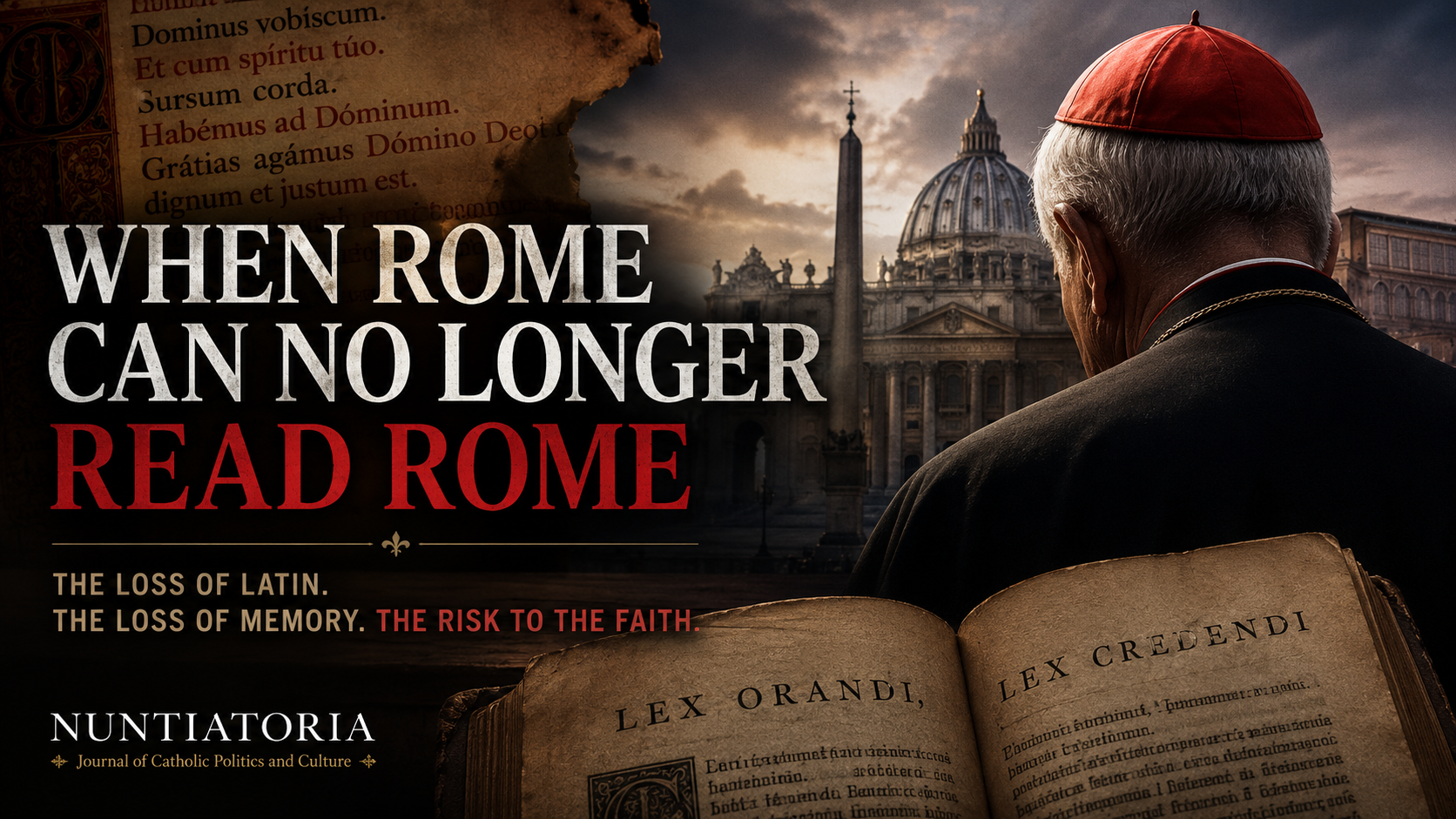
When Rome Can No Longer Read Rome
Reports that most members of the College of Cardinals possess little working knowledge of Latin expose far more than an educational deficiency. A hierarchy unable to read the normative language of its own liturgy, law and theological inheritance is condemned to receive the Catholic tradition through translations, summaries and the interpretations of others. The result is not greater accessibility, but institutional amnesia.
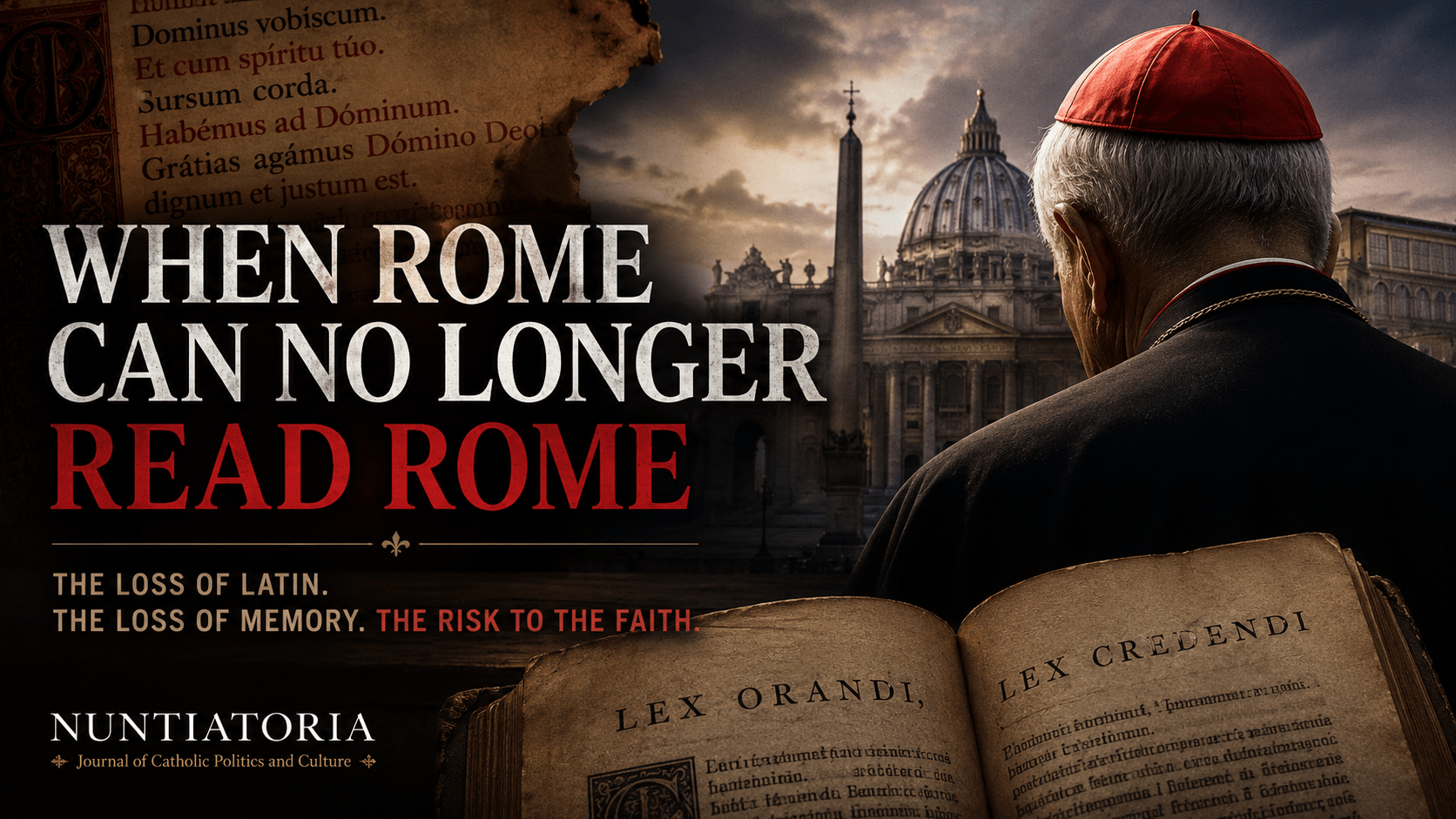
An investigation attributed to the Italian Vatican correspondent Francesco Capozza has produced a startling claim: more than sixty-five per cent of the present College of Cardinals possess little or no appreciable command of Latin. The precise figure has been repeated by several Catholic publications, although the underlying data and methodology have not yet been made publicly available. It should therefore be treated as an attributed estimate rather than an independently established statistic. Yet few acquainted with the present condition of clerical formation will find the substance of the allegation implausible.¹
The significance of this is easily missed. Latin is commonly dismissed as an antiquarian interest, a liturgical preference, or the badge of an ecclesiastical faction. It is none of these things. One need not maintain that every conversation in a presbytery should be conducted in Ciceronian periods, nor that a priest must compose verse in the manner of Virgil, to recognise that the Latin clergy ought to understand the language of the Latin Church.
A cardinal who cannot read Latin has not merely forgotten a foreign language. He has lost direct access to much of the documentary memory of the institution he is charged with governing. He must approach the Fathers, the scholastics, the councils, the Roman liturgy, the decrees of the Holy See and the technical language of canon law through the mediation of translators. He is therefore placed in the extraordinary position of exercising authority over a tradition whose primary sources he may be unable personally to examine.
That is not a harmless inconvenience. Every translation is an interpretation. The translator must decide which meaning of a term is intended, which nuance should be emphasised, which syntactical ambiguity should be resolved and which theological associations should be carried into the receiving language. Even the best translation cannot reproduce every shade of the original. A prelate dependent entirely upon translations is consequently dependent upon the theological judgement of those who prepare them.
The difficulty becomes acute when dealing with the vocabulary of Catholic doctrine. Persona, natura, substantia, essentia, gratia, caritas, traditio, communio, sacrificium and religio are not decorative ecclesiastical expressions. They are words whose meanings were refined through centuries of controversy, conciliar definition and scholastic analysis. They bear within them a history of distinctions upon which doctrinal clarity frequently depends.
Modern languages change rapidly. Words are recruited into political causes, softened by euphemism, expanded beyond their traditional meaning or emptied of determinate content altogether. “Dignity”, “inclusion”, “development”, “identity”, “relationship”, “conscience” and even “pastoral” can mean radically different things depending upon the speaker. Latin does not render manipulation impossible, but its established ecclesiastical vocabulary provides a comparatively stable point of reference against which innovation can be tested.
This was precisely the argument advanced by Pope John XXIII in the Apostolic Constitution Veterum Sapientia of 22 February 1962. Quoting Pius XI, he described the Church as requiring a language that was universal, immutable and non-vernacular. Latin, he explained, belonged to no single modern nation, was not subject to the continual alteration of everyday speech and had acquired meanings capable of expressing Christian doctrine with consistency.²
John XXIII did not present Latin as a picturesque survival. He legislated for its preservation. Seminaries were to ensure that future priests obtained a proper command of it; teachers were to be adequately qualified; and the principal ecclesiastical disciplines were to be taught in a manner that enabled clerics to consult their sources directly. Pope Paul VI subsequently acknowledged the difficulty of implementing these requirements because suitably trained teachers were already becoming scarce, yet he did not repudiate the principle. In 1964 he established the Pontifical Institute for Advanced Latin Studies precisely to remedy that deficiency.³
Nor can the disappearance of Latin honestly be attributed to the Second Vatican Council. Sacrosanctum Concilium declared that “the use of the Latin language is to be preserved in the Latin rites”, while permitting a wider use of the vernacular under defined conditions.⁴ The decree on priestly formation, Optatam Totius, required seminarians to acquire sufficient Latin to understand and use the sources of the sacred sciences and the documents of the Church.⁵
The present Code of Canon Law maintains the same obligation. Canon 249 requires priestly formation programmes to ensure that seminarians “understand Latin well”.⁶ Benedict XVI repeated the rationale in 2012 when establishing the Pontifical Academy for Latin. Knowledge of Latin, he observed, remains necessary for theology, liturgy, patristics and canon law; the liturgical books of the Roman Rite, the most important documents of the papal Magisterium and the most solemn official acts of the Roman Pontiffs are traditionally expressed in Latin in their authentic form.⁷
The collapse of Latin formation cannot therefore be defended as obedience to the Council, adaptation to canon law or fidelity to the modern Magisterium. It represents the widespread non-observance of all three. This is one of the peculiarities of contemporary ecclesiastical life: practices explicitly required by the Council are ignored by those who invoke the Council most insistently, while Catholics attempting to preserve them are accused of resisting conciliar reform.
The practical consequences extend beyond the library and lecture hall. A bishop who cannot read the normative texts of the Church’s law is forced to rely upon canonical advisers, summaries or translations. A cardinal who cannot consult a disputed conciliar or papal text in its authoritative language is less able to judge competing interpretations. A member of a Roman dicastery who does not understand the established vocabulary of the Holy See may unconsciously import into ecclesiastical documents the conceptual assumptions of contemporary politics, psychology or sociology.
The result is government by mediation. Officials who were once expected to possess the intellectual equipment necessary to examine the Church’s sources become dependent upon specialists, secretaries and drafting committees. Authority remains with the prelate, but effective control over the meaning of texts migrates towards those who compose, translate and interpret them.
This helps to explain why modern ecclesiastical controversies so often become arguments about what a document “really means”. Different language editions appear with different emphases. Ambiguous expressions are defended by reference to one translation and criticised by reference to another. Commentators consult interviews and press conferences to establish the supposed intention of a text which ought to have been composed with sufficient precision to speak for itself.
The absence of a published Latin version of Pope Leo XIV’s first encyclical, Magnifica Humanitas, is therefore symbolically important. The Holy See’s official webpage presently lists Arabic, German, English, Spanish, French, Italian, Polish, Portuguese and Russian versions, but no Latin text.⁸ It would be rash to accept without further documentary evidence the claim that this is literally the first important papal document ever to have appeared without a Latin original. Yet the omission remains revealing. An encyclical devoted to the human person in the age of artificial intelligence has been issued in multiple living languages without the traditional common text that might provide an enduring terminological standard between them.
This matters especially because humanitas itself carries a range of meanings. It may signify human nature, mankind collectively, civilisation, humane conduct, culture or the qualities proper to a human being. These meanings are related, but they are not identical. When an encyclical discusses humanity, human dignity, technological development and the nature of the person, terminological precision is not pedantry. It is the substance of the argument.
The same principle applies to the liturgy. The Roman Rite possesses Latin typical editions from which vernacular versions are derived. The original text is not merely one translation among others; it is the standard against which the translations are judged. The Holy See has explicitly maintained that approved vernacular sacramental formulae must be understood according to the meaning expressed in the original Latin text.⁹ A priest incapable of understanding that text is separated from the normative form of the rite he celebrates.
This separation inevitably changes his perception of the Roman liturgical tradition. Latin appears alien because he was never taught it. Gregorian chant appears impractical because he was never formed to sing it. The ancient prayers appear obscure because he encounters them only through modern paraphrases. What earlier generations of priests received as their ordinary ecclesiastical inheritance is experienced by their successors as the specialised interest of an eccentric minority.
Benedict XVI understood that Latin could still function as a sign of Catholic universality. In Sacramentum Caritatis, he recommended that at major international celebrations the principal prayers should be said in Latin and that future priests should be prepared to celebrate Mass and use the best-known prayers in that language.¹⁰ This was not an attempt to erase legitimate national languages. It was a recognition that a universal Church requires some means by which Catholics of different nations can worship together without making the language of one contemporary power the language of all.
Latin does not belong to the English, Italians, French, Germans, Americans or Spaniards. It places them upon common ground. An African, Asian, European or American priest who learns Latin acquires no one modern nation’s language as his ecclesiastical superior. He enters a patrimony that was inherited rather than manufactured by the present generation.
This point should not be exaggerated into the claim that Latin is the only sacred language of Catholicism. The venerable Greek, Syriac, Coptic, Armenian, Slavonic and other traditions of the Eastern Catholic Churches form part of the Church’s apostolic inheritance and must be honoured in their integrity. The present question concerns the Latin Church and, most particularly, those appointed to govern from Rome. It is hardly unreasonable to expect the princes of the Roman Church to understand the Roman Church’s own language.
Nor does knowledge of Latin guarantee orthodoxy, wisdom or holiness. A man may decline every noun correctly and still teach error. The twentieth century produced no shortage of heterodox theologians who were perfectly competent Latinists. Yet ignorance is not a protection against error. The inability to read the sources makes a churchman more, not less, vulnerable to selective quotation, tendentious translation and fashionable reinterpretation.
The remedy is not ceremonial tokenism. A few Latin mottos, an occasional Gregorian hymn and a carefully rehearsed phrase at a consistory will not restore ecclesiastical literacy. Seminaries must again teach Latin as a working language of theology, liturgy and law rather than as a short introductory course to be forgotten after examination. Students should read conciliar canons, papal documents, liturgical collects and scholastic texts in the original. Episcopal candidates and those appointed to senior positions in the Roman Curia should be expected to demonstrate a real ability to understand the texts they will be responsible for interpreting and applying.
The Holy See should also recover the discipline of publishing significant doctrinal, legislative and liturgical texts in Latin at the time of promulgation, not as an ornamental translation added years later. Vernacular editions are pastorally necessary, but they require a common standard. Universality is not achieved by issuing numerous translations without a normative point of reference. That creates a federation of linguistic interpretations rather than a single Roman voice.
The Church does not preserve her identity by embalming the past. She preserves it by remaining capable of receiving what has been handed down, understanding it and transmitting it faithfully. Tradition is not a collection of old objects displayed behind glass. It is an act of communication between generations. When the language of that communication is lost, the modern generation becomes increasingly free to imagine that the Church formerly believed whatever the modern generation finds convenient.
A hierarchy that cannot read its own inheritance will eventually cease to recognise it. It will mistake novelty for development, approximation for doctrine and bureaucratic consensus for tradition. It may continue to speak constantly, publish prolifically and conduct endless processes of consultation, yet its words will become progressively detached from the settled meanings by which the Catholic faith was once expressed.
The crisis of Latin is therefore not principally about grammar. It is about whether Rome can still hear Rome; whether the Church’s governors can consult the testimony of their predecessors without interpreters standing between them; and whether Catholic doctrine will continue to possess a vocabulary resistant to the ideological fashions of the age.
A Church that knows her sources only second-hand is already forgetting them. A Church that forgets the language in which she received, defined and defended her faith may retain a great many voices, but she will have lost her own.
- “A Church Without a Tongue: More and More Cardinals No Longer Master the Language of the Church”, Complicit Clergy, 6 August 2026; “A Church without a tongue: more and more cardinals no longer master the language of the Church”, InfoVaticana, 6 August 2026. The published articles attribute the estimate to Francesco Capozza but do not reproduce the underlying survey or methodology.
- John XXIII, Apostolic Constitution Veterum Sapientia, 22 February 1962.
- Paul VI, Apostolic Letter Studia Latinitatis, 22 February 1964.
- Second Vatican Council, Constitution Sacrosanctum Concilium, 4 December 1963, nn. 36 and 101.
- Second Vatican Council, Decree Optatam Totius, 28 October 1965, n. 13.
- Code of Canon Law, can. 249.
- Benedict XVI, Apostolic Letter Latina Lingua, 10 November 2012.
- Leo XIV, Encyclical Letter Magnifica Humanitas, signed 15 May and published 25 May 2026. The official list of editions does not presently include a Latin version.
- Sacred Congregation for the Doctrine of the Faith, Declaration on the Approval of Translations of Sacramental Formulae, 25 January 1974; Congregation for Divine Worship and the Discipline of the Sacraments, Liturgiam authenticam, 28 March 2001.
- Benedict XVI, Post-Synodal Apostolic Exhortation Sacramentum Caritatis, 22 February 2007, n. 62.
RELATED ARTiCLES


LATEST ARTICLES
- THE DATA YOU OUTSOURCE IS STILL YOUR RESPONSIBILITYThe RNLI’s exposure through the Beacon CRM cyberattack illustrates a problem far wider than one charity. Organisations can outsource their databases, hosting and technical security, but they cannot outsource responsibility for the information they choose to collect. Data minimisation, supplier scrutiny and controlled access are not merely GDPR exercises: they are duties of custodianship.
- “THAT THE WORLD MAY HAVE LIFE”: LEO XIV GOES TO FRANCEPope Leo XIV arrives in France five weeks after its assisted-dying law came into force and two years after guaranteed access to abortion was written into the Constitution. His first encyclical calls life from conception to natural death the first human right. At the Élysée, Notre-Dame and Lourdes, the question is now how explicitly he will apply that doctrine to France.
- Today’s homily: St Matthew, Apostle & EvangelistThe Reckoning of Mercy reflects on the transformative calling of St Matthew, a despised tax collector, by Christ. It illustrates the concept that God’s grace empowers genuine conversion, emphasising that true mercy requires both acknowledgment of one’s past and active adherence to justice. Matthew’s journey from publican to apostle embodies this principle.
- Today’s Mass: September 21 St Matthew, Apostle & EvangelistMatthew the Apostle and Evangelist, also called Levi, was sitting at his tax-collector’s desk in Capernaum when he was called by Christ. He followed Him at once, and also gave a feast for Him and the other disciples.
- Sermon for St. MatthewToday, we honour St. Matthew, a tax collector called by Jesus to discipleship. Despite their notorious reputation, tax collectors were essential to Jesus’ ministry of redemption. St. Matthew’s Gospel, aimed at a Jewish audience, emphasises Jesus as the fulfilment of prophecy and outlines Christ’s teachings, including the Sermon on the Mount.
CURRENT EDITION


Today’s Mass Propers
- Today’s Mass: September 21 St Matthew, Apostle & Evangelist
 Matthew the Apostle and Evangelist, also called Levi, was sitting at his tax-collector’s desk in Capernaum when he was called by Christ. He followed Him at once, and also gave a feast for Him and the other disciples.




Leave a Reply