
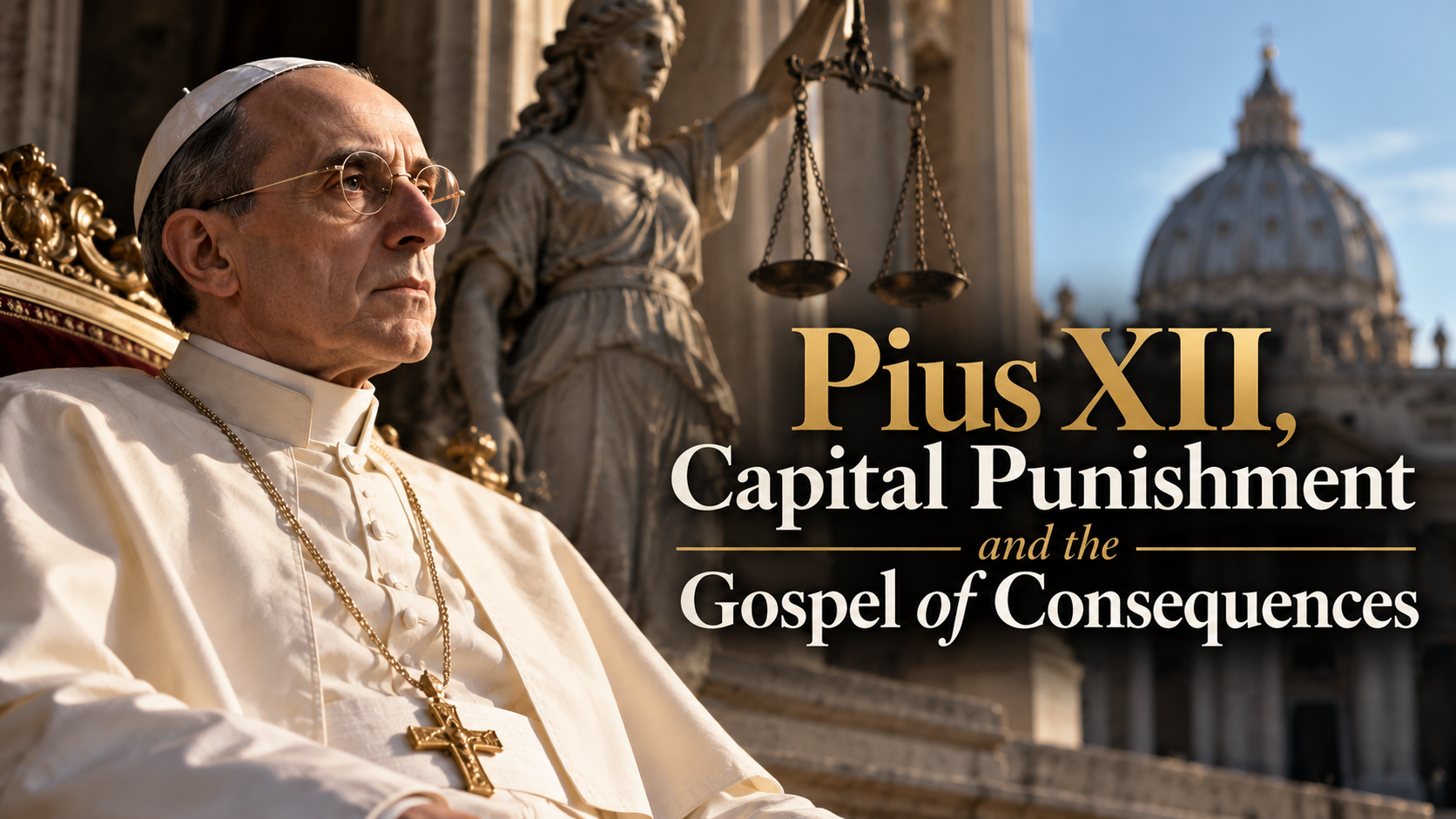
The criminal’s responsibility, the limits of State authority, and the danger of subordinating man’s eternal salvation to the pursuit of temporal human welfare.
Pius XII taught that a condemned criminal could, through his own crime, forfeit his right to the continued enjoyment of earthly life. His words raise a question that contemporary society increasingly evades: whether human freedom can retain its meaning when actions are divorced from their consequences. But the deeper question confronts the Church herself. Has the pursuit of the common good begun to obscure the Supreme Good, transforming the Gospel’s call to repentance and salvation into an increasingly temporal programme of human improvement?
There is a remarkable sentence in an address delivered by Pope Pius XII on 14 September 1952 which cuts through much of the confusion surrounding crime, punishment and human dignity. Discussing the limits of public authority over the human person, the Pope explained that even when the State executes a condemned criminal, it does not exercise an unrestricted dominion over human life. Public authority may deprive the offender of the enjoyment of life in expiation of his crime because, as Pius XII expressed it, “by his crime, he has already disposed himself of his right to live.”¹
Those words deserve careful attention. The Pope did not locate the moral foundation of capital punishment in the arbitrary will of the State. Neither did he suggest that human life becomes worthless when its possessor commits a sufficiently grave offence. He identified a prior moral reality: culpable actions can entail the forfeiture of particular rights. Under the conditions recognised by traditional Catholic moral theology, the offender’s own conduct establishes his liability to punishment. The State does not create that liability merely by deciding to impose a penalty. It administers justice in response to wrongdoing.
The significance of the distinction extends far beyond the death penalty. It concerns the increasingly neglected relationship between freedom and responsibility, between moral action and its consequences, and ultimately between divine justice and the human desire to escape judgement.
A murderer who knowingly commits a capital offence has not necessarily consented to execution. The distinction between consent and culpability must be preserved. Nor does an offender acquire unlimited ownership of his own life, which remains God’s gift. What Pius XII described was a forfeiture of juridical protection consequent upon culpable conduct, not a voluntary act of self-destruction. The offender has supplied the moral grounds of his liability; the competent authority remains responsible for determining guilt and administering a just penalty.
That responsibility cannot be dismissed. A sentence does not become just simply because it is lawful. The offence must be sufficiently grave, the evidence reliable, the proceedings fair and the punishment proportionate. No government may turn an arbitrary penal statute into moral truth by the mere act of enforcing it. An innocent man wrongfully executed is the victim of a terrible injustice, whatever a court may have pronounced. Nor does the offender’s guilt diminish the State’s obligation to exercise restraint. The criminal’s responsibility and the State’s responsibility exist together.
Yet the criminal who is justly punished is not, merely by being punished, an innocent victim. That elementary distinction has become surprisingly difficult to express. Contemporary discussion frequently begins with the suffering imposed by a penalty while treating the conduct which occasioned it as an inconvenient preliminary. The offender’s circumstances are investigated, his difficulties explained and his dignity asserted. All may be legitimate considerations. But the moral question cannot be answered without returning to the action for which he is responsible.
There is a difference between understanding a person’s circumstances and explaining away his culpability. Compassion does not require the denial of moral agency. Indeed, to take human dignity seriously is to recognise that man possesses reason and free will, and that his choices therefore matter. He is neither an animal governed solely by appetite nor a helpless product of his environment. He is a moral creature capable of choosing good or evil, and answerable for that choice.
St Thomas Aquinas understood punishment within this framework. In the Summa Theologiae, he distinguished the rights of public authority from those of private individuals and considered capital punishment in relation to justice and the preservation of the community.² His argument did not confer unlimited power upon rulers. It presupposed a moral order to which rulers themselves remained subject. Punishment was not justified simply because the State desired it, any more than criminal conduct became innocent because the offender desired to commit it.
The classical doctrine also recognised the retributive character of punishment. Justice is not concerned solely with preventing future harm or rehabilitating the offender, valuable though those purposes may be. It also recognises that wrongdoing deserves a proportionate response. This is not vengeance. Vengeance seeks satisfaction in another’s suffering; justice seeks the restoration, so far as possible, of the order violated by wrongdoing. To abandon that distinction is to risk making punishment either an instrument of resentment or a form of social management divorced from moral desert.
The difficulty becomes particularly evident when Pius XII’s teaching is compared with the revision of paragraph 2267 of the Catechism of the Catholic Church, approved by Pope Francis in 2018. The revised text acknowledges that legitimate authority historically regarded the death penalty as an appropriate response to certain grave offences, but now declares it inadmissible because it constitutes an attack upon the inviolability and dignity of the person. The accompanying explanation appeals to a deeper understanding of personal dignity, a changed conception of penal sanctions and the availability of effective means of imprisonment.³
These are not considerations to be dismissed. The possibility of judicial error alone should make any responsible person cautious about an irreversible punishment. Modern systems of detention may render execution unnecessary for public protection. There are substantial reasons to prefer penalties which preserve the possibility of repentance and amendment of life. A Catholic may therefore argue against the contemporary use of capital punishment without denying the seriousness of criminal guilt or the authority of the State to punish.
But the doctrinal question remains. If capital punishment ought not to be employed because society can protect itself without it, that is principally an argument concerning circumstances, necessity and prudential judgement. If its very nature necessarily violates an inalienable human dignity, a different proposition has been advanced. The latter appears considerably harder to reconcile with Pius XII’s explanation that an offender could, through his crime, incur the forfeiture of the right to continued earthly life.
The Congregation for the Doctrine of the Faith maintained in 2018 that the revision represents an authentic development continuous with earlier teaching.⁴ That claim deserves serious theological examination rather than either automatic rejection or uncritical repetition. A development of doctrine must preserve the substance of what has previously been taught, even when its application becomes clearer or its practical implications change. The important question is whether the newer formulation concerns the proper exercise of penal authority in contemporary circumstances or implies that the earlier moral judgement was intrinsically erroneous.
This cannot be resolved by declaring that one pope possessed a more enlightened understanding of human dignity than another. Pius XII did not deny the dignity of the condemned criminal. He considered that dignity compatible, under certain conditions, with the offender’s liability to capital punishment. The precise relationship between enduring human dignity, the forfeiture of particular juridical rights and the limits of penal authority therefore requires explanation. Appeals to continuity are not themselves demonstrations of continuity.
Yet to remain confined to the death penalty would be to miss the greater significance of the argument. The central question concerns whether the moral order is something to which human conduct must conform or something continually reconstructed to protect individuals from the consequences of their choices.
Modern society increasingly struggles with the idea that freely chosen actions create genuine obligations and liabilities. Rights are proclaimed with great confidence, while the duties that accompany them receive less attention. Personal autonomy is praised as an expression of dignity, but accountability is sometimes treated as a threat to that dignity. The individual is celebrated as the author of his own life until the results of his decisions become unwelcome; then the emphasis shifts towards the forces, circumstances and institutions presumed responsible for his condition.
None of this means that hardship, coercion, ignorance, mental incapacity or social injustice should be ignored. Such matters can affect culpability and must be weighed conscientiously. But circumstances do not abolish moral responsibility as a category. To treat every offender principally as the product of forces beyond his control is ultimately to deny the freedom which distinguishes him as a rational person.
Christianity cannot accept such a reduction. Man is created in the image of God, endowed with reason and free will, and subject to a moral law he did not invent. Freedom is not the unrestricted capacity to determine good and evil for oneself. It is ordered towards truth and goodness. The Commandments do not constitute arbitrary limitations upon authentic human flourishing; they express the divine order within which that flourishing becomes possible.
Sin matters because human actions matter. Repentance is necessary because wrongdoing is real. Divine mercy is meaningful because there exists a divine justice which man has offended. Remove those principles and Christianity becomes unintelligible. The Cross itself ceases to be the supreme act of redemption and risks becoming little more than a moving symbol of solidarity with human suffering.
It is here that the discussion passes from criminal justice to a far more serious question about the contemporary mission of the Church.
The common good is not the Supreme Good.
Catholic theology has never regarded temporal human welfare as unimportant. Justice, peace, social stability, protection of the innocent, care for the poor and the cultivation of virtue are genuine moral goods. Political society possesses its own proper purpose, and the Church has both the right and the duty to address moral questions affecting the human community. To suggest otherwise would be to misrepresent the Catholic tradition.
But the temporal common good is neither absolute nor self-sufficient. It belongs within an order whose ultimate end is God. Man was not created merely to enjoy a prosperous society, equitable institutions, political freedom or harmonious human relationships. He was created to know, love and serve God, and to attain eternal beatitude through divine grace. The common good is rightly pursued when it respects that higher end; it becomes disordered when temporal wellbeing is treated as the final measure of human existence.
Pope John XXIII recognised this hierarchy explicitly in Pacem in Terris, insisting that the pursuit of the common good must not obstruct man’s eternal salvation but should assist him towards it.⁵ There was no suggestion that Catholic social teaching could be detached from the supernatural destiny of the person. The common good was not presented as a substitute for salvation, but as a genuine temporal good properly situated within the divine moral order.
This distinction becomes particularly important when examining the language of contemporary ecclesiastical teaching. Fraternity, solidarity, inclusion, dignity, participation and integral human development occupy a prominent place in the Church’s public vocabulary. Properly understood, none is objectionable. The problem arises when these terms begin to function as though their meaning were self-evident, requiring no consistent reference to sin, grace, repentance, divine judgement and eternal life.
Nuntiatoria raised this difficulty in Integral — But to What End?, examining the direction of the Church’s human-development agenda under Leo XIV and questioning whether its temporal objectives remained sufficiently governed by the supernatural end of the Christian vocation.⁶ That criticism requires precision. Leo XIV’s encyclical Magnifica Humanitas does not simply exclude God or the supernatural from its conception of the common good. Indeed, its eleventh paragraph expressly grounds authentic human fulfilment in communion with God. Later passages develop the social principles of human dignity, solidarity, subsidiarity and the common good.⁷
The real question, therefore, is not whether God receives a mention. It is whether the supernatural end consistently governs the theological and pastoral argument. Is social development understood as a subordinate expression of man’s vocation to God, or does salvation risk appearing as the religious accompaniment to an essentially temporal programme? Does the Church present Christian civilisation chiefly as a better arrangement of human relationships, or as a society whose laws, institutions and common life must themselves acknowledge the sovereignty of God?
The difference is decisive. A society might become materially more prosperous, politically more stable and socially more harmonious without becoming more Christian. It might reduce particular forms of suffering while multiplying occasions of sin. It might proclaim the dignity of every human person while repudiating the divine law that gives human freedom its proper direction. Such achievements may contain genuine temporal goods. But temporal improvement is not the same as spiritual conversion.
A world made more peaceful, prosperous and humane is not thereby a world reconciled to God.
Our Lord established the proper order when He identified the greatest commandment: “Thou shalt love the Lord thy God with thy whole heart, and with thy whole soul, and with thy whole mind.” The second follows from it: “Thou shalt love thy neighbour as thyself” (Matthew 22:37–39). The relationship between them cannot be reversed without changing the meaning of Christian charity.
Love of neighbour is not an independent humanitarian programme to which love of God may be added as a devotional preference. Its supernatural character comes from its relation to God. St Thomas teaches that God is the formal reason for loving our neighbour with charity, and that the good ultimately desired for him is participation in divine beatitude.⁸ To love another person as a Christian is therefore to desire his eternal salvation, not merely his temporal happiness.
This does not diminish the corporal works of mercy. Feeding the hungry, caring for the sick, sheltering the homeless and protecting the vulnerable are indispensable obligations of Christian charity. But they do not exhaust it. The spiritual works of mercy are equally necessary: instructing the ignorant, counselling the doubtful, admonishing sinners, forgiving injuries and praying for the living and the dead. A Church that provides material assistance while becoming reluctant to speak about sin and repentance risks attending to man’s immediate suffering while neglecting his greatest need.
The condemned criminal offers a particularly revealing example. His guilt does not extinguish his humanity. His punishment does not release Christians from the obligation to love him. Nor does charity require that his crime be denied or his culpability concealed. The traditional pastoral ministry to condemned prisoners rested upon precisely this distinction. The offender might remain liable to earthly punishment while still possessing an immortal soul capable of repentance and reconciliation with God.
The Church’s concern for his salvation did not depend upon his innocence. It arose because he was a sinner in need of redemption.
The account of the penitent thief at Calvary makes the distinction unmistakable. Rebuking his companion, the thief acknowledges that their punishment is the consequence of their deeds, while Christ has done no evil. He then turns to Our Lord and begs to be remembered in His Kingdom (Luke 23:40–43). Christ does not declare that the man’s criminal actions were morally insignificant. Nor does He deliver him from the temporal punishment he is suffering. He promises him Paradise.
Here is the Gospel’s answer to the supposed opposition between justice and mercy. The criminal acknowledges responsibility; he does not demand that guilt be transformed into victimhood. Yet his wrongdoing does not place him beyond redemption. Divine mercy accomplishes something infinitely greater than a reversal of his earthly sentence. It opens the possibility of eternal salvation.
The lesson is not that temporal suffering should be welcomed or that civil authorities may punish without restraint. It is that Christian charity must be measured by a greater good than the removal of suffering. The penitent thief receives no earthly reprieve, yet he receives the greatest gift that can be bestowed upon a human soul.
This is the supernatural perspective that contemporary ecclesiastical discourse must never allow to disappear.
It is entirely proper for the Pope and bishops to speak about poverty, migration, social injustice, war, technological change and the responsibilities of public authority. These matters involve moral obligations which the Church cannot ignore. But she possesses no mandate to reduce Christianity to the provision of a more compassionate social order. Her essential mission remains the conversion of sinners, the proclamation of revealed truth, the administration of the sacraments and the salvation of souls.
Nor is it sufficient merely to append religious language to a predominantly humanitarian message. A social programme does not become the Gospel simply because it is accompanied by references to fraternity, compassion or the dignity of the human person. The distinctive Christian proclamation is that man has fallen through sin, that Jesus Christ has redeemed him, and that he must respond through faith, repentance, grace and obedience to the divine commandments.
There is no shortage of organisations capable of advocating human welfare. There are international institutions concerned with peace, governments committed to poverty reduction, charities devoted to relieving suffering and countless secular movements dedicated to social improvement. Some accomplish admirable work. But none has been entrusted with the mission given by Christ to His Apostles.
That mission was not to obtain the world’s approval by making Christian teaching conform to prevailing moral preferences. It was to preach repentance and remission of sins, baptise the nations and teach them to observe everything Christ commanded (Luke 24:47; Matthew 28:19–20). The Church is not commissioned merely to affirm what an age already considers virtuous. She must also proclaim the truths that expose its errors.
This responsibility extends to the exercise of ecclesiastical authority itself. As Nuntiatoria argued in When Authority Answers Only to Itself, the possession of office does not eliminate the obligation to give an intelligible account of how authority is exercised.⁹ In matters of doctrine, that obligation assumes particular importance. The Church’s teaching office exists to preserve, expound and defend the deposit of faith, not to place successive generations in the position of choosing between apparently incompatible moral explanations.
The continuity of doctrine cannot be established by assertion alone. Nor should legitimate theological questions be dismissed merely because they arise from an earlier papal statement. Pius XII’s teaching on capital punishment belongs to the historical record of Catholic moral doctrine. The later revision of the Catechism must be examined in relation to it, with proper attention to the distinction between moral principle, prudential application and legitimate doctrinal development.
Yet the deeper continuity at stake is not confined to penal theory. It concerns the hierarchy of goods which governs the whole Christian life. Public authority is not supreme because it governs the temporal community. Ecclesiastical authority is not absolute because it occupies sacred office. Human dignity is not self-defining because its possessor has free will. Every authority, every freedom and every right must be understood in relation to the moral order established by God.
Modernity’s characteristic error is to make man the final measure of his own good. Its preferred language is increasingly that of autonomy without objective obligation, dignity without moral accountability, compassion without correction and freedom without judgement. Christianity cannot merely supply religious approval to such a conception of the person. It must challenge its foundations.
The same applies to the Church’s use of the language of mercy. Divine mercy does not make wrongdoing inconsequential. Forgiveness presupposes something requiring forgiveness. Reconciliation presupposes estrangement. Redemption presupposes sin. Christ’s command to the woman taken in adultery concludes not with permission to continue in her former life, but with the injunction: “Go, and now sin no more” (John 8:11).
A Church reluctant to explain why sin must be abandoned cannot adequately explain why Christ came to redeem sinners. A pastoral practice that avoids moral correction for fear of causing distress may offer reassurance, but reassurance is not necessarily charity. The eternal consequences of sin are infinitely more serious than the temporary discomfort of hearing the truth.
None of this permits harshness, self-righteousness or indifference to human suffering. On the contrary, the Christian who understands the seriousness of sin should be more conscious of his own need for repentance and more solicitous for the salvation of others. But genuine love cannot be separated from truth. To desire a neighbour’s good while withholding the truth necessary for his salvation is to misunderstand what that good ultimately is.
The discussion returns, therefore, to the principle identified by Pius XII. Human actions have moral consequences because man is a responsible creature living within an objective order. The State may neither invent that order nor disregard it. The individual cannot repeal it through an assertion of personal autonomy. And the Church cannot faithfully serve mankind by obscuring it.
The controversy over capital punishment illustrates the problem, but does not exhaust it. Even if every government abolished the death penalty tomorrow, the moral question would remain. Does wrongdoing deserve punishment? Can mercy be exercised without denying justice? Do rights exist independently of duties? Is human dignity compatible with accountability? Above all, is the Church prepared to proclaim that the ultimate consequence of man’s moral choices concerns not merely his earthly condition but his eternal destiny?
That final question is the one contemporary society most wishes to avoid, and the one the Church can least afford to neglect.
Our Lord asked: “For what doth it profit a man, if he gain the whole world, and suffer the loss of his own soul?” (Mark 8:36). It is a question addressed not only to the criminal, but to the statesman, the philanthropist, the bishop, the pope and every person who mistakes temporal achievement for ultimate fulfilment.
A criminal spared execution is not thereby absolved of his crime. A sinner reassured of his dignity is not thereby reconciled to God. A society made more prosperous is not thereby made holy. And a Church admired for its humanitarian concern has not necessarily fulfilled her commission to preach repentance and salvation.
The common good must be served. Justice must protect the innocent. Mercy must be shown to the guilty. Human dignity must be respected even where criminal conduct deserves punishment. But none of these duties can be understood adequately when separated from the Supreme Good towards which human existence is directed.
The Church was not founded to make the world comfortable with its sins, nor to persuade mankind that the consequences of wrongdoing can simply be negotiated away. She was founded to proclaim the truth by which sinners may be saved. Her first duty is not to reconcile the Gospel with the expectations of the age, but to summon the age to reconciliation with God.
- Pius XII, The Moral Limits of Medical Research and Treatment, Address to the First International Congress on the Histopathology of the Nervous System, 14 September 1952, §33.
- St Thomas Aquinas, Summa Theologiae, II–II, q. 64, aa. 2–3.
- Congregation for the Doctrine of the Faith, New Revision of Number 2267 of the Catechism of the Catholic Church on the Death Penalty, 1 August 2018.
- Congregation for the Doctrine of the Faith, Letter to the Bishops Regarding the New Revision of Number 2267 of the Catechism of the Catholic Church on the Death Penalty, 1 August 2018, §§2–9.
- John XXIII, Pacem in Terris, 11 April 1963, §59.
- Nuntiatoria, Integral — But to What End? Leo XIV Consolidates the Francis-Era Human Development Project, 21 August 2026.
- Leo XIV, Magnifica Humanitas, 15 May 2026, §§11, 59–74.
- St Thomas Aquinas, Summa Theologiae, II–II, q. 25, a. 1; Summa Theologiae, II–II, q. 26, a. 2.
- Nuntiatoria, When Authority Answers Only to Itself: Fauci, the Bishops and the Clericalism of Managed Accountability, 21 August 2026.



Leave a Reply