
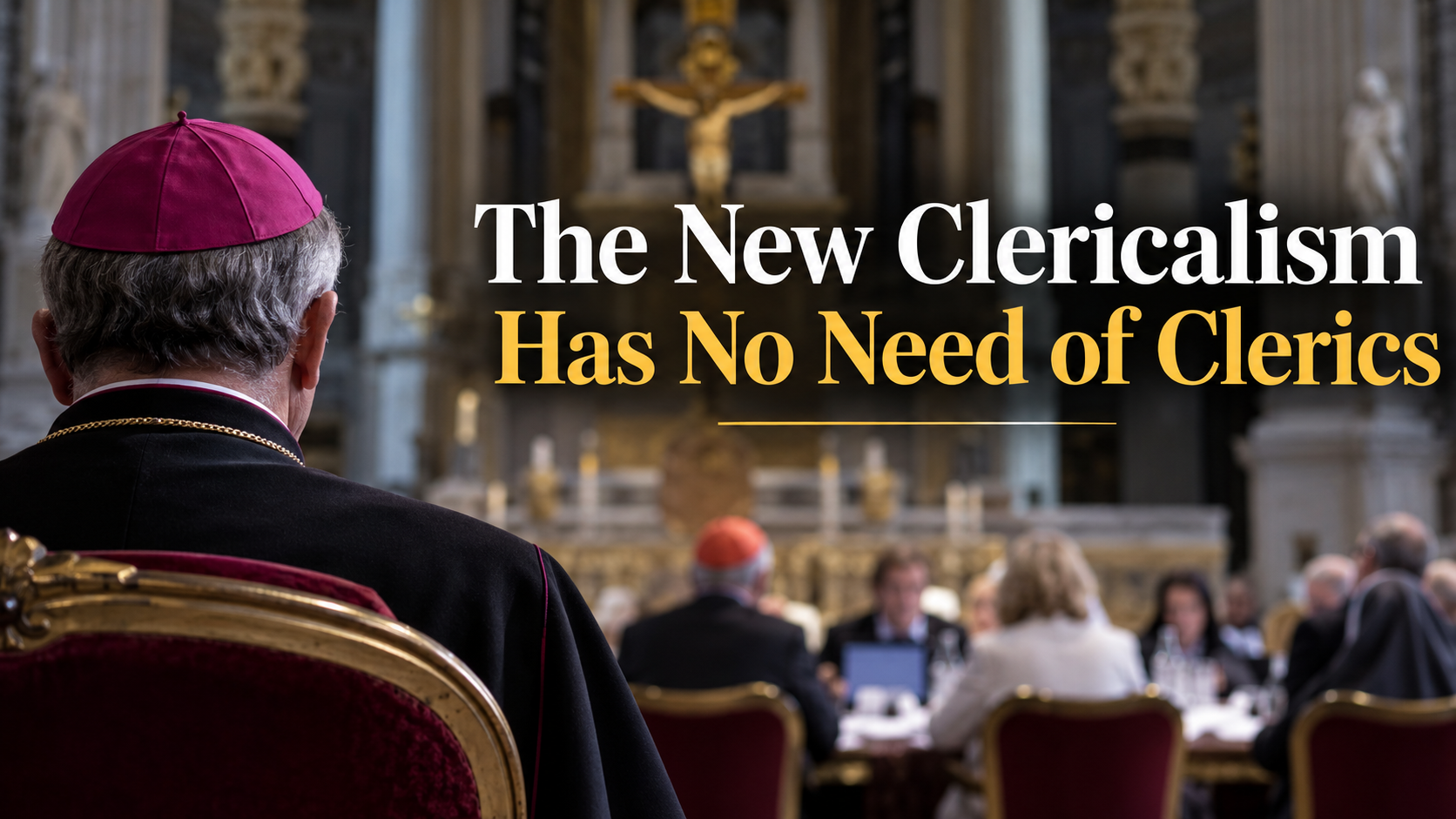
Timothy Kirchoff proposes a Church liberated from clericalism through lay participation and the redistribution of administrative power. But his argument confuses the abuse of authority with its possession, treats episcopal government as a historical accumulation of responsibilities, and overlooks the emergence of a new ecclesiastical bureaucracy whose influence depends neither upon Holy Orders nor upon the consent of the faithful.
The most successful form of clericalism may be the one that no longer requires a cleric. It needs only an ecclesiastical office, a recognised vocabulary, sufficient institutional authority and the conviction that those directing the Church’s affairs are uniquely qualified to determine what ordinary Catholics ought to believe, practise and become. Vestments are optional. Ordination is unnecessary. The old assumption that Father knows best survives remarkably well when Father has been replaced by a diocesan official, a theological consultant or a facilitator of ecclesial discernment.
This is the difficulty at the heart of Timothy Kirchoff’s Clerics Without Clericalism, published in Commonweal on 1 October 2026. Kirchoff presents Popes Francis and Leo XIV as pursuing a Church in which lay Catholics assume greater responsibility for administration while priests and bishops are freed to concentrate upon their distinctive sacramental and evangelical vocation. He regards the development as an answer to clericalism: the misuse of ecclesiastical position, the treatment of ordained status as personal privilege, and the assumption that meaningful service in the Church must involve the acquisition of clerical power.¹ His article contains several legitimate criticisms of ecclesiastical culture. Its weakness is that the proposed remedy rests upon an inadequate distinction between administrative work and the sacred authority by which the Church is governed.
Kirchoff is not advocating the indiscriminate transfer of priestly functions to the laity. Indeed, he approves the preservation of the distinction between ordained and lay ministry, and recognises that the liturgical homily belongs properly to those authorised by sacred orders. He also rejects the suggestion that a woman’s dignity or influence should depend upon acquiring a clerical title. These are substantial concessions, and any fair response must acknowledge them. The issue is not whether his account explicitly denies the sacramental priesthood. It does not. The issue is whether his understanding of ecclesiastical government leaves the episcopal office possessing its full theological character, or gradually reduces it to a sacramental vocation accompanied by administrative powers which history has unnecessarily attached to it.
That distinction is decisive. A bishop may delegate financial management, property administration, employment responsibilities and innumerable practical tasks without surrendering anything essential to his office. But the government of the Church is not merely one such task. The bishop succeeds the Apostles in a pastoral responsibility traditionally expressed through the threefold office of teaching, sanctifying and governing. He is not simply the principal celebrant of diocesan worship, assisted by an administrative organisation whose constitutional character is essentially interchangeable. His governance belongs to his episcopal office, even though its exercise is regulated by ecclesiastical law and its practical administration may involve extensive cooperation with others.
The mistake becomes apparent when Kirchoff turns to the appointment of the Seven in Acts 6. He interprets the Apostles’ decision to delegate the practical distribution of assistance as evidence that the modern bishop’s executive responsibilities are largely an historical accumulation of institutional power. Yet the passage demonstrates precisely the distinction his argument requires. The Apostles identify the problem, prescribe the means of resolving it and appoint those who will undertake the service. The delegated responsibility is practical; the decision to delegate is governmental. The Apostles do not abandon authority in order to fulfil their ministry. They exercise authority so that their ministry may be fulfilled.
Nor should the appointment of the Seven be treated as an exhaustive account of the sacramental diaconate or as a constitutional blueprint for removing government from the episcopate. The early Church’s developing administrative arrangements must be distinguished from the apostolic authority exercised within them. One may reasonably conclude that bishops ought to delegate more effectively. One cannot infer that their governmental authority is consequently an extraneous addition to their vocation.
Even the Second Vatican Council, so frequently invoked to justify contemporary ecclesiastical reconstruction, establishes the contrary. Lumen Gentium teaches that bishops govern their particular Churches as vicars and ambassadors of Christ, exercising a power that is proper, ordinary and immediate, although subject to regulation by the supreme authority of the Church. It expressly identifies their duty to legislate, judge and regulate matters concerning worship and the apostolate.² These are not merely the duties of an ecclesiastical managing director. They are manifestations of sacred pastoral authority. The contingent means of carrying them out may change; the episcopal responsibility itself remains.
The distinction requires further canonical precision. Sacramental consecration, ecclesiastical office, jurisdiction and the exercise of particular administrative responsibilities are related realities, but they are not identical. Episcopal consecration confers the fullness of Holy Orders; the lawful exercise of governing authority is determined within the Church’s hierarchical communion and canonical constitution. Not every ordained priest possesses the jurisdiction of a diocesan bishop, and not every person exercising responsibility within an ecclesiastical institution possesses the sacred power attached to episcopal office. Canon 129 identifies those in sacred orders as qualified for ecclesiastical governance according to law, while recognising that lay members of the faithful may cooperate in its exercise.³ Other canonical provisions permit laypersons to hold suitable ecclesiastical offices and fulfil responsibilities which do not require sacred orders. The proper juridical scope of that cooperation must be respected, rather than obscured by either an exaggerated clerical exclusivity or an undifferentiated account of lay empowerment.
Consequently, the appointment of a lay administrator does not itself demonstrate either the abandonment of clericalism or the diminution of episcopal authority. Everything depends upon the nature of the office, the source and limits of its competence, the manner in which it is exercised, and the accountability accompanying it. A competent lay financial officer may serve a diocese admirably. A lay ecclesiastical official who treats appointed status as a licence to regulate the religious lives of others according to personal ideological preferences may reproduce clericalism perfectly well without ever having received Holy Orders.
This is where Kirchoff’s argument begins to encounter the historical evidence examined in Nuntiatoria’s earlier commentary. In The Most Clerical Revolution in Modern Catholic History, published on 21 August, the supposed emancipation of the laity through the post-conciliar reforms was subjected to precisely the distinction between intention, participation and institutional control.⁴ Whatever the aspirations of those who welcomed reform, the transformation of Catholic liturgical and ecclesiastical life was principally conceived, authorised and implemented through bishops, priests, theologians, commissions, seminaries and professional ecclesiastical institutions. Lay Catholics were frequently its intended beneficiaries and sometimes its enthusiastic supporters. They were not thereby its principal architects.
This matters because the language of participation can conceal the actual location of authority. A consultation may be extensive without determining the subsequent policy. The faithful may be invited to contribute without possessing any control over how their contributions are interpreted. A reform may be promulgated for their benefit without having originated in their expressed wishes. None of these circumstances necessarily invalidates the reform: legitimate ecclesiastical authority can act without obtaining a popular mandate. The difficulty arises when an exercise of authority from above is subsequently presented as though it were the spontaneous demand or collective achievement of those below.
The distinction is not merely historical. It is visible in the contemporary understanding of synodality.
Kirchoff describes synodal dialogue as bringing participants together on terms of fundamental equality, seeking understanding rather than imposing agreement, and producing documents that principally express what participants have been able to discover together. This may describe an aspiration towards courteous and constructive consultation. It does not adequately describe the constitutional operation of the recent synodal process, still less the authority which its conclusions have subsequently been accorded.
On 25 November 2024, Francis issued a note accompanying the Final Document of the Synod on Synodality. He declared that the document would form part of the ordinary Magisterium of the Successor of Peter and asked that it be accepted accordingly. He acknowledged that it was not strictly normative and that implementation would require further mediation. Nevertheless, he directed local Churches to make decisions consistent with its authoritative indications and required bishops to report upon their implementation.⁵ These qualifications prevent the text from being mistaken for an infallible doctrinal definition or a comprehensive legislative code. They do not permit it to be characterised as merely a record of voluntary agreement among equal participants.
Here Kirchoff’s account fails to confront the constitutional reality. The process is presented in the language of shared discernment, but its authoritative conclusions depend upon papal approval, and their implementation remains subject to the Church’s governing structures. There is nothing intrinsically improper about this. Popes and bishops may consult widely before teaching or governing. The problem is the suggestion that consultation constitutes a new source of ecclesiastical authority, or that participation in a process gives its eventual conclusions a legitimacy independent of the office which approves and promulgates them.
It is especially important not to confuse the authority of a document with the authority of every proposition contained within it. A papal text may include doctrinal teaching, pastoral encouragement, prudential assessments and proposals for institutional implementation. These are not necessarily equivalent in character or weight. Authentic reception requires attention to what is actually being taught, the manner in which it is proposed and its relationship to the Church’s received doctrine. The duty to recognise legitimate ecclesiastical authority does not abolish theological distinctions. Indeed, without them the very language of authority becomes susceptible to abuse.
Nuntiatoria addressed the institutional implications in Synodality for the Initiated: How Collegiality Became Permanent Process, published on 14 July.⁶ The article examined how the Synod of Bishops, established by Paul VI to assist the Roman Pontiff through episcopal consultation, had developed into a much wider and increasingly permanent apparatus of ecclesiastical participation. Its concern was not that lay Catholics were being heard. It was that the interpretation of their contributions was passing through successive structures of consultation, synthesis, evaluation and implementation, each possessing the capacity to influence the meaning eventually attributed to what the faithful had said.
Archbishop Paul Coakley’s warning that synodality risked becoming the preserve of specialists and the initiated gave particular force to the criticism. An ecclesiastical process ostensibly designed to make ordinary Catholics more fully involved had generated a professional vocabulary and administrative culture requiring extensive explanation before those same Catholics could participate effectively. Facilitators, consultants, synthesis teams and appointed experts acquired increasing influence through their ability to frame questions, select themes, reconcile disagreements and formulate conclusions. Such influence is not necessarily illegitimate. Expertise is useful, and large consultations require organisation. But its existence must be acknowledged, especially when the resulting documents are presented as expressions of the discernment of the People of God.
The earlier Nuntiatoria analysis also highlighted the very limited proportion of Catholics participating in the initial worldwide consultation. Estimates based upon the available reporting suggested participation amounting to less than one per cent of the global Catholic population, although the figures depend upon how participation is counted and the completeness of national returns. A small consultation can yield valuable insights. It cannot reasonably be treated as a representative expression of the convictions of the universal faithful without substantial qualification. The danger is not simply that few Catholics have spoken. It is that those entrusted with interpreting what was said may acquire the practical power to speak in the name of the many who did not.
This is a genuine form of ecclesiastical influence, even where it is neither jurisdictional nor sacramental. Those who control the process may not possess authority to legislate or teach in their own name. Yet they may exercise considerable influence over the information upon which bishops act, the alternatives placed before them and the vocabulary within which decisions are subsequently explained. Formal authority remains with the hierarchy; practical influence may be distributed through an extensive professional apparatus. The two realities should not be confused, but neither should the second be dismissed merely because it lacks the canonical character of the first.
Kirchoff’s treatment of clericalism gives insufficient attention to this distinction. He is rightly concerned that sacred office should not become a means of personal domination. Yet he appears considerably more optimistic about the transfer of practical responsibility to those outside the ordained ministry than the available institutional evidence warrants. If clericalism means the assumption that ecclesiastical status confers privileged insight, influence and freedom from ordinary accountability, the pathology can survive the transfer almost unchanged. It is quite possible to remove a priest from an administrative office while preserving every objectionable feature of the culture in which that office operates.
The historical investigation discussed in Nuntiatoria’s September editorial, The Revolution Had an Office, provides a concrete illustration.⁷ Hanael Bianchi’s archival study of post-conciliar change in Baltimore, as examined by Dr John Pepino, identified both the clerical actors who drove particular reforms and the bureaucratic structures through which their programme became institutionally durable. The significance lay not simply in identifying priests who favoured change. It lay in showing how seminaries, diocesan departments, committees and administrative procedures could preserve an outlook long after its original promoters had retired or departed.
That evidence must not be inflated into a universal history of every diocese. Baltimore cannot establish that identical events occurred everywhere. Nor does institutional continuity prove that the policies preserved by an institution are necessarily mistaken. It establishes something more precise and relevant: ecclesiastical ideas become remarkably difficult to challenge once they have acquired permanent offices, personnel, budgets, systems of formation and procedures of implementation. Their authority may eventually be experienced less as the consequence of explicit theological argument than as the ordinary operation of an institution.
A reforming cleric may die. The department he established can continue to employ people who have never questioned his premises. A theological preference may become an administrative policy; the policy may become a standard of professional competence; the standard may eventually be invoked as though it were simply the teaching of the Church. The mechanism is neither mysterious nor necessarily conspiratorial. It is an ordinary feature of institutional life. Precisely for that reason, those who denounce clericalism should examine it with particular care.
Kirchoff’s discussion of conscience introduces a related ambiguity. He rightly criticises the habit of dismissing unwelcome papal or episcopal statements as inappropriate political interventions simply because they disturb existing convictions. Catholics must allow the Gospel to judge their politics. The Church has every right to teach the moral principles governing human conduct, including conduct within public life. Yet it does not follow that every papal observation concerning contemporary political circumstances is equivalent to definitive moral doctrine, or that disagreement with a prudential judgement necessarily indicates a malformed conscience.
Catholic obedience is not indiscriminate agreement. The faithful owe assent and obedience according to the character of the authority exercised and the nature of what is proposed. Doctrine, disciplinary legislation, pastoral instruction, political assessment and personal opinion must not be collapsed into one undifferentiated category of ecclesiastical speech. To distinguish them is not to deny the Church’s authority. It is to take that authority seriously enough to understand what it actually requires.
Equally, the legitimate freedom of conscience does not mean that doctrine becomes a matter of negotiated agreement. Conscience must be formed by truth; it does not create truth. The Church has received a deposit of faith which she is obliged to guard, explain and transmit. She may consult the faithful concerning their circumstances, needs, difficulties and understanding. She may seek prudent applications of doctrine in changing conditions. She cannot determine through consultation whether revealed truth remains binding.
That was the essential distinction developed in When Listening Has a Predetermined Answer, also published by Nuntiatoria on 21 August.⁸ The Church is receptive before she is deliberative. She hears the Word of God before she considers the opinions of her members. Her sacramental constitution and apostolic commission precede every committee, assembly and process of discernment. The responsibility of legitimate ecclesiastical authority is therefore not to discover what the Church might become, but to ensure that what she has received is faithfully preserved and effectively communicated.
This does not render consultation pointless. Quite the opposite. A bishop who listens carefully to his clergy and people is better placed to understand their spiritual condition, the obstacles confronting their families and the pastoral consequences of his decisions. But consultation serves his responsibility to govern; it does not replace it. Nor should those who organise consultation acquire an unacknowledged authority to determine which testimony is worthy of reception. The person who formulates the official synthesis may exercise less visible power than the bishop who approves it, but the power to interpret others’ contributions can be consequential.
Traditional Catholics have particular reason to recognise the danger. Their attachment to the inherited Roman liturgy, the older sacramental disciplines and the theological continuity of Catholic worship is frequently explained by critics in terms of rigidity, nostalgia or resistance to ecclesiastical authority. Such diagnoses are sometimes offered without seriously examining the arguments upon which that attachment rests. Yet a genuine process of ecclesiastical listening must be capable of receiving testimony which calls its governing assumptions into question.
The issue is not whether every Traditionalist criticism is correct. Traditional Catholics are no more immune from error, exaggeration or imprudence than any other members of the Church. Nor does attachment to Tradition confer an unrestricted right to disregard legitimate ecclesiastical discipline. The issue is whether the arguments advanced can be examined according to doctrine, history, law and pastoral justice, rather than dismissed through categories which make their very disagreement evidence of an allegedly defective ecclesial disposition.
A synodal institution which welcomes criticism of clerical power but treats criticism of its own preferred reforms as resistance to the Holy Spirit has not overcome clericalism. It has merely changed the circumstances under which obedience is demanded. The same caution applies to the use of the term clericalism itself. It becomes a weapon of institutional power when its meaning is determined chiefly by whether a person supports or opposes the prevailing ecclesiastical programme.
At this point Kirchoff’s appeal to St Ignatius of Antioch becomes especially revealing. He invokes Leo XIV’s exhortation that those exercising ecclesiastical authority should make themselves small so that Christ may be known and glorified. This is a worthy principle. The bishop who uses his office to magnify himself betrays the Lord whose authority he serves. Yet Ignatius is an extraordinary witness to employ in an argument which risks treating episcopal government as an accumulation of worldly power. His letters insist upon the visible unity of the Church around her bishop, the ordered relationship between bishop, presbyters and deacons, and the indispensable significance of ecclesiastical communion.
Ignatius did not suppose that humility required episcopal authority to be displaced into an administrative apparatus. He understood that authority and personal sanctity were not competing principles. The bishop must be humble precisely because his office is sacred; he must exercise his responsibilities faithfully precisely because they are not his private possession. The legitimate exercise of ecclesiastical government is not an obstacle to making Christ visible. Properly exercised, it is one of the means by which Christ continues to shepherd His Church.
The answer to clericalism is therefore neither the preservation of every clerical privilege nor the progressive reassignment of ecclesiastical responsibilities to a professional laity. It is the restoration of the proper relationship between office, authority, vocation and supernatural purpose. Bishops must govern because they are successors of the Apostles, not because they aspire to managerial control. Priests must teach, sanctify and shepherd according to their office, not because ordination confers personal superiority. Lay Catholics must fulfil their apostolate in the Church and in the world, not because ecclesiastical promotion is the measure of their baptismal dignity.
That last point deserves particular emphasis. The Catholic father instructing his children, the mother forming a household in prayer, the teacher transmitting the faith, the physician defending the sanctity of life and the worker conducting his profession according to Christian justice do not require a diocesan appointment to participate fully in the Church’s mission. Indeed, their apostolates may accomplish considerably more for the salvation of souls than many hours of ecclesiastical consultation. The dignity of the laity is diminished, not enhanced, when their contribution is measured principally by the number of institutional offices opened to them.
Pius XII had already explained this in Mystici Corporis Christi, long before the contemporary campaign against clericalism acquired its distinctive vocabulary. The Church is one Mystical Body possessing different members, offices and functions, all animated by the supernatural life of Christ.⁹ Equality in baptismal dignity does not require identity of ecclesiastical function. Neither does diversity of office justify personal domination. The Church’s constitution is not a competition between clerical and lay estates, each seeking a more favourable distribution of institutional authority. It is an ordered participation in a mission whose origin and end are divine.
This is what Kirchoff’s argument ultimately fails to keep sufficiently in view. He considers at length the distribution of responsibility and the possibilities for institutional transformation. The more fundamental question is what all ecclesiastical responsibility exists to accomplish. The Church’s purpose is not the production of a model administrative culture, however agreeable its procedures may be. It is the glory of God and the salvation of souls. Her hierarchy, sacraments, discipline, teaching office and apostolates exist to serve that end.
The effectiveness of any reform must therefore be judged by more than participation, representation or administrative efficiency. Does it assist the Church to preach the faith more clearly? Does it strengthen sacramental life, foster vocations, encourage conversion and support Catholic families? Does it help bishops govern justly and priests sanctify faithfully? Does it lead the faithful towards holiness? A process which cannot demonstrate its contribution to these ends should not be presumed successful merely because it has produced a larger apparatus of consultation.
There is a legitimate place for administrative reform, greater lay cooperation and more effective delegation. There is no theological necessity to maintain every historically inherited arrangement of diocesan management. But the distinction between the Church’s divine constitution and her changeable administrative practices cannot be sacrificed to the rhetoric of emancipation. The abuse of authority is not corrected by obscuring its source. Institutional domination is not overcome by removing the Roman collar from those who exercise it.
Kirchoff is right to desire a Church free from clerical ambition and the misuse of ecclesiastical office. He is wrong to suppose that a redistribution of institutional functions, accompanied by synodal procedures, provides sufficient evidence that such a Church is emerging. The history of post-conciliar reform, the development of the synodal apparatus and the continuing influence of professional ecclesiastical structures suggest a less reassuring possibility: clericalism can outlive the clergy who established it, reproduce itself through bureaucracy and flourish beneath the language of participation.
The decisive question is not how many clerics remain in administration. It is whether every person exercising ecclesiastical responsibility recognises the limits of that responsibility, its accountability to legitimate authority, and its subordination to the faith entrusted to the Church.
A bishop who governs faithfully is not a clericalist for being a bishop. A priest who defends doctrine is not a clericalist for being a priest. A lay official who controls ecclesiastical policy does not cease to exercise institutional power because he or she has never been ordained.
The old clericalism claimed that Father knew best. The new clericalism insists that the process knows best. Neither is an adequate substitute for fidelity to what Christ has entrusted to His Church.
¹ Timothy Kirchoff, “Clerics Without Clericalism”, Commonweal, 1 October 2026.
² Second Vatican Council, Lumen Gentium, 21 November 1964, §§20–21, 27.
³ Code of Canon Law, “The Power of Governance”, canons 129–144, especially 129 and 131.
⁴ Nuntiatoria, “The Most Clerical Revolution in Modern Catholic History”, 21 August 2026.
⁵ Francis, “Note Accompanying the Final Document of the XVI Ordinary General Assembly of the Synod of Bishops”, dated 24 November, published 25 November 2024.
⁶ Nuntiatoria, “Synodality for the Initiated: How Collegiality Became Permanent Process”, 14 July 2026.
⁷ Nuntiatoria, “Unpacking the Clerical Revolution of Vatican II in Baltimore”, 18 September 2026 (editorial headline: “The Revolution Had an Office”).
⁸ Nuntiatoria, “When Listening Has a Predetermined Answer”, 21 August 2026.
⁹ Pius XII, Mystici Corporis Christi, 29 June 1943.



Leave a Reply