
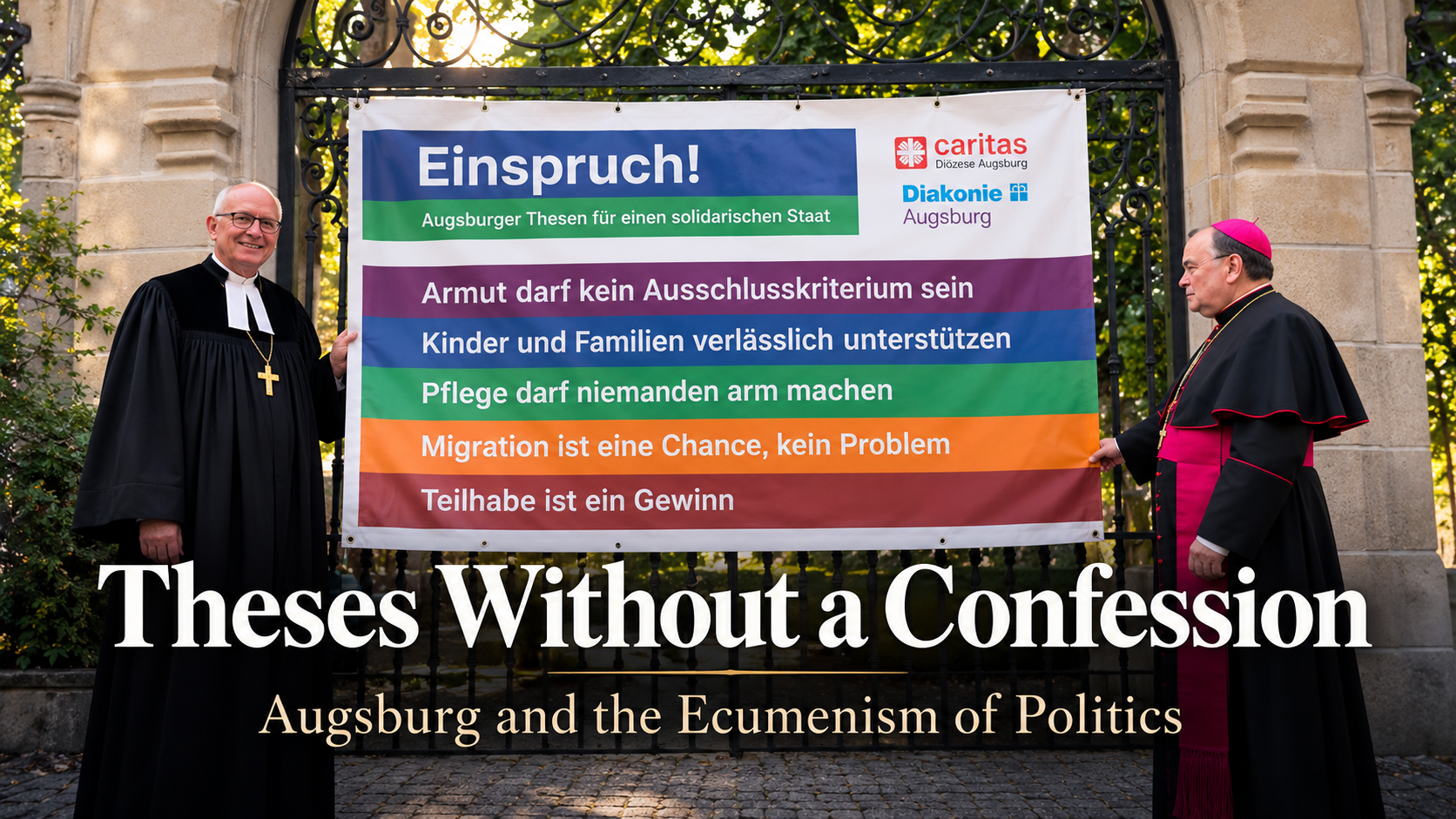
At Augsburg’s historic St Anna, Catholic and Lutheran leaders have staged a deliberate new “posting of theses” concerning poverty, families, care, migration and participation. Many of the principles invoked belong properly to Christian social teaching. Yet the spectacle exposes a striking inversion in contemporary ecumenism: separated Christians can proclaim prudential political judgements with remarkable corporate confidence while the doctrinal and sacramental questions which divided Western Christendom remain unresolved. Social cooperation may serve Christian unity. It cannot become its substitute.
Augsburg has acquired another set of theses. On 26 September, outside the Evangelical church of St Anna, the Catholic Bishop of Augsburg, Bertram Meier, and Lutheran Regional Bishop Klaus Stiegler joined Caritas and the Diakonie in what the organisers themselves called a symbolic Thesenanschlag — a posting of theses. After an ecumenical service the two bishops unfurled a large banner headed Einspruch! — “Objection!” — bearing five propositions: poverty must not become a criterion for exclusion; children and families must receive reliable support; care must not impoverish anyone; migration is an opportunity rather than a problem; and participation is a gain.¹
The five sentences were not improvised expressions of Christian goodwill. Caritas Augsburg had prepared a policy paper containing nine demands for what it calls a “solidaristic state” and coordinated them with the Diakonie. Five were selected as the public core of the campaign. Caritas described them as guidelines for good social policy and explicitly connected them with forthcoming reform of the German welfare state.² Markus Müller, diocesan director of Caritas, told BR24 that the purpose was to send a political signal particularly towards Berlin and Munich. He acknowledged the need for reform of social expenditure while opposing general reductions which, in the organisations’ judgement, would fall disproportionately upon the weakest.³ Whatever conclusions one reaches about the policies involved, this was therefore an intentionally ecclesiastical intervention in a live political debate, not merely an abstract meditation upon Christian charity.
That distinction matters because much of what appears on the Augsburg banner begins from principles no Catholic should find alien. Poverty is morally significant. Families deserve protection. The sick, elderly and disabled are not economic liabilities whose dignity varies according to their cost to society. Christians possess obligations towards the stranger and the vulnerable. Catholic social doctrine speaks unmistakably of the dignity of the human person, the common good, solidarity, the social priority of the family and a particular solicitude for the poor. Bishop Meier was therefore on recognisably Catholic ground when he insisted upon the inviolability of human dignity and upon society’s responsibilities towards its weaker members.¹
But Catholic social doctrine also insists upon subsidiarity, and here slogans are no longer sufficient. The Compendium of the Social Doctrine of the Church describes subsidiarity as one of the Church’s most constant principles of social philosophy. Higher authority should assist persons, families and intermediate bodies when necessary, but it should not unnecessarily absorb functions which properly belong to them. Solidarity without subsidiarity tends towards centralisation; subsidiarity without solidarity can become abandonment. Catholic social doctrine requires both.⁴
That balance immediately establishes an important distinction between moral principle and prudential policy. The Church can teach that the family deserves protection without thereby revealing the precise structure of family benefits. She can teach the obligation of justice towards the poor without defining one universally obligatory level of public expenditure. She can insist upon the dignity of those requiring long-term care without canonising one insurance model, taxation regime or administrative mechanism. Catholic principles judge politics, sometimes decisively; they do not transform every technical question of government into a proposition of faith.
The Congregation for the Doctrine of the Faith stated the distinction with considerable precision in its 2002 Note concerning Catholics in political life. Catholic citizens possess legitimate freedom to choose among political judgements compatible with faith and the natural moral law, and the complexity of temporal affairs can produce a plurality of morally acceptable policies. It is not ordinarily the Church’s task to prescribe one specific political solution to contingent questions which remain within responsible human judgement. At the same time, plurality cannot be invoked against moral principles which admit of no legitimate compromise.⁵ The distinction is essential: there are things which Catholics may not morally endorse, and there are other questions upon which faithful Catholics applying the same moral principles may reasonably disagree.
The fourth Augsburg thesis demonstrates the problem especially clearly: “Migration is an opportunity, not a problem.”¹ Its accompanying explanation presents well-managed migration as conducive to integration and economically beneficial. That may be defended as a political, demographic or economic judgement. It is not, however, an adequate summary of Catholic doctrine concerning migration. The Catechism teaches that prosperous nations are obliged, according to their capacity, to welcome foreigners seeking security and the means of livelihood unavailable in their countries of origin. In the same treatment it recognises the authority of governments to regulate immigration according to the common good and states that immigrants acquire duties towards the countries which receive them.⁶
Catholic teaching consequently refuses two reductions at once. The migrant cannot simply be reduced to a problem, because he is first a human person possessing God-given dignity. Migration cannot simply be declared not to present problems either, because large movements of peoples create real questions of capacity, social cohesion, public order, economic consequence, integration and justice towards both newcomers and existing communities. Governments have duties; migrants have rights and duties; receiving societies possess legitimate common goods; prosperous nations possess obligations towards those genuinely in need. Catholic doctrine establishes those principles without pretending that every particular border, quota, benefit, integration programme or migration policy follows automatically from them.
None of this requires episcopal silence. A bishop who condemns racial hatred, insists upon the human dignity of foreigners, defends the poor from exploitation or teaches the obligations of justice is acting squarely within his pastoral office. The difficulty arises when the moral authority attaching to episcopal teaching becomes indistinguishable from the prudential authority attaching to one particular analysis of social expenditure, migration, taxation or administrative policy. The former can bind conscience because of the truth taught; the latter must ordinarily persuade by the quality of its reasoning.
Yet even that is not the most remarkable aspect of Augsburg. The more revealing question is why these political propositions were presented through a deliberately ecumenical re-enactment of the symbolism of thesis-posting.
The allusion was not invented afterwards by observers. BR24 states expressly that the banner was presented in conscious reference to Luther’s Ninety-Five Theses, and Markus Müller explained the analogy by saying that, as five centuries ago, they were drawing attention to abuses.³ Historical precision is important: the celebrated Ninety-Five Theses belong to Wittenberg in 1517, not Augsburg. But the choice of St Anna in Augsburg gave the symbolism another unmistakable Reformation resonance.
Luther stayed in Augsburg from 7 to 20 October 1518 and met Cardinal Thomas Cajetan on 12, 13 and 14 October. St Anna is inseparably associated with that episode. The dispute already touched fundamental questions of authority, faith and the relationship between Luther’s developing theology and Roman teaching.⁷ Augsburg was therefore not merely a picturesque German location in which to imitate thesis-posting. It was one of the places in which the early conflict between Luther and ecclesiastical authority became unmistakably theological.
Twelve years later Augsburg acquired still greater confessional significance. The Confessio Augustana was presented to Emperor Charles V in 1530 and became the foundational confession of Lutheranism. Its articles addressed matters infinitely more fundamental than the administration of a modern welfare state: God, original sin, justification, ministry, the Church, the sacraments, the Mass, ecclesiastical authority and the disputed practices of the age. Whatever the intentions of Melanchthon and whatever degree of inherited Catholic substance remained within the text, Augsburg thereafter stood among the great landmarks of the division of Western Christendom.
That history gives the 2026 event a deeper irony, because there was once a very different modern Augsburg thesis. During the 1970s, Catholic theologians including Joseph Ratzinger and Vinzenz Pfnür examined whether the Confessio Augustana might be capable of recognition from the Catholic side. In 1976 Ratzinger formulated the remarkable possibility more precisely: not merely Catholic recognition of the Augsburg Confession, but recognition of the Confession as Catholic, with the possibility of a corporate reconciliation that could preserve legitimate distinction within restored communion. Cardinal Kurt Koch’s later account of the debate records both the seriousness of that ambition and its limits: significant Catholic substance could be recognised, but remaining doctrinal problems prevented the Confessio Augustana from becoming a common confession of Catholic and Lutheran faith.⁸
The comparison is illuminating. The earlier Augsburg project asked whether Christians separated by the Reformation could recover sufficient agreement in revealed truth to overcome ecclesial separation. The new Augsburg project discovers agreement concerning the social state. The older conversation examined confession, sacrament, authority and ecclesiology. The new theses address poverty, family assistance, nursing care, migration and participation. The first attempted to confront the doctrinal causes of Christian division. The second demonstrates how readily divided ecclesial institutions can already appear before the public as a united Christian voice when the subject is contemporary social policy.
That does not make their cooperation illegitimate. Unitatis Redintegratio itself encourages cooperation among Christians for the common good and in relieving human suffering. Such work can manifest the genuine bonds which remain among the baptised and can foster better understanding. Yet the Council did not identify social cooperation with the objective of ecumenism. It looked towards the overcoming of obstacles to full ecclesiastical communion and ultimately towards Christians being gathered together in common Eucharistic celebration. It simultaneously warned against false irenicism by which the purity and certain meaning of Catholic doctrine might be obscured.⁹ Social cooperation is therefore capable of serving ecumenism. It is not itself the fulfilment of ecumenism.
This is precisely where the Augsburg spectacle becomes revealing. Contemporary institutional ecumenism can appear most confident where Catholic teaching permits prudential plurality and least visibly united where revealed truth demands doctrinal agreement. On welfare provision, migration and social policy, declarations can be short, categorical and jointly proclaimed. On the sacrificial character of the Mass, the nature of Holy Orders, apostolic succession, sacramental validity, ecclesiastical authority, Tradition and papal primacy, language necessarily becomes slower and more qualified because the differences remain substantive.
The problem is not that the churches care about poverty together. The problem would arise if their ability to agree upon social policy gradually became a functional substitute for confronting the matters which still divide them at the altar. Ecumenism would then no longer principally mean the recovery of unity in professed faith and sacramental communion. It would increasingly mean maintaining confessional separation while demonstrating public solidarity through those political and social causes upon which denominational institutions find it easiest to agree.
That would amount to a quiet inversion of priorities. Questions upon which Catholics themselves may legitimately differ would acquire the rhetorical certainty of common Christian proclamation, while questions which determine ecclesial communion would recede into the permanent background of dialogue. The visible sign of ecumenical success would cease to be progress towards unity of faith and become the frequency with which separated churches can issue the same public statement.
Pius XI addressed a different ecumenical movement and different historical circumstances in Mortalium Animos, but the doctrinal principle underlying his intervention does not depend upon those circumstances. Christian unity cannot be constructed by setting aside incompatible claims concerning revealed truth and replacing unity of faith with association around purposes upon which separated Christians happen to agree. Pius XI specifically rejected the conception of a Christian federation whose members retained contradictory doctrines concerning Tradition, hierarchy, the Eucharist, sacrifice and the invocation of the saints.¹⁰ Those are not merely controversies belonging to a discarded age. They concern the substance of Catholic belief.
Vatican II profoundly altered the method and atmosphere in which Catholics engage separated Christians, but it did not make truth negotiable and it did not redefine the objective as permanent denominational coexistence supplemented by joint activism. Unitatis Redintegratio begins from the scandal of Christian division and directs ecumenical activity towards its overcoming. Its commendation of common action belongs within that purpose. Detached from that purpose, cooperation risks becoming an alternative destination.
The deliberate Luther symbolism at Augsburg therefore deserved more theological caution than appears to have accompanied it. The Reformation cannot be reduced to an inspiring historical example of speaking truth to institutional power. It resulted in ruptured communion, rival ecclesiologies, contradictory accounts of sacrament and authority, and the enduring inability of Christians who share Baptism to share the same altar. Catholics may acknowledge grave abuses preceding the Reformation and the sins of Catholics during its history without turning the symbolic vocabulary of the rupture itself into an uncomplicated motif for contemporary ecclesiastical campaigning.
There is an especially striking irony here. The Confessio Augustana of 1530, despite everything Catholics must contest within and beyond it, attempted to answer the primary theological question: what is true? Melanchthon sought to demonstrate continuity with the ancient Church and to defend his party’s doctrines as authentically Christian. Catholic theologians answered at the level of doctrine because both parties understood that claims about revealed truth were capable of determining communion.
The new Augsburg Theses answer a different question: what can we publicly demand together? It is a legitimate question, but an ecumenically secondary one. A Catholic bishop and a Lutheran regional bishop may possess overlapping convictions about social provision. They may work together for the poor and defend the dignity of the vulnerable. Such cooperation may be admirable in itself. But no amount of agreement concerning the German welfare state can resolve whether the Eucharist is a propitiatory sacrifice, whether Holy Orders is a sacrament transmitted through apostolic succession, whether the Petrine office was divinely instituted with universal jurisdiction, or where Christ’s Church is concretely to be found.
Those questions cannot be displaced indefinitely without changing the meaning of ecumenism itself.
Half a century ago, theologians discussing Augsburg dared to ask whether the sixteenth-century confession contained sufficient Catholic substance to contribute to actual corporate reconciliation. The proposal did not overcome the doctrinal difficulties, but it at least kept the proper end in view: could those divided by the Reformation actually become one in the faith and sacramental life of the Church?
In September 2026, Augsburg supplied a different image: churches which cannot share full communion confidently reproducing Reformation symbolism in order to announce common judgements about the social state. The contrast does not make their concern for the vulnerable false, nor does it invalidate every proposal upon the banner. It does, however, provide a searching test of what contemporary ecumenism believes itself to be for.
The proper measure of Christian unity is not finally how many political propositions Catholics and Lutherans can place beneath the same banner. It is whether the doctrinal divisions which prevent them from standing in full communion at the same altar are still experienced as an intolerable wound to the unity Christ wills for His Church. Social cooperation can assist that work, demonstrate charity and remove inherited hostility. It cannot replace the work itself. If political unanimity becomes more compelling than ecclesial reunion, ecumenism has not reached its destination. It has changed the subject.
- Bistum Augsburg — Ökumenisches Zeichen gegen sozialen Kahlschlag: Neue „Augsburger Thesen“ angeschlagen. Bistum Augsburg
- Caritasverband für die Diözese Augsburg — Augsburger Thesenanschlag der Kirchen, Caritas und Diakonie für einen solidarischen Staat. Caritas Augsburg
- BR24 — „Augsburger Thesen“: Kirchen gegen Sozialkürzungen. BR.de
- Pontifical Council for Justice and Peace — Compendium of the Social Doctrine of the Church.
- Congregation for the Doctrine of the Faith — Doctrinal Note on Some Questions Regarding the Participation of Catholics in Political Life. Vatican
- Catechism of the Catholic Church — §2241, The Authorities in Civil Society.
- Evangelisch-Lutherische Kirchengemeinde St Anna, Augsburg — Luther und Augsburg. St. Anna Augsburg
- Cardinal Kurt Koch, Dicastery for Promoting Christian Unity — Die Katholische Kirche und die Confessio Augustana. Christian Unity
- Second Vatican Council — Unitatis Redintegratio. Vatican
- Pope Pius XI — Mortalium Animos. Vatican



Leave a Reply