
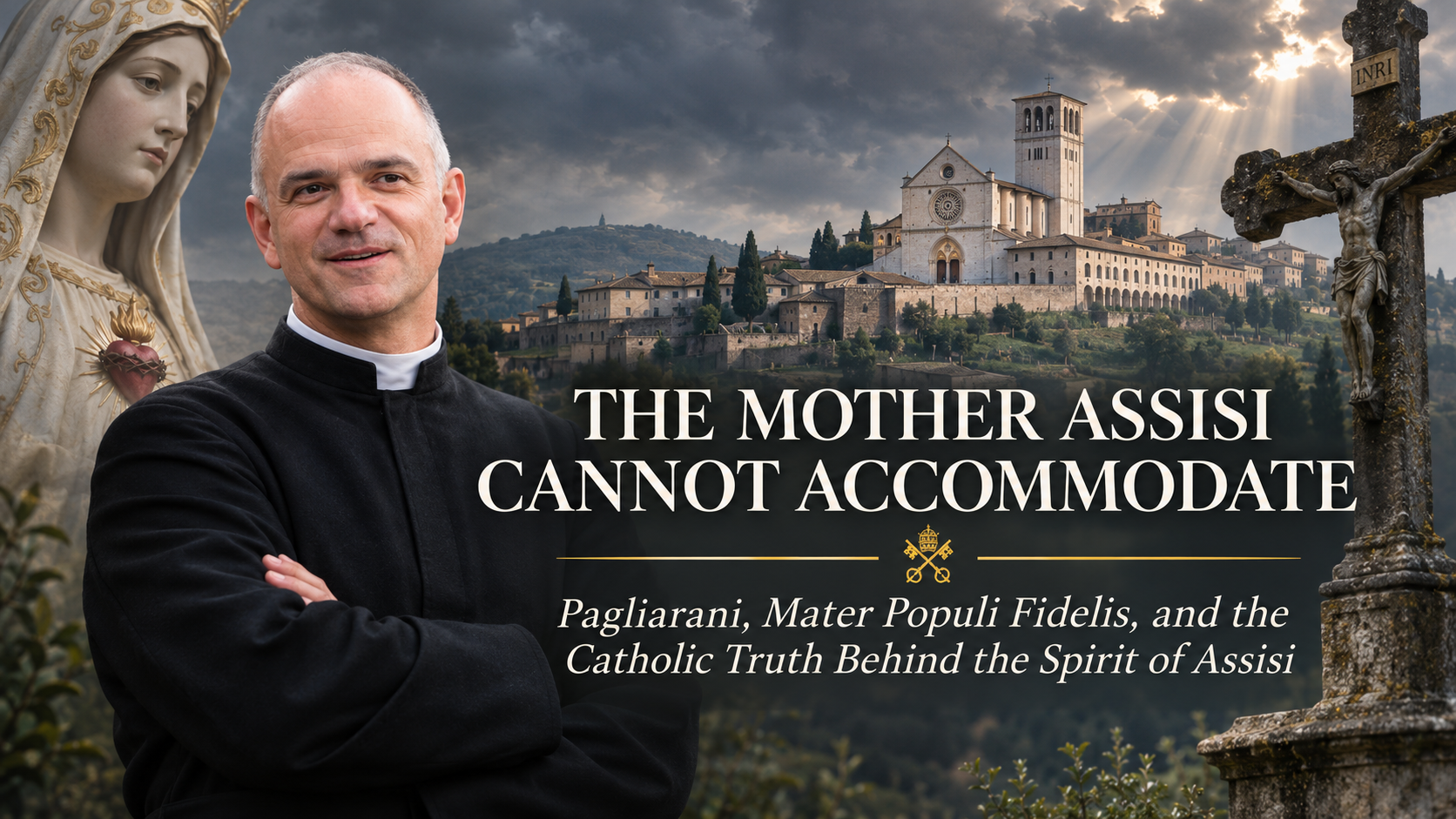
Pagliarani, Mater Populi Fidelis, and the Catholic Truth Behind the Spirit of Assisi
Father Davide Pagliarani’s anniversary letter challenges forty years of interreligious practice and Rome’s recent treatment of traditional Marian titles. His argument reaches beyond the controversy over Co-Redemptrix to the relationship between divine Revelation, supernatural life and the Church’s public confession of Christ. It deserves examination because the doctrinal difficulty he identifies has become increasingly apparent in the very language employed by contemporary ecclesiastical authorities.
Father Davide Pagliarani has chosen an unusually revealing point of departure for his latest criticism of Rome. Writing on 4 November 2026, the Superior General of the Society of Saint Pius X brings together two anniversaries: forty years since John Paul II assembled representatives of the world’s religions at Assisi, and one year since the Dicastery for the Doctrine of the Faith published Mater Populi Fidelis, discouraging the use of certain traditional Marian titles. He considers both events manifestations of a theological tendency which has gradually altered the Church’s manner of speaking about revealed truth. Yet the greater part of his letter concerns neither ecclesiastical diplomacy nor the Society’s differences with the Holy See. Instead, he examines the supernatural life of God, the purpose of Revelation, and the peculiar relationship of the Blessed Virgin Mary to her divine Son. His conclusion is that Our Lady cannot be indifferent to religious error without ceasing to be the Mother whom Catholic doctrine professes her to be.¹
The argument is developed around an ancient liturgical expression, Gaude, Maria Virgo, cunctas haereses sola interemisti in universo mundo: Rejoice, O Virgin Mary, for thou alone hast destroyed all heresies throughout the world. Found in the Western liturgical tradition, including medieval Marian antiphons and chants, these words have a history considerably older than contemporary disputes about ecumenism. They are striking because Mary is usually invoked as the Mother of Mercy, Refuge of Sinners, Comforter of the Afflicted, and Advocate of Christians. To celebrate her as the destroyer of heresies may appear less immediately maternal, particularly to those who have come to regard doctrinal disagreement as an unfortunate impediment to religious fellowship. Pagliarani’s purpose is to demonstrate that the title follows from her maternity itself. The Mother who brings souls to her Son cannot regard with indifference those errors which prevent them from knowing Him.²
This reasoning depends upon an understanding of divine life which the letter develops at some length. God possesses within Himself the fullness of Truth and Goodness, knowing and loving Himself eternally with an infinite perfection beyond the capacity of created intelligence. He has freely willed to communicate a participation in His own life to rational creatures through grace. Revelation belongs to that divine generosity: God makes Himself known so that men may believe in Him, love Him, and ultimately possess Him in the Beatific Vision. Faith, therefore, involves the intellect’s assent to truths revealed by God on His own authority, even though their mysteries exceed the powers of natural reason. The theological virtue of charity unites the soul to God in love, but such union cannot be understood apart from the Truth which God has disclosed. One cannot knowingly reject the God of Revelation and claim, by that very rejection, to have acquired a more authentic understanding of Him.
Pagliarani applies this principle to the Blessed Virgin with considerable theological force. Her Immaculate Conception, fullness of grace and divine maternity place her in a singular relationship with the Incarnate Word. She possesses an intimacy with Jesus Christ granted to no other creature, for she is truly His Mother and He is truly her Son. The humanity assumed by the eternal Word was received from her, and during the hidden years at Nazareth she lived in the closest earthly association with the Person in whom the fullness of divine Revelation dwells. Saint Luke twice records that Mary preserved the events concerning her Son and pondered them in her heart. Pagliarani sees in this contemplation something more substantial than a mother’s recollection of extraordinary circumstances. The Blessed Virgin, already endowed with an incomparable fullness of grace, was continually formed in her knowledge and love of the Incarnate Word, whom she contemplated with a purity and spiritual understanding surpassing that of every other human soul.
From this relationship he develops his account of Marian mediation. Mary’s knowledge of Christ and the supernatural life she received were ordered towards her maternal mission in the Church. Having given the Redeemer to the world, she remains associated with the communication of His grace, always in complete dependence upon Him. Her mediation neither supplies a deficiency in Christ’s Redemption nor establishes another source of salvation. It belongs entirely to the order of grace which proceeds from His merits. The Catholic understanding of Mary’s maternal intercession is consequently inseparable from the truth about her Son. She desires that souls should know Him, receive His grace and attain the supernatural end for which He redeemed them. Error concerning His identity obstructs that purpose, even where the individual holding the error bears no personal culpability for it.
The distinction between objective error and subjective responsibility is essential. A man may profess a false doctrine through ignorance, inherited religious conviction or circumstances which have prevented him from encountering the Catholic Faith adequately. His sincerity may be entirely genuine, and the judgement of his conscience belongs ultimately to God. Nevertheless, sincerity cannot make contradictory propositions equally true. Christianity and Islam cannot both be correct concerning the divinity of Jesus Christ; neither can the Catholic doctrine of the Eucharistic Sacrifice be reconciled with a religious account which denies the sacrificial nature of the Mass. The dignity of those who disagree remains untouched by the recognition of such contradictions. Indeed, Christian charity would become a curious enterprise if respect for another person’s dignity required indifference towards what the Church believes to concern his eternal salvation.
There is a historical reason why Catholic theology has attached such importance to the language of doctrine. The Church’s earliest dogmatic controversies frequently concerned expressions which appeared excessively technical to those unfamiliar with their consequences. At Nicaea, the defence of homoousios protected the confession that the Son is truly God, consubstantial with the Father. At Ephesus, Mary’s title Theotokos safeguarded the unity of Christ’s divine Person against interpretations which threatened to divide the Incarnation. The Fathers did not suppose that a carefully chosen word could exhaust the mystery of God, but they understood that an inadequate expression might permit an erroneous account of that mystery to gain acceptance. The doctrinal formulas adopted by the Church established boundaries within which the faithful might contemplate the truth safely. To alter those boundaries was to alter the faith which they protected.
Saint Pius X addressed the same problem in Pascendi Dominici Gregis, examining the Modernist theory according to which dogmatic formulas arise from religious experience and must be adapted as that experience develops. Such a theory eventually places religious consciousness above Revelation, for the truths professed by the Church become expressions whose authority depends upon their usefulness to successive generations. The danger is especially serious where doctrinal terminology is considered an obstacle to pastoral effectiveness. The language of faith is then increasingly judged according to whether it facilitates religious encounter, rather than whether it adequately conveys what God has revealed. Pagliarani believes that this tendency has entered deeply into contemporary ecclesiastical practice, and he regards the discouragement of traditional Marian titles as an especially revealing example.³
His condemnation of Mater Populi Fidelis is severe. The document, issued under Cardinal Víctor Manuel Fernández on 4 November 2025, declares in paragraph 22 that the title Co-Redemptrix is always inappropriate for expressing Mary’s cooperation in Redemption, because its use risks obscuring Christ’s unique mediation and requires repeated explanation. The note also raises objections to the title Mediatrix of All Graces, particularly where it suggests that Mary independently distributes the grace which comes from God alone. Yet the document acknowledges that earlier popes employed Co-Redemptrix, records the theological development of the expression, and explicitly affirms the singular cooperation of the Blessed Virgin in the saving work of her Son. Its doctrinal purpose is presented as the protection of Christ’s unique redemptive office. An accurate criticism must acknowledge these affirmations rather than attribute to the Dicastery a formal denial of Marian cooperation which its own text contradicts.⁴
Nor can the note’s objections simply be dismissed as an invention of the present pontificate. It cites Cardinal Joseph Ratzinger’s reservations, expressed in 1996 and again publicly in 2002, concerning the clarity and theological adequacy of Co-Redemptrix. He considered the expression liable to obscure the fact that everything Mary possesses comes through Christ, and he questioned whether the proposed doctrine had reached the maturity required for solemn definition. These are serious objections from a theologian whose defence of the integrity of Catholic doctrine can scarcely be characterised as indifference to revealed truth. Their inclusion presents a difficulty for Pagliarani’s interpretation. The fact that an ecclesiastical authority discourages a particular expression does not, without further evidence, establish adherence to the Modernist account of dogma condemned by Saint Pius X.
Nevertheless, the categorical judgement in Mater Populi Fidelis leaves a theological problem which Rome has not satisfactorily resolved. The legitimate meaning of an expression, its suitability for public ecclesiastical use, and the prudence of defining the proposition it conveys as dogma are distinct considerations. Cardinal Gerhard Ludwig Müller pressed precisely this distinction in his October intervention at the De Maria numquam satis conference, subsequently explaining why he had reconsidered his earlier reservations. Nuntiatoria examined his argument in its reports of 9 and 12 October, particularly his contention that the truth expressed by Co-Redemptrix is objectively contained in Revelation and cannot simply be silenced because the terminology requires explanation. Müller’s position does not oblige the Church to proclaim another Marian dogma, but it does require an answer concerning the orthodox theological meaning of an expression which the Dicastery itself acknowledges has been employed by previous pontiffs. The mere observation that uninstructed persons may misunderstand a term would be a precarious principle upon which to regulate the vocabulary of Catholic doctrine. Much of the Church’s theological inheritance requires patient explanation.⁵
Pagliarani’s latest intervention brings this dispute into a wider theological setting. His concern is that the alteration of doctrinal language eventually changes the way Christians understand and contemplate the mysteries of their faith. He illustrates the process through the Holy Sacrifice of the Mass. If the faithful cease to understand that the Eucharistic Sacrifice makes present sacramentally the one Sacrifice of Calvary, offered in an unbloody manner upon the altar, their understanding of worship will inevitably suffer. The sacramental reality remains what Christ instituted, irrespective of deficiencies in individual comprehension, but the believer’s disposition towards that mystery depends considerably upon what he has been taught. Where the sacrificial and propitiatory character of the Mass becomes obscured, Eucharistic devotion may gradually assume the character of a communal religious observance whose principal significance is fellowship. Pagliarani attributes much of this development to the post-conciliar liturgical reform. His historical assessment would require fuller examination, but the theological principle is firmly established: the Church’s worship communicates what she believes, and the manner in which the mysteries are presented affects the supernatural formation of the faithful.
The same principle governs the Church’s public profession of Christ’s Kingship. Pius XI established the feast of Christ the King in 1925 against the growing exclusion of Jesus Christ from the public life of nations. In Quas Primas, he insisted that the authority of Christ extends over all mankind, irrespective of whether individuals or societies acknowledge Him. His sovereignty rests upon His divine Person and His redemptive work; it is consequently neither conferred by Christian allegiance nor suspended by the existence of competing religious claims. The Pope understood the peace of nations to depend ultimately upon the recognition of Christ’s authority, and he considered the treatment of Christianity as simply one religion among others a serious consequence of the secularising tendencies of his age.⁶
It is within this theological tradition that Pagliarani’s criticism of Assisi must be understood. John Paul II’s invitation to representatives of the world’s religions in October 1986 was intended to encourage prayer and a common rejection of violence. The Pope expressly disclaimed religious syncretism, arranged for the different traditions to pray separately according to their respective rites, and permitted their prayers to be offered successively in a common public setting. His concluding address explicitly professed Jesus Christ as the Saviour of all and the source of true peace. Those facts are indispensable to an accurate account of the gathering. Whatever criticisms may be made of its symbolism and subsequent influence, John Paul II did not formally teach that the world’s religions were equally true or that salvation could be obtained independently of Christ.⁷
Benedict XVI defended his predecessor’s intention in a letter marking the twentieth anniversary of Assisi in September 2006. He nevertheless insisted upon the need to prevent religious relativism and the impression that the different traditions were equivalent ways of approaching God. His argument acknowledged that the public form of such gatherings required particular theological care. The organisers’ intentions, however sincere, cannot determine entirely the meaning communicated by the arrangements themselves. A ceremony may expressly disclaim religious equivalence whilst giving spectators reason to suppose that the participants are engaged in substantially similar religious acts possessing a common spiritual value. Distinguishing between coming together to pray and praying together may satisfy an important canonical and theological requirement, but its practical intelligibility cannot simply be assumed. The fact that successive pontificates have found it necessary to explain the distinction indicates that the difficulty has never been entirely resolved.⁸
The original Assisi gathering has since acquired an authority in contemporary ecclesiastical practice considerably greater than that of an isolated pastoral initiative. Its anniversary is celebrated, its example repeatedly invoked, and its guiding assumptions presented as characteristic of the Church’s relations with other religions. Cardinal George Jacob Koovakad, Prefect of the Dicastery for Interreligious Dialogue, went further in October by arguing that the 1986 gathering had entered the ordinary teaching of the Magisterium through its subsequent papal reception. As Nuntiatoria explained in Cardinal Koovakad’s Assisi Error: An Event Is Not Doctrine, the distinction between a proposition taught authoritatively and an historical event employed to illustrate it remains fundamental. The Church may teach the moral duty to seek peace and condemn religious violence without thereby making every arrangement adopted at Assisi a normative expression of Catholic doctrine. The authority of the Magisterium cannot be enlarged by retrospectively investing prudential decisions with the character of revealed truth.⁹
Our earlier examination of the Society’s September pilgrimage to Assisi supplied a rather more practical illustration of the prevailing difficulties. The pilgrims, having travelled to the Basilica of Saint Francis, were refused permission to enter corporately and profess the Nicene Creed at the saint’s tomb, although they could enter individually for private prayer. The Franciscan authorities justified their decision by reference to the Society’s irregular canonical position, while explaining that authorised ecumenical prayer with Christians separated from Rome could legitimately take place under Catholic oversight. Those circumstances were canonically distinguishable, and the Society’s claim that non-Christian rites would be permitted within the Basilica during the October anniversary was expressly denied. Nevertheless, the episode exposed a pastoral incongruity which Nuntiatoria documented in The Creed Outside the Basilica. The organised public profession of the Catholic Creed was prohibited to one group of Catholic pilgrims because of their disputed relationship with Roman authority, whilst authorised religious encounters with separated Christians remained part of the Basilica’s established pastoral practice.¹⁰
The theological problem became particularly apparent during the fortieth-anniversary commemorations themselves. On 27 October 2026, Pope Leo XIV addressed the international gathering at Assisi through a recorded message devoted to peace, prayer, fraternity and the responsibilities of religious believers. Although his appeal concerned entirely legitimate moral objectives, the address contained no explicit proclamation of Jesus Christ, His Incarnation, Resurrection or universal Kingship. Nuntiatoria examined the omission in Peace Has a Name: The King Left Unnamed at Assisi, comparing the address with the Pope’s own earlier Christological teaching on peace. His silence on these doctrines in one speech cannot establish that he personally embraces religious indifferentism, but it illustrates how easily the specifically Christian grounds for a papal appeal may disappear when that appeal is addressed to representatives of other religions.¹¹
The timing was particularly unfortunate. Only two days earlier, Catholics observing the traditional Roman calendar had celebrated the feast of Christ the King, proclaiming His universal sovereignty and renewing the consecration of the human race to His Sacred Heart. The Church’s liturgical prayer acknowledged the authority of Christ over those who do not yet believe in Him and implored their conversion. At Assisi the Roman Pontiff spoke in terms acceptable to a considerably wider religious audience, without explaining the divine authority which the Catholic Church professes her Founder to possess. It was possible to understand and endorse much of his message without sharing the Catholic Faith at all. The contrast exposed a difficulty which the language of pastoral discretion has done little to resolve. Where the Church addresses the world concerning peace, her own understanding of peace ought to be especially relevant. To confine its explicit expression principally to occasions when the audience already believes in Christ is a strange way of fulfilling the missionary commission received from Him.
The implications of Pagliarani’s argument extend to the purpose of dialogue itself. Ecumenism, properly speaking, concerns the restoration of unity among Christians separated from full Catholic communion. Interreligious dialogue involves adherents of religions which do not profess the Christian Revelation. The distinction is important because the theological foundations and permissible forms of these encounters are different. Catholics may cooperate with people of other religions in relieving suffering, protecting human life, defending religious liberty and pursuing a just peace. Such cooperation belongs to the common good and need imply no shared profession of faith. Difficulties arise when religious acts are introduced into that cooperation in a manner which obscures the difference between the worship of the Triune God and religious practices founded upon incompatible understandings of the divine. The Church may respect the consciences of those who do not share her faith without pretending that their religious claims are equally true.
The declaration Dominus Iesus, issued by the Congregation for the Doctrine of the Faith in 2000 under Cardinal Ratzinger, addressed this question with exemplary clarity. It affirmed the definitive character of Revelation in Jesus Christ and rejected theories which understand other religions as independent or complementary paths of salvation. It also recognised that God’s grace may operate in persons who, through no fault of their own, lack explicit knowledge of the Gospel. The Church has never claimed authority to pronounce upon the eternal destiny of every individual who dies outside her visible communion, nor does Catholic doctrine permit the assumption that such persons are necessarily personally culpable for their religious errors. But whoever is saved is saved through the merits of Jesus Christ, whose mediation remains unique and universal. The operation of grace beyond the Church’s visible boundaries does not confer upon contradictory religious systems a salvific authority independent of Him.¹²
This distinction bears directly upon Pagliarani’s presentation of Our Lady. His description of her as fundamentally opposed to ecumenism is deliberately provocative and ought not to be interpreted as opposition to the reconciliation of separated Christians or to legitimate cooperation with non-Christians. Properly understood, his criticism concerns religious indifferentism and any form of ecclesiastical activity which treats the exclusive claims of Christ as negotiable. Mary’s maternal solicitude must include concern for those who do not yet know her Son, because the supernatural life she desires for them proceeds from Him alone. Her opposition to error, in this sense, arises from the same charity which impels the Church to evangelise. The Catholic missionary does not announce the Gospel because he despises the religious convictions of those who have not received it. He announces it because he believes that God has revealed a truth intended for their salvation.
There is an important theological qualification here which strengthens rather than diminishes Pagliarani’s argument. The Blessed Virgin is not the principal author of grace, nor does the traditional acclamation that she alone has destroyed heresies establish a separate redemptive authority or a personal power independent of Christ. The language of the liturgy celebrates the singular dignity of the Mother of God and the victory of her Son in which she participates. Mary’s mediation is subordinate to His, and the precise manner in which she cooperates in the distribution of grace remains a matter of legitimate theological study. The Second Vatican Council’s Lumen Gentium expressly retained the title Mediatrix whilst insisting that Mary’s maternal function neither obscures nor diminishes the unique mediation of Christ. John Paul II subsequently explained the title in the same terms. Such teaching provides the doctrinal foundation upon which Marian devotion must rest, whatever judgement is reached concerning the additional expressions discouraged by Mater Populi Fidelis.¹³
Pagliarani is therefore strongest where he demonstrates the connection between Mary’s maternal office and the integrity of the faith which brings souls to supernatural life. His accusation that Modernism has triumphed throughout contemporary ecclesiastical practice requires more discrimination than the letter itself sometimes provides. The theological reservations of Cardinal Ratzinger concerning Co-Redemptrix cannot fairly be explained through the same categories as religious indifferentism, and the official teaching of John Paul II and Benedict XVI concerning the unique mediation of Christ is more explicit than Pagliarani’s account of Assisi suggests. These qualifications should prevent the legitimate criticism of particular ecclesiastical practices from developing into an indiscriminate condemnation of everything associated with recent pontificates.
Yet the cumulative evidence of the present controversy cannot be dismissed through those qualifications. For several decades the Church has increasingly employed a public religious vocabulary intended to facilitate encounter with those who do not share her doctrines. The purpose may be generous, and the practical benefits of cooperation should not be despised. But the recurring reluctance to express those doctrines which distinguish Christianity from other religions has consequences. It influences what the faithful hear from their pastors, what the world understands the Church to believe, and what ecclesiastical authorities themselves appear to regard as essential to their public mission. A doctrine may remain formally affirmed in official documents whilst receiving progressively less attention in the ordinary exercise of pastoral authority. The resulting change is difficult to quantify, but it is no less real for being gradual.
The controversy over Marian titles is especially revealing because the Church’s devotion to Our Lady has always depended upon a body of precise theological truths. Her divine maternity presupposes the Incarnation; her Immaculate Conception depends upon the anticipated merits of Christ; her Assumption manifests the supernatural destiny promised to those redeemed by Him. Her maternal intercession belongs within the economy of grace established by the Redeemer. Remove these doctrines and the Blessed Virgin becomes little more than an admirable religious figure, capable of receiving affection from people who possess radically different understandings of her Son. She may remain an object of sentimental regard, but the reasons for her singular dignity have disappeared.
Pagliarani recalls an incident which, if accurately reported, provides a curious illustration. According to his letter, pilgrims from southern Italy arrived at Assisi in October 1986 carrying a statue of Our Lady of Fatima, apparently hoping that the Queen of Peace might be included in the gathering. The organisers, he says, turned them away because the statue would have interfered with the scheduled ceremonies. The story had already appeared in a Society publication in 2007, although independent contemporary documentation has not been established. Its factual limitations should be acknowledged. Even so, the anecdote has acquired its force from the theological difficulty it is employed to illustrate. A religious gathering devoted to peace under Catholic auspices ought not to find the explicit claims of Catholic doctrine an embarrassment.¹⁴
Our Lady of Fatima is a particularly awkward figure for any religious account which treats peace principally as the outcome of mutual goodwill. Her message included the necessity of repentance, conversion and prayer, together with warnings concerning sin and its consequences. Whatever legitimate questions may arise concerning the interpretation of particular private revelations, the essential themes of Fatima are unmistakably Catholic. They presuppose the reality of supernatural grace, the consequences of sin, the necessity of conversion and the saving work of Jesus Christ. None can be accommodated within an understanding of religious fellowship which regards adherence to revealed truth as a secondary consideration.
The Catholic Church is called to preach the Gospel to all nations, and that commission has never depended upon the prior agreement of those to whom it is addressed. The Apostles did not understand the religious differences of the ancient world as sufficient reason to withhold the proclamation of Christ. Saint Paul, speaking at the Areopagus, recognised the religious disposition of his Athenian hearers and drew upon what was familiar to them; he nevertheless proceeded to announce the God whom they did not know, the necessity of repentance and the Resurrection of the man appointed to judge the world. His charity towards his audience did not require him to leave their existing religious convictions undisturbed. He treated them as rational persons capable of receiving an account of truth, even when some responded with ridicule.
There is an ecclesiastical lesson here which contemporary diplomacy would do well to recover. Respectful encounter requires honesty concerning what each participant believes. A Catholic bishop may speak courteously with a Muslim, a Hindu or an adherent of another religion without surrendering his conviction that Jesus Christ is the Incarnate Son of God. He may work alongside them for peace without inviting them to participate in acts of common worship whose meaning remains theologically uncertain. The obligation to treat all men with charity arises from the very faith which he professes. Where that faith is concealed for fear of causing offence, the dignity of the listener is scarcely enhanced. It may simply indicate that the speaker considers him incapable of receiving an honest account of Catholic belief.
Pagliarani’s letter does not resolve every question concerning Marian terminology, nor does it establish that every form of interreligious encounter modelled upon Assisi is necessarily an act of religious indifferentism. It does, however, identify a contradiction which ecclesiastical authorities cannot indefinitely avoid. The Church continues to teach the uniqueness of Jesus Christ, yet her public religious practice sometimes leaves that uniqueness remarkably difficult to discern. The theological principles defended in her doctrinal documents ought to govern the language and symbolism employed in her pastoral activity. Where those principles are regularly absent from public expression, the resulting impression cannot be remedied indefinitely by directing concerned Catholics towards official texts which say something clearer.
The ancient Marian acclamation with which Pagliarani begins belongs to a Church convinced that truth and salvation are inseparable. Its language is severe only when one has ceased to believe that religious error can endanger the supernatural good of souls. The Blessed Virgin Mary desires the salvation of all men because she desires their union with the Son whom she brought into the world. Her maternal office cannot be detached from His divine Person, His Redemption or His universal Kingship.
If the spirit of Assisi can accommodate that profession without qualification or embarrassment, there should be no difficulty in making it explicit. If it cannot, the theological difficulty lies with the spirit of Assisi, and not with the Mother of God.
¹ Fr Davide Pagliarani, The Virgin Mary versus the Spirit of Assisi: Letter from the Superior General to Friends and Benefactors, No. 95, FSSPX News, 4 November 2026.
² Cantus Database, “Gaude Maria virgo cunctas haereses”, Münster Antiphoner, 1537, fol. 403r; Pagliarani, The Virgin Mary versus the Spirit of Assisi, 4 November 2026.
³ Pius X, Pascendi Dominici Gregis, 8 September 1907, §§7–15, 26.
⁴ Dicastery for the Doctrine of the Faith, Mater Populi Fidelis: Doctrinal Note on Some Marian Titles Regarding Mary’s Cooperation in the Work of Salvation, 4 November 2025, §§16–29, 67–70; Nuntiatoria, Rome Redefines Mary: From Co-Redemptrix to Mater Populi Fidelis, 4 November 2025.
⁵ Dicastery for the Doctrine of the Faith, Mater Populi Fidelis, §19; Nuntiatoria, Co-Redemptrix: When “Always Inappropriate” Meets “Objectively Contained in Revelation”, 9 October 2026; Mater Populi Fidelis: Müller’s Challenge to Rome, 12 October 2026.
⁶ Pius XI, Quas Primas, 11 December 1925, §§11–18, 24–28.
⁷ John Paul II, Address to Representatives of Christian Churches, Ecclesial Communities and World Religions at Assisi, 27 October 1986; Concluding Address at the Basilica of Saint Francis, 27 October 1986.
⁸ Benedict XVI, Letter to Bishop Domenico Sorrentino on the Twentieth Anniversary of the Interreligious Meeting of Prayer for Peace, 2 September 2006.
⁹ Nuntiatoria, Cardinal Koovakad’s Assisi Error: An Event Is Not Doctrine, 23 October 2026.
¹⁰ Nuntiatoria, The Creed Outside the Basilica, 11 September 2026.
¹¹ Leo XIV, Video Message to the Participants in the International Meeting “Unarmed and Disarming Peace”, 27 October 2026; Nuntiatoria, Peace Has a Name: The King Left Unnamed at Assisi, 30 October 2026.
¹² Congregation for the Doctrine of the Faith, Dominus Iesus: Declaration on the Unicity and Salvific Universality of Jesus Christ and the Church, 6 August 2000, §§4–8, 13–15, 20–22.
¹³ Second Vatican Council, Lumen Gentium, 21 November 1964, §§60–62; John Paul II, General Audience: Mary’s Mediation Derives from Christ’s, 1 October 1997.
¹⁴ Pagliarani, The Virgin Mary versus the Spirit of Assisi, 4 November 2026; Society of Saint Pius X, District of Asia, The Blessed Virgin Mary and Ecumenism, January–April 2007.







Leave a Reply