
What Cardinal Ratzinger’s theologians actually concluded — and why the new International Theological Commission must reckon with their answers
Pope Leo XIV’s newly constituted International Theological Commission is reportedly preparing to investigate what constitutes Sacred Tradition, how it is identified and how it is transmitted through different cultures. Yet the Commission examined substantially these questions in 1988 and 1989, reaching conclusions about doctrinal continuity, authentic development and the limits of cultural adaptation which remain highly relevant. Before Rome commissions another examination of Tradition, it ought to explain what, if anything, was insufficient about the answers it gave nearly forty years ago.
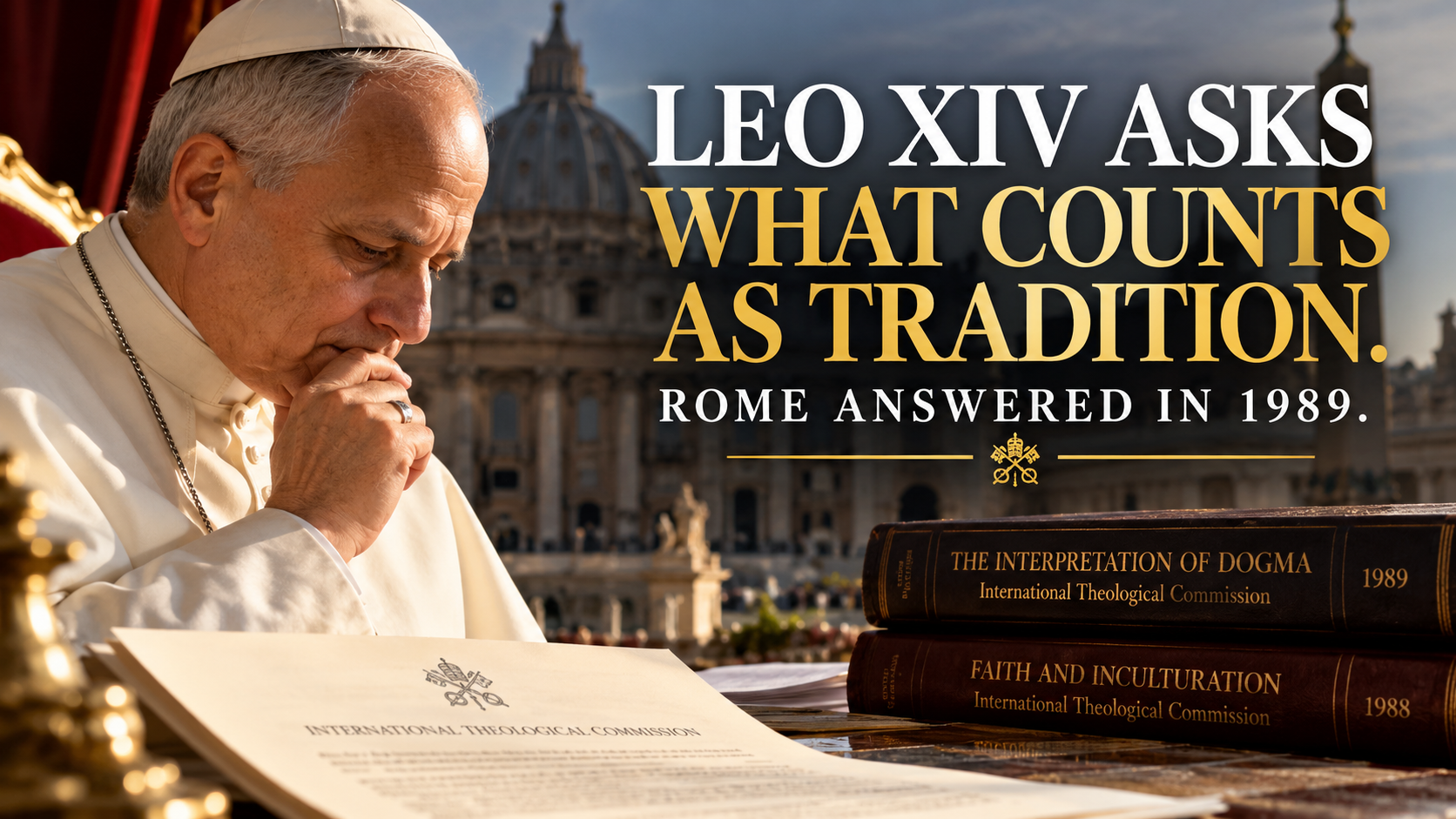
In 1989, the International Theological Commission issued a warning which deserves to be heard in Rome today. Doctrinal development, it declared, becomes corruption when it contradicts the original doctrine or an earlier authentic development. The principle was neither a concession to traditionalist sentiment nor an eccentric observation buried in an obscure theological publication. It appeared in The Interpretation of Dogma, a substantial study prepared under the direction of Walter Kasper, approved by the Commission and published with the authorisation of its President, Cardinal Joseph Ratzinger. Thirty-seven years later, Pope Leo XIV has appointed a new Commission which is reportedly preparing to investigate what constitutes Sacred Tradition and how it may be recognised. The obvious question is what has happened to the answers already given.¹
On 19 October, the Holy See announced twenty-four new appointments to the International Theological Commission, alongside the confirmation of six existing members for the 2026–2031 term. According to EWTN News, citing sources within the Dicastery for the Doctrine of the Faith, two subcommissions are envisaged. The first will examine what Tradition with a capital T means, where it is found and how something may be determined to belong to it. The second will investigate its transmission through different cultures, with particular attention to inculturation, popular piety and religious language. The proposed subjects reportedly emerged from discussions between Leo XIV and Cardinal Víctor Manuel Fernández, Prefect of the Dicastery and President of the Commission.²
The Holy See has confirmed the appointments but has not published a formal research mandate establishing the precise scope of these enquiries. No conclusion should therefore be attributed to a Commission which has yet to produce one. Nevertheless, the selection of subjects is significant. Determining what belongs to Sacred Tradition is not simply a question of historical classification. It bears directly upon what the Church is obliged to preserve, what may legitimately develop and what falls within the competence of ecclesiastical authority to modify. A mistaken answer could make the alteration of doctrine appear to be development, or elevate a changeable ecclesiastical custom into an obligation of divine law.
These difficulties have accompanied the Church throughout her history. They were addressed by the Council of Trent, which affirmed the authority of Sacred Scripture and unwritten Apostolic Tradition, and by Vatican I, which established the governing principle of doctrinal development. In Dei Filius, the latter Council declared that revealed doctrine had been entrusted to the Church as a divine deposit, not as a philosophical discovery to be perfected through human ingenuity. Understanding could deepen, but a different meaning could not be substituted for what the Church had definitively taught. The familiar Vincentian formula, in eodem dogmate, eodem sensu, eademque sententia, expressed the essential condition: the same doctrine, the same meaning and the same judgment.³
That principle is neither an argument against theological scholarship nor an attempt to arrest the legitimate development of doctrine. The Church’s understanding of revelation grows through study, contemplation, controversy and authoritative clarification. The solemn definitions of the Immaculate Conception and the Assumption did not introduce additional revelations. They gave definitive expression to truths belonging to the Church’s received belief. Development makes explicit what was already contained within the Deposit of Faith; corruption replaces it with something incompatible.
What makes the 1989 Commission’s work so important is that it went beyond repeating this distinction. Its members sought to explain how legitimate development could actually be recognised, particularly when doctrines were expressed through changing languages and intellectual systems. The study acknowledged the historical circumstances in which doctrinal formulations arise, but rejected the conclusion that their truth must therefore be confined to those circumstances. The substance of revealed teaching remained universally valid, even where its communication required fresh explanation.
The Commission identified three essential theological criteria. The first was the internal coherence of Tradition, grounded in Jesus Christ as the centre and fullness of revelation. The second was apostolicity: the permanent obligation of the Church to remain faithful to what she received from the Apostles. The third was catholicity, understood in relation to the communion of the whole Church and the common profession of the Apostolic Faith. These criteria were not alternatives from which theologians could select according to preference. They belonged together, because the same Christ who entrusted His revelation to the Apostles established the Church through which it would be preserved.
The document also made an important distinction between the one Apostolic Tradition and the many particular traditions which have developed within ecclesiastical life. It acknowledged that human customs might require correction or even removal where they obscured the Faith. Yet the standard by which such changes were to be judged remained the Apostolic Tradition itself. The Church was not authorised to revise divine revelation in order to preserve a contemporary interpretation of ecclesiastical life. She was obliged to examine ecclesiastical life according to the revelation she had received.
Perhaps the most revealing aspect of the study was its treatment of St John Henry Newman’s seven criteria for authentic doctrinal development. Newman had distinguished genuine development from corruption through the preservation of type, continuity of principles, the capacity to assimilate new insights, logical coherence, anticipation of later developments, conservation of what had previously been achieved and durability. The Commission recognised these as useful criteria for understanding how doctrine might be articulated more fully without losing its identity.¹
Their importance becomes evident when applied to an actual theological controversy. A proposition may retain traditional vocabulary while acquiring a different meaning through its association with principles previously foreign to Catholic teaching. A familiar expression can survive while the doctrine it once conveyed has effectively disappeared. Conversely, a new expression need not constitute innovation if it faithfully communicates an established truth. The decisive question is not whether the words are old or new, but whether the doctrine remains substantially the same.
The Commission was explicit that authentic development must conserve what has already been established. It could deepen an earlier understanding, resolve an ambiguity or draw out implications which had not previously been recognised. It could not contradict the original doctrine or an earlier authentic development. This was not presented as an optional theological preference. It was a criterion by which the legitimacy of development could be assessed.
That conclusion ought to have considerable influence upon the new Commission’s work. If a development is proposed, the theologian must demonstrate how it preserves the principles and substance of the doctrine already received. An assurance that continuity exists is not sufficient. Nor does the mere existence of competent ecclesiastical authority resolve the theological question. Authority authenticates and expounds revelation; the substantive relationship between what is now proposed and what has previously been taught must still be intelligible.
The 1989 document went further. It warned against theological approaches which reduced revelation to the historically conditioned experience of its interpreters. Its introduction specifically identified the danger of allowing contemporary social or ideological concerns to become decisive criteria for determining the meaning of dogma. The resulting difficulty was not that theologians might employ new intellectual methods. It was that those methods could cease to serve revealed truth and instead subject that truth to the assumptions of a particular age.
There is a considerable difference between asking how Catholic doctrine may illuminate a contemporary question and asking how that doctrine must be reinterpreted to satisfy a contemporary expectation. The first begins with revelation and applies it to circumstances which may be new. The second begins with circumstances and makes their demands the measure of revelation. Whatever vocabulary is employed, these are different theological operations.
The Commission also recognised the necessity of doctrinal boundaries. In its concluding treatment of the Magisterium, it rejected the idea that the Church’s teaching office exists merely to ratify the conclusions of theological discussion. The Magisterium must guide interpretation, preserve certainty for the faithful and, where necessary, reject serious error. The study even reaffirmed the possibility and duty of formally condemning heresy when the integrity of the Faith requires it. In doing so, it drew upon the Commission’s own earlier work on theological pluralism.¹
This is a striking conclusion in an ecclesiastical culture increasingly accustomed to describing disagreement as an opportunity for further conversation. The Commission did not regard doctrinal definition as the enemy of legitimate enquiry. It recognised that some theological questions require authoritative judgment precisely because revelation is not an indefinite collection of competing religious opinions.
Nor was this concern confined to abstract formulations. The 1989 study attached considerable importance to the relationship between doctrine and worship. It recognised the liturgy as a principal expression of the Church’s living Tradition, invoking the ancient principle lex orandi, lex credendi. The Faith was not transmitted exclusively through theological propositions. It was also embodied in the Church’s prayers, sacramental life, rites and common profession of belief.¹
That observation has consequences which extend beyond the Commission’s immediate enquiry. Not every inherited ceremonial practice belongs to divine law, and ecclesiastical authority possesses genuine competence to regulate public worship. Nevertheless, the distinction between immutable doctrine and changeable discipline cannot be employed to deprive inherited worship of theological significance. Liturgical forms bear witness to the Faith which successive generations have received and professed. Their historical continuity may therefore constitute evidence relevant to theological judgment, even where particular customs remain subject to legitimate reform.
The Church is not obliged to preserve every custom simply because it is ancient. Equally, the existence of authority to modify a practice does not establish that modification is prudent, necessary or conducive to the faithful transmission of doctrine. That requires a separate judgment. The theological value of an inheritance cannot be determined solely by establishing whether it is legally alterable.
The Commission’s other relevant study, Faith and Inculturation, published in 1988, addressed questions closely resembling those reportedly assigned to the second new subcommission. It examined how the Gospel encounters different cultures, how Christianity may assume legitimate cultural expressions, and how popular piety and religious practices must be evaluated within the life of the Church.⁴
Its conclusions were more exacting than a general endorsement of cultural diversity. The Commission recognised that cultures contain genuine human goods through which the Gospel may be expressed. It also insisted that cultures may preserve errors, disordered practices and assumptions incompatible with Christianity. Their encounter with revelation must therefore involve purification and transformation. The Gospel does not acquire its truth from the culture receiving it. Rather, the culture encounters a revelation capable of judging, correcting and elevating what it already possesses.
This distinction was particularly important in the Commission’s treatment of other religions. It acknowledged the legitimacy of dialogue and the recognition of what is true and good in religious traditions outside the Church. Yet it explicitly rejected syncretism as an acceptable consequence of inculturation. The universal character of Christianity could not be secured through the amalgamation of incompatible religious beliefs. Respect for different peoples did not require the surrender of the Gospel’s claim to truth.
The document’s treatment of popular piety was similarly discriminating. It recognised the importance of traditional devotions, pilgrimages, festivals and other expressions through which Catholic belief has entered the daily lives of successive generations. Such practices could preserve the Faith even where formal religious instruction was weak or contemporary society increasingly hostile to Christianity. Yet the Commission also acknowledged the dangers of superstition, manipulation and religious sentiment detached from authentic faith. Proper pastoral care required both encouragement and correction, rather than indiscriminate approval or contemptuous dismissal.
These conclusions deserve attention because they establish a coherent relationship between Tradition and cultural development. The Church can accept legitimate diversity precisely because her unity does not depend upon every Catholic possessing the same cultural inheritance. But diversity remains Catholic only insofar as its expressions are coherent with the one Apostolic Faith. Cultural adaptation cannot become an independent source of doctrine.
The two studies therefore complement one another. The 1988 document considered how the Gospel might be transmitted through different cultures without losing its identity. The 1989 document examined the criteria by which continuity of doctrine could be recognised amid historical development. Together they supplied a substantial theological framework for addressing the questions now reportedly being assigned to the new Commission.
It would be unreasonable to claim that every possible question had thereby been settled. The earlier studies were theological documents, not dogmatic definitions. They did not eliminate the need for further historical research, nor did they anticipate every difficulty which subsequent decades might produce. Their own account of Tradition acknowledged the continuing task of interpretation. Yet they established principles which remain relevant, and any new examination ought to begin by explaining how its questions relate to those already considered.
A particularly interesting detail in EWTN’s report concerns the period of magisterial reflection the new Commission is expected to examine. According to the Dicastery sources, it will seek to assimilate teaching extending from Paul VI to Leo XIV’s Magnifica Humanitas. This may simply indicate a particular area of research, rather than an exclusion of earlier teaching. Nevertheless, the reported emphasis raises a legitimate question concerning the relationship between post-conciliar theological developments and the preceding doctrinal inheritance.²
Why should the investigation give particular attention to the period beginning with Paul VI? The report does not establish that Trent, Vatican I or the pre-conciliar Magisterium will be neglected, and no such intention should be presumed. But a study concerned with identifying Sacred Tradition cannot derive its fundamental criteria principally from the very period whose theological developments are under examination. The measure of continuity must be established through the whole inheritance, not merely through its most recent interpretation.
The reference to Magnifica Humanitas is also noteworthy. Published in May 2026, Leo XIV’s encyclical examines the human person in the age of artificial intelligence and includes a substantial discussion of Catholic social teaching and its historical development. That development involves the application of enduring moral principles to social and technological circumstances which earlier generations could not have anticipated. The emergence of artificial intelligence provides an obvious instance of a genuinely new problem requiring theological and moral judgment.⁵
Yet such development cannot simply be treated as equivalent to every other proposed change in Catholic doctrine or practice. Applying a permanent moral principle to a new technology is not the same operation as altering the meaning of a previously defined dogma. Revising an ecclesiastical regulation is not the same as modifying divine law. Clarifying an ambiguous theological formula is not the same as replacing the proposition it was intended to express. These distinctions are indispensable if the term development is to retain any useful theological meaning.
The earlier Commission’s criteria make them possible. Its insistence upon apostolicity, doctrinal coherence and the conservation of previous authentic developments provides a means of examining whether a proposed change genuinely belongs to the Church’s continuing understanding of revelation. The same criteria also protect legitimate reform from the mistaken assumption that every alteration of an inherited practice must necessarily constitute doctrinal corruption.
There is a further consideration which gives the present initiative an almost paradoxical character. Leo XIV himself addressed the relationship between Scripture and Tradition on 28 January 2026, during a general audience devoted to Dei Verbum. He explained that the two constitute one sacred deposit entrusted to the Church, invoking St John Henry Newman’s account of doctrinal development. Most significantly, he described the juridical meaning of a deposit: the depositary is obliged to preserve what has been entrusted and transmit it intact.⁶
The formulation is entirely consistent with the central principle developed by the earlier Commission. A depositary does not become the owner of the deposit. The obligation to preserve arises precisely because the inheritance precedes the authority of the person entrusted with its care. Greater understanding may enrich the way it is explained and transmitted; custodianship does not confer unrestricted power to replace its substance.
The First Vatican Council made the corresponding principle explicit in its treatment of the Papacy. Pastor Aeternus declared that the Holy Ghost was not promised to Peter’s successors so that they might reveal new doctrine, but so that they might guard and faithfully expound the revelation transmitted by the Apostles. Supreme ecclesiastical authority is therefore inseparable from the purpose for which Christ instituted it.⁷
This does not make the Church’s teaching office subordinate to an independent tribunal of individual theologians or lay critics. The Magisterium possesses the authority to authenticate and interpret revelation, and Catholics are obliged to recognise the proper distinctions between definitive teaching, non-definitive instruction and ecclesiastical discipline. Yet the exercise of that authority is not a substitute for the objective content of the Faith. The Church’s teaching office exists to preserve and expound revelation, not to establish that whatever it presently favours must therefore have belonged to revelation all along.
The distinction is particularly important when considering the work of a theological commission. Such a body can make an invaluable contribution through scholarship, historical investigation and reasoned doctrinal analysis. It can identify weaknesses in prevailing interpretations and propose more precise explanations. But it does not possess authority to redefine revealed doctrine. Nor do its conclusions become definitive acts of the Magisterium merely because they are published under Vatican auspices.
The Commission’s responsibility is consequently intellectual as well as ecclesiastical. It must demonstrate its conclusions rather than rely upon institutional prestige. Where previous theological judgments remain persuasive, they ought to be acknowledged. Where an earlier study proves inadequate, the deficiency ought to be identified. Where a new interpretation is proposed, its relationship to the doctrine already received must be explained.
Nuntiatoria has previously examined this problem in relation to the doctrinal interpretation of Vatican II, particularly the distinction between establishing continuity and merely asserting it. The same standard applies to the present investigation. The theological question cannot be resolved by institutional assurances that a proposed development is faithful to Tradition. Its fidelity must be demonstrated through the relevant doctrinal evidence.⁸
The Commission appointed by Leo XIV may yet perform a valuable service. It could clarify distinctions which have become increasingly confused in contemporary ecclesiastical discussion. It could explain the evidential value of liturgical and patristic witnesses, the criteria governing authentic doctrinal development, the legitimate diversity of ecclesiastical traditions and the limits of cultural adaptation. It might also identify questions insufficiently resolved in 1988 and 1989, offering more precise answers grounded in subsequent research.
Such work would be welcome. What would be considerably less satisfactory is an enquiry which proceeds as though the Church’s prior theological judgments were merely provisional expressions of historical circumstances, valuable chiefly as material for further reinterpretation.
The 1989 Commission understood that danger. It recognised both the necessity of development and the enduring authority of revealed truth. It rejected the idea that doctrinal formulas could be understood solely through the changing experience of those interpreting them. It affirmed the Church’s obligation to distinguish truth from error, to conserve the substance of previous authentic developments and to preserve the coherence of Catholic doctrine. The 1988 Commission supplied an analogous principle for inculturation: the Gospel must be transmitted through human cultures without becoming subordinate to them.
Those conclusions were not the personal opinions of Cardinal Ratzinger, nor do they possess the authority of solemn definitions. They remain, nevertheless, the considered findings of the very institution now preparing to revisit these questions. Their significance cannot responsibly be ignored merely because a new Pope has appointed a new membership or because contemporary circumstances have altered the language of theological debate.
The new Commission should therefore be required to explain what remains unresolved. Has scholarship identified serious deficiencies in the criteria previously established? Have new historical discoveries substantially altered the evidence? Do contemporary cultural circumstances present questions which the earlier studies could not adequately anticipate? Or is the principal difficulty that the application of those criteria would produce judgments less congenial to certain contemporary theological preferences?
The first three possibilities would provide entirely legitimate reasons for further investigation. The fourth would be a reason for caution. None should be presumed in advance, but all demonstrate why the Commission’s terms of reference and eventual conclusions deserve careful scrutiny.
There is no need to portray Leo XIV’s initiative as an attempt to undermine Tradition. Equally, there is no reason to exempt it from examination simply because it originates in Rome. The proposed work concerns the means by which Catholicism remains faithful to its own identity. That makes its intellectual assumptions, theological criteria and practical consequences matters of legitimate concern to the whole Church.
The most revealing aspect of the present controversy may ultimately be that the decisive questions are already familiar. Can doctrine develop without changing its meaning? Can cultural adaptation transmit the Gospel without subjecting it to the assumptions of a particular society? Can ecclesiastical authority reform inherited practices without disregarding their theological significance? Can the Church recognise authentic diversity without surrendering the unity of the Apostolic Faith?
The Commission of 1988 and 1989 answered these questions in principle. Genuine development conserves what is true; inculturation serves the Gospel; ecclesiastical traditions are judged by their fidelity to Apostolic Tradition; and the Magisterium possesses the responsibility to preserve doctrinal integrity. Those are not incidental observations which may be discarded when another theological fashion takes their place. They form a substantial account of the Church’s continuing obligation to transmit what she has received.
Pope Leo XIV has already expressed that obligation in the language of a deposit entrusted to the Church. His newly appointed theologians should have no difficulty recognising the connection between his words and the conclusions reached under Cardinal Ratzinger.
Nearly forty years after those conclusions were published, the burden of explanation rests upon those proposing another investigation. They need not reproduce every earlier formulation, nor pretend that theological research reached its final destination in 1989. But they must show what requires further clarification and why the established criteria do not already provide the necessary answer.
Rome does not need to rediscover Tradition. It needs to demonstrate that the answers it already possesses continue to govern the questions it now proposes to ask.
- International Theological Commission, The Interpretation of Dogma, 1989, Introduction and Part C.
- Victoria Cardiel, EWTN News, Pope Leo XIV Tasks Theologians with Clarifying Meaning of Church Tradition, 20 October 2026; Dicastery for the Doctrine of the Faith, Appointment of the Members of the ITC for the Quinquennium 2026–2031, 19 October 2026.
- Council of Trent, Session IV, Decree Concerning the Canonical Scriptures, 8 April 1546; First Vatican Council, Dei Filius, chapter IV, 24 April 1870.
- International Theological Commission, Faith and Inculturation, 1988, especially Parts I and III.
- Leo XIV, Magnifica Humanitas, chapter I, 15 May 2026.
- Leo XIV, General Audience: A Single Sacred Deposit — The Relationship Between Scripture and Tradition, 28 January 2026.
- First Vatican Council, Pastor Aeternus, chapter IV, 18 July 1870.
- Nuntiatoria, Vatican II and the Doctrinal Question of Continuity, 24 July 2026.





Leave a Reply