
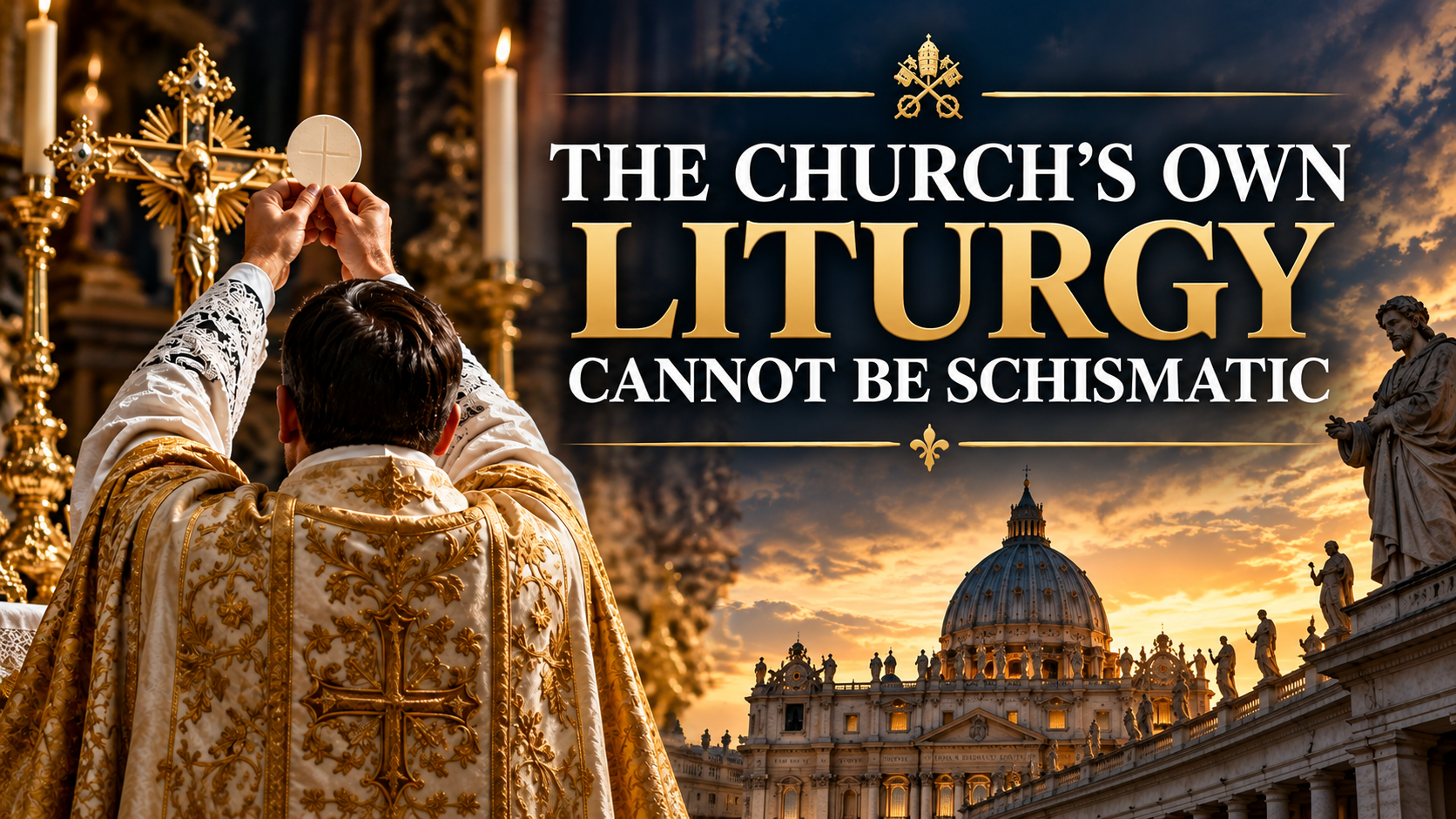
Andrea Grillo’s attack on Archbishop Cordileone exposes the dangerous confusion between Catholic communion and compulsory agreement with the postconciliar liturgical settlement. By portraying Benedict XVI’s attempt at liturgical reconciliation as an institutionalisation of schism, the Italian theologian raises a question far more serious than the comparative merits of Summorum Pontificum and Traditionis Custodes: whether the Church’s inherited worship can become an obstacle to Catholic unity merely because ecclesiastical policy has changed.
There is something profoundly disordered about a theological argument which treats the Church’s own inherited worship as a potential source of schism while presenting the suppression of that worship as an indispensable requirement of Catholic unity. Yet this is the extraordinary position advanced by Andrea Grillo in his latest attack upon Archbishop Salvatore Cordileone of San Francisco. Writing in Munera on 12 October 2026, under the provocative headline A Schismatic Archbishop in the Apostolic Signatura? The Irresponsible Words of Bishop Cordileone, Grillo accuses the Archbishop of employing schismatic arguments because he suggested that the Church enjoyed greater unity under Benedict XVI’s Summorum Pontificum than under the restrictions imposed by Francis’s Traditionis Custodes.¹ The Archbishop has not denied papal authority, repudiated Catholic doctrine, or advocated separation from Rome. He has questioned the pastoral consequences of a particular disciplinary policy. Grillo’s response is to treat that judgement as evidence of an ecclesiology fundamentally opposed to Catholic communion.
The distinction matters because the controversy is no longer simply about the regulation of liturgical books. It concerns the criteria by which Catholic fidelity itself is increasingly judged. In Grillo’s account, the postconciliar liturgical settlement is not merely the currently normative expression of Roman worship; it becomes the indispensable measure of ecclesiastical unity. Acceptance of that settlement is consequently treated as inseparable from acceptance of the Second Vatican Council, while attachment to the earlier Roman liturgy is regarded as an implicit challenge to both. The argument proceeds by conflating three questions which Catholic theology must distinguish: whether the Church possesses authority to reform her liturgy, whether the particular reforms undertaken were necessary and prudent, and whether Catholics who question those reforms thereby place themselves outside the proper understanding of ecclesiastical communion. An affirmative answer to the first question does not determine the answers to the other two.
Archbishop Cordileone’s observations, made during an interview with Tribune Chrétienne, were concerned principally with the pastoral consequences of successive liturgical policies, the attraction of traditional worship for younger Catholics, and the desirability of dialogue with those alienated by contemporary ecclesiastical restrictions.² These are legitimate matters for episcopal judgement. A diocesan Archbishop is entitled to assess whether legislation intended to strengthen unity has actually achieved that purpose. Indeed, such assessment belongs to the responsibilities of pastoral governance. The validity of a law does not establish its pastoral success, and recognition of the authority which enacted it does not require the conclusion that its effects have been beneficial.
Grillo nevertheless describes Cordileone’s understanding of unity as schismatic. This is an accusation of exceptional gravity, especially when directed against an Archbishop appointed by Pope Leo XIV to the Supreme Tribunal of the Apostolic Signatura. Such an appointment does not render Cordileone immune from criticism, but neither does Grillo’s academic expertise confer authority to redefine the boundaries of ecclesiastical communion. The question is whether the Archbishop’s position involves the refusal of submission to the Roman Pontiff or a rupture with those subject to him. Grillo supplies no evidence of either. Instead, he assumes that disagreement with the ecclesiological interpretation underpinning Traditionis Custodes is itself sufficient to establish a defective conception of Catholic unity.
His historical argument is equally problematic. Grillo presents the postconciliar period as a progression from legitimate reform through increasing traditionalist resistance, culminating in what he regards as the disastrous concessions of Benedict XVI. In his reconstruction, the indults granted under John Paul II encouraged opposition to the reform, while Summorum Pontificum effectively adopted Archbishop Marcel Lefebvre’s programme as the governing principle of the Church. Between 2007 and 2021, he alleges, every priest and community could decide whether to accept the Council. Traditionis Custodes then restored the unity which Benedict’s legislation had supposedly compromised. This is not merely a tendentious interpretation of recent ecclesiastical history. It is contradicted by the explicit provisions of the legislation Grillo condemns.
Benedict XVI did not authorise Catholics to reject the Second Vatican Council. He did not permit priests to deny the legitimacy of the reformed Roman Missal. He expressly described the older and newer editions as usages of the one Roman rite and declared that they did not imply a division in the Church’s lex credendi. His accompanying letter to the bishops insisted that priests attached to the earlier usage could not exclude celebration according to the newer books as a matter of principle while claiming full communion.³ Whatever criticisms may legitimately be made of Benedict’s juridical construction, it cannot honestly be described as permission to reject the Council. Grillo attributes to the legislation precisely the position its author expressly excluded.
The distinction is decisive. One may argue that Summorum Pontificum was pastorally unsuccessful, that it produced unforeseen difficulties, or that its description of two forms of the Roman rite was historically or liturgically unsatisfactory. Those propositions require evidence and theological argument. They cannot be established by claiming that Benedict institutionalised an ecclesiology of resistance to the Council when his own legislation explicitly required recognition of the Council and the reformed liturgical books. The existence of communities which may have misused the permissions does not establish that the permissions themselves authorised such misuse. To confuse the abuse of a provision with its intended purpose is to substitute retrospective accusation for historical analysis.
The precedent of John Paul II makes Grillo’s position still more difficult to sustain. In Ecclesia Dei adflicta, issued following the episcopal consecrations at Écône in 1988, John Paul identified those consecrations, undertaken against the express prohibition of the Roman Pontiff, as a schismatic act. Yet in the same document he called for generous pastoral provision for Catholics attached to earlier liturgical and disciplinary traditions.⁴ The distinction was deliberate. The Pope did not regard attachment to traditional worship as intrinsically schismatic. On the contrary, he considered appropriate accommodation of that attachment a means of preserving and restoring ecclesiastical communion. Grillo’s argument effectively erases a distinction which John Paul II explicitly maintained.
This raises a question which Grillo cannot avoid. If the coexistence of the traditional and reformed Roman liturgies is intrinsically incompatible with Catholic unity, why did two successive Roman Pontiffs deliberately authorise it? The answer cannot simply be that Francis subsequently adopted a different disciplinary policy. Popes may revise the legislation of their predecessors, and no particular arrangement governing the use of liturgical books is necessarily immutable. But a subsequent change in ecclesiastical discipline cannot retrospectively transform previously lawful worship into an intrinsically schismatic activity. The distinction between what ecclesiastical law presently permits and what Catholic doctrine necessarily requires is fundamental. Without it, the criteria of communion would fluctuate according to successive legislative preferences.
The canonical definition of schism is not obscure. Canon 751 identifies it as the refusal of submission to the Supreme Pontiff or withdrawal from communion with those subject to him.⁵ It does not define schism as disagreement concerning the prudence of a disciplinary policy, criticism of the implementation of a council, or attachment to a form of worship previously authorised by the Church. Nor does every act of disobedience automatically constitute schism. The nature of the act, the authority involved, and the circumstances must be examined. Grillo does not formally pronounce a canonical sentence against Cordileone, but his repeated characterisation of the Archbishop’s position as schismatic invokes the gravity of that category without demonstrating its defining elements.
This is the same confusion which has increasingly characterised arguments advanced in defence of restrictive liturgical policies. The authority of the Roman Pontiff is invoked as though it settled every question concerning the wisdom of the measures enacted under that authority. Yet the possession of jurisdiction and the prudent exercise of jurisdiction are distinct. A law may be validly promulgated and nevertheless produce undesirable consequences. A disciplinary measure may be binding without every argument advanced in its defence becoming an article of faith. A bishop may recognise the authority of the legislator while questioning whether the legislation has served the common good. Such distinctions are not concessions to disobedience. They belong to a proper Catholic understanding of authority exercised in service of truth, justice and the salvation of souls.
Grillo’s conception of liturgical unity also encounters a fundamental historical difficulty. Catholic communion has never depended upon absolute uniformity of liturgical expression. The Eastern Catholic Churches preserve distinct liturgical traditions while remaining in communion with the Roman Pontiff. Within the Latin Church, the Ambrosian and Mozarabic rites, together with historically recognised usages of religious orders, demonstrate that legitimate liturgical diversity has existed without constituting ecclesiastical division. These examples do not determine whether different editions of the Roman Missal should enjoy simultaneous legal authorisation. They do, however, establish that uniformity of ritual expression cannot itself be made the essential theological definition of Catholic unity.
Grillo attempts to overcome this difficulty by describing the older and newer Roman usages as contradictory. Yet this assertion creates a theological problem more serious than the one he seeks to resolve. If he means that the Missals differ substantially in their texts, ceremonial structures, offertory prayers, lectionaries, calendars and theological emphases, the observation is demonstrably correct. These differences have been central to the liturgical controversy for more than half a century. If, however, he means that they express mutually incompatible Catholic doctrines, the implications are grave. The older Roman Missal was the authorised worship of the Western Church for centuries. The newer Missal was promulgated by the Roman Pontiff as a legitimate expression of the same Eucharistic faith. An assertion of doctrinal contradiction between them cannot simply be used to justify suppressing the older usage without explaining what that contradiction would imply about the Church’s own doctrinal and liturgical continuity.
This is the question which the defenders of the postconciliar settlement repeatedly avoid confronting on its own terms. The issue is not whether the Church possesses authority to revise her liturgical books. She does. Nor is it whether the revised Missal was promulgated by competent ecclesiastical authority. It was. The question concerns the relationship between the reform and the tradition which preceded it: whether the changes were necessary, whether they represented organic development, whether their cumulative effect preserved the theological emphases of the inherited Roman rite, and whether their pastoral consequences corresponded to the expectations advanced in their defence. These questions cannot be answered merely by invoking the authority responsible for promulgating the revised books. The existence of authority establishes jurisdiction; it does not demonstrate that every decision taken under that authority was necessary, prudent or beneficial.
The Second Vatican Council itself provides a criterion by which the reform must be examined. Sacrosanctum Concilium required that liturgical innovations should be introduced only where the genuine and certain good of the Church demanded them, and that new forms should grow organically from those already existing.⁶ These were not incidental qualifications. They expressed a principle of continuity governing the reform envisaged by the Council. The subsequent implementation involved decisions extending beyond the conciliar text itself, and the distinction between the Council’s prescriptions and the work of the reforming authorities remains historically and theologically indispensable. Criticism of particular postconciliar decisions does not automatically constitute rejection of the Council. Indeed, the Council’s own principles provide legitimate grounds upon which those decisions may be examined.
Grillo’s approach threatens to make such examination impossible. If the postconciliar settlement is treated as the definitive expression of the Council, and the Council is then invoked as sufficient justification for every element of that settlement, the argument becomes circular. The reform is declared faithful to the Council because it was undertaken in the Council’s name, while objections to the reform are dismissed as opposition to the Council because they question what was subsequently undertaken. The substantive question of continuity is thereby evaded. Yet if organic development has any theological meaning, it must be possible to assess the relationship between what was received and what was introduced without determining the conclusion in advance.
The historical narrative advanced by Grillo is similarly inadequate. The years following the Council cannot simply be described as the peaceful implementation of legitimate reform subsequently disrupted by traditionalist resistance. The experience of many Catholics was one of profound and sometimes bewildering change. Familiar ceremonies disappeared, devotional practices were discouraged, sanctuaries were reordered, sacred music was displaced, and liturgical experimentation frequently extended beyond what the revised books themselves prescribed. These developments were not uniform, nor should every local abuse be attributed to the official reform. But their cumulative consequences cannot be excluded from an honest account of postconciliar division. Benedict XVI himself acknowledged the pain caused by arbitrary liturgical innovations and the impression that worship had become something subject to human fabrication rather than an inheritance received from the Church.³
To attribute the resulting conflict principally to those who resisted change is therefore to mistake one manifestation of the crisis for its entire cause. Resistance did not emerge in a historical vacuum. It arose amid changes which affected the Church’s public worship, devotional culture, priestly formation and understanding of continuity. Some opposition undoubtedly became excessive or developed into untenable ecclesiological positions. Other criticism arose from legitimate concern for the preservation of inherited Catholic worship. A serious historical account must distinguish between these responses rather than assimilating them all to a single narrative of reactionary obstruction.
This distinction is especially important in considering the Society of Saint Pius X. The Society’s contested canonical position, including the questions arising from the episcopal consecrations of July 2026, involves matters of ecclesiastical jurisdiction, episcopal authority, obedience and communion which cannot be reduced to liturgical preference. Nor can the seriousness of those questions be dismissed. Yet advocating dialogue with the Society is not equivalent to endorsing every position or action associated with it. John Paul II and Benedict XVI both sought reconciliation while acknowledging the existence of substantial disagreements. Grillo’s dismissal of dialogue as the inevitable consequence of a defective ecclesiology overlooks the fact that reconciliation ordinarily requires engagement with those from whom communion has been impaired. The desire to heal a rupture is not itself an endorsement of the rupture.
Nor should the situation of Catholics who attend the traditional Roman liturgy under lawful ecclesiastical provision be confused with that of communities whose canonical status is disputed. The former may involve no irregularity whatsoever. The latter requires consideration of particular facts and applicable law. The common attachment to an inherited liturgical form does not erase these distinctions. Yet Grillo’s reasoning repeatedly approaches precisely that conclusion, treating traditional worship as though it carried within itself an ecclesiology incompatible with the contemporary Church. This is neither canonically precise nor historically defensible.
Francis’s Traditionis Custodes must, of course, be considered according to what it actually enacted. The legislation designated the liturgical books promulgated by Paul VI and John Paul II as the unique expression of the lex orandi of the Roman rite and imposed substantial restrictions upon the celebration of the older Missal.⁷ Francis explained that he acted in response to concerns about the instrumentalisation of traditional worship by those who rejected the Council and questioned ecclesiastical authority. His accompanying letter presented the restrictions as measures intended to preserve communion.⁸ These concerns cannot simply be dismissed, and where traditionalist communities have employed liturgical attachment as a vehicle for rejecting the Church’s legitimate authority, their conduct requires appropriate examination.
But the existence of particular abuses does not establish that every Catholic attached to the older liturgy shares them. Nor does it demonstrate that the previous legislative arrangement was intrinsically incompatible with ecclesiastical unity. Francis made a disciplinary judgement in response to what he understood to be a serious pastoral problem. That judgement possesses juridical consequences. It does not thereby become a dogmatic determination that the older Roman liturgy is itself a source of schism, or that Benedict XVI’s contrary pastoral approach was ecclesiologically illegitimate. To argue otherwise is to confuse the binding force of legislation with the theological status of the reasoning advanced in its defence.
There is also a practical question which Grillo does not satisfactorily answer. If unity is the object of the restrictions, by what evidence is their success to be judged? It cannot be sufficient merely to point to the existence of a more restrictive law. The enactment of legislation is not proof that its intended pastoral consequences have followed. Have Catholics previously reconciled through the older liturgy become more closely attached to diocesan life? Have communities formerly at peace become less divided? Have younger Catholics attracted to traditional worship found their relationship with ecclesiastical authority strengthened? Have the restrictions diminished opposition to the Council, or have they sometimes intensified the very alienation they were intended to overcome? These are empirical questions, and they require evidence rather than assumptions.
The distinction between juridical uniformity and genuine ecclesiastical communion is essential here. A diocese may possess a single authorised liturgical arrangement while experiencing profound theological, devotional and pastoral divisions. Conversely, legitimate diversity of liturgical expression need not prevent substantial unity in faith, sacramental life and ecclesiastical governance. Uniformity may serve communion in particular circumstances, but it cannot simply be identified with communion itself. Nor can the disappearance of a permitted liturgical alternative be treated as sufficient evidence that the underlying disagreements have been resolved.
The deeper problem concerns the nature of tradition. Grillo appears to treat the postconciliar liturgical settlement as the normative criterion by which earlier forms of worship must now be judged. Yet the Church’s liturgical inheritance is not merely an earlier version of whatever legislation happens presently to govern its celebration. It is the accumulated expression of centuries of Catholic faith, prayer and sacramental theology. Its significance does not depend exclusively upon its current juridical status. The Roman Canon, the ancient offertory prayers, the ceremonial expression of sacrifice, the traditional calendar and the inherited structures of sacred worship cannot be rendered theologically suspect simply because subsequent authorities adopted different arrangements.
This is not to suggest that every inherited practice must remain legally unalterable, or that liturgical development ceased at some preferred historical moment. The Church has always possessed authority to regulate and develop her rites. But legitimate development presupposes continuity with what has been received. Authority serves the transmission of the sacred inheritance; it does not acquire the power to make that inheritance retrospectively foreign to the Church. The distinction matters because Grillo’s argument appears to make the latest disciplinary settlement the measure of all that preceded it, rather than examining that settlement in the light of the tradition it claims to continue.
Benedict XVI understood the danger. His defence of the older liturgy was not founded upon the proposition that the Church could never revise her books, but upon the conviction that what had nourished Catholic worship for generations could not suddenly be regarded as harmful.³ This principle did not require the permanent preservation of every provision of Summorum Pontificum. It did, however, recognise that the Church’s historical worship possesses a dignity which cannot be extinguished by subsequent disciplinary change. Grillo’s accusation against Cordileone is troubling precisely because it appears to abandon that distinction. What Benedict regarded as a legitimate instrument of reconciliation becomes, in Grillo’s account, the institutional expression of schism.
The irony is considerable. Grillo condemns Cordileone for allegedly promoting division while advancing a conception of unity which leaves diminishing room for Catholics whose liturgical attachment differs from his own. He invokes the authority of the Church while treating the contrary pastoral judgements of two previous popes as evidence of ecclesiological failure. He insists upon communion while characterising the desire to accommodate traditional worship as a threat to its integrity. And he questions the judgement of a bishop appointed to the Apostolic Signatura because that bishop has dared to ask whether restrictive legislation has actually achieved the reconciliation which its defenders promise.
None of this makes Cordileone infallible. His assessment that Summorum Pontificum fostered greater unity than Traditionis Custodes remains a pastoral judgement which should be tested against evidence. It is possible to acknowledge real problems under Benedict’s arrangement while also recognising serious difficulties created by Francis’s restrictions. The two observations are not mutually exclusive. But an argument about the relative success of successive disciplinary policies cannot legitimately be resolved by portraying one position as schismatic. That manoeuvre does not establish the superiority of the restrictive policy; it merely attempts to place criticism of it beyond the boundaries of acceptable Catholic discourse.
The issue is ultimately much larger than either Cordileone or Grillo. It concerns whether the Church’s authority is understood as the guardian of an inherited faith and worship, or as the power to determine retrospectively which elements of that inheritance remain acceptable expressions of Catholic identity. The former understanding recognises the legitimate scope of ecclesiastical government while preserving the distinction between doctrine, discipline and prudential judgement. The latter risks making Catholic continuity dependent upon conformity to the prevailing interpretation of recent ecclesiastical policy.
Catholic communion cannot be reduced to agreement about the wisdom of liturgical reform. It requires profession of the apostolic faith, participation in the sacramental life of the Church, and communion with legitimate ecclesiastical authority. These obligations are substantial and cannot be set aside. But they do not require Catholics to regard every disciplinary measure as pastorally successful, every liturgical innovation as necessary, or every inherited practice as superseded by something intrinsically superior. The Church’s authority is not diminished by recognising these distinctions. It is exercised more faithfully when they are respected.
The genuine scandal in this controversy is not that an Archbishop has questioned the consequences of Traditionis Custodes. It is that a theologian should regard such questioning as evidence of a schismatic conception of ecclesiastical unity, while overlooking the implications of his own argument for the Church’s historical worship and the legislative judgements of previous popes. If Benedict XVI’s effort to reconcile Catholics through respect for the older liturgy constituted the institutionalisation of division, then the burden rests upon Grillo to explain how an arrangement expressly designed to preserve communion became intrinsically opposed to it. Denunciation cannot discharge that burden.
The Church cannot heal her divisions by declaring her own inheritance an obstacle to communion. Nor can she defend legitimate authority by confusing obedience with the surrender of theological judgement. The Roman liturgy which sustained generations of Catholics did not become schismatic when its celebration ceased to be the ordinary practice of the Latin Church. Its continued preservation may raise legitimate questions of ecclesiastical discipline, but its Catholic character cannot be erased by the alteration of those disciplines.
The decisive question is therefore not whether the Church possesses authority to regulate her worship. She does. It is whether the exercise of that authority can be defended without disparaging the worship which the Church herself received, sanctified and transmitted.
Grillo has not demonstrated that Archbishop Cordileone’s understanding of unity is schismatic. He has demonstrated how readily a contested interpretation of liturgical reform can be elevated into a criterion of orthodoxy, and how easily the language of communion can become an instrument for excluding those who question it.
The Church cannot preserve her unity by treating fidelity to her own liturgical inheritance as a form of disloyalty. What she has received, she is bound to guard and transmit.
Quod accepimus, custodimus et tradimus.
1. Andrea Grillo, Un arcivescovo scismatico in Segnatura Apostolica? Le parole irresponsabili di Mons. Cordileone, Munera, 12 October 2026.
2. Tribune Chrétienne, Interview exclusive de Mgr Salvatore Cordileone, 8 October 2026.
3. Benedict XVI, Summorum Pontificum, 7 July 2007, art. 1; Letter to the Bishops Accompanying Summorum Pontificum, 7 July 2007.
4. John Paul II, Ecclesia Dei adflicta, 2 July 1988, §§3–6.
5. Code of Canon Law, 1983, canon 751.
6. Second Vatican Council, Sacrosanctum Concilium, 4 December 1963, §§4, 23.
7. Francis, Traditionis Custodes, 16 July 2021, arts. 1–4.
8. Francis, Letter to the Bishops Accompanying Traditionis Custodes, 16 July 2021.



Leave a Reply