
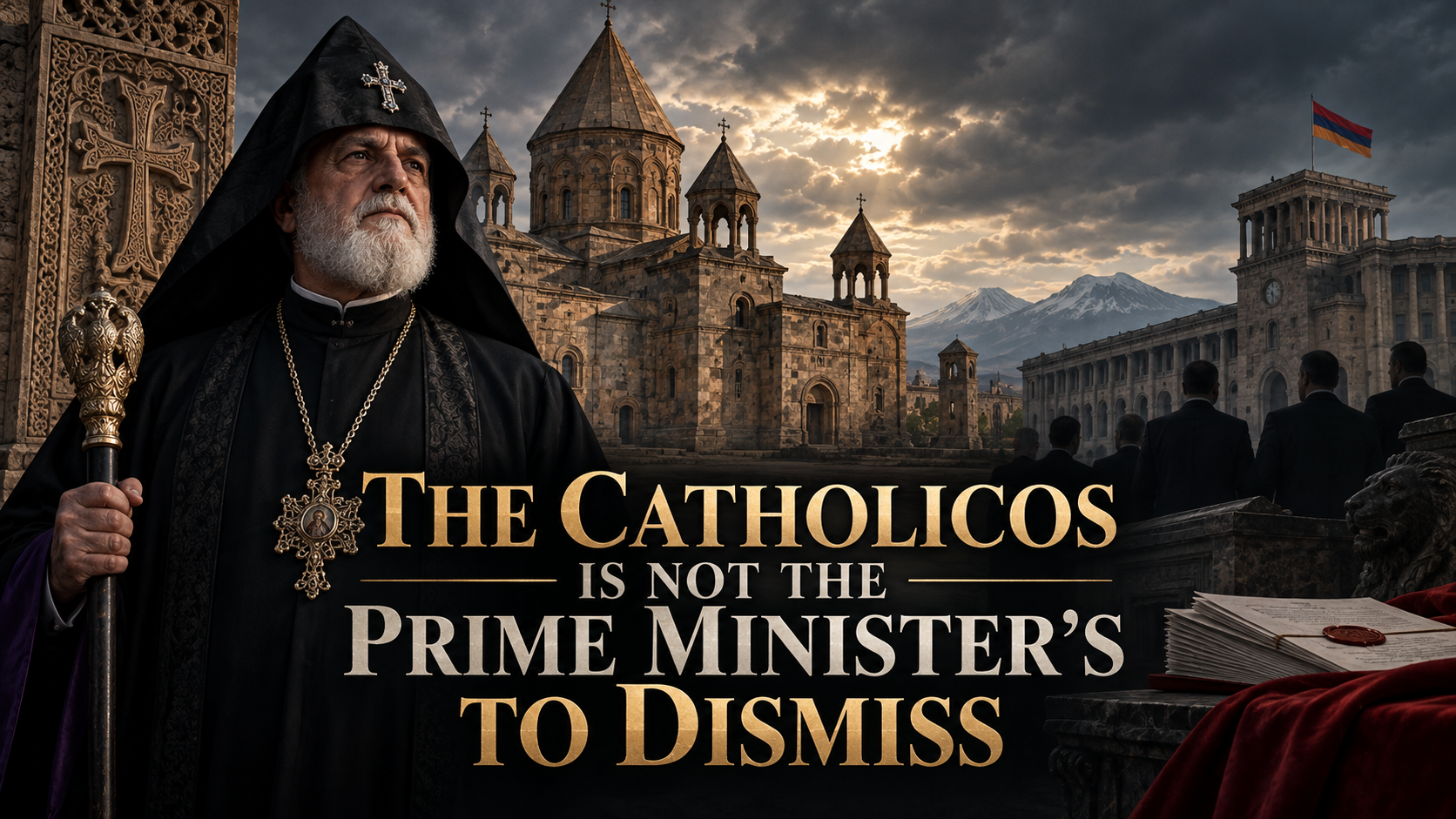
Armenia’s confrontation with its ancient Church has passed from political hostility into criminal prosecution, parliamentary investigation and a declared programme for replacing its spiritual head.
Armenia’s prime minister has made the removal of the head of his country’s ancient Church an official government objective. Catholicos Karekin II now faces possible imprisonment, while Parliament investigates the Church’s internal government. Behind the accusations of misconduct and foreign interference lies a fundamental question: by what authority does a secular government presume to determine who shall lead the Church?
Armenia’s prime minister wants the head of the national Church removed. His government has incorporated that objective into its official programme, Parliament has established an inquiry into the Church’s internal affairs, and Catholicos Karekin II now faces criminal prosecution alongside six senior bishops. The charges arise from their refusal to implement a civil court order concerning an ecclesiastical appointment. If convicted, they could face up to two years’ imprisonment. The Catholicos has not been arrested, although he remains subject to a travel ban. Yet the implications are already grave. An elected government is seeking to determine the leadership of an ancient apostolic Church whose independence is protected by the very constitution that government is sworn to uphold.¹ ²
This is no ordinary quarrel between an unpopular religious leader and an impatient politician. Armenia was the first kingdom to adopt Christianity as its state religion, traditionally in AD 301. Its Church helped preserve the Armenian people through centuries of conquest, dispossession, genocide and Communist persecution. Political sovereignty repeatedly disappeared; the Church endured. Now, within an independent Armenian republic, that same Church confronts a government which claims the authority to decide whether its supreme spiritual head should remain in office. The question is not whether bishops are above the law. They are not. It is whether civil authority may use the law to assume powers that do not belong to it.
That history lends particular gravity to the present circumstances. Nuntiatoria has previously examined the destruction and appropriation of Armenian Christian heritage following Azerbaijan’s reconquest of Nagorno-Karabakh, or Artsakh, and the displacement of its Armenian population in September 2023. In Erasure in Artsakh: A Test of Civilisation After the Silence, the concern was not only the destruction of ecclesiastical buildings, but the removal of the material witnesses to a people’s historical existence. The events now unfolding in Armenia raise a different question about the same inheritance. In Artsakh, the danger concerns the survival of Christian memory after the removal of its people. Within Armenia itself, it concerns the freedom of the institution which has carried that memory through centuries of adversity. These are not identical circumstances, and it would be irresponsible to equate the policies of Yerevan with Azerbaijan’s military actions. They do, however, place the preservation of Armenian Christianity within an uncomfortable convergence of political, territorial and ecclesiastical pressures.³
Prime Minister Nikol Pashinyan approaches this confrontation against the background of Armenia’s military defeats, the loss of Artsakh and his determination to secure peace with Azerbaijan while reducing the country’s dependence upon Russia. Those objectives command considerable political support within Armenia and among its European partners. They have also provoked substantial domestic opposition, particularly over territorial concessions, the treatment of displaced Armenians and the future security of the republic. Senior ecclesiastics have criticised the government’s decisions, while Archbishop Bagrat Galstanyan emerged as a prominent figure in anti-government demonstrations. The Catholicos himself has supported calls for Pashinyan’s resignation. The Prime Minister, in turn, has accused elements of the Church of serving foreign interests and has questioned Karekin II’s personal and ecclesiastical legitimacy. Reuters reported in August that the government had not presented evidence substantiating the accusation that the Church was operating as a proxy for Russia. The existence of genuine Russian interference in Armenian politics does not, without further proof, establish that the national Church or its supreme head is acting under Russian direction.
The significance of the dispute lies in the government’s response. Pashinyan’s administration has incorporated the reorganisation of the Armenian Apostolic Church into its official programme for 2026–2031. That programme envisages the removal or retirement of Karekin II, the installation of a locum tenens, the adoption of a new Church charter and the election of a successor. It also proposes measures concerning clerical conduct, financial transparency and the social protection of clergy. Some of these matters may legitimately involve civil legislation or public accountability. Others concern the Church’s own canonical constitution. The difficulty is not that a prime minister has expressed dissatisfaction with religious leadership. Politicians may criticise bishops, and bishops may criticise politicians. It is that the proposed replacement of a spiritual leader has become an objective of government policy. This crosses a threshold which cannot be justified merely by invoking reform.⁴
On 1 October, Pashinyan sharpened the argument by declaring that the Church had effectively been seized by its present leadership. He asserted that ordinary believers had been excluded from participation in ecclesiastical government and pointed to failures to convene bodies provided for within the Church’s own arrangements. His contention that the Church consists of the faithful, rather than simply its hierarchy, touches upon an authentic ecclesiological truth: bishops do not own the Church, and authority must be exercised for the salvation of souls. But that truth does not establish the competence of a secular government to determine how ecclesiastical offices are filled. The faithful possess rights within the Church according to its received constitution and canonical order; they do not derive those rights from the willingness of a parliamentary majority to reorganise their religious institutions. An appeal to the people cannot become a means by which the state assumes an authority that belongs neither to ministers nor legislators.⁵
The government’s justification has acquired an additional dimension through a report published on 24 September by the Public Relations and Information Centre of the Prime Minister’s Office. Prepared at Pashinyan’s instruction, the report alleges serious irregularities in the Church’s administration, financial affairs, clerical discipline and governance. It also raises allegations concerning misconduct and foreign influence. Some of the matters described, if supported by credible evidence, would plainly require proper investigation; allegations involving abuse or the exploitation of minors must be examined by the competent civil authorities, without deference to ecclesiastical office. No religious institution can reasonably invoke spiritual autonomy to shield criminal behaviour, financial dishonesty or the mistreatment of vulnerable persons. Yet the legitimacy of investigating such allegations does not validate every institutional remedy proposed in their name. A government may prosecute a bishop for a demonstrable civil offence without acquiring the right to decide whether he remains a bishop. It may investigate the misuse of charitable funds without acquiring jurisdiction over doctrine, sacramental discipline or canonical succession. The protection of the vulnerable and the preservation of ecclesiastical freedom are not competing principles; rightly understood, both require authority to remain within its proper limits.⁶
The Constitution of Armenia makes those limits particularly relevant. Article 17 guarantees the freedom of religious organisations and declares their separation from the state. Article 18 expressly recognises the exceptional mission of the Armenian Apostolic Church in the spiritual life, cultural development and national identity of the Armenian people. It also permits Church–State relations to be regulated by law. That final provision does not erase the preceding guarantee. Regulation of relations between institutions is not the same as civil control of the internal constitution of one of them. Were Article 18 interpreted as allowing the government to determine the Church’s supreme leadership, the constitutional recognition of its exceptional mission could become the very instrument by which its independence was diminished. A constitutional guarantee intended to acknowledge the Church’s historic position would then acquire an almost opposite meaning.⁷
The proceedings against Karekin II demonstrate how such a conflict can arise in practice. In January, the Catholicos removed Bishop Gevorg Saroyan from the leadership of his diocese. Saroyan, who had publicly supported criticism of Karekin II, challenged the decision through the civil courts and obtained an interim order providing for his reinstatement. The Church did not comply, maintaining that the determination of episcopal office belonged to the competent ecclesiastical authority. Prosecutors subsequently charged the Catholicos and six members of the Supreme Spiritual Council with obstructing enforcement of the judicial decision. The prosecution maintains that a binding court order was disregarded. The defence maintains that the order concerns a matter which a civil tribunal cannot properly determine. This is the essential legal issue, and it cannot be resolved by treating either the existence of a court order or the invocation of canon law as conclusive. Courts may properly determine civil rights arising from a religious dispute; whether they can require a Church to recognise someone as possessing ecclesiastical jurisdiction is a distinct and more difficult question.
The government has now extended its examination beyond that particular dispute. On 2 October the National Assembly established an inquiry commission concerning the alleged crisis within the Armenian Apostolic Church. By 9 October its composition had been approved, with the committee chaired by ruling-party deputy Arman Yeghoyan and comprising members of the governing majority after opposition legislators declined to participate. Its remit refers not merely to particular allegations against individual clergymen, but to the supposed failure of the Church to fulfil its exceptional mission in Armenian spiritual and national life. That formulation deserves close attention. The state has an understandable interest in the protection of national heritage; it does not follow that Parliament is competent to determine whether the Church has discharged its spiritual mission. The question is not whether an investigation may seek information about identifiable abuses of civil law, but whether an inquiry can become the means by which secular authority evaluates and directs the government of a religious body.⁸
Meeting under the presidency of Karekin II at Holy Etchmiadzin on 9 October, the bishops issued a formal statement opposing the parliamentary inquiry. They accused the authorities of interfering unlawfully in the Church’s internal life and objected particularly to the commission’s claimed power to assess conformity with canon law, a function which they maintained belonged to ecclesiastical institutions. The bishops called upon legislators to act within their constitutional competence and appealed for the defence of the Church’s rights through lawful means. Their response is significant because it does not present ecclesiastical office as an exemption from the civil order. Rather, it contests the extension of civil authority into a sphere which the hierarchy regards as intrinsically spiritual. Whether the commission has exceeded the law will require proper legal determination; the bishops’ objections nevertheless concern questions central to religious freedom, rather than a mere demand that public officials cease criticising the clergy.⁹
Another development on 9 October deserves equal attention. Armenia’s Constitutional Court declined to examine an opposition challenge to the government programme’s provisions concerning Karekin II’s removal. Crucially, the Court did not decide that those provisions were constitutionally lawful. Its reasoning, as reported, was that a government programme is a political statement without normative legal force, and that its contents acquire legally reviewable significance only when implemented through legislation or other acts. The Court therefore declined to determine the substantive constitutional issue. This distinction is fundamental. A refusal to hear a challenge is not a judicial endorsement of the policy challenged. The question of whether Parliament or government may lawfully undertake the proposed ecclesiastical reforms remains open, and it becomes more urgent as political declarations are translated into concrete measures.¹⁰
Armenia’s obligations under the European Convention on Human Rights provide an additional standard by which these developments can be assessed. In Hasan and Chaush v. Bulgaria in 2000, the European Court of Human Rights considered state interference in the leadership of a Muslim religious community. The Court held that the autonomous existence of religious communities lies at the heart of the protection afforded by Article 9, read in conjunction with Article 11. It recognised that religious freedom includes the ability of believers to organise their communal life without arbitrary state intervention. In Metropolitan Church of Bessarabia and Others v. Moldova, the Court subsequently reaffirmed the importance of state neutrality and the protection of ecclesiastical autonomy. Neither judgment decides the present Armenian litigation; the factual and procedural circumstances differ. Nevertheless, the principles are plainly relevant. A democratic state cannot claim an unrestricted discretion to determine which religious leadership possesses legitimacy, particularly when its intervention favours one faction of a divided community over another.¹¹
This is why the wider pattern of proceedings against Armenian clergy merits serious scrutiny. Archbishop Bagrat Galstanyan has faced prosecution over alleged activities directed against the government, while Archbishop Mikael Ajapahyan has been involved in separate criminal proceedings concerning statements about political change. Other clergy and persons associated with the Church have faced detention or investigation. These cases must not be conflated: their allegations, evidence, procedural histories and possible defences differ. But the cumulative effect upon ecclesiastical independence is a legitimate subject of concern. Christian Solidarity International, following a fact-finding mission, published a report in May arguing that the government was attempting to subordinate the Church to state control. Its comparison with Soviet-era persecution represents the organisation’s assessment, rather than a judicial finding, and present conditions cannot simply be equated with Soviet repression. Nevertheless, such concerns warrant independent investigation, particularly where criminal justice and an announced programme of ecclesiastical restructuring proceed simultaneously.¹²
There is a revealing historical parallel which Nuntiatoria has examined in another context. In The Constitutional Church and the Patriotic Church: The Lesson Rome Forgot, the relationship between ecclesiastical freedom and political authority was considered through the Civil Constitution of the Clergy imposed during the French Revolution and the modern difficulties confronting Catholics in China. The distinction established there is equally pertinent here, though the circumstances and ecclesiastical jurisdictions differ substantially. Revolutionary France did not initially seek to abolish Christianity. It sought to reorganise ecclesiastical government according to the political principles of the state, making bishops and clergy dependent upon civil arrangements for the exercise of their ministries. In China, the question has concerned the extent to which official recognition and the appointment of bishops remain subject to political supervision. In neither case does the central principle depend upon the personal merits of the ecclesiastics concerned. The issue is whether the state may constitute the Church according to its own judgement of what the Church ought to be.¹³
Catholic teaching offers a particularly precise formulation of that distinction. Pope Leo XIII, in Immortale Dei of 1885, explained that ecclesiastical and civil authority possess different proper spheres, each with limits arising from its nature and purpose. He did not deny the authority of governments or the possibility of matters involving both civil and ecclesiastical jurisdiction. Rather, he insisted that their proper relationship requires recognition of those respective competencies. This Catholic doctrine cannot simply be imposed as the internal ecclesiology of the Armenian Apostolic Church, whose historical separation from Rome remains a matter of profound doctrinal consequence. Nevertheless, the principle that spiritual government does not originate in civil appointment is one which Catholics can recognise and defend without pretending that the ecclesiastical divisions of Christianity have ceased to exist. Religious liberty is not conditional upon agreement with every doctrine of the religious community whose rights are at stake.¹⁴
The European Union’s relationship with Armenia introduces a further question of institutional consistency. Pashinyan has received substantial political and strategic support from Brussels as his administration seeks to deepen European integration, reduce Russian influence and secure a regional peace settlement. The EU has legitimate reasons to support Armenia’s sovereignty and democratic institutions, particularly given the security pressures confronting the country. Yet support for a government’s international orientation cannot properly become a substitute for scrutiny of its domestic conduct. This concern has already surfaced within the European Parliament itself. In April, members of the Socialists and Democrats group submitted a motion expressing concern about criminal proceedings against senior Armenian clergy, describing them as widely perceived to be politically motivated and emphasising that democratic resilience required protection of religious independence and political pluralism. That motion was not adopted in its original form, but its existence demonstrates that the concerns are not confined to Armenian opposition parties or Christian advocacy organisations.¹⁵
The resolution ultimately adopted by the European Parliament on 30 April placed greater emphasis upon Russian interference, democratic resilience and the protection of Armenia’s electoral institutions. It also referred to the possible use of domestic actors, including certain religious figures, in foreign influence operations. Such threats are not imaginary, and Armenia has legitimate grounds for concern about external interference. But suspicion of foreign manipulation is not evidence that any particular bishop or ecclesiastical institution is an agent of a hostile government. The danger arises when the vocabulary of national security becomes sufficiently elastic to encompass religious opposition, criticism of foreign policy or resistance to governmental demands for institutional change. Europe’s commitment to countering foreign interference is compatible with religious freedom only if allegations against religious bodies are examined individually, supported by evidence and tested through independent legal processes.¹⁶
The contrast became more pronounced on 2 July, when European Commission President Ursula von der Leyen congratulated Pashinyan upon his electoral victory and praised the strength of Armenia’s democracy. The Commission announced further cooperation intended to strengthen Armenia’s resilience, economy and European connections. These statements do not establish European endorsement of the proceedings against Karekin II, and it would be inaccurate to suggest that Brussels directed or authorised the prosecution. But the EU’s political influence creates a corresponding responsibility. If democratic resilience is the justification for European engagement, then the independence of religious institutions, the freedom of political opposition and the impartial administration of justice cannot be treated as secondary matters merely because the government concerned is pursuing a desirable geopolitical realignment. The application of human-rights principles loses credibility when it appears to depend upon whether the government under examination is considered a strategic friend.¹⁷
There is a further danger in the Armenian government’s appeal to religious reform. The need for ecclesiastical reform is not in itself evidence of persecution, and the failings of Church leaders cannot be dismissed simply because those exposing them may have political motives. Churches can become complacent, administratively opaque or compromised by inappropriate alliances. Bishops can fail in their duties. Financial accountability, safeguarding and the proper investigation of misconduct are not concessions to secularism but responsibilities which Christian institutions ought themselves to acknowledge. The essential distinction concerns the source and exercise of authority. Reform undertaken by competent ecclesiastical institutions, according to their own constitution and under the scrutiny of legitimate civil law where civil rights are involved, is one thing. Reform prescribed by a government which has already declared the removal of the Church’s supreme head to be its objective is another. The existence of ecclesiastical failings cannot establish a general political right to remake the Church.
Nor is the argument resolved by pointing out that the Armenian Apostolic Church enjoys an exceptional constitutional position. That position acknowledges historical reality: the Church contributed decisively to the preservation of Armenian national identity. It does not follow that the Church exists to ratify the decisions of the Armenian government. Indeed, if its spiritual and historical mission has genuine significance, that significance must include the ability to speak when its moral judgement differs from the policy of the state. The Church cannot exercise a credible spiritual ministry if criticism of ministers is treated as proof of disloyalty or if its continued independence requires political acquiescence. Conversely, ecclesiastical authority must not mistake its historic importance for a mandate to govern the republic. The proper freedom of Church and State requires limits on both, not the political supremacy of either.
The tragedy of the present confrontation lies partly in the pressures already borne by the Armenian people. The displacement of the population of Artsakh, the unresolved future of its Christian heritage, anxieties about Azerbaijan, the loss of confidence in Russia and the difficult pursuit of a durable peace have produced profound uncertainty. In such circumstances, disagreement over national policy is inevitable. The task of democratic government is to preserve the constitutional space in which that disagreement may occur without converting every substantial opponent into a presumed enemy of the state. The task of ecclesiastical authority is to maintain its spiritual mission without allowing that mission to be swallowed by partisan conflict. Neither obligation is made easier when the government undertakes to decide who should occupy the supreme spiritual office of the Church.
For Catholics, there is an additional obligation to resist the temptation to view religious liberty principally through the fortunes of their own ecclesiastical institutions. It would be incoherent to condemn the subordination of Catholic bishops to political power while regarding equivalent interference in an ancient Oriental Orthodox Church as an internal matter of little consequence. The ecclesiastical differences remain real; so does the common interest in protecting the freedom of Christian institutions from arbitrary temporal control. Solidarity in the defence of that freedom neither diminishes Catholic claims concerning the nature of the Church nor requires an artificial ecumenical agreement. It simply recognises that the liberty of the Church cannot be treated as important only when Catholics themselves are its immediate beneficiaries.
The necessary response is not to declare Karekin II above investigation, nor to demand that Armenia abandon its pursuit of peace or its European relationships. It is to insist that criminal allegations be properly proved, that civil courts distinguish enforceable civil obligations from disputed questions of canonical jurisdiction, and that parliamentary authority remain within constitutional limits. The proposed removal of the Catholicos must be examined according to those principles, rather than accepted as an ordinary instrument of administrative reform. The Constitutional Court’s refusal to consider the government programme on its merits has not removed the controversy; it has left the substantive question to be confronted as the administration moves from declared intentions to legal measures.
Armenia’s Christian inheritance has survived rulers who possessed armies, territories and institutions vastly more formidable than those of the modern republic. It survived because its spiritual identity could not finally be reduced to the political arrangements under which Armenians happened to live. That history does not make the Church infallible in its administration, and it does not absolve its leaders of responsibility for their conduct. It does, however, explain why the attempt of a government to prescribe its supreme leadership carries implications far beyond the immediate dispute.
The test for Yerevan is whether it can distinguish criticism of the government from disloyalty to Armenia, and the enforcement of civil law from the assumption of ecclesiastical jurisdiction. The test for Brussels is whether its defence of democratic values extends with equal seriousness to religious institutions whose leaders challenge a government enjoying European support. And the test for the Christian world is whether the freedom of an ancient apostolic Church will command attention before the consequences of political intervention become irreversible.
The Catholicos may be called upon to answer allegations before a properly constituted court. He is not, by virtue of that fact, a spiritual officer appointed at the pleasure of the Prime Minister. The government may govern Armenia according to its lawful mandate. It cannot thereby claim the right to govern the Armenian Apostolic Church.
That is the boundary upon which this controversy now turns. If it is not respected, the dispute will cease to concern merely the tenure of Karekin II. It will concern whether the Church which helped preserve Armenia through the loss of political sovereignty may now be required to surrender its own independence to the sovereignty it helped make possible.
- Reuters, Armenian Church Leader Goes on Trial in Standoff with Government amid Russia Tensions, 7 August 2026.
- PAN.am, Court to Decide Catholicos Case Motions Oct 30, 18 September 2026.
- Nuntiatoria, Erasure in Artsakh: A Test of Civilisation After the Silence, 8 May 2026.
- Armenpress, Government Program Calls for Removal of Karekin II, New Election and Church Reforms, 20 August 2026.
- Armenpress, Pashinyan Highlights Legislative Changes for Resolving Church Crisis, 1 October 2026.
- Armenpress, PM Office Information and Public Relations Center Publishes Report on Church Crisis, 24 September 2026.
- Constitutional Court of the Republic of Armenia, Constitution of the Republic of Armenia, Articles 17–18.
- NEWS.am, Armenia Parliament Speaker Signs Order Approving Composition of Inquiry Committee on Several Clergymen’s Activities, 9 October 2026.
- Mother See of Holy Etchmiadzin, Meeting Held at the Mother See of Holy Etchmiadzin, 9 October 2026.
- NEWS.am, Armenia Constitutional Court Declines to Examine Parliament Opposition’s Petition Challenging Government Program Provision on Catholicos Karekin II’s Dismissal, 9 October 2026.
- European Court of Human Rights, Hasan and Chaush v. Bulgaria, Application No. 30985/96, judgment of 26 October 2000, §62.
- Christian Solidarity International, CSI Releases New Report on Persecution of Armenian Church, 4 May 2026.
- Nuntiatoria, The Constitutional Church and the Patriotic Church: The Lesson Rome Forgot, 14 August 2026.
- Pope Leo XIII, Immortale Dei, 1 November 1885.
- European Parliament, Motion for a Resolution on Supporting Democratic Resilience in Armenia, B10-0198/2026, 24 April 2026.
- European Parliament, Resolution on Supporting Democratic Resilience in Armenia, P10_TA(2026)0162, 30 April 2026.
- European Commission, Statement by President von der Leyen with Armenian Prime Minister Pashinyan, 2 July 2026.




Leave a Reply