
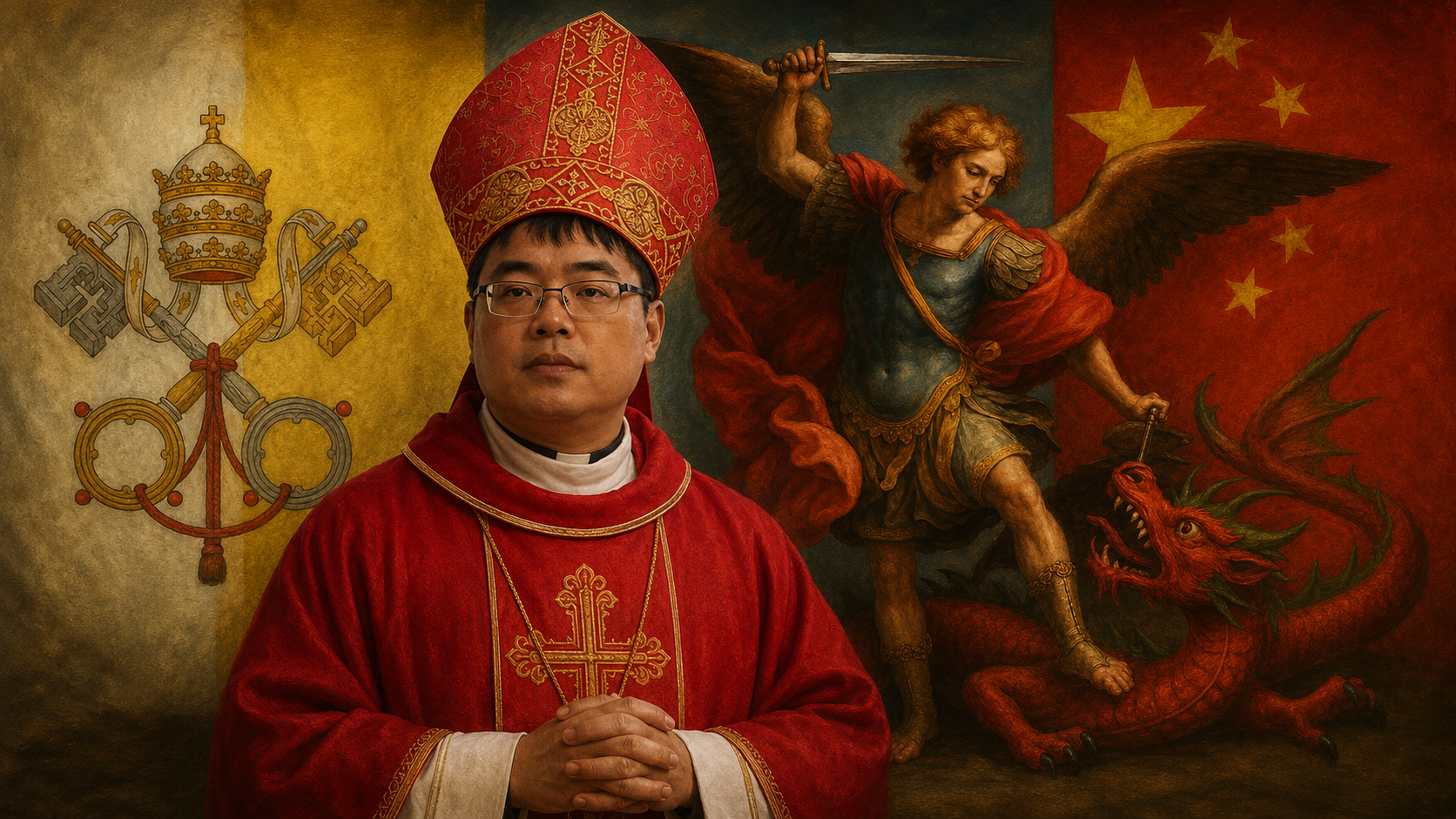
Chifeng, Écône and Rome’s Uneven Measure of Ecclesial Communion
Pope Leo XIV authorised the consecration of a bishop selected through China’s state-supervised ecclesiastical system and forbade the four consecrations at Écône. The canonical distinction is clear. Less easily explained is why Rome treats institutions founded upon principles condemned as incompatible with Catholic doctrine more indulgently than a priestly society which explicitly professes the Roman primacy and the traditional Catholic constitution of the Church.

During the episcopal consecration of Joseph Chang Yanfeng at Chifeng on 22 July, Father Joseph Yang Yu rose to address the clergy and faithful assembled in the cathedral. According to Fides, the Vatican-connected missionary news agency, he “referred to the Pope’s appointment of the new Bishop and read the decree of approval issued by the Conference”.
The sentence deserves to be read carefully. Pope Leo XIV’s appointment was referred to. The document publicly read was the approval decree of the state-recognised Chinese Catholic Bishops’ Conference.¹
No complete recording, transcript or official order of service has yet been produced. It cannot therefore be stated with absolute certainty that an apostolic mandate was nowhere read during the ceremony. The fullest available account, however, identifies only the Chinese conference’s instrument as having been formally proclaimed. The Holy See Press Office confirmed that Leo XIV had appointed Chang on 15 June, having approved his candidature under the Provisional Agreement with the People’s Republic of China, but said nothing about the presentation or reading of the papal document at the consecration.²
This does not render Bishop Chang’s ordination invalid or illicit. The Pope had appointed him. The pontifical mandate required by canon law existed. Whatever irregularity may have occurred in the ceremonial presentation of the appointment, Chang was not consecrated against the will of the Roman Pontiff.
That elementary distinction must be preserved, particularly after the four episcopal consecrations conducted by the Society of Saint Pius X at Écône on 1 July. Those consecrations took place without papal authorisation and after Leo XIV had personally asked the Society’s Superior General, Father Davide Pagliarani, to desist. Rome consequently regarded them as grave acts of disobedience and declared that the bishops concerned had incurred excommunication.
Chifeng possessed the mandate which Écône lacked. That settles the immediate question of canonical authorisation. It does not settle the wider question of Catholic ecclesiology.
What a papal mandate establishes
Canon 1013 states that no bishop may consecrate another bishop unless it is first evident that a pontifical mandate exists. The requirement protects the visible unity of the episcopate and the sovereign right of the Roman Pontiff to determine who shall enter it.
An episcopal consecration is not the private transmission of sacramental power from one bishop to another. The bishop is incorporated into an order whose unity is maintained through hierarchical communion with the Successor of Peter. The apostolic mandate gives public expression to that communion and demonstrates that the new bishop has not been imposed upon the Church by a government, an electorate, a private association or the consecrating prelates themselves.³
For that reason, the absence of a mandate at Écône was not a negligible procedural defect. The Society acted against an explicit papal prohibition. Its contention that necessity excused or justified the act may be examined canonically, but it cannot make the absence of authorisation disappear.
Yet a mandate answers a particular question: did the Pope permit this consecration?
It does not establish that every institution involved in selecting the candidate possesses a sound doctrine of the Church. Nor does its absence prove that those responsible reject the papacy, deny the Roman primacy or adhere to an alternative ecclesiology.
Papal authorisation is juridically decisive. It is not doctrinal alchemy.
The ecclesiology behind the Chinese system
The Chinese Catholic Patriotic Association and the Chinese Catholic Bishops’ Conference are distinct institutions. They must not be carelessly conflated. Both, however, form part of the official structure through which the Communist state supervises Catholic life.
The Patriotic Association has historically promoted the principles of independence, autonomy, self-management and democratic administration. The state-recognised bishops’ body, for its part, has not been acknowledged by the Holy See as a legitimate episcopal conference in the canonical sense. It excludes or marginalises bishops whom the civil authorities do not recognise and functions within a system in which ecclesiastical appointments and pastoral activity are subject to political approval.
Benedict XVI addressed these matters with considerable precision in his 2007 letter to Chinese Catholics. State-created entities could not legitimately place themselves above bishops or direct the life of the Church. Preaching, catechesis, worship and pastoral government belonged to the bishops and their priests, not to bodies imposed from outside the Church’s apostolic constitution.
He judged the programme of “independence and autonomy, self-management and democratic administration” to be “incompatible with Catholic doctrine”. He also stated that the Chinese bishops’ organisation could not be recognised as an episcopal conference because its membership and statutes contained elements contrary to the Church’s constitution.⁴
These were doctrinal judgements, not expressions of diplomatic irritation. The issue was the source and exercise of authority in the Church.
Catholic doctrine permits the Church in China to be thoroughly Chinese in language, culture, customs and legitimate civil organisation. It does not permit her to become independent of the Holy See in the religious sphere, subordinated to the Communist Party or governed by associations which stand above the bishops.
The Church may negotiate with the state over legal recognition, property, public order and the civil consequences of ecclesiastical appointments. The state cannot become a constituent part of the apostolic mission by which bishops govern the flock of Christ.
The Holy See’s own pastoral guidelines of 2019 acknowledged that Chinese priests and bishops were being asked to sign registration documents containing language that did not respect Catholic doctrine. Rome proposed that clergy might qualify their signatures by explaining that independence concerned the political sphere and could never mean separation from the Pope and the universal Church. It also respected those who judged in conscience that they could not register under such conditions.⁵
That was an understandable pastoral accommodation for Catholics living under coercion. It did not make the original formulas doctrinally harmless.
Nor should criticism of the system be turned against Chinese Catholics themselves. Many clergy and faithful have endured imprisonment, surveillance and deprivation because of their fidelity to Rome. Others may cooperate outwardly with official structures to preserve sacramental life under circumstances which Western Catholics are fortunate not to face. Personal culpability cannot be inferred from institutional membership.
The question concerns what Rome is prepared to recognise publicly as an acceptable framework for episcopal government.
At Chifeng, the Pope’s appointment existed. The ceremony nevertheless appears to have given documentary prominence to the approval of a Chinese body which Benedict XVI said could not be recognised as a legitimate episcopal conference. The pontifical act was reported; the Chinese decree was read.
The doctrine professed at Écône
The Society of Saint Pius X presents a different problem.
On 14 May, Father Pagliarani addressed a formal Declaration of Catholic Faith to Pope Leo XIV. The document professed one Roman Catholic Church, founded by Christ and possessing the four marks of unity, holiness, catholicity and apostolicity. It declared the Roman Pontiff to be “the sole possessor of supreme authority over the whole Church” and affirmed that ecclesiastical jurisdiction is conferred through him.
The declaration concluded by asking the Pope to instruct and confirm the Society in that faith. Whatever may be said about its subsequent conduct, this was not the manifesto of a national church declaring independence from Rome. It explicitly accepted the traditional Catholic doctrine of the papacy, apostolic succession and hierarchical jurisdiction.⁶
The Society also stated before and after the consecrations that its new bishops would claim no territorial or ordinary jurisdiction. They were consecrated to ordain priests, administer Confirmation and provide episcopal ministry within the Society’s apostolate. The Society denied any intention to establish dioceses, usurp papal jurisdiction or create a parallel hierarchy.
Rome may reject the Society’s argument from necessity. It may judge that its distinction between sacramental episcopacy and jurisdiction does not excuse consecration against the Pope’s command. It may maintain that sustained disobedience has acquired a schismatic character despite the doctrinal formulations employed by the Society.
Those are serious arguments. The Society’s profession of Catholic ecclesiology does not automatically vindicate every practical conclusion it draws from that ecclesiology. A man may acknowledge an authority in principle while disobeying it in fact.
The converse must also be admitted. Disobedience does not of itself prove denial of the doctrine upon which the authority rests. An illicit act is not automatically a heresy, and a claim of necessity is not equivalent to a constitutional principle of ecclesiastical independence.
No honest account of the Écône dispute can pretend that the Society teaches that the Pope is merely an honorary president, that individual nations may appoint their own bishops without reference to Rome, or that ecclesiastical government properly belongs to civil authorities. The Society teaches the opposite. Its May declaration says so in terms derived from Vatican I and the pre-conciliar magisterium.
The bishops consecrated at Écône lacked papal authorisation. They did not claim that papal authorisation was irrelevant in principle, nor that they had received jurisdiction from the Swiss state, the Society’s General Council or the consecrating bishop.
Rome’s doctrinal imbalance
The Dicastery for the Doctrine of the Faith described the Écône consecrations as an act of a schismatic nature. It declared excommunications against the consecrating and consecrated bishops and warned clergy and laity against adhering to what it called the Society’s schism. Leo XIV had already spoken of the threatened act as tearing the seamless garment of Christ.⁷
The severity is understandable insofar as the unity of episcopal government requires obedience to the Roman Pontiff. The difficulty lies in the contrast with the language and concessions employed towards China.
In one case, the Holy See confronts clergy who profess Catholic doctrine concerning the papacy but claim an extraordinary necessity for acting without its permission. Their claim may be rejected, but the faith they formally profess is not in doubt.
In the other, Rome works through institutions whose foundational principles concerning independence, democratic management and state control have been judged incompatible with Catholic doctrine. The process receives papal approval, while the institutional contradiction is managed through confidential diplomacy and carefully restricted interpretations.
The difference in canonical status is real. The difference in doctrinal content is real as well.
At Écône there was no mandate, but the Society expressly professed that the Pope alone possesses supreme authority and confers ecclesiastical jurisdiction.
At Chifeng there was a mandate, but the candidate emerged from a system in which bodies external to the Church continue to exercise a determining influence over episcopal selection and public ecclesiastical life. The decree solemnly read during the consecration came from that system.
Rome appears increasingly willing to treat canonical authorisation as sufficient proof of ecclesial communion, even where the surrounding institutional principles remain defective. It treats the absence of canonical authorisation as sufficient proof of schismatic separation, even where those responsible explicitly profess Catholic doctrine and deny any claim to independent jurisdiction.
Neither conclusion is adequate on its own.
Catholic communion includes faith, sacraments and hierarchical government. These elements belong together. Juridical obedience cannot be dismissed as bureaucracy; doctrinal profession cannot be dismissed as irrelevant once a law has been broken.
A sound judgement of Écône must therefore consider both the grave objective disobedience and the Society’s continued profession of Roman Catholic faith and ecclesiology. A sound judgement of Chifeng must acknowledge both the valid papal appointment and the continuing doctrinal disorder of institutions which claim powers over the Church that do not belong to them.
The question Rome should answer
The Holy See can clarify the immediate ceremonial question without difficulty. It should state whether the apostolic mandate was publicly read at Chifeng and, should it not have been, explain why the decree of the state-recognised Chinese conference was proclaimed in its place or given greater prominence.
A complete transcript or recording would settle the matter. Until one is available, the evidence must be described accurately: Fides reports that the Pope’s appointment was referred to and that the Chinese conference’s approval decree was read.
The larger difficulty will not be resolved by publishing an order of service.
Rome must explain how an ecclesiastical system founded upon state supervision and principles condemned by Benedict XVI is being brought into conformity with Catholic doctrine. It must also explain why those principles now appear less destructive of communion than the conduct of Catholics who, however disobediently, continue to profess the Pope’s supreme jurisdiction and seek no episcopal authority independent of him.
The papal mandate makes Bishop Chang’s consecration lawful. It does not vindicate the ecclesiology of the system which selected him.
The absence of a mandate makes the Écône consecrations unlawful. It does not prove that the Society has adopted a non-Catholic doctrine of the Church.
Rome has every right to require obedience from Écône. It has a still greater duty not to allow Beijing to determine what the Church in China may visibly understand herself to be.
- Agenzia Fides, “Father Joseph Chang Yanfeng ordained Bishop of Chifeng”, 22 July 2026, reporting that Father Joseph Yang Yu referred to the papal appointment and read the approval decree issued by the Chinese Catholic Bishops’ Conference.
- Holy See Press Office, “Resignations and Appointments”, 22 July 2026; Pope Leo XIV appointed Joseph Chang Yanfeng on 15 June after approving his candidature under the Provisional Agreement between the Holy See and the People’s Republic of China.
- Code of Canon Law, can. 1013; Benedict XVI, Letter to the Bishops, Priests, Consecrated Persons and Lay Faithful of the Catholic Church in the People’s Republic of China, 27 May 2007, no. 9.
- Benedict XVI, Letter to Chinese Catholics, nos. 7–9, especially his treatment of external bodies placed above bishops, the principles of independence and democratic administration, and the canonical standing of the Chinese bishops’ organisation.
- Holy See Press Office, “Pastoral Guidelines of the Holy See concerning the Civil Registration of Clergy in China”, 28 June 2019.
- Priestly Society of Saint Pius X, “Declaration of Catholic Faith addressed to His Holiness Pope Leo XIV”, 14 May 2026; General House statements of 26 May and 1 July 2026 concerning the absence of any claim to jurisdiction or parallel authority.
- Leo XIV, Letter to Father Davide Pagliarani, 29 June 2026; Dicastery for the Doctrine of the Faith, Decree, 2 July 2026.
RELATED ARTICLES


LATEST ARTICLES
- Today’s homily: St John CantiusThe account of St John of Kenty illustrates true charity, as he prioritised the needs of a poor man over his own comfort, exemplifying how knowledge of faith must translate into actions. His life was marked by humility, generosity, and a dedication to both charitable works and doctrinal integrity, urging a holistic expression of faith.
- Today’s Mass: October 22 St John CantiusSt John of Kenty, originally a humble country lad, succeeded as a theology professor in Kraków but faced opposition that led to his role as a parish priest. Known for his kindness, he lived simply, aiding the poor. After winning his parishioners’ hearts, he returned to teaching, living a life of humility and faith.
- Today’s Mass: October 21 St Ursula, Virgin Martyr & CompanionsSt Ursula and Companions, Virgins and Martyrs; Commemoration of St Hilarion, Confessor. Though legends concerning Ursula and eleven thousand virgins are historically uncertain, early Christian martyrs were venerated at Cologne. St Hilarion, Palestinian hermit and disciple of St Anthony, embraced severe penance and solitude, dying in 371 aged eighty.
- FR RIPPERGER’S YEAR OF SILENCE: Obedience is not an explanationFr Chad Ripperger has accepted a year-long withdrawal from public speaking as requested by Archbishop Golka of Denver, aimed at focusing on his priestly community. This decision, following the removal of another exorcist, raises concerns about the Church’s balance between discretion and public witness regarding exorcism and supernatural matters.
- Today’s Mass: October 20 Octave Day of St Edward, King & ConfessorEdward the Confessor, England’s last Saxon king, ruled from 1042 until his death in 1066. Born in 1003, he fled to Normandy during Danish rule and returned to take the throne. His reign is debated, seen as both weak and a time of peace. Edward’s legacy includes the establishment of Westminster Abbey, where he is buried.



Leave a Reply