
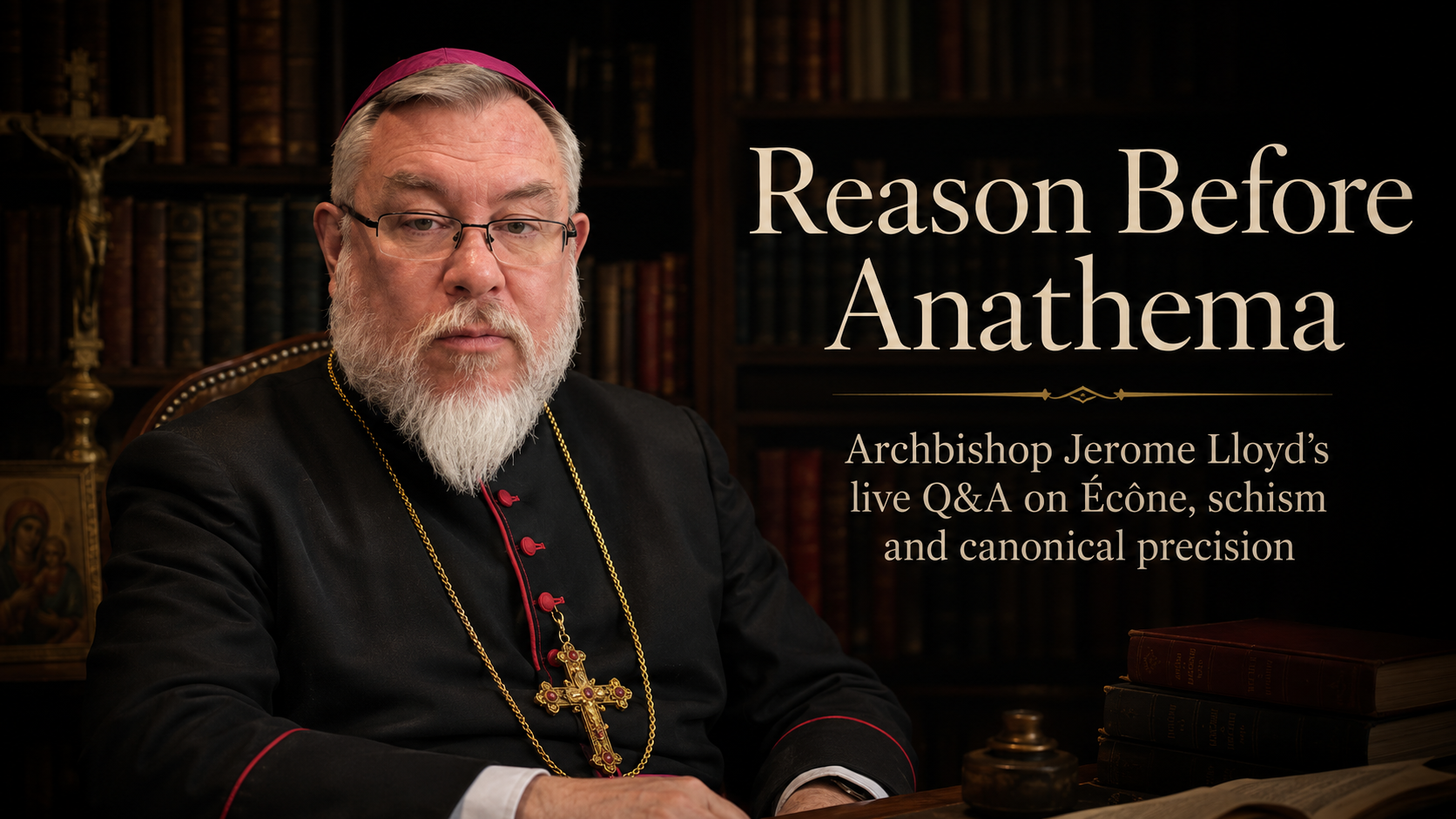
Reason Before Anathema: Q&A with ✠Jerome Lloyd
In the first of a proposed series of weekly live question-and-answer broadcasts, Archbishop Jerome Lloyd addressed the Écône consecrations, excommunication, schism, sacramental validity and the wider crisis of Catholic reason. His governing principle was both simple and urgently necessary: ecclesiastical controversy must be judged through truthful distinctions, proportionate judgment and canonical due process, rather than by slogans, factional passions or guilt by association.

The first instalment of Archbishop Jerome Lloyd’s live question-and-answer programme was conceived as an opportunity for viewers to raise questions arising from the recent Écône consecrations and the subsequent decree of excommunication. Over the course of almost two hours, the discussion broadened naturally to include sacramental validity, episcopal jurisdiction, the meaning of schism, the canonical state of irregular clergy, the Transalpine Redemptorists, sedevacantism, the possibility of a future orthodox pope, the failure of Catholic catechesis and the theological significance of the traditional Roman liturgy.¹
Although wide-ranging, the broadcast possessed a clear and consistent argument. The Archbishop was not attempting to defend every prudential judgment made by the Society of Saint Pius X. He was defending the necessity of accuracy, justice and proportion when Catholics discuss the Society, its bishops, its clergy and the faithful whom it serves.
“I am defending the need for truthful distinctions, proportionate judgment and canonical due process,” he explained. “One can believe that the consecrations were unlawful, irregular, or even imprudent without accepting every subsequent claim made about the bishops, priests, and the faithful.”
That distinction provided the intellectual and moral centre of the programme. Since the consecrations, much public commentary has treated the words “disobedient”, “excommunicated”, “schismatic” and “outside the Church” as though they described one undifferentiated reality. They do not. Canon law distinguishes carefully between an illicit act, a canonical offence, the incurring of a penalty, the formal declaration of that penalty and the separate offence of schism. It also distinguishes the conduct of named individuals from the supposed guilt of an entire body of priests and faithful.
The Archbishop was therefore correct to insist that penalties apply to persons rather than to vague categories of association. The decree issued after Écône named the six bishops directly involved in the consecrations. The much broader language of the accompanying explanatory note, particularly concerning priests and faithful, cannot eliminate the canonical necessity of establishing personal conduct, intention and imputability.
Formal adherence to schism cannot simply be inferred from attendance at Mass, attachment to the traditional liturgy, financial support for a chapel or receipt of the sacraments. The Church’s penal law does not ordinarily proceed by collective accusation. A person’s actual acts and intentions matter.
The Archbishop’s spoken explanation of undeclared penalties was also substantially correct in its practical application. A latae sententiae penalty may, in principle, be incurred by the commission of an offence before a decree is issued, but it cannot therefore be indiscriminately presumed against every person connected with a religious body. The alleged act, the applicable law, the individual’s imputability and any excusing or mitigating circumstances must still be considered.²
This was precisely the Archbishop’s essential point. The fact that canon law recognises automatic penalties does not permit commentators to pronounce entire congregations, families or congregations of worshippers excommunicated merely by association. Nor does it permit internet polemicists to decide, without evidence or authority, that another Catholic has formally rejected the Roman Pontiff or withdrawn from ecclesiastical communion.
His discussion of suspended clergy and supplied jurisdiction similarly expressed a sound canonical principle in accessible spoken language. Clergy ordained or exercising ministry outside ordinary canonical structures may be subject to canonical prohibitions, but the Church’s law itself contains provisions intended to safeguard the spiritual needs of the faithful. Canon 1335 permits the exercise of ministry in certain circumstances when an undeclared latae sententiae censure exists and a member of the faithful requests a sacrament, sacramental or act of governance for a just reason. Canon 144 separately supplies executive power of governance in cases of common error or positive and probable doubt of law or fact.³
These provisions do not erase every irregularity, but they demonstrate why the sacramental life of Catholics cannot be analysed by merely repeating the word “suspended”. Canon law is not an instrument designed only to prohibit. It also supplies, mitigates and protects, because its final purpose is the salvation of souls.
The Archbishop returned repeatedly to this supreme principle of ecclesiastical law. Canon law is frequently caricatured as an inflexible system of prohibitions and penalties, yet its penal provisions are marked by concern for culpability, intention, necessity, grave fear, proportionality and mercy. A just canonical judgment must ask not only what externally occurred, but why it occurred, what danger was perceived, what alternatives were available and what degree of responsibility can fairly be attributed to the person concerned.
This was particularly relevant to the Society’s appeal to a state of necessity. The Archbishop did not suggest that mere inconvenience, disagreement or frustration creates canonical necessity. He explained that necessity concerns a grave danger to persons or to an important good which cannot reasonably be protected by ordinary means.
From the Society’s perspective, the danger is not merely the eventual absence of bishops available to confer Confirmation or Holy Orders. It is the possible extinction or effective neutralisation of a complete priestly, liturgical and doctrinal tradition. The Society argues that it requires bishops who understand its formation, share its doctrinal analysis and can serve its apostolate without making its continuation dependent upon hierarchs who may be hostile to its very existence.
The Archbishop strengthened this argument by recalling that Rome itself accepted in 1988 that Archbishop Marcel Lefebvre required an episcopal successor. The negotiations preceding the original Écône consecrations were not concerned with whether the Society could conceivably need a bishop, but with the identity and timing of such an appointment. The Priestly Fraternity of Saint Peter subsequently emerged from the crisis with an expectation that its own traditional apostolate would also eventually receive episcopal provision. Nearly four decades later, no bishop has been granted to it.
This history does not of itself settle every canonical question, but it explains why traditional Catholics remain wary of assurances that their long-term sacramental needs will always be met through external episcopal goodwill. The Society’s judgment may still be debated, but it cannot reasonably be dismissed as though it were based upon a merely aesthetic preference or a desire for institutional independence.
The Archbishop was equally clear concerning the validity of the new bishops. The Écône consecrations were sacramentally valid. There is no serious reason to doubt the apostolic succession of the consecrating bishops, the validity of the traditional rite employed or the necessary sacramental intention. Rome’s declaration of a penalty for consecration without pontifical mandate itself presupposes that episcopal consecration truly occurred.
Illicit does not mean invalid. The four priests became bishops and received the fullness of Holy Orders. They possess the sacramental capacity to ordain priests, confirm the faithful and consecrate other bishops, although the legitimate exercise of those powers remains subject to ecclesiastical law.
The Archbishop also accurately distinguished episcopal Orders from ordinary jurisdiction. Consecration does not, by itself, assign a diocese, establish canonical office or confer territorial jurisdiction. The new bishops did not become diocesan ordinaries and were not presented by the Society as members of a rival territorial hierarchy. The Society expressly denied any intention to create a parallel Church or jurisdiction.
Episcopal consecration confers the fullness of the sacrament of Orders and the corresponding episcopal offices of teaching, sanctifying and governing. Their juridical exercise, however, ordinarily requires hierarchical communion and canonical mission.⁴ Thus the bishops possess true episcopal Orders without having received ordinary governance over dioceses or territories.
This distinction is decisive when evaluating allegations of schism. Had the Society attempted to establish dioceses, appoint rival ordinaries, claim territorial jurisdiction or erect a parallel universal government, the accusation of schismatic intention would have considerably greater force. Instead, it maintained that the bishops were consecrated to provide sacramental ministry within an existing priestly society, without claiming the ordinary jurisdiction belonging to the Roman Pontiff and diocesan bishops.
The Archbishop’s treatment of disobedience and schism was one of the strongest portions of the broadcast. Not every act of disobedience constitutes schism. Canon 751 defines schism as the refusal of submission to the Supreme Pontiff or of communion with those members of the Church who remain subject to him.⁵ That is more specific than the violation of a command.
A Catholic may disobey a lawful superior while continuing to recognise his office and authority. The act may be gravely wrong and canonically punishable, but it does not automatically amount to a denial that the superior possesses authority at all. The distinction is familiar in every other sphere of life. A child who disobeys his father does not thereby deny his fatherhood; an employee who contests or refuses an instruction does not necessarily deny that his employer retains legitimate authority.
The Society’s public profession of recognition of Pope Leo XIV, its continued prayer for him in the Canon of the Mass and its recourse to the Church’s canonical procedures are all relevant when assessing the accusation that it has rejected papal submission absolutely. They do not settle the question by themselves, but neither may they be ignored.
The Archbishop was therefore justified in drawing attention to the precise juridical status of the decree. It was issued by the Dicastery for the Doctrine of the Faith and signed by Cardinal Víctor Manuel Fernández and the relevant officials. It was not issued personally by Pope Leo XIV, nor was it presented as a papal act approved in forma specifica.
This distinction matters because canon law excludes ordinary hierarchical recourse against an administrative act of the Roman Pontiff himself, while permitting recourse against other singular administrative decrees. The Society announced that it had initiated the preliminary recourse provided by canon 1734. Canon 1353 further provides that recourse against a decree imposing or declaring a penalty has suspensive effect.⁶
The Archbishop did not claim that the Society’s appeal must succeed. He correctly observed that the appeal is a recognised canonical procedure and that the existence of the procedure itself disproves the assertion that every question was definitively and personally settled by the Pope. Catholics may hold different views about the likely outcome, but they cannot honestly dismiss canonical recourse as though it were simply another act of rebellion.
The programme’s discussion of the Church’s divine constitution placed these legal questions within a wider theological framework. The Mystical Body belongs to Christ. The Pope is the visible head of the Church on earth, but he is not the source of the Church’s supernatural existence. During a papal interregnum the Church does not cease to exist, lose the faith or dissolve into disconnected individuals. She remains the Mystical Body of Christ, sustained by her divine Head.
This observation was not offered to diminish the papacy. It was intended to correct a papal maximalism which speaks as though the Church exists only through the immediate will of the reigning Pontiff. The Pope possesses supreme authority within the divine constitution of the Church, but that authority serves the deposit of faith, the sacramental order and the salvation of souls. It does not replace Christ, Tradition or the very nature of the Church.
The same concern for distinctions shaped the Archbishop’s response to questions about whether he was “defending the SSPX”. His answer was admirably balanced. He expressed respect and admiration for the Society, acknowledged the similarity between its canonical predicament and that of Old Roman clergy, and made no pretence of personal detachment from the broader questions involved. Yet he did not present himself as an official apologist or suggest that every Society decision was necessarily beyond criticism.
The distinction between defending a person’s rights and endorsing all his actions ought to be elementary. In the present atmosphere, however, even a request for fair procedure is treated as evidence of factional loyalty. The Archbishop exposed the injustice of that approach. A Catholic can question the prudence of the consecrations and still object to the indiscriminate condemnation of priests and faithful. Indeed, anyone concerned with justice ought to do so.
The broadcast also identified the deeper cultural cause of the controversy: the displacement of reason by emotion. Modern public debate is increasingly governed by labels, moral panic, personal identification and performative outrage. Once someone has been classified as a “schismatic”, “modernist”, “extremist” or “rebel”, the label is treated as a substitute for evidence.
The Archbishop warned that emotion, although an unavoidable and sometimes valuable part of human experience, is a dangerous guide for serious judgment. Anger, grief, enthusiasm and fear can overwhelm the intellect and move people to decisions which they later recognise as irrational. Catholic spirituality does not demand emotional sterility, but it does insist that the passions must be governed by reason and reason illuminated by faith.
This applies equally to every side in the traditionalist crisis. Critics of the Society must not allow outrage at disobedience to replace canonical analysis. Supporters of the Society must not allow admiration, fear or resentment to exempt every extraordinary act from examination. The point is not to eliminate judgment, but to make judgment truthful.
The Archbishop connected this failure of reasoning with the long collapse of Catholic catechesis. Many Catholics have never been taught the difference between sacramental validity and canonical liceity, between the power of Orders and the power of jurisdiction, or between disobedience and schism. They are consequently vulnerable to confident but inaccurate claims circulated through social media.
This failure extends beyond traditionalist controversies. Surveys repeatedly suggest that many practising Catholics do not understand or accept the Church’s teaching concerning the Eucharist, abortion, contraception, marriage and sexual morality. Record numbers entering the Church at Easter may be encouraging, but they do not compensate for generations of Catholics who have lapsed or retained only a cultural affiliation.
The Archbishop’s discussion of emotional conversion within Evangelical and charismatic settings was therefore not an exercise in Protestant-bashing. He used the example to illustrate the difference between an intense religious experience and sustained discipleship. A conversion rooted chiefly in atmosphere, music, collective enthusiasm or emotional release may fail when those supporting conditions disappear. Catholic evangelisation faces the same danger whenever sacramental initiation is not followed by serious doctrine, discipline and spiritual formation.
The question concerning the forthcoming consecration of Father Michael Mary of the Sons of the Most Holy Redeemer introduced another important contemporary issue. The Archbishop offered a cautious welcome, recognising both the need for traditional bishops and the dangers associated with episcopal independence.
Father Michael Mary’s history, the Redemptorists’ reconciliation with Rome, their later canonical conflict and their subsequent adoption of the sedevacantist thesis make the proposed consecration very different from that of the Society’s bishops. The Archbishop did not endorse their conclusion that the Holy See is vacant, nor did he embrace the proposal for an “imperfect general council” of traditional bishops as a ready solution to the crisis.
He did, however, recognise Father Michael Mary as a serious spiritual and pastoral figure and expressed the hope that episcopal consecration would not alter that character. His humorous reference to “purple fever” conveyed a genuine ecclesiastical danger: the episcopate can tempt weak men to imagine themselves princes, founders of private jurisdictions or possessors of authority beyond what they truly hold.
The Archbishop’s cautious welcome was therefore neither naïve nor inconsistent. Traditional Catholics require bishops for ordination and Confirmation, and geography matters. A handful of bishops cannot easily serve faithful scattered across continents. The need for bishops is real, even when the circumstances in which they are consecrated demand prudence and careful theological judgment.
His comments concerning the possibility of a future orthodox pope were sober rather than despairing. The Archbishop observed that Pope Leo XIV appears committed to maintaining much of the ecclesiastical programme inherited from Pope Francis and may reign for many years. The immediate prospect of a thorough Roman restoration therefore seems remote.
Yet he also recognised signs of hope. Younger priests and seminarians are frequently more doctrinally conservative and liturgically traditional than the generation which preceded them. Communities such as the Priestly Fraternity of Saint Peter and the Institute of Christ the King continue to attract vocations. The recovery of Tradition may therefore proceed slowly through generations rather than through one sudden pontifical reversal.
His call to pray for the Pope’s conversion was properly explained. Conversion in Catholic spirituality is not merely the first passage from unbelief to belief. It is the lifelong reorientation of intellect, will and heart towards God. Catholics pray continually for their own conversion and may therefore pray, without disrespect, that Pope Leo and every member of the hierarchy may grow in fidelity, wisdom, courage and holiness.
The final extended discussion concerned the traditional Roman liturgy. Here too the Archbishop rejected a false simplification. Attachment to the ancient Mass is not principally an aesthetic preference. A reverently celebrated Novus Ordo may employ Latin, Gregorian chant, incense, eastward celebration, traditional vestments and a large ceremonial. It may be visually impressive and devotional in atmosphere.
The traditionalist objection is deeper. It concerns the doctrinal expression, historical development and theological structure of the rite. The ancient Roman Mass developed organically over many centuries. Saint Pius V did not manufacture a new liturgy at the Council of Trent; he codified, protected and standardised the received Roman rite.
The post-conciliar liturgy arose through a markedly different process. It was reconstructed by commissions, drawing upon historical scholarship, pastoral theories, reconstructed ancient forms and material derived from several liturgical traditions. Its supporters may defend that process, but they cannot plausibly describe it as identical to the organic development by which the classical Roman rite reached maturity.
The Archbishop’s reference to the Jewish form of blessing reflected the well-known resemblance between the offertory formulas of the reformed rite and Jewish berakoth: “Blessed are you, Lord God of all creation.” This does not mean that such words are intrinsically objectionable. Our Lord and the Apostles themselves prayed within the Jewish liturgical tradition. The traditionalist criticism is that the ancient Roman offertory prayers, with their explicit sacrificial and propitiatory language, were removed and replaced by formulas whose immediate doctrinal expression is less complete.
A magnificently celebrated reformed liturgy may therefore demonstrate that the new rite can be performed with dignity. It cannot by aesthetics alone answer the theological criticism that the older rite expresses the sacrificial priesthood, propitiation, sin, mediation and the oblation of the Victim with greater density and clarity.
The broadcast’s treatment of Anglican Orders likewise served the wider theme of sacramental intention. Pope Leo XIII’s judgment in Apostolicae Curae did not rest upon ceremony alone, nor upon the mere absence of elaborate Catholic ornament. It concerned the conjunction of defective form and defective intention within a rite deliberately altered in a Protestant theological context.⁷
The presentation of the chalice and paten in the traditional ordination rite, the repeated sacrificial language of the Roman Pontifical and the doctrinal setting of the Catholic priesthood all manifest the Church’s intention to ordain a sacrificing priest. The Edwardine Ordinal emerged from a reform which rejected that understanding of priesthood and Eucharistic sacrifice. The Thirty-Nine Articles’ condemnation of “the sacrifices of Masses” as “blasphemous fables, and dangerous deceits” makes the underlying theological rupture unmistakable.⁸
The Archbishop’s treatment was necessarily condensed for a live audience, but its essential theological argument was correct: sacramental intention is not an invisible private sentiment detached from the rite and the doctrinal community which employs it. It is publicly manifested through words, ceremonial, theological context and the objective meaning of the rite.
Taken as a whole, the first live Q&A was a successful experiment. Its unscripted character permitted subjects to develop organically and allowed the Archbishop to answer questions in the language of pastoral conversation rather than in the more compressed style of a formal lecture. The resulting breadth was part of the programme’s appeal.
More importantly, the broadcast modelled a form of Catholic discussion urgently needed in the present crisis. It did not demand the suspension of judgment. It demanded that judgment be disciplined by facts, definitions, law and charity. It rejected both papal maximalism and reflexive anti-Romanism. It defended Tradition without pretending that every traditionalist initiative must automatically be prudent. It recognised ecclesiastical penalties without turning them into instruments of collective denunciation.
The programme’s most memorable rebuke was directed towards the sudden multitude of self-appointed canonists who have appeared online to condemn priests, bishops and lay faithful to schism, excommunication and even damnation. Such pronouncements are not merely intemperate. They frequently ignore the very law in whose name they are delivered.
Canon law presumes innocence, distinguishes offences, considers imputability, recognises necessity, permits recourse and makes the salvation of souls its supreme law. It is not a vocabulary for decorating personal hostility with ecclesiastical language.
Archbishop Lloyd’s broadcast restored that truth to the centre of the Écône controversy. The issue is not whether Catholics must choose between authority and reason. Catholic authority itself must be exercised and interpreted according to reason, justice and the divine purpose for which it exists.
Before Catholics pronounce anathema, they must establish the facts. Before they declare schism, they must understand its definition. Before they attribute penalties to whole classes of people, they must remember that souls are judged individually. Before they condemn those who acted under an asserted necessity, they must at least examine the crisis which gave rise to that assertion.
That is not special pleading for the Society of Saint Pius X. It is the minimum demanded by Catholic justice.
Transcript of Archbishop Jerome Lloyd’s live question-and-answer broadcast concerning the Écône consecrations, canonical penalties, traditional Catholic episcopacy, sedevacantism, catechesis and the Roman liturgy.
² Code of Canon Law, canons 18, 1321–1324 and 1387.
³ Code of Canon Law, canons 1335 and 144.
⁴ Second Vatican Council, Dogmatic Constitution Lumen Gentium, no. 21; Code of Canon Law, canons 375–377.
⁵ Code of Canon Law, canon 751.
⁶ Code of Canon Law, canons 1353 and 1732–1737; Society of Saint Pius X, communiqué concerning its preliminary canonical recourse, 13 July 2026.
⁷ Leo XIII, Apostolic Letter Apostolicae Curae, 13 September 1896.
⁸ The Thirty-Nine Articles of Religion, Article XXXI.
RELATED ARTiCLES


LATEST ARTICLES
- Today’s homily: St John CantiusThe account of St John of Kenty illustrates true charity, as he prioritised the needs of a poor man over his own comfort, exemplifying how knowledge of faith must translate into actions. His life was marked by humility, generosity, and a dedication to both charitable works and doctrinal integrity, urging a holistic expression of faith.
- Today’s Mass: October 22 St John CantiusSt John of Kenty, originally a humble country lad, succeeded as a theology professor in Kraków but faced opposition that led to his role as a parish priest. Known for his kindness, he lived simply, aiding the poor. After winning his parishioners’ hearts, he returned to teaching, living a life of humility and faith.
- Today’s Mass: October 21 St Ursula, Virgin Martyr & CompanionsSt Ursula and Companions, Virgins and Martyrs; Commemoration of St Hilarion, Confessor. Though legends concerning Ursula and eleven thousand virgins are historically uncertain, early Christian martyrs were venerated at Cologne. St Hilarion, Palestinian hermit and disciple of St Anthony, embraced severe penance and solitude, dying in 371 aged eighty.
- FR RIPPERGER’S YEAR OF SILENCE: Obedience is not an explanationFr Chad Ripperger has accepted a year-long withdrawal from public speaking as requested by Archbishop Golka of Denver, aimed at focusing on his priestly community. This decision, following the removal of another exorcist, raises concerns about the Church’s balance between discretion and public witness regarding exorcism and supernatural matters.
- Today’s Mass: October 20 Octave Day of St Edward, King & ConfessorEdward the Confessor, England’s last Saxon king, ruled from 1042 until his death in 1066. Born in 1003, he fled to Normandy during Danish rule and returned to take the throne. His reign is debated, seen as both weak and a time of peace. Edward’s legacy includes the establishment of Westminster Abbey, where he is buried.
CURRENT EDITION


Today’s Mass Propers
- Today’s Mass: October 22 St John Cantius
 St John of Kenty, originally a humble country lad, succeeded as a theology professor in Kraków but faced opposition that led to his role as a parish priest. Known for his kindness, he lived simply, aiding the poor. After winning his parishioners’ hearts, he returned to teaching, living a life of humility and faith.

Leave a Reply