
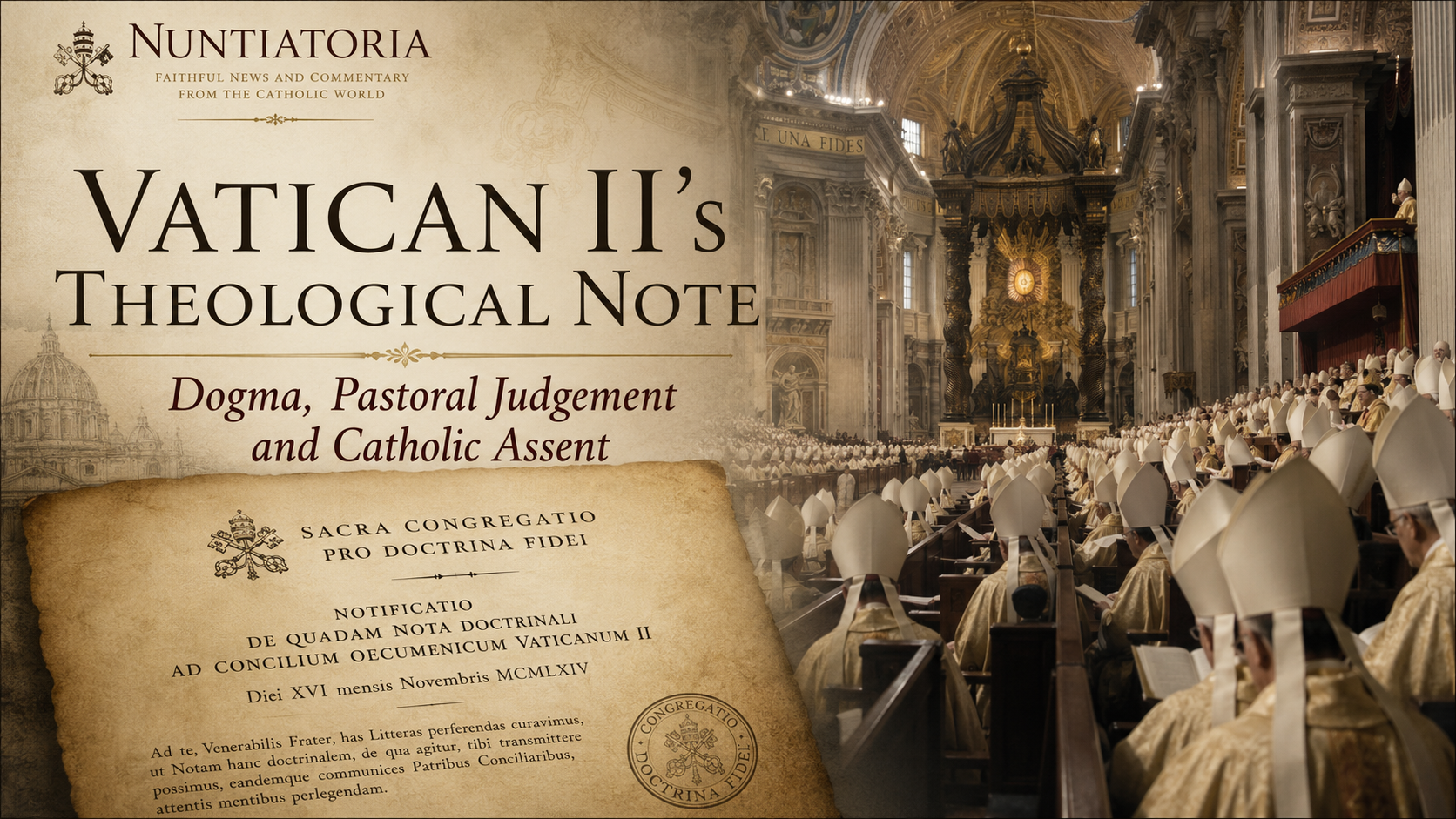
Vatican II’s Theological Note: Dogma, Pastoral Judgement and the Measure of Catholic Assent
On 16 November 1964, the Second Vatican Council’s Secretary-General gave the Fathers an official explanation of the authority attaching to its teaching. Sixty-two years later, that explanation is still routinely ignored. Vatican II neither defined a new body of infallible dogma nor produced a collection of optional essays. Catholics owe its texts the assent proper to their actual theological character, while retaining the right—and sometimes the duty—to examine ambiguous formulations and failed pastoral policies in the light of the Church’s prior and permanent teaching.

On 16 November 1964, five days before the promulgation of Lumen Gentium, Archbishop Pericle Felici rose before the 123rd General Congregation of the Second Vatican Council to answer a question that had troubled some of the Fathers. What precise theological note, they had asked, should be attached to the doctrine contained in the schema on the Church?
The answer, drawn from a declaration of the Council’s Theological Commission, was placed in the official acts and later appended to the promulgated text. Because of the Council’s pastoral purpose, it said, the Council would define as binding upon the Church only those matters of faith and morals which it openly declared to be binding. Its remaining teaching was to be received according to the Council’s mind, discerned from the subject under discussion and its manner of expression.¹
That statement ought to have prevented much of the confusion that followed. It did not reduce the Council to a theological discussion group. Nor did it elevate every sentence, prudential observation and pastoral aspiration into irreformable doctrine. It required distinctions.
Those distinctions have largely disappeared from ordinary Catholic argument. Question a disputed passage of Dignitatis Humanae, Unitatis Redintegratio or Gaudium et Spes, and the reply often comes at once: Vatican II was an ecumenical council; an ecumenical council exercises the supreme Magisterium; therefore every conciliar proposition must be accepted without qualification. On the other side, one sometimes hears that the Council was “merely pastoral” and may therefore be ignored altogether.
Neither position expresses Catholic theology. One treats authority as though it admitted no degrees; the other mistakes the absence of a solemn definition for the absence of any teaching authority. Both evade the question Felici was addressing: what kind of assent is owed to this particular proposition, stated in this particular document, with this particular intention?
What the Council did—and did not—claim
Paul VI returned to the question less than six weeks after the Council closed. At his General Audience of 12 January 1966, he acknowledged that Vatican II had deliberately avoided solemn dogmatic definitions engaging the infallibility of the extraordinary Magisterium. He immediately added that the Council’s teaching nevertheless possessed the authority of the supreme ordinary Magisterium and should be received sincerely by the faithful “according to the mind of the Council regarding the nature and purposes of the individual documents”.²
The qualification matters. Paul VI did not say that every line had become infallible because bishops had voted upon it. He referred the faithful back to the nature, purpose and language of each text. At the Council’s final public session on 7 December 1965, he had already said that many questions had been treated only in restricted or general terms and remained open to further investigation and differing applications. He described the Council’s pastoral character as its programme, even while insisting that its teaching retained authority.³
Vatican II therefore issued no new solemn dogmatic definition. That proposition does not mean that nothing in its documents is infallibly true. The Council repeatedly restated doctrines already taught infallibly by previous councils or by the ordinary and universal Magisterium: the divinity of Christ, the sacrificial character of the Mass, episcopal succession, the Real Presence, the necessity of the Church and the primacy of the Roman Pontiff. Such doctrines do not become less certain because Vatican II repeated them without an anathema. Their authority rests upon the Revelation and Magisterium by which they had already been proposed.
It is consequently inaccurate to claim that the Church can bind the faithful only by attaching the formula anathema sit. Councils and popes have used solemn definitions, canons, professions of faith, doctrinal decrees and the constant teaching of the ordinary and universal Magisterium. The formula of anathema is one recognisable indication of a definitive judgement, but it is not the sole means by which the Church teaches infallibly. The intention to define must be established from the wording, context, repetition and manifest judgement of the teaching authority.⁴
The actual Catholic distinction is more demanding than either popular extreme. Revealed doctrines proposed as such require the assent of divine and Catholic faith. Doctrines definitively connected with Revelation must be firmly accepted and held. Authentic but non-definitive teaching requires religious submission of intellect and will. Disciplinary provisions and prudential judgements deserve respectful obedience according to their nature, but they are neither irreformable nor immune from defective application.
To describe every one of these acts simply as “binding” conceals more than it explains. A dogma is binding, a definitive doctrinal judgement is binding, a non-definitive teaching is binding in another manner, and a disciplinary direction binds according to law and circumstance. They do not all claim the same certainty or demand the same species of assent.
The Magisterium serves what it has received
The expression “living Magisterium” is often used as though “living” meant capable of changing its doctrinal identity. In Catholic theology it means that Christ continues to teach His Church through the successors of the Apostles. The Magisterium is living because it authoritatively guards, explains and applies the deposit of faith in changing circumstances. It is not living in the sense that yesterday’s condemnation may become tomorrow’s revelation.
Vatican II itself states the principle with admirable clarity in Dei Verbum. The teaching office of the Church is “not above the word of God, but serves it”, teaching only what has been handed down, listening to it devoutly, guarding it scrupulously and explaining it faithfully.⁵ The Magisterium possesses authority from Christ, but that authority is ministerial rather than creative. It cannot manufacture a new revelation, reverse a dogma or render true what the Church has definitively taught to be false.
The Council must therefore be interpreted within the whole doctrinal inheritance of the Church. Paul VI explicitly rejected the idea that Vatican II represented a rupture or release from traditional teaching. Even its novelties, he said, had to be understood in their proper proportions and in coherence with the Church’s doctrinal patrimony.⁶ Benedict XVI later described the same necessity as a “hermeneutic of reform”, involving renewal within the continuity of the one subject-Church, rather than a hermeneutic of discontinuity and rupture.⁷
Continuity, however, cannot be produced by repeatedly pronouncing the word. It must be demonstrated through argument. Where a conciliar expression appears difficult to reconcile with earlier teaching, the theologian must identify the respective propositions, their objects, qualifications and historical circumstances. Sometimes the apparent conflict disappears when terms are defined. Sometimes the later text addresses a distinct question. Sometimes it corrects a contingent policy rather than a doctrine. There may also remain a formulation whose ambiguity has encouraged readings at odds with the received faith.
Catholic fidelity does not require pretending that these possibilities are identical.
Development or alteration?
St Vincent of Lérins supplied the classical measure of doctrinal development in the fifth century. Christian understanding may grow greatly with the passage of time, he wrote, but it must grow within its own kind: in the same doctrine, the same sense and the same judgement. Development resembles the growth of a human body. The adult is more fully developed than the child, but he has not become a different species.⁸
The Church may express ancient truth more precisely, draw implications from revealed principles and address circumstances unknown to earlier centuries. What she cannot do is call a contradiction a development. A teaching which formerly meant one thing cannot legitimately be made to signify its contrary while the original formula is left standing as an embarrassing historical artefact.
The International Theological Commission made the same point in its study on the interpretation of dogma: authentic development conserves the values and formulations that preceded it; development becomes corruption when it contradicts the original doctrine or an earlier legitimate development.⁹
This criterion must govern the reception of Vatican II as surely as it governs the reception of any other ecclesiastical text. Antiquity is not an alternative Magisterium set against the living Church. It is the inheritance which the living Magisterium has been instituted to preserve.
Religious liberty and the burden of proof
The dispute over religious liberty illustrates why exact distinctions are necessary. Dignitatis Humanae declares that the human person possesses a right to religious freedom, understood as immunity from coercion by individuals, social groups or human authority, in private and in public, within due limits. It also insists that the declaration leaves untouched the traditional Catholic doctrine concerning the moral duties of men and societies towards the true religion and the one Church of Christ.¹⁰
The conciliar text cannot fairly be reduced to the proposition that error possesses moral rights or that all religions are equally true. It grounds the civil immunity it describes in the dignity of the person and the nature of the free act of faith. No man may be forced to believe. The Church had taught that principle long before the Council.
The difficulty concerns the breadth and foundation of the civil right being affirmed, especially its public and corporate exercise, and its relation to the duties of political society towards the true religion. Pius IX’s Quanta Cura had condemned claims of liberty of conscience and worship embedded in a wider liberal doctrine which treated religion as a matter of subjective choice and denied the authority of Christian truth over public life. Leo XIII likewise distinguished legitimate tolerance from a supposed natural entitlement to propagate religious error without regard to the common good.
A serious defence of continuity must therefore do more than quote Dignitatis Humanae’s assurance that traditional doctrine remains untouched. It must show how the right it recognises differs in object and limits from the propositions previously condemned. There are substantial arguments available: the distinction between moral liberty and civil immunity; the difference between coercing belief and restraining harmful public acts; the altered constitutional form of the modern state; and the Council’s express reference to due limits and public order.
Yet the need for these arguments proves the point. The matter is not settled by announcing that Vatican II “developed” the doctrine. The precise development must be demonstrated. Even the International Theological Commission, writing in 2019, acknowledged an “apparent contradiction” between earlier condemnations and the later affirmation of religious freedom, while explaining the Council as a maturation concerning the juridical form of the state and the civil immunity of persons. It also admitted that Dignitatis Humanae left aspects of the subject open to further study.¹¹
When Catholics ask how the propositions fit together, they are not necessarily repudiating the Magisterium. They may be requesting the very theological clarification that the Church’s own institutions have recognised as necessary.
Ecumenism and the identity of the Church
A similar difficulty appears in Catholic ecumenism. Pius XI’s Mortalium Animos condemned the pan-Christian project of constructing unity through federations of churches which retained contradictory doctrines. The Apostolic See, he said, could not participate in assemblies premised upon bargaining over revealed truth. Christian unity could be attained only in the one Church of Christ, through unity of faith, government and sacramental life.¹²
Unitatis Redintegratio begins by affirming that Christ founded one Church and one Church only. It recognises division among Christians as contrary to His will and directs Catholics to work for restoration of unity. It does not formally teach that contradictory confessions constitute equally valid branches of an invisible Church. It locates the fullness of the means of salvation in the Catholic Church and presupposes Catholic doctrine concerning the Church, the sacraments and apostolic succession.¹³
The problem has often arisen less from those propositions than from ecumenical practice. Common prayer, ambiguous ceremonies, intercommunion experiments, the language of “sister Churches”, and diplomatic reluctance to call non-Catholics to conversion have frequently conveyed an ecclesiology more permissive than the decree itself. The method which was supposed to lead separated Christians towards Catholic unity has at times been treated as though dialogue were itself the unity sought.
Here again, doctrine, pastoral method and subsequent implementation must be separated. An abuse committed “in the spirit of the Council” is not necessarily taught by the Council. Yet neither may decades of predictable misinterpretation be dismissed as wholly unrelated to the formulations and emphases from which they claimed inspiration. Texts should not be blamed for everything done in their name, but pastoral language must also be judged partly by its capacity to protect the truths it was written to convey.
The right to raise difficulties
The Church herself has provided a disciplined account of what may occur when non-definitive teaching presents serious difficulties. The 1990 instruction Donum Veritatis, issued by the Congregation for the Doctrine of the Faith under Cardinal Joseph Ratzinger and approved by John Paul II, insists that loyal submission is the ordinary rule. It rejects the liberal notion that Catholics may disregard every teaching which has not been infallibly defined.
The same instruction states that non-irreformable interventions may contain contingent and conjectural elements. A theologian may raise questions about their timeliness, form or even content. Prudential documents may not always be free from deficiencies, and the passage of time may be required to distinguish what was necessary from what was contingent. If serious difficulties remain after loyal study, they may be presented to the competent authority in a spirit of ecclesial communion.¹⁴
That is a far cry from the caricature of Catholic obedience now commonly advanced. The Church does not teach that every prudential sentence issuing from an ecclesiastical office must be internally accepted as though spoken by God. She requires docility, reverence and a sincere effort to understand. She also recognises that non-definitive judgements may prove inadequate and that their clarification can contribute to doctrinal progress.
The traditional Catholic critique of Vatican II is strongest when it operates within these distinctions. Blanket repudiation ignores the authority of an ecumenical council and risks separating private judgement from the teaching Church. Blind maximalism erases the theological notes assigned by the Church herself and converts pastoral texts into something their authors declined to make them.
Cardinal Ratzinger warned the Chilean bishops in 1988 that Vatican II had often been treated as the end of Tradition and a new beginning, almost as a “super-dogma” depriving the rest of the Church’s history of importance. His answer was not rejection of the Council, but its recovery within the whole living Tradition of the Church.¹⁵
Pastoral councils may be judged pastorally
The Council’s pastoral programme is also subject to assessment by its fruits. That statement requires care. A decline occurring after 1965 is not, by chronology alone, proved to have been caused by Vatican II. Secularisation, demographic change, mass affluence, political upheaval, new communications and the sexual revolution all affected Christian life. Catholic weakness cannot honestly be explained by a single council.
It is equally unreasonable to declare the Council pastorally triumphant while separating it from everything that followed in its name. The reformers claimed that new liturgical forms, ecumenical methods, catechetical approaches and relations with modernity would renew Christian life. Where those policies were followed by empty seminaries, abandoned convents, collapsed sacramental practice, doctrinal illiteracy and uncertainty concerning the Real Presence and the sacrificial nature of the Mass, the results require examination.
Paul VI himself did not speak as a man surveying an uncomplicated springtime. In June 1972 he lamented that “the smoke of Satan” had entered the temple of God. The phrase has been overused, but its context cannot be erased: the Pope who had presided over the Council recognised confusion, doubt and self-destruction within the post-conciliar Church.¹⁶
The faithful are therefore entitled to ask whether the pastoral remedies were suited to the disease. They may ask why rites, devotions and disciplines that had nourished generations were suppressed or discouraged; why catechesis became less exact just as the surrounding culture became more hostile; why missionary confidence so often yielded to interreligious ambiguity; and why attachment to the inherited Roman liturgy has been treated more severely than open contradiction of Catholic moral doctrine.
These are questions of pastoral government, prudence and historical consequence. They do not deny the divine constitution of the Church. They arise because Christ entrusted real authority to men whose prudential decisions, unlike dogmatic definitions, are not guaranteed to be the best possible decisions.
Restoration without private judgement
A restoration of Catholic tradition cannot be built upon contempt for authority. The Church is visible, hierarchical and endowed with a living teaching office. The Roman Pontiff and the bishops in communion with him are not optional advisers whose words may be disregarded whenever they inconvenience a preferred theological school.
Neither can restoration be built upon an obedience which treats every recent policy as more authoritative than the settled inheritance it displaced. The pope is guardian of the deposit, not its proprietor. An ecumenical council receives its authority within the Church’s continuous life, not against the councils, Fathers, liturgies and pontifical teaching which preceded it.
The Catholic course is exacting. What Vatican II restates from the defined faith must be believed. What it teaches definitively must be firmly held. Its authentic non-definitive teaching must be approached with religious submission, interpreted favourably and studied within Tradition. Its ambiguities may be identified without rhetorical evasion. Its prudential measures may be reconsidered. Its pastoral programme may be judged by its consequences.
None of this permits the faithful to appoint themselves judges over Revelation. It does prevent ecclesiastical authority from being confused with a power to make contradiction orthodox by decree.
The movement towards tradition is not justified simply because it is old, aesthetically impressive or sociologically vigorous. It is justified insofar as it restores what the Church has certainly taught, worshipped and handed down; repairs damage caused by imprudent innovation; and assists the hierarchy in preserving the faith entrusted to it. Its purpose must be the recovery of Catholic order, not the creation of a parallel church governed by suspicion.
Sixty-two years after Felici read the Council’s own theological notification, Catholics should finally take it seriously. Vatican II is neither a new beginning from which all earlier Catholic life must be judged nor a nullity which may be dismissed without theological consequence. It belongs within Tradition, is measured according to the intention and authority of its particular teachings, and must be interpreted in continuity with what the Church has always believed.
The older and clearer faith is not an embarrassment to be overcome. It is the standard by which every genuine development is known.
- Second Vatican Council, “Notificationes Given by the Secretary-General of the Council at the 123rd General Congregation”, 16 November 1964, appendix to Lumen Gentium.
- Paul VI, General Audience, 12 January 1966.
- Paul VI, Address at the Last Public Session of the Second Vatican Council, 7 December 1965.
- Congregation for the Doctrine of the Faith, Doctrinal Commentary on the Concluding Formula of the Professio Fidei, 29 June 1998, especially nos 5–10.
- Second Vatican Council, Dogmatic Constitution Dei Verbum, no. 10.
- Paul VI, General Audience, 12 January 1966.
- Benedict XVI, Address to the Roman Curia, 22 December 2005; see also the Council’s own principles in Lumen Gentium, no. 25.
- St Vincent of Lérins, Commonitorium, chapter 23.
- International Theological Commission, The Interpretation of Dogma, 1989, section B, II.
- Second Vatican Council, Declaration Dignitatis Humanae, nos 1–2.
- International Theological Commission, Religious Freedom for the Good of All: Theological Approaches and Contemporary Challenges, 2019, nos 14–22.
- Pius XI, Encyclical Mortalium Animos, 6 January 1928, especially nos 7–10.
- Second Vatican Council, Decree Unitatis Redintegratio, nos 1–4.
- Congregation for the Doctrine of the Faith, Instruction Donum Veritatis, 24 May 1990, nos 23–31.
- Joseph Cardinal Ratzinger, Address to the Bishops of Chile, Santiago, 13 July 1988.
- Paul VI, Homily for the Solemnity of Saints Peter and Paul, 29 June 1972, subsequently cited by Pope Francis in his Address to the Roman Curia, 22 December 2014.
RELATED ARTiCLES


LATEST ARTICLES
- NOMEN MANET, RES DEEST ~ The Name Remains; the Reality Is Lacking: Spiritual Conference for Nuntiatoria CXXIIThe content emphasises the disconnect between the names associated with Catholicism and the actual practices of faith. It highlights the importance of embodying belief through genuine actions, urging self-examination rather than mere external observance. Ultimately, it advocates for a restoration of sincerity in faith, calling individuals to authentically reflect their beliefs through their lives and worship.
- Mary Is Co-Redemptrix: Cardinal Burke Reopens Rome’s Marian ControversyCardinal Raymond Leo Burke has declared the Virgin Mary as “Co-Redemptrix” amidst controversy over the Vatican’s restriction on this title. The debate revolves around the appropriateness of certain theological language and whether terminology historically used can still accurately express Marian cooperation in Redemption without compromising Christ’s unique role.
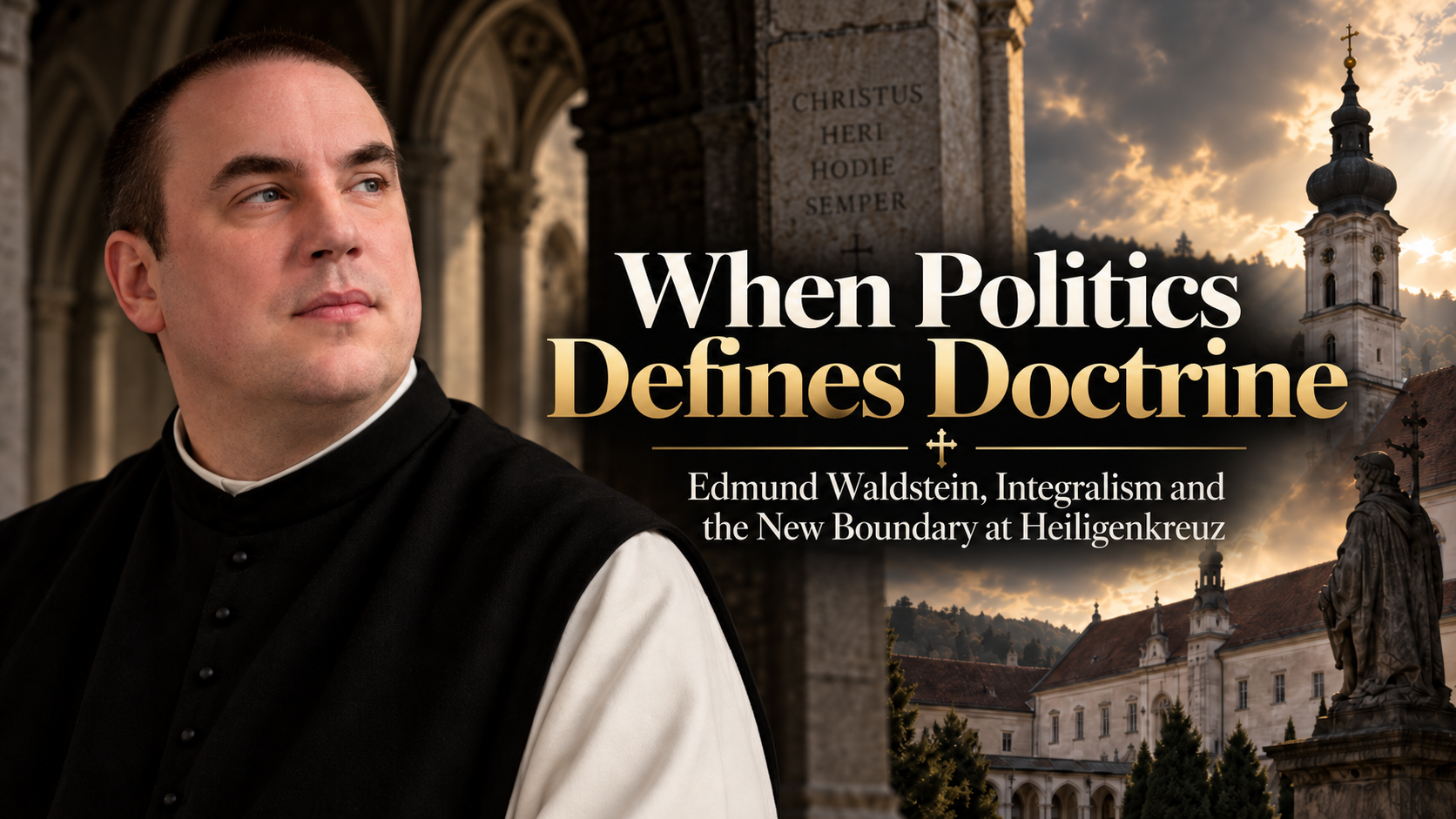
- When Politics Defines Doctrine: Edmund Waldstein, Integralism and the New Boundary at HeiligenkreuzThe ongoing exclusion of Father Edmund Waldstein from teaching at Heiligenkreuz has sparked debate on the limits of acceptable Catholic thought, particularly regarding integralism and its relationship to Church doctrine. Critics argue that Waldstein and similar positions challenge both Catholic teachings and democratic values, raising questions about the intersection of faith and politics.
- Christianity Is Right ~ Not Right WingThe article discusses the distinction between Catholic orthodoxy and modern political ideologies, particularly the Right and Christian nationalism. It argues that Catholic beliefs about family, morality, and authority predate contemporary political classifications and should not be conflated with right-wing politics. The ordo amoris framework is presented as a guiding principle for evaluating political alliances while maintaining a focus on the common good and the Social Kingship of Christ.
- Today’s homily: The Nativity of the Blessed Virgin MaryThe Nativity of the Blessed Virgin Mary marks a significant moment in salvation history, representing the dawn of the Incarnation. Mary’s birth, unnoticed by the world, was part of God’s providential plan leading to Christ. This feast invites reflection on humility, obedience, and trust in God’s will, emphasising Mary’s role as the Mother of the Redeemer.
CURRENT EDITION


Today’s Mass Propers
- Today’s Mass: September 08 The Nativity of the Blessed Virgin Mary
 The Nativity of the Blessed Virgin Mary celebrates her birth, symbolising a new beginning tied to salvation. Originating in the East, it gained recognition in Rome under Pope Sergius I. Additionally, the feast commemorates Saint Hadrian, a martyr who converted to Christianity, underscoring themes of faith and redemption.



Leave a Reply