
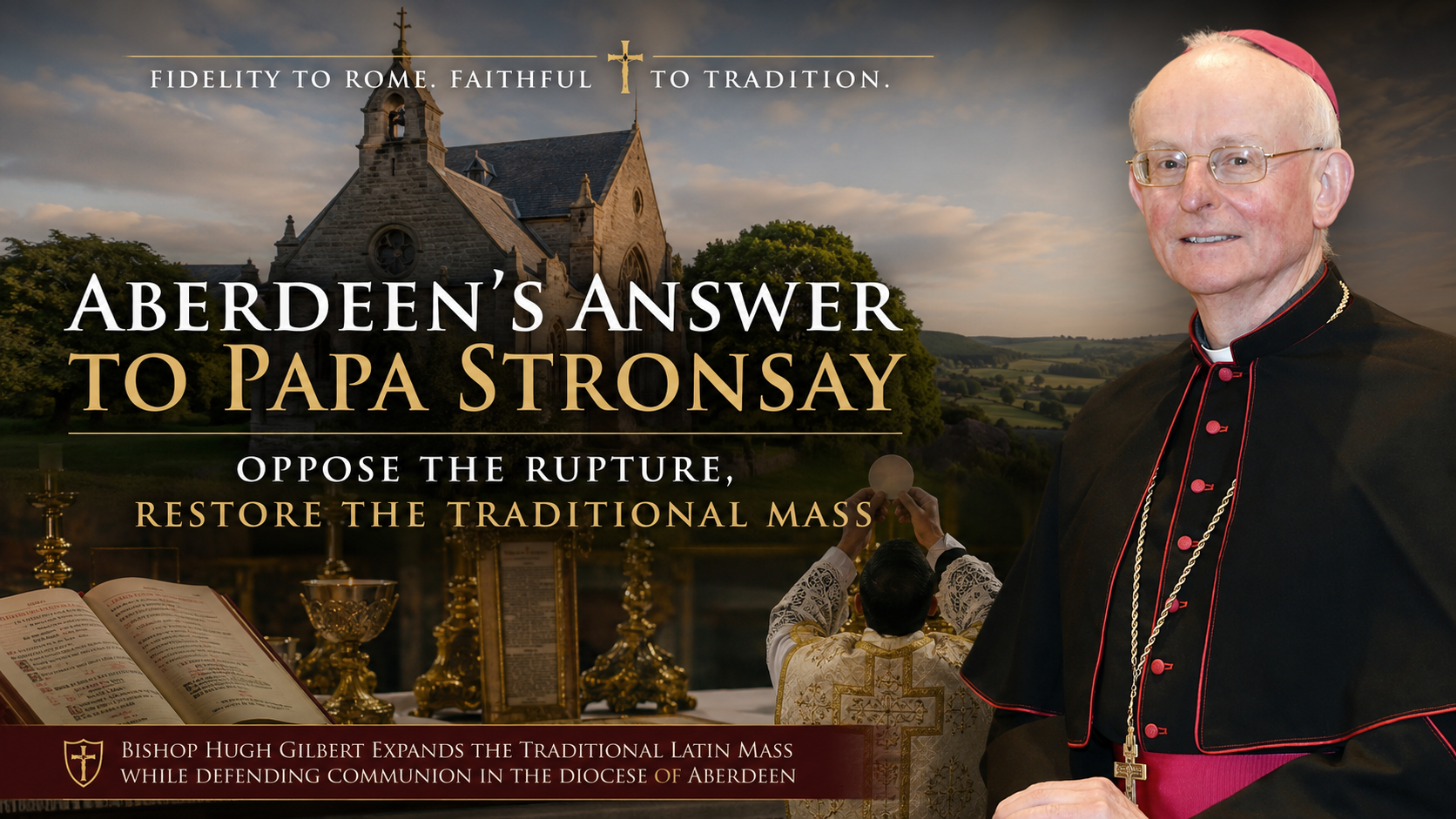
Aberdeen’s Answer to Papa Stronsay: Oppose the Rupture, Restore the Traditional Mass
Bishop Hugh Gilbert has condemned Papa Stronsay’s proposed episcopal consecration without papal mandate while expanding Sunday provision of the traditional Roman Rite. In doing so, he has applied the principle set out by Cardinal Joseph Ratzinger after the 1988 Écône consecrations: defend ecclesial communion, but also confront the pastoral failures which make separation attractive.

Next Sunday, Catholics in rural Aberdeenshire who are attached to the traditional Roman Rite will have somewhere regular to go.
Bishop Hugh Gilbert OSB has authorised the Traditional Latin Mass to be offered every Sunday at the Church of Our Lady of the Garioch and St John the Evangelist at Fetternear, near Inverurie. The provision, previously monthly, has been entrusted to Fr Yousef Marie and Fr Peter Mary, former members of the Sons of the Most Holy Redeemer who have declined to follow the present leadership of Papa Stronsay into sedevacantism.¹
Six days later, on 25 July, the founder and Superior General of that community, Fr Michael Mary, is due to be consecrated a bishop at Papa Stronsay without a pontifical mandate. The intended principal consecrator, Bishop Pierre Roy, denies that Pope Leo XIV is the Roman Pontiff and argues that the supposed vacancy of the Holy See justifies an emergency consecration.²
Bishop Gilbert has told Catholics not to attend. He has described the proposed ceremony as unlawful, gravely disobedient and incompatible with communion with the Catholic Church. Since the consecration is planned within his diocese, silence would have been impossible.³
The more important fact, however, is that he has not stopped there.
He has opposed the rupture while increasing access to the liturgy around which the Papa Stronsay apostolate was formed. He has condemned a consecration without papal mandate, but refused to make the traditional Roman Rite itself the accused party. That distinction is obvious in theology and has often proved elusive in practice.
Nearly forty years ago, Cardinal Joseph Ratzinger explained why such a response matters.
Addressing the bishops of Chile on 13 July 1988, less than a fortnight after Archbishop Marcel Lefebvre consecrated four bishops at Écône, Ratzinger urged the hierarchy to look beyond the final canonical act. The attraction exercised by Lefebvre, he said, could not be explained adequately by political motives, cultural nostalgia or the temperament of an ageing prelate. Too many young Catholics from markedly different nations and circumstances were involved.
There were, he acknowledged, restricted and one-sided elements in the movement. Yet it would have been inconceivable without “good elements at work” which were not finding sufficient room within the ordinary life of the Church.
Then came the judgement which remains inconvenient:
“For all these reasons, we ought to see this matter primarily as the occasion for an examination of conscience. We should allow ourselves to ask fundamental questions, about the defects in the pastoral life of the Church, which are exposed by these events. Thus we will be able to offer a place within the Church to those who are seeking and demanding it, and succeed in destroying all reason for schism. We can make such schism pointless by renewing the interior realities of the Church.”⁴
Ratzinger did not excuse Archbishop Lefebvre’s action. He did not suggest that pastoral neglect creates jurisdiction, or that an illicit consecration becomes lawful because those involved believe themselves mistreated. He had been directly involved in the failed negotiations before Écône and regarded the rupture with gravity.
His argument was more demanding than a simple condemnation. Ecclesiastical authority could be justified in judging an act while still being obliged to examine its own conduct. A penalty might identify the final offence. It could not explain why large numbers of Catholics had come to regard an irregular apostolate as the only place where important elements of Catholic life remained secure.
There is a temptation whenever a traditionalist crisis erupts to imagine that the problem begins with the last dramatic act: the declaration, the chapel, the consecration, the refusal of obedience. Ratzinger saw further. Long before a bishop is consecrated without Rome, ordinary Catholics may already have concluded that something precious cannot be found in ordinary parish life. Canon law may judge the final act. Good shepherding asks why the story reached that point.
Bishop Gilbert’s decision at Fetternear amounts to a practical application of that principle.
The proposed Papa Stronsay consecration is not made licit because the community preserves the traditional Mass. Nor is its sedevacantism excused by liturgical destruction, doctrinal confusion or scandal in Rome. Private judgement cannot depose the pope. A monastery cannot create an episcopal mission for itself. The visible constitution of the Church does not survive by allowing every distressed cleric to establish a substitute hierarchy.
Yet none of this makes the traditional Roman Rite suspect. The Mass has not denied Pope Leo XIV. The Roman Canon has not adopted sedevacantism. The Church’s inherited worship cannot be blamed for the conclusions drawn by those who celebrate it.
Bishop Gilbert has made that distinction concrete. He has told Catholics not to follow Papa Stronsay into a consecration founded upon rejection of the reigning pope. At the same time, he has ensured that they need not abandon the older liturgy in order to obey him.
A prohibition tells the faithful where they must not go. Pastoral provision gives them somewhere sound to remain.
That is why the Aberdeen decision should be noticed well beyond Scotland. For much of the period since Traditionis Custodes, ecclesiastical policy has proceeded upon a different assumption. Traditional Catholics have often been treated as though deprivation would cure alienation. Suppress a parish Mass, prevent the formation of new groups, limit access to the sacraments, and attachment to the older rite will eventually wither.
It has not withered. In many places it has become more determined, more youthful and less trusting of diocesan authority. Where regular provision has disappeared, independent and irregular alternatives have gained credibility.
This should not have surprised anyone familiar with Ratzinger’s analysis. Catholics do not cease to desire something because authority refuses to provide it. They look elsewhere. When the thing sought is not an innovation but the Church’s own received worship, its suppression supplies irregular communities with their most persuasive argument: that ordinary ecclesiastical structures no longer have room for those who wish to live according to the liturgical and doctrinal inheritance of their forebears.
Aberdeen has weakened that argument directly. Catholics near Fetternear are no longer confronted with a monthly diocesan Mass on one side and a fuller traditional apostolate at Papa Stronsay on the other. A weekly provision now exists under clergy who retain the older rite while remaining within the visible order of the Church.
It is difficult to read Cardinal Ratzinger’s 1988 address without noticing how different his diagnosis was from the assumptions which later informed Traditionis Custodes. Ratzinger asked why Catholics sought Archbishop Lefebvre. The more recent instinct has too often been to ask how quickly the older liturgy itself can be reduced. Those are profoundly different pastoral diagnoses, and they produce profoundly different remedies.
As Pope Benedict XVI, Ratzinger acted upon his earlier reasoning. In the letter accompanying Summorum Pontificum in 2007, he acknowledged that Church leaders had sometimes failed to maintain or recover reconciliation and had thereby allowed divisions to harden. He also rejected the notion that the older liturgy could suddenly become harmful:
“What earlier generations held as sacred, remains sacred and great for us too, and it cannot be all of a sudden entirely forbidden or even considered harmful.”⁵
The line from Santiago in 1988 to Summorum Pontificum in 2007 is coherent. Preserve unity by giving Catholic tradition a recognised place within the Church. Correct irregularity without suppressing what is legitimate. Remove the appeal of separation by ensuring that Catholics need not leave ordinary ecclesiastical life to find the worship which nourished generations of saints.
The Aberdeen case also exposes the carelessness of treating all traditionalist disputes as identical. The Society of St Pius X recognises the reigning pope, names him in the Canon and rejects sedevacantism. Papa Stronsay’s present leadership denies the legitimacy of Leo XIV and proposes an episcopal consecration based explicitly upon that denial. Whatever judgement is made concerning the SSPX, the two positions are not interchangeable.
They do, however, present the hierarchy with a related pastoral question. Why do Catholics continue to support irregular traditional apostolates when doing so brings inconvenience, uncertainty and suspicion?
Ratzinger rejected the lazy answer. Nostalgia does not explain the number of young people involved. Politics does not explain the movement’s persistence across nations and cultures. Traditional communities flourish because they often provide identifiable Catholic goods which many faithful struggle to find elsewhere: doctrinal seriousness, sacramental reverence, continuity, discipline and a sense that the religion they inherited has not been quietly superseded.
Acknowledging that fact does not ratify every conclusion drawn in reaction to modern ecclesiastical failures. It simply refuses to confuse diagnosis with endorsement.
Bishop Gilbert’s own pastoral letter strengthened his position by avoiding papal maximalism. He acknowledged that popes may be unwise or sinful, that not everything a pope says is divinely inspired, and that the pope is not above the Church. His defence of the Petrine office rested instead upon its place within the visible constitution of Catholic unity.⁶
That is the necessary distinction. Catholics are not required to choose between an absolute papal monarchy and a private declaration that the Apostolic See is vacant. Traditional Catholic doctrine permits criticism of imprudent acts, resistance to abuses and recognition of grave failures in Church government. It does not permit individuals or communities to declare the pope deposed and construct an episcopal succession upon that judgement.
The proposed consecration at Papa Stronsay should therefore not proceed. Its theological premise is false, its canonical position is untenable, and its likely consequence is the consolidation of a community around a self-authorising ecclesiology.
The hierarchy should not, however, imagine that saying this completes its duty. Every such crisis should provoke the examination of conscience commended by Ratzinger. Why was the traditional Mass not already available every Sunday at Fetternear? Why does stable provision elsewhere so often appear only when an irregular community has gained influence? Why are Catholics warned against leaving while the reasons they feel displaced remain unaddressed?
Canon law can identify an unlawful consecration. It cannot, by itself, make an irregular chapel unnecessary.
At Fetternear, Bishop Gilbert has taken the additional step. He has defended communion by giving Catholic tradition more room to live. He has shown that the Church does not have to choose between authority and inheritance. She never did.
Cardinal Ratzinger understood that in 1988. Pope Benedict XVI acted upon it in 2007. Aberdeen has quietly demonstrated it again in 2026.
The question now is whether other bishops are prepared to learn the lesson.
- Luke Coppen, “Bishop expands TLM provision ahead of illicit consecration”, The Pillar, 20 July 2026.
- Bishop Pierre Roy, announcement of the proposed episcopal consecration of Fr Michael Mary, 18 June 2026; Sons of the Most Holy Redeemer, “Announcement of the Episcopal Consecration of Very Rev. Fr Michael Mary, F.SS.R.”, 18 June 2026.
- Diocese of Aberdeen, “Statement on the Proposed Episcopal Consecration of Father Michael Mary”, 18 June 2026.
- Joseph Cardinal Ratzinger, address to the bishops of Chile concerning Archbishop Marcel Lefebvre and the Écône consecrations, Santiago, 13 July 1988.
- Benedict XVI, Letter to the Bishops accompanying the Apostolic Letter Summorum Pontificum, 7 July 2007.
- Hugh Gilbert OSB, pastoral letter to the Diocese of Aberdeen concerning ecclesial communion and the proposed episcopal consecration, July 2026.
RELATED ARTICLES


LATEST ARTICLES
- Today’s Mass: October 25 SOVEREIGNTY OF OUR LORD JESUS CHRIST, SUPREME KINGThe Feast of the Sovereignty of Our Lord Jesus Christ celebrates Christ’s dual kingship by birth and conquest. Established by Pius XI, it aims to deepen faith and counter anti-clericalism. The liturgical observance underscores His authority as King, advocating for societal recognition of His reign to bring peace and harmony.
- TRADITION BEHIND THE FENCEThe Vatican’s prohibition of the traditional Ad Petri Sedem pilgrimage to St Peter’s Basilica has sparked controversy, especially among traditional Catholics. While some cite scheduling conflicts, the broader issue lies in the restrictive policies of Traditionis custodes, which may confine traditional liturgical practices to specific enclaves, risking the transmission and recognition of Catholic Tradition within the wider Church.
- Today’s Mass: October 24 St Raphael the ArchangelThe Feast of Saint Raphael the Archangel highlights his healing powers as depicted in the Book of Tobit, where he aids Tobit and his son, Tobiah. Venerated as a protector of travellers and the blind, Raphael is celebrated for his miraculous interventions. His legacy includes support for nurses, matchmakers, and Catholic studies.
- 25.10.26 Nuntiatoria CXXIX: CHRISTUS REXThe text discusses the relationship between Christ’s kingship and authority within the Church amidst contemporary challenges. It contrasts ecclesiastical power with genuine faith, emphasising that authority must protect divine truth rather than alter it. The witness of imprisoned priests illustrates the enduring significance of fidelity to Christ over institutional conformity.
- THE DOMESTIC CHURCH: 25 October – 2 November 2026 A Home with Room for Heaven: Preparing for All Saints and All SoulsThe content outlines a week’s plan for traditional Catholic families to prepare for the feasts of All Saints and All Souls. Emphasising daily prayers, remembrance of the deceased, and engagement with children’s activities, it aims to integrate Catholic customs into family life, enriching spiritual practices and fostering a shared faith experience.



Leave a Reply