
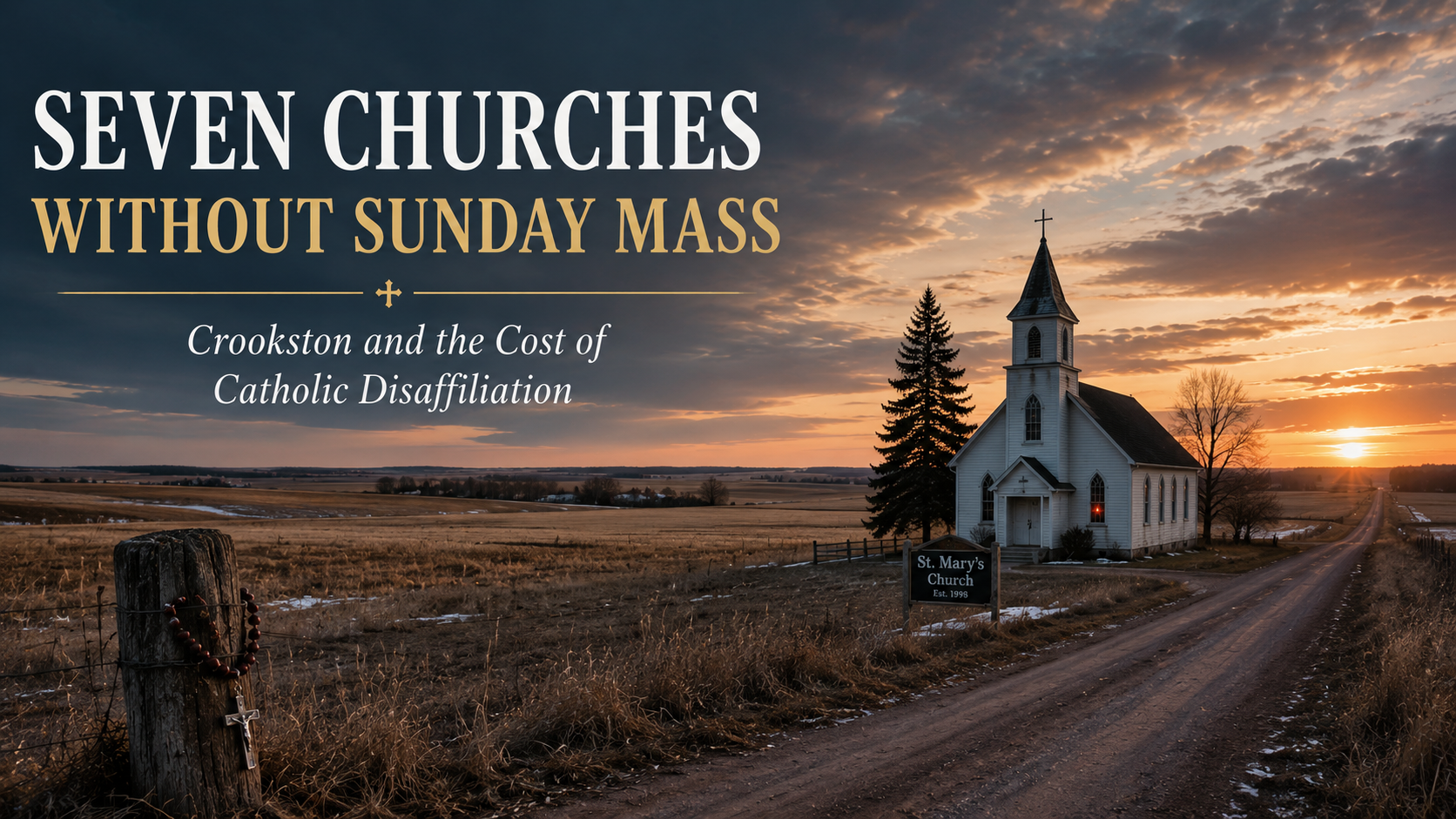
Seven Churches Lose Sunday Mass as Crookston Confronts the Fruits of Catholic Disaffiliation
The Diocese of Crookston has acknowledged that its losses arise not only from rural depopulation but also from Catholic disaffiliation. Seven churches are now losing regular Sunday Mass because communities have shrunk, priests are scarce and the Faith has not been handed on with sufficient strength through liturgy, catechesis, piety and Catholic family life.

On Sunday, 30 August, the final regularly scheduled Sunday Masses will be offered at St Philip’s Church in Falun and St Mary’s in Badger. Three weeks later, the same will happen at St Francis Xavier in Oklee and St Ann’s in Goodridge. St Francis of Assisi in Fisher will follow on 18 October and St Joseph’s in Oslo on 25 October. The sequence ends at St Mary’s in Euclid on Saturday, 31 October, with the anticipated Mass of Sunday.¹
The Diocese of Crookston has not yet suppressed these parishes, merged them canonically or determined the future of the buildings. The decision announced by Bishop Andrew Cozzens is specifically that regular Sunday Mass will cease. Weddings, funerals and occasional celebrations may still take place, depending upon the arrangements made during the transition.
For the Catholics of these seven communities, however, the decisive change has already been made. The church in which generations assembled each Sunday will no longer provide the ordinary place of the Eucharistic Sacrifice. The tabernacle may remain. The bell tower may still mark the horizon. Yet the weekly rhythm around which Catholic life was once ordered will have been broken.
Cozzens has not spoken as though the churches were redundant properties upon an estate ledger. “They are sacred places,” he wrote, recalling the baptisms, weddings, confirmations, funerals and innumerable Sundays celebrated within them. He acknowledged the sorrow of parishioners without attempting to dissolve it into managerial language: “If this feels like a loss, it is because it truly is a loss.”²
The material difficulties are formidable. Crookston extends across more than 17,000 square miles of north-western Minnesota. In January 2024, the diocese had 33 active priests serving 66 parishes, with many priests responsible for three churches. Almost half of the presbyterate was expected to reach retirement age within ten years, two priests were retiring that year and the next ordination was then still four years away. The diocese obtained the temporary assistance of three priests from the Archdiocese of St Paul and Minneapolis because, as Cozzens put it, Crookston was “severely stretched”.³
The geography cannot be wished away. Neither can the ageing and depopulation of rural communities. In the north-east deanery, the diocese cites projections of population losses reaching 40 to 60 per cent in some counties during the next two decades. Several small parishes have few or no young people in religious formation. Volunteers are scarce. Some communities struggle even to find musicians for Sunday worship.⁴
A bishop cannot send a priest who does not exist. Nor can an ageing priesthood be required to spend every weekend racing between distant churches, offering Mass according to an exhausting timetable while having little time to hear confessions, visit the sick, instruct converts or know the people entrusted to its care. Some reorganisation may therefore be unavoidable. It would be dishonest to pretend that every parish arrangement inherited from the settlement patterns of the early twentieth century can be maintained unchanged.
Crookston’s own documents, however, prevent the discussion from ending with rural demography.
On the diocesan Planning for Mission resource page, the problem is stated with unusual frankness. Church membership, it says, has “declined dramatically over the past 10–20 years, not just because of demographics but also because of disaffiliation”.⁵
That admission shifts the discussion from economics to religion.
People leave rural communities for employment, education and opportunity. Catholics become disaffiliated for other reasons. They cease to believe, cease to practise, cease to pray, fail to transmit the Faith to their children or gradually conclude that the Church no longer asks anything distinctive of them. Rural depopulation explains why there are fewer inhabitants. It does not explain why those who remain no longer live as Catholics.
The word “disaffiliation” is sociologically convenient, but spiritually inadequate. It describes the outward result without disclosing the interior loss. These are men and women who were baptised, perhaps confirmed and educated in Catholic institutions, but for whom the Faith ceased to govern worship, marriage, family life, moral judgement and the hope of eternity. Some rejected defined doctrine consciously. Others drifted away because they had never received enough doctrine to know what they were abandoning.
The present closures cannot therefore be understood apart from the wider retreat from Catholic Tradition that has marked much of Western ecclesial life during the past sixty years.
The sacred liturgy was frequently stripped of inherited solemnity, silence, continuity and the clear sense of sacrifice. Altars were turned, sanctuaries reordered and ancient texts replaced, not merely as disciplinary adjustments but as part of a pastoral programme intended to make worship more immediately accessible to modern man. The result was often a form of celebration in which the personality of the celebrant, the activity of the congregation and the demands of local participation obscured the objective action of Christ the High Priest.
Where the Mass is experienced principally as a community gathering, attendance soon appears optional. One gathering may be exchanged for another. Where it is known as the Holy Sacrifice of Calvary made sacramentally present, Sunday worship is understood as an obligation owed first to Almighty God and only secondarily as an expression of fellowship.
Traditional Catholic piety declined with the liturgical inheritance that had sustained it. Benediction, processions, the Rosary, novenas, the Forty Hours, devotion to the Sacred Heart, prayers for the dead, fasting and the regular use of sacramentals receded from ordinary parish life. Such practices were sometimes dismissed as peripheral, sentimental or unsuited to a mature faith. In fact, they had carried doctrine into the imagination and daily habits of Catholics who might never read a theological manual.
A child who knelt before the Blessed Sacrament learned something about the Real Presence before he could define transubstantiation. A family that prayed the Rosary together entered repeatedly into the mysteries of the Incarnation and Redemption. A parish procession taught publicly that Christ was not confined to private conviction but claimed the streets, the household and the social order. When these practices disappeared, the truths they embodied became easier to forget.
Catechesis suffered a comparable loss of confidence. Systematic instruction in the Creed, the Commandments, the sacraments, prayer, sin, grace and the Four Last Things was often replaced by thematic discussion, personal reflection and the language of experience. Children were encouraged to feel welcomed before they had been taught what they were being welcomed into.
The consequences are now measurable. If children are not taught the doctrines of the Faith with clarity, they will not retain them as adults. If mortal sin is rarely named, confession will become exceptional. If the indissolubility of marriage is softened in practice, Catholic family life will lose its distinctive form. If heaven, hell, judgement and the necessity of grace are seldom preached, the Church will appear to offer little that cannot be obtained from therapy, civic virtue or a benevolent voluntary association.
Disaffiliation did not begin when a Catholic finally stopped attending Mass. It began when Catholicism ceased to shape the whole of life.
A parish with no children in religious formation is therefore suffering from something more serious than a shortage of volunteers. Its continuity has nearly broken. There may still be an altar, a cemetery and parishioners who have served faithfully for decades, but the Faith is no longer passing reliably from one generation to the next. The absence of children is the final visible condition. The failure of transmission began much earlier, often in homes where prayer had faded, in schools where doctrine had been diluted and in parishes where supernatural religion had been replaced by pastoral activity.
The priest shortage arises from the same soil.
Vocations flourish where the priesthood is presented as a supernatural calling, a sacrifice and a participation in the eternal priesthood of Christ. They rarely flourish where the priest is understood chiefly as a community organiser, social worker or chairman of a liturgical assembly. A young man will surrender marriage, family, income and personal independence for the altar and the salvation of souls. He is less likely to do so for a position whose sacred identity has been deliberately obscured.
Nor are vocations created by publicity campaigns alone. They arise in families that pray, attend Mass faithfully, practise penance, honour priests and teach children that eternity is real. A diocese unable to ordain enough priests to serve its existing parishes is not merely confronting a personnel shortage. It is receiving a judgement upon the strength of Catholic life within the preceding generation.
This does not mean that every parish using the traditional Roman liturgy will prosper, or that every community formed by the newer rites will collapse. Demography, migration, personality, local leadership and economics all matter. Tradition is not a mechanical device for increasing attendance figures.
Yet the wider pattern cannot be denied. Communities in which liturgical continuity, doctrinal catechesis, confession, devotional life and clear Catholic discipline remain strong have frequently shown an ability to attract young families and foster vocations disproportionate to their size. The post-conciliar pastoral establishment has too often treated these signs of vitality as an embarrassment while presiding over increasingly elaborate schemes for the management of decline.
No parish normally loses Sunday Mass because its people were too devoted to the sacred liturgy, too faithful in family prayer, too well instructed in doctrine or too serious about raising children as Catholics. It loses Sunday Mass because these things weakened, sometimes over several generations, until a small remnant was left maintaining structures built by a more believing age.
Responsibility for this crisis cannot simply be placed upon Bishop Cozzens. He inherited most of the circumstances he must now govern. It would also be unjust to portray him as indifferent to Eucharistic faith or evangelisation. As chairman of the United States bishops’ Committee on Evangelization and Catechesis, he played a leading role in the National Eucharistic Revival. Opening that initiative in Crookston in June 2022, he acknowledged that many Catholics did not understand the Real Presence or live according to the Eucharistic faith they professed.⁶
The present closures show how advanced that crisis has become. A national revival was launched because Eucharistic belief had weakened; four years later, seven churches in the diocese of one of its principal episcopal architects are losing regular Sunday Mass. This does not prove that the revival achieved nothing, still less that the bishop was wrong to undertake it. It does show that conferences, congresses and programmes cannot substitute for the slow reconstruction of Catholic life through reverent worship, doctrinal formation, personal holiness and the Catholic home.
The decline is not peculiar to Minnesota. Comparative figures assembled by the Center for Applied Research in the Apostolate record the long contraction of Catholic practice in the United States: fewer priests and religious, fewer marriages and baptisms, fewer children receiving parish formation and a steep fall in weekly Mass attendance since 1970.⁷ The causes vary between regions and cannot be reduced to a single reform, bishop or historical decision. The chronology nevertheless makes complacency impossible.
During much of the period in which churches emptied, the prevailing ecclesiastical assumption was that Catholic life would be renewed by making it less demanding and less visibly distinct. Ancient forms were discarded, disciplines relaxed and hard doctrines passed over in silence. The Church sought intelligibility through accommodation, yet often succeeded only in making herself appear unnecessary.
The intended springtime did not arrive across much of Europe and North America. The institutional consequences accumulated quietly. A convent ceased to receive novices. A seminary combined classes with another diocese. A parish school closed. Sunday Masses were reduced, then clustered, then withdrawn. By the time a bishop must make the final decision, the causes lie decades behind him and every available choice inflicts loss.
Cozzens has repeatedly invoked the fifteenth chapter of St John, describing the closures as a form of pruning intended to produce greater fruit. The scriptural image requires care. In Our Lord’s words, the Father is the husbandman: “every branch that beareth fruit, he will purge it, that it may bring forth more fruit” (John 15:2). The passage does not turn every painful institutional decision into divine pruning. A closure may be prudent and necessary, but its pain does not prove that new life will follow.
The fruit must be demonstrated.
Crookston calls its programme Planning for Mission. Its stated purpose is to create parish communities capable of evangelisation, discipleship, outreach and growth. That purpose should be taken seriously enough to be measured. The diocese ought to publish clear annual figures for Sunday Mass attendance, baptisms, Catholic marriages, converts received, children in religious formation, seminarians and ordinations within the reorganised deaneries. The faithful should be able to see whether consolidation strengthens sacramental life or merely postpones another reduction.
More importantly, the diocese must say what kind of Catholic life it intends to rebuild. Mission cannot mean administering fewer churches more efficiently. It must mean restoring belief in the Mass as sacrifice, reverence before the Blessed Sacrament, regular confession, serious catechesis, family prayer, fasting, devotion and the expectation that Catholics will live differently from the surrounding culture.
Without that recovery, “mission” becomes another name for contraction. Larger parish clusters may use priests more efficiently and support programmes which small communities cannot afford. They may also increase travelling distances, weaken local responsibility and make it easier for elderly or marginal Catholics to disappear unnoticed. A church forty miles away remains accessible to a committed family with a reliable car. It may be practically inaccessible to an elderly widow in a Minnesota winter.
The parish church is not valuable only because ancestors built it or because its architecture contributes to the character of a town. It was erected for the worship of Almighty God. Its altar was consecrated for the Holy Sacrifice; its font for the rebirth of souls; its confessional for the reconciliation of sinners. Prudence may require the withdrawal of Sunday Mass, but the decision should never be described as though a service point had been moved to a more efficient location.
The seven affected communities deserve more than sympathy. They deserve a credible account of how the remaining parishes will recover those who have disaffiliated, restore the transmission of doctrine to children and foster priestly vocations. Parishioners who preserved their churches through years of dwindling numbers should not be treated as though their fidelity caused the problem. In many cases, they are the remnant carrying the consequences of an ecclesiastical culture they did not create.
The immediate judgement may be that Crookston has no workable alternative. Thirty-three active priests cannot serve 66 parishes indefinitely, especially when nearly half are approaching retirement. The larger judgement is less comfortable. A diocese which once established parishes across an immense rural territory now lacks the practising faithful and clergy required to maintain Sunday Mass in seven of them.
That is not the failure of Tradition. It is the result of having lived for too long without enough of it.
When the last scheduled Mass has been offered at St Mary’s in Euclid on 31 October, Crookston’s Planning for Mission will not have achieved its purpose. It will have reached the point at which its purpose can be tested. Success will not consist in a neater parish map, fuller car parks at fewer churches or a more manageable weekend rota. It will be found in restored worship, children learning the Faith, families living it, sinners returning to confession and young men presenting themselves for the priesthood.
The diocese has already supplied the decisive word: disaffiliation. The remedy is not another pastoral slogan. It is the recovery of Catholic Tradition in liturgy, doctrine, piety and life.
¹ Diocese of Crookston, “Letter from Bishop Cozzens Regarding Northeast Deanery Decisions”, 13 June 2026; “Letter from Bishop Cozzens Regarding Northwest Deanery Decisions”, 18 July 2026.
² Andrew H. Cozzens, letters to the north-east and north-west deaneries, Diocese of Crookston, 13 June and 18 July 2026.
³ Andrew H. Cozzens, “Letter re: The Companions of Christ”, Diocese of Crookston, 23 January 2024.
⁴ Diocese of Crookston, “Letter from Bishop Cozzens Regarding Northeast Deanery Decisions”, 13 June 2026; “Letter from Bishop Cozzens Regarding Northwest Deanery Decisions”, 18 July 2026.
⁵ Diocese of Crookston, “Planning for Mission: Resources”, diocesan planning materials.
⁶ Diocese of Crookston, Bishop Andrew Cozzens’s homily for the opening of the National Eucharistic Revival, 19 June 2022; diocesan biographical material concerning his chairmanship of the United States Conference of Catholic Bishops’ Committee on Evangelization and Catechesis.
⁷ Center for Applied Research in the Apostolate, “Frequently Requested Church Statistics”, comparative United States statistics from 1970 onwards.
RELATED ARTiCLES


LATEST ARTICLES
- Today’s homily: St John CantiusThe account of St John of Kenty illustrates true charity, as he prioritised the needs of a poor man over his own comfort, exemplifying how knowledge of faith must translate into actions. His life was marked by humility, generosity, and a dedication to both charitable works and doctrinal integrity, urging a holistic expression of faith.
- Today’s Mass: October 22 St John CantiusSt John of Kenty, originally a humble country lad, succeeded as a theology professor in Kraków but faced opposition that led to his role as a parish priest. Known for his kindness, he lived simply, aiding the poor. After winning his parishioners’ hearts, he returned to teaching, living a life of humility and faith.
- Today’s Mass: October 21 St Ursula, Virgin Martyr & CompanionsSt Ursula and Companions, Virgins and Martyrs; Commemoration of St Hilarion, Confessor. Though legends concerning Ursula and eleven thousand virgins are historically uncertain, early Christian martyrs were venerated at Cologne. St Hilarion, Palestinian hermit and disciple of St Anthony, embraced severe penance and solitude, dying in 371 aged eighty.
- FR RIPPERGER’S YEAR OF SILENCE: Obedience is not an explanationFr Chad Ripperger has accepted a year-long withdrawal from public speaking as requested by Archbishop Golka of Denver, aimed at focusing on his priestly community. This decision, following the removal of another exorcist, raises concerns about the Church’s balance between discretion and public witness regarding exorcism and supernatural matters.
- Today’s Mass: October 20 Octave Day of St Edward, King & ConfessorEdward the Confessor, England’s last Saxon king, ruled from 1042 until his death in 1066. Born in 1003, he fled to Normandy during Danish rule and returned to take the throne. His reign is debated, seen as both weak and a time of peace. Edward’s legacy includes the establishment of Westminster Abbey, where he is buried.
CURRENT EDITION


Today’s Mass Propers
- Today’s Mass: October 22 St John Cantius
 St John of Kenty, originally a humble country lad, succeeded as a theology professor in Kraków but faced opposition that led to his role as a parish priest. Known for his kindness, he lived simply, aiding the poor. After winning his parishioners’ hearts, he returned to teaching, living a life of humility and faith.

Leave a Reply