
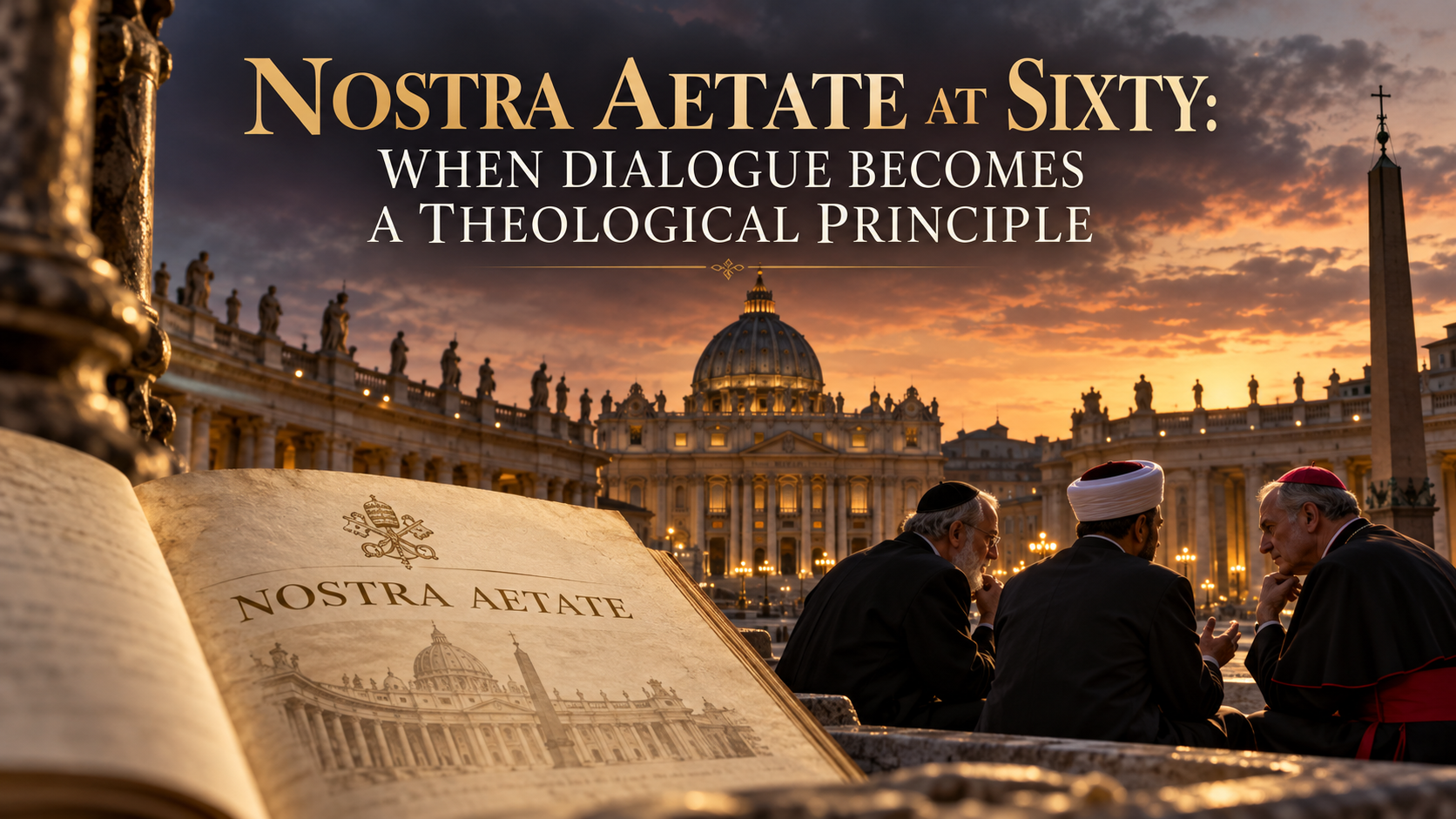
The Vatican’s new sixtieth-anniversary Note on Nostra aetate does not teach that all religions are equal. It explicitly reaffirms Christ as the unique Redeemer and rejects relativism and syncretism. Yet it also describes interreligious encounter as a theological locus, speaks of the Holy Ghost acting within religions, and calls religions towards becoming expressions of God’s will. Read beside Nuntiatoria’s continuing reportage from Assisi, European ecumenism, Islam and, in this edition, Osaka, the decisive question is no longer whether dialogue is permissible. It is whether a pastoral means has progressively acquired a theological status which the Council itself never gave it.
There is a methodological mistake which Nuntiatoria has encountered repeatedly in the post-conciliar Church. A council says one thing. Subsequent authorities construct a pastoral practice around it. The practice becomes habitual. Habit acquires a professional vocabulary. The vocabulary generates a theological rationale. Eventually the rationale is projected backwards and treated as though the Council itself had contained the whole subsequent development from the beginning.
We identified precisely that mechanism in The Council, the Reform, and the Missing “Thus”.¹⁵ Vatican II authorised liturgical reform; that fact did not by itself demonstrate that every subsequent reform, practice and theological justification was required by the Council. Between authorisation and outcome stood an unproved “thus”. The same question now confronts the Church in another field. Nostra aetate encouraged Catholics to approach followers of other religions with respect, dialogue and appropriate collaboration. Does it therefore follow that the elaborate theology of interreligious encounter constructed during the following sixty years represents the necessary content of the conciliar Declaration? Or has a pastoral means gradually become something greater than the original text itself claimed?
That question acquired new urgency on 16 September 2026, when the Dicastery for the Doctrine of the Faith, the Dicastery for Promoting Christian Unity and the Dicastery for Interreligious Dialogue jointly published A Journey of Hope: Sixty Years of Interreligious Dialogue and Fraternity in the Light of the Conciliar Declaration Nostra Aetate.¹ Pope Leo XIV had approved the Note at an audience on 22 June and ordered its publication. The document is consequently neither an unofficial Vatican reflection nor a replacement for Nostra aetate. It is a substantial papally approved curial synthesis of the post-conciliar interreligious project, taking stock of sixty years and explicitly proposing directions for its future.¹
Nuntiatoria has already begun examining precisely this development. In Truth Must Be Confessed; Persons Must Be Loved, published immediately after the new Vatican text appeared, we identified the central difficulty: Nostra aetate commended dialogue while maintaining Christian witness and proclamation, whereas the 2026 Note goes further by describing interreligious dialogue as “a theological locus” in which the Holy Ghost is encountered through engagement with the religious other.⁹ This present examination does not abandon that argument; it verifies and develops it against the full Vatican document, its doctrinal safeguards, its historical claims, its magisterial status and the practical trajectory Nuntiatoria has been documenting elsewhere.
Accuracy requires beginning with what the Note does not say. It does not teach that all religions are equal. It does not establish a plurality of independent ways of salvation. In its treatment of Judaism it says explicitly that “Christ is the one and only Redeemer”.¹ It does not recommend dissolving Catholic identity into a universal religious synthesis. On the contrary, it requires dialogue to proceed while “avoiding relativism and syncretism”.¹ These qualifications are doctrinally important. A serious traditional Catholic criticism gains nothing by pretending they are absent.
The same precision is required when reading Nostra aetate itself. The Council famously declared that the Catholic Church “rejects nothing that is true and holy in these religions”, but that sentence cannot properly be detached from the same paragraph’s insistence that she **“ever must proclaim Christ ‘the way, the truth, and the life’.”**² The second proposition orders the first. Whatever truth, natural virtue, moral insight or providential preparation may be discovered outside the visible Church cannot constitute another revelation or another salvific economy. Truth outside visible Catholic communion is recognisable as truth precisely because truth has an objective measure and its fullness is found in Christ.
The 2026 Note retains that fundamental claim in its treatment of Judaism. The covenant with the Jewish people is described as irrevocable and the religious life of contemporary Judaism is accorded theological significance, but the document expressly excludes the inference that Christians therefore believe in two parallel paths to salvation.¹ This matters because respect for Judaism cannot become the theory that the Incarnation, Cross and Resurrection are salvifically necessary for Gentiles while the Jewish people possess another sufficient covenantal road to God independent of Jesus Christ.
Dominus Iesus remains indispensable here. The Congregation for the Doctrine of the Faith issued that Declaration in 2000 precisely because religious pluralist interpretations had begun to obscure the uniqueness and universal salvific mediation of Christ.³ It recognised that elements within non-Christian religious traditions may sometimes assist or prepare persons to receive grace while simultaneously insisting that those traditions also contain deficiencies and errors. The distinction is essential: God may act within the life of a Muslim, Hindu, Buddhist or Jew without thereby declaring Islam, Hinduism, Buddhism or post-Christian Judaism to be autonomous salvific systems established alongside the Church.
Grace operating within a person is not the same proposition as divine authentication of the religious system to which that person belongs. Providence working through a culture is not the same proposition as revelation through that culture’s religion. The natural law recognised by a non-Christian remains true; the religious error held beside it does not thereby become true. Once these distinctions are lost, the indisputable Catholic truth that God can act beyond the visible boundaries of the Church is subtly transformed into the very different claim that religions as religions possess a positive theological role established by God.
This was the principle Nuntiatoria expressed in Truth Must Be Confessed; Persons Must Be Loved.⁹ A Catholic can defend a Jew against antisemitism without affirming Judaism as salvifically sufficient. He can defend a Muslim against unjust discrimination without professing Islam. He can cooperate with a Hindu in protecting the unborn or feeding the hungry without imagining Hindu doctrine to be another expression of divine revelation. He can defend the civil religious liberty of an unbeliever without believing unbelief to be true. Charity concerns the human person before us; theological judgement concerns whether what that person believes about God corresponds with reality. The two duties are not enemies. Properly distinguished, they make honest dialogue possible.
That same distinction governed our recent *Twenty-Five Years After 9/11: Are We Really Safer?*¹³ Muslims as persons are owed justice, protection from collective blame and Christian charity; Islam as a religion remains open to theological, historical and political examination. To say that most Muslims are peaceful does not make Islamic texts, jurisprudence and religious claims analytically irrelevant to jihadism; equally, to examine those connections does not make peaceful Muslims responsible for terrorism. A mature society must be capable of saying both things at once.
The new Vatican Note’s discussion of Islamophobia should be read in precisely that way. It expresses concern about manifestations of Islamophobia which fail to distinguish violent fundamentalism from Muslims who live peacefully within wider societies.¹ There is nothing intrinsically objectionable in that distinction. Collective guilt is unjust. The Note, however, does not stop there. It also recalls demands for reciprocal religious freedom for Christians in Muslim-majority societies and later acknowledges persecution inflicted upon Christians by religious extremists.¹ Reporting only the warning about Islamophobia while suppressing the reciprocal demand would therefore distort the document.
Nuntiatoria reached a comparable distinction in An Award Is Not a Meeting, examining Lambeth Palace’s withdrawal of an interfaith award from Hafiz Tahir Ashrafi.¹⁴ Dialogue does not require endorsement. One may meet a religious leader, cooperate where cooperation is legitimate, acknowledge good actions and still question his record or challenge doctrines and political structures associated with his religion. Indeed, interreligious dialogue worthy of the name should make the difficult questions possible rather than creating ceremonial relationships in which the questions become impolite.
The Note’s treatment of antisemitism is likewise not where the theological difficulty principally lies. It reiterates Nostra aetate’s repudiation of hatred and persecution directed against Jews and recalls the Holy Office’s condemnation of antisemitism in 1928.¹ The Shoah understandably occupies a major place in its historical account of the origins of modern Catholic-Jewish dialogue. None of this requires religious indifferentism. Racial hatred does not become permissible because Christianity rejects another religion’s theological claims.
The document is equally restrained in its description of the contemporary Middle East. It says that conflicts there during recent years have strained channels of Jewish-Christian dialogue because events are interpreted differently and notes that those interpretations are not even uniform within the respective religious communities.¹ It does not in that passage adjudicate responsibility for Gaza, Hamas, the Israeli Government or Palestinian political authorities. Its concern is with the damage geopolitical conflict can inflict upon relationships built through six decades of religious dialogue. The distinction between political judgement and theological relations should therefore be preserved.
The more difficult propositions appear elsewhere. The Note presents interreligious dialogue not merely as diplomacy, courtesy or cooperation for temporal goods but as a theological reality. Later it says that religions are called to transform society so as to become “fraternal expressions of God’s will”.¹ It finally speaks of the Holy Ghost operating within human history and within the cultures and religions of peoples.¹ Taken within the document as a whole, those formulations cannot fairly be interpreted as an outright declaration that all religions are equally revealed, because the same Note has expressly excluded relativism and affirmed Christ’s unique mediation. Yet the formulations require distinctions which the formulations themselves do not always supply.
What exactly is the subject of divine action when Rome speaks of the Holy Ghost working within religions? Certainly the Holy Ghost may work within people who belong to them. Certainly Providence operates within cultures and histories marked by mixtures of truth, error, virtue and sin. Certainly natural reason may discover truths about God, morality, creation and human dignity. Certainly elements derived ultimately from revelation may survive within traditions which no longer possess the fullness of revealed faith. Catholic theology has never required us to believe that every non-Christian culture is an absolute wasteland untouched by grace.
But these propositions remain distinct from saying that a religion considered precisely as a religious system is positively willed by God. Islam denies the divine Sonship of Jesus Christ. Christianity confesses it. Rabbinical Judaism denies that Jesus is the Messiah and incarnate Son of God. Christianity confesses Him as both. Buddhism does not confess the personal Creator revealed in Scripture. Catholicism does. Contradictions cannot become complementary truths merely because those holding them encounter one another fraternally.
That is why the controversy created by the Abu Dhabi Document on Human Fraternity in 2019 remains directly relevant. Francis and the Grand Imam of Al-Azhar signed a text asserting that **“pluralism and the diversity of religions … are willed by God in His wisdom.”**⁵ Read without theological qualification, the statement appeared to place religious plurality alongside divinely willed differences such as sex, race and language. Yet God cannot positively will contradictory claims about Himself as though contradiction were a good.
The classical distinction between God’s positive and permissive will therefore became indispensable. God positively wills truth and goodness. He permits error because He permits created freedom and, within Providence, can draw good even from circumstances distorted by ignorance and sin. To say that God permits Islam, Hinduism or religious unbelief to exist within history is consequently not the same as saying that He positively wills their doctrinal errors as alternative expressions of revelation.
That distinction was at the heart of ✠Athanasius Schneider’s intervention after Abu Dhabi. It remains the only orthodox way to construe the controversial formula. The 2026 Note does not simply repeat the Abu Dhabi sentence, and it would be inaccurate to say that it does. Its explicit affirmation of Christ’s uniqueness supplies safeguards absent from a crude pluralist reading. Nevertheless, the description of religions themselves as capable of becoming expressions of God’s will returns us to exactly the same theological frontier. What is divinely willed: the fraternity achieved between believers, the authentic truths preserved within their cultures, their cooperation for the common good, God’s providential permission of religious diversity, or the religions as religions? Those propositions cannot simply be merged.
The practical importance of that distinction has been demonstrated repeatedly in the material Nuntiatoria has reported during recent weeks. The Creed Outside the Basilica examined the extraordinary situation at Assisi in which an SSPX pilgrimage could enter the Basilica of St Francis privately but could not enter corporately to make a public profession of the Catholic Creed.¹² The Franciscan authorities defended the restriction by reference to canonical communion and denied exaggerated claims that adherents of other religions were about to conduct their rites within the Basilica. Our criticism deliberately preserved those qualifications. The ecclesiological question nevertheless remained: how has the contemporary language of communion developed such that irregular Catholics publicly professing the Church’s Creed can present a disciplinary problem while authorised engagement with communities which reject portions of that Creed belongs routinely to the Church’s institutional programme?
Assisi matters in a second sense. John Paul II’s 1986 gathering became perhaps the most powerful visual symbol of the post-conciliar interreligious project. Benedict XVI later insisted that Assisi had to be understood without syncretism and with the centrality of Christ preserved.⁸ That qualification itself reveals the problem inherent in religious symbolism. Official explanations may carefully distinguish praying together from gathering together in order to pray; ordinary observers see religious leaders assembled under papal sponsorship in a sacred city and understandably draw theological conclusions from what is enacted before their eyes.
Elsewhere in this edition, our examination of the Shinto presence before the altar in Osaka and the earlier Assisi controversies presses the same question further. The difficulty is not whether Catholics may meet Shinto priests or Buddhists, discuss peace, exchange courtesies, study another culture or cooperate in genuine civic goods. They may. The difficulty begins when dialogue enters explicitly Catholic sacred space and takes ritual form. An altar is not a neutral platform for cultural exchange. Once the encounter becomes liturgical or quasi-liturgical in appearance, the distinction between respecting the person and appearing to validate his worship becomes materially harder to maintain.
The theological vocabulary of the new Vatican Note therefore matters enormously. If interreligious dialogue is a pastoral means, then its location, method and limits remain prudential questions governed by prior doctrine. If dialogue becomes a theological locus in itself, however, encounter acquires an additional theological significance. The religious other ceases merely to be the neighbour whom the Christian is called to understand and love; his religious otherness begins to become part of the theological event.
That is precisely the movement Nuntiatoria has also detected in contemporary ecumenism. Peace Without the King, Unity Without the Church examined the revised Charta Oecumenica and its organised reception among European Christian bodies.¹¹ The difficulty was not that Catholics may never pray appropriately with separated Christians or cooperate with them. Vatican II explicitly permits such engagement under defined conditions. The more profound problem was the development of an ecclesial operating system in which common prayer, common witness, shared discernment, joint mission and movement towards Eucharistic fellowship can acquire an institutional momentum while unresolved contradictions regarding Church, priesthood, Eucharist and authority remain formally acknowledged but practically displaced.
Doctrine can remain technically intact while ceasing to govern the imagination of practice. A Catholic document may still affirm that the Church of Christ possesses a unique visible identity while everyday ecumenical vocabulary increasingly presents denominations as ecclesial partners journeying reciprocally towards a unity none presently possesses in fullness. Likewise an interreligious Note may insist that Christ alone is Redeemer while ordinary ecclesial culture increasingly presents religions as spiritual partners contributing distinctive treasures to humanity’s common journey.
No formal denial is necessary. The hierarchy of emphasis can perform much of the work.
That was the warning contained in Truth Must Be Confessed; Persons Must Be Loved.⁹ The decisive change need not occur through a sentence announcing that Catholicism is merely one religion among others. It can occur when conversion, error, mission, false worship and the objective necessity of Christ become progressively less prominent while encounter, listening, fraternity, mutual enrichment and common pilgrimage become the dominant categories through which relations with other religions are conceived. The older doctrine remains formally available, but another practical theology occupies the foreground.
Our examination of Archbishop Paul Gallagher’s Assisi address in A Gesture Is Not Settlement supplied another necessary distinction.¹⁰ Dialogue can open a road; it cannot substitute indefinitely for the question of where the road leads. Encounter is capable of creating conditions for reconciliation, but encounter is not itself settlement. Applied to interreligious relations, the principle is obvious. Dialogue may correct misunderstandings, reduce hostility, secure cooperation, defend persecuted communities and open opportunities for witness. None of those goods establishes that dialogue is the final purpose for which the Church approaches another religion.
That final horizon remains evangelisation.
The 1991 document Dialogue and Proclamation expressed the relation with useful precision: dialogue and proclamation are **“intimately related, but not interchangeable.”**⁴ The distinction deserves preservation because contemporary ecclesiastical usage can make “dialogue” sound intrinsically generous while “proselytism” becomes intrinsically suspect. If proselytism means coercion, exploitation, manipulation or the purchase of conversions through material advantage, Catholics should reject it. Faith cannot be compelled. If, however, the term gradually comes to include deliberate persuasion, missionary preaching or the sincere desire that another person become Catholic, the Great Commission itself has been placed under suspicion.
Christ did not send the Apostles merely to understand the nations better. He commanded them to teach and baptise them.
The 2026 Note does not formally abolish that mission. Again, fairness requires saying so. It repeatedly insists upon Christian identity and includes evangelisation within its account. Yet the relative emphasis deserves notice. Dialogue, encounter, fraternity, mutual enrichment and common journey repeatedly appear as the dynamic future of Catholic relations with religions, while the uniqueness of Christ, the rejection of relativism and the continued validity of mission function repeatedly as doctrinal safeguards against possible misunderstanding. When safeguards must continually reassure the reader that the developmental vocabulary does not mean what it repeatedly appears capable of suggesting, the vocabulary itself deserves examination.
The document’s magisterial status makes that examination more important, not less. Nostra aetate is a Declaration of the Second Vatican Ecumenical Council promulgated by Paul VI on 28 October 1965.² It is therefore an act of the conciliar Magisterium. Its title as a “Declaration” does not make it optional theology. At the same time, Vatican II did not thereby solemnly define every historical judgement, pastoral recommendation or theological formulation contained in the text as a new infallible dogma. Catholic theology has always distinguished between subjects, modes and levels of magisterial teaching.
The 2026 Note occupies a different category. It is a joint document of three Roman dicasteries, including the Dicastery for the Doctrine of the Faith, expressly approved by Leo XIV, who ordered its publication.¹ It therefore cannot responsibly be dismissed as an unofficial essay by Vatican bureaucrats. Donum Veritatis teaches that doctrinal documents of the Roman doctrinal authority expressly approved by the Pope participate in the ordinary Magisterium of the successor of Peter.⁶ The involvement of the DDF and Leo’s express approval consequently give the Note genuine magisterial significance.
But that statement must not be exaggerated in the opposite direction. The approval formula does not turn the joint Note into another ecumenical council, a solemn definition or a papal encyclical. Nor does it make every sentence within the Note equal in doctrinal weight. Donum Veritatis itself requires attention to the nature of magisterial interventions, the manner in which teachings are expressed and the insistence with which they are proposed.⁶ The 1998 doctrinal commentary accompanying the Professio fidei likewise distinguishes truths requiring divine and Catholic faith, doctrines to be held definitively and non-definitive teachings of the authentic Magisterium.⁷
The proper method is therefore proposition by proposition. The statement that Christ alone is Redeemer rests upon the deposit of faith and longstanding magisterial teaching. A judgment about the pastoral success of sixty years of dialogue plainly stands on another level. Condemnation of racial persecution rests upon moral principles not identical in theological note to a proposal for educating young people in a culture of interreligious encounter. A claim about the Holy Ghost’s activity within religions requires theological interpretation according to revelation and prior teaching; it does not acquire the same certainty as the divinity of Christ because both propositions happen to appear within one papally approved Note.
Catholics do not honour the Magisterium by flattening it.
This point is particularly important because the Note narrates the post-conciliar history of dialogue as a largely continuous development of Nostra aetate.¹ Sixty years of practice are presented as the Declaration’s living heritage. Yet historical development proves that a development occurred; it does not by itself demonstrate that every stage of that development was doctrinally necessary, pastorally successful or already contained within the conciliar act.
Here the missing “thus” returns. Nostra aetate commended dialogue; thus Assisi? Nostra aetate recognised truths and elements of holiness among non-Christians; thus interreligious encounter as a theological locus? Nostra aetate urged collaboration; thus religions becoming expressions of God’s will? Each inference may be defended, qualified or rejected, but each requires demonstration. Sixty years of repetition cannot supply a theological premise which the original declaration did not state.
The comparison with the liturgical reform is therefore methodological rather than rhetorical. In both cases an authorised development took place after the Council. In both cases the development acquired structures, specialists, vocabulary and its own theology. In both cases the later reality can then be presented as the authentic meaning of the conciliar beginning. The Catholic duty is not to reject everything subsequent to Vatican II merely because it is subsequent. It is to test the claimed continuity rather than assuming it.
That exercise is not hostility towards non-Christians. The Church can defend Jews against antisemitism, Muslims against unjust discrimination, Christians against Islamic persecution, unbelievers against coercion and every human person against violence while remaining perfectly clear that contradictory religions cannot all be true. Catholics can cooperate with non-Christians in protecting life, feeding the poor, securing peace or defending the natural family because natural goods do not cease to be goods when recognised by someone outside the Church. Cooperation does not require theological equivalence.
Nor is this an argument against dialogue. The question is what dialogue serves.
If dialogue enables Catholics to understand another person accurately, avoid calumny, reduce unnecessary hostility, clarify doctrine, secure legitimate cooperation, protect religious freedom and create circumstances in which Christian witness can be heard, it can serve the mission of the Church very well indeed. If dialogue becomes an autonomous theological good whose indefinite continuation matters more than whether truth is confessed, error corrected or Christ proclaimed, means and end have exchanged places.
The evidence accumulated in recent Nuntiatoria reporting makes the question increasingly difficult to dismiss. At Assisi the public Catholic Creed of an irregular pilgrimage became a canonical problem while ecumenical and interreligious engagement remained a celebrated ecclesial programme.¹² In European ecumenism, common structures of prayer, witness and discernment develop despite unresolved contradictions about the nature of the Church and Sacraments.¹¹ In our examination of Islam, we have repeatedly found institutions reluctant to distinguish legitimate protection of Muslim persons from immunity of Islamic claims from criticism.¹³ ¹⁴ In the Vatican’s new anniversary Note, dialogue itself is explicitly elevated into theological vocabulary.¹
No single instance establishes formal religious indifferentism. Together, however, they establish a legitimate question about direction.
The Catholic answer depends upon distinctions older and more durable than the current vocabulary. God is the author of truth. Whatever is true in another religion is true because truth comes ultimately from Him; whatever is false remains false however sincerely believed. Grace may act in a person surrounded by religious error without making the error a vehicle of revelation. Providence may permit a plurality of religions without positively willing contradictory doctrines. Charity honours the person without reverencing false worship. Religious liberty protects conscience without declaring conscience infallible. Dialogue may serve mission without becoming the purpose of mission.
These distinctions are not residues of a harsher Church which Vatican II taught to be compassionate. They are what make genuine compassion possible without intellectual dishonesty.
Sixty years after Nostra aetate, the serious question is therefore not whether Catholics should hate non-Christians. They should not. It is not whether Jews should be protected against antisemitism or Muslims against indiscriminate hostility. They should. It is not whether Catholics may meet, converse and cooperate with adherents of other religions. They may and often should. The question is whether the theology built around interreligious dialogue during the post-conciliar period has moved beyond the more limited claims of the conciliar Declaration, and whether later practice is increasingly being used to interpret backwards the authority which originally permitted it.
The new Note gives reasons both for reassurance and scrutiny. Its confession of Christ as unique Redeemer is clear. Its rejection of relativism and syncretism is welcome. Its acknowledgement of the persecution of Christians and its demand for reciprocal religious liberty deserve attention. Its repudiation of antisemitism and indiscriminate hostility towards peaceful Muslims requires no departure from Catholic Tradition. Precisely because those safeguards are real, however, the more expansive claims concerning encounter, religions and the activity of the Holy Ghost require careful theological distinction rather than automatic acceptance of every possible implication.
Nuntiatoria has reached this problem repeatedly from different controversies because the underlying mechanism is becoming familiar. A pastoral method becomes a permanent structure; the structure develops its own vocabulary; the vocabulary creates theological assumptions; those assumptions are eventually treated as the authentic reception of Vatican II. At that point criticism of the development can be represented as criticism of the Council itself.
It is not. The Council should be read according to what it actually taught. Subsequent magisterial documents should be received according to the authority and theological weight they actually possess. Pastoral practice must remain governed by Catholic doctrine rather than becoming the means by which Catholic doctrine is retrospectively reinterpreted. Genuine development preserves identity because development without identity is merely change.
The rule Nuntiatoria stated last week therefore remains decisive: truth must be confessed and persons must be loved.⁹ Truth without charity can become cruelty; charity detached from truth becomes sentimentality. Catholic mission requires neither. The Church can approach every man peacefully because Christ commands charity, recognise every fragment of truth because Christ is Truth, defend conscience because faith cannot be coerced, and engage every culture because no people lies beyond Providence. But she approaches the nations as the bearer of something already received, not as a religious participant waiting for dialogue to complete what Revelation has left unfinished. Interreligious dialogue can have an honourable and useful place in that mission, but it cannot become its destination. The Gospel entrusted to the Church is not dialogue about Christ; it is Christ Himself.
¹ Dicastery for the Doctrine of the Faith, Dicastery for Promoting Christian Unity and Dicastery for Interreligious Dialogue, A Journey of Hope: Sixty Years of Interreligious Dialogue and Fraternity in the Light of the Conciliar Declaration Nostra Aetate, 16 September 2026. Official Vatican text
² Second Vatican Ecumenical Council, Nostra aetate: Declaration on the Relation of the Church to Non-Christian Religions, 28 October 1965. Official Vatican text
³ Congregation for the Doctrine of the Faith, Dominus Iesus: On the Unicity and Salvific Universality of Jesus Christ and the Church, 6 August 2000. Official Vatican text
⁴ Pontifical Council for Interreligious Dialogue and Congregation for the Evangelization of Peoples, Dialogue and Proclamation, 19 May 1991. Official Vatican text
⁵ Pope Francis and Ahmad al-Tayyeb, Document on Human Fraternity for World Peace and Living Together, Abu Dhabi, 4 February 2019. Official Vatican text
⁶ Congregation for the Doctrine of the Faith, Donum Veritatis: On the Ecclesial Vocation of the Theologian, 24 May 1990, especially §§18, 23–24. Official Vatican text
⁷ Congregation for the Doctrine of the Faith, Doctrinal Commentary on the Concluding Formula of the Professio fidei, 29 June 1998; cf. Code of Canon Law, can. 752. Official Vatican text
⁸ Benedict XVI, Letter to the Bishop of Assisi-Nocera Umbra-Gualdo Tadino on the occasion of the twentieth anniversary of the Interreligious Meeting of Prayer for Peace, 2 September 2006. Official Vatican text
⁹ Nuntiatoria, Truth Must Be Confessed; Persons Must Be Loved, 18 September 2026. Nuntiatoria article
¹⁰ Nuntiatoria, A Gesture Is Not Settlement: Gallagher, Assisi and the Catholic Meaning of Reconciliation, 11 September 2026. Nuntiatoria article
¹¹ Nuntiatoria, Peace Without the King, Unity Without the Church, 14 September 2026. Nuntiatoria article
¹² Nuntiatoria, The Creed Outside the Basilica, 11 September 2026. Nuntiatoria article
¹³ Nuntiatoria, Twenty-Five Years After 9/11: Are We Really Safer?, 11 September 2026. Nuntiatoria article
¹⁴ Nuntiatoria, An Award Is Not a Meeting, 18 September 2026. Nuntiatoria article
¹⁵ Nuntiatoria, The Council, the Reform, and the Missing “Thus”, 28 August 2026. Nuntiatoria article





Leave a Reply