
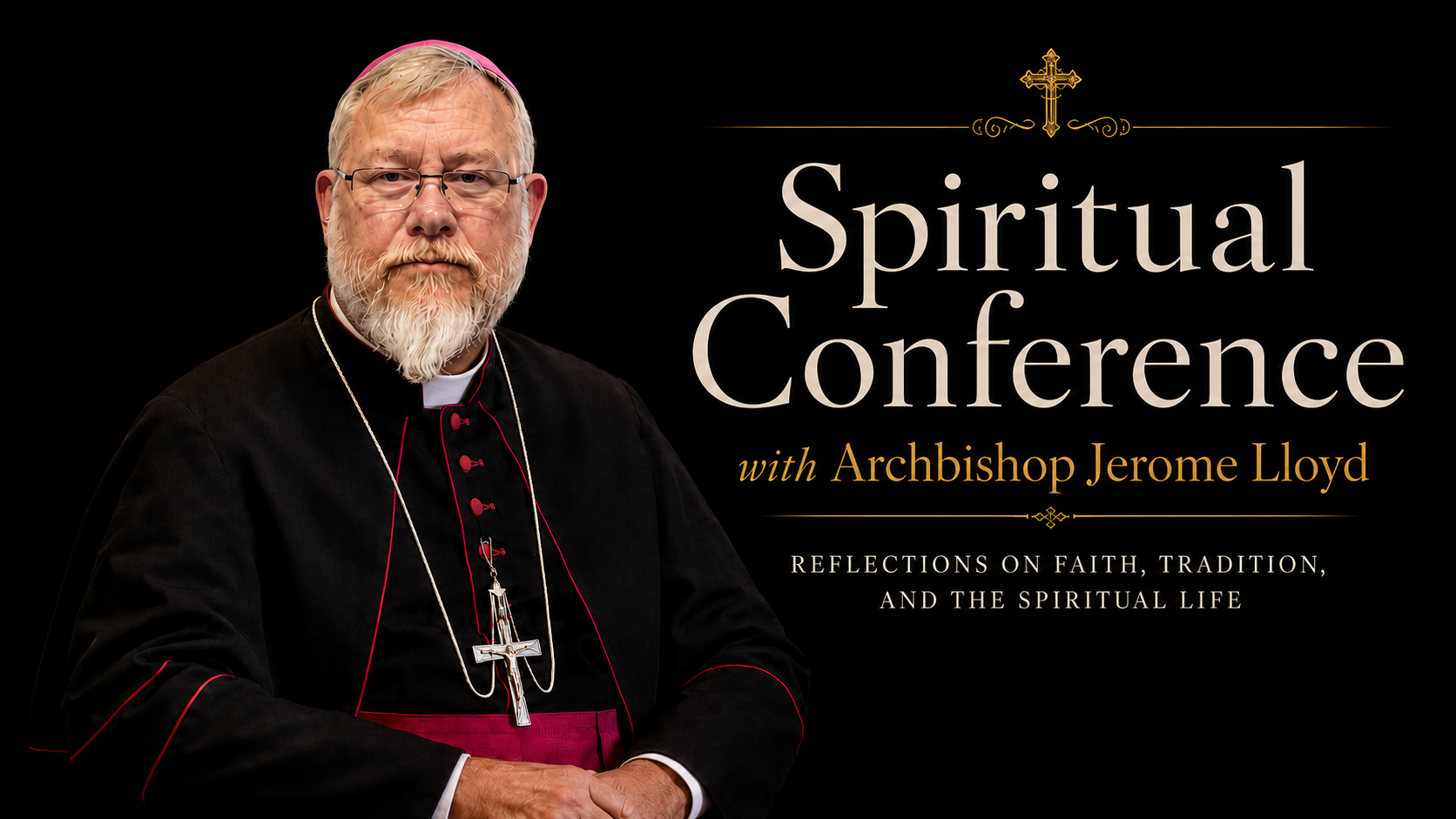
The Crisis in the Church, the Preservation of the Faith and the Salvation of Souls
HE ✠Jerome Lloyd, Titular Archbishop of Selsey and Primus of the Old Roman Apostolate
Beloved in Christ,
There is an old Roman question which I should like to borrow this week: Cui bono? To whose benefit? Cicero tells us that Lucius Cassius, a judge with a reputation for getting to the bottom of things, was fond of asking who profited from a particular action.¹ It is a sensible question, although it must be asked fairly. A person who stands to gain from something is not thereby proved responsible for it, as any competent investigator would remind us. Still, it makes us look beyond fine words and examine what has actually happened. And I have been wondering whether it might help us to look not only at the difficulties presently confronting the Church, but also at the way we ourselves respond to them.
There is plenty to be concerned about, as I hardly need tell you. Catholics who were brought up to believe that the Church had received her doctrine from Christ and His Apostles now sometimes find themselves listening to ecclesiastical statements and wondering whether the meaning of familiar teachings has somehow changed. Families who have gone to considerable trouble to preserve the traditional Mass may encounter suspicion precisely because they wish to worship as their grandparents did. Many would be delighted if their religious life consisted chiefly of attending Mass, saying their prayers, educating their children in the Faith and serving their neighbours. Instead, they have had to acquire an unexpected familiarity with Roman documents, episcopal conferences and the more obscure corners of ecclesiastical administration. That is not quite what most of us imagined when we learnt our catechism.
I have met faithful people for whom these difficulties have been deeply painful. Their attachment to the traditional liturgy is not a hobby, and their concern for doctrine is more than a taste for theological debate. They wish to remain Catholics, to receive the means of grace and to hand on what they themselves received. Their distress deserves to be heard respectfully. Indeed, part of a pastor’s duty is to listen when people say they are struggling, rather than treating the very fact of their concern as proof that they are the problem. But once we have acknowledged the difficulty, another question arises: how do we make sure that our response serves the good for which the Faith was given to us?
The parable appointed for the resumed Fifth Sunday after Epiphany offers a very useful place to begin. In the older Roman calendar followed by our Apostolate, we heard it this year as the proper Last Gospel on the Octave Day of All Saints, with the prayers of the Sunday commemorated in the Mass.² A householder has sown good seed. His servants discover cockle growing amongst the wheat and naturally ask where it came from. The master replies, Inimicus homo hoc fecit: an enemy hath done this. They are ready to go straight into the field and pull it all out. I rather sympathise with them. One sees the problem, rolls up one’s sleeves and wants to get on with putting it right. Their master, however, has a better knowledge of the field and forbids it, lest they uproot the wheat as well.
Our Lord explains the parable Himself. The field is the world; the good seed represents the children of the Kingdom; the cockle the children of the wicked one; the enemy is the devil; and the harvest is the consummation of the world. The reapers are the angels.³ We ought not to lose this original meaning by rushing too quickly to whichever controversy happens to be before us. Christ is teaching us about the condition in which mankind lives until the final judgement and about the patience of God, who knows the history and the possibilities of every soul. The master does not approve of the weeds. His refusal to act immediately is concerned with preserving the good crop and bringing the harvest to its appointed fulfilment.
That does not answer every painful question about suffering and injustice. We see wrongdoing prosper, good people suffer and prayers apparently unanswered. Nor should we offer the doctrine of providence as though it were a convenient phrase to be recited whenever somebody is in distress. God has created beings capable of freely loving Him, and that freedom can be grievously misused. The devil can corrupt what God has made; he cannot establish a rival creation. The damage of evil is real. Yet the Lord sees what we cannot, including the graces by which somebody now estranged from Him may still be converted. His patience is a gift, particularly to those of us who have at some point needed to make rather extensive use of it.
The Fathers of the Church also applied this parable to the life of the Church. St Augustine, commenting upon the servants sleeping, warns of what happens when those entrusted with guarding the flock become negligent. The enemy takes advantage of their failure to watch. Augustine distinguishes the danger of heresy, which distorts what Catholics believe, from the sins of those who profess the truth but fail to live by it.⁴ In his later Retractations he made clear that the image of the cockle need not be confined to heretics beyond the Church’s visible communion. Wickedness can be found within it too. The Church’s holiness comes from Christ, and the sins of her members must never become an excuse for abandoning her unity.⁵
Augustine was unusually well qualified to speak about the possibility of conversion. He spent approximately nine years associated with Manichaeism. He was intelligent, educated and capable of defending his errors with some sophistication. Yet his mother Monica prayed, St Ambrose preached, and grace eventually brought him to the Faith he had once misunderstood.⁶ I sometimes think we forget how extraordinary that is. Had there been an internet in fourth-century North Africa, one can imagine the confident predictions which might have been made about the future of that troublesome young rhetorician. Happily, God’s judgement of his prospects proved rather more generous than ours might have been.
St John Chrysostom makes a related observation. Cockle resembles wheat, and error often borrows the language of truth. A teaching may sound reassuringly Catholic whilst altering something essential. A programme may profess great concern for the Church and yet leave the faithful less certain about her doctrine. Chrysostom’s answer was neither indifference nor indiscriminate severity. Pastors must correct false teaching and guard their people. They must also remember that a person presently in error may yet repent. Plants cannot change their nature; people can be converted. We have no commission to announce in advance which souls are beyond the reach of mercy.⁷
It is impossible to consider these warnings without thinking about the state of Catholic life during the past sixty years. Religious observance has declined sharply in many places; churches and religious houses have closed; catechesis has sometimes failed to transmit even elementary doctrines; devotions which nourished generations were dismissed as old-fashioned. We should not attribute every loss in Western Catholicism to a single council or a single decision. Secularisation, the cultural upheavals of the 1960s and the weakening of family and communal religious practice have all played their part. But decisions taken within ecclesiastical institutions have consequences too, and we cannot excuse them by referring indefinitely to changes outside the Church. The people responsible for teaching, governing and sanctifying the faithful must be prepared to ask what the practical fruits of their policies have been.
Cardinal Joseph Ratzinger once criticised the tendency to treat Vatican II as a kind of ‘superdogma’, as though everything preceding it had become subordinate to whatever interpretation was currently fashionable.⁸ The Council had a declared pastoral orientation, although its texts contain doctrinal teaching to be received according to its proper authority. A council, a disciplinary law, a pastoral programme and a theological theory are not interchangeable. If we lose these distinctions, it becomes possible to treat a recently introduced policy with more reverence than doctrines which the Church has proclaimed for centuries. We ought to be able to question that without being regarded as enemies of ecclesiastical unity.
Similar questions arise around synodality. Bishops should certainly listen to their people, and I should be a very poor advocate of pastoral care if I suggested otherwise. A bishop who never hears anything disagreeable may be surrounded by exceptionally contented Catholics; alternatively, his door may be too firmly shut. Yet consultation serves the truth which the Church has received. It does not determine whether divine revelation remains true. We should be equally careful when language about relations with other religions obscures Christ’s unique saving mission. The distinction between what God positively wills and what He permits is indispensable when considering the controversial wording of the 2019 Abu Dhabi declaration.⁹ Good relations with our neighbours do not require us to become uncertain about the Gospel we have been commanded to preach.
Then there is the treatment of the traditional Roman liturgy. It is difficult for families who have found in it a profound source of prayer and holiness to understand why their attachment should sometimes be regarded with suspicion, whilst other theological experiments attract enthusiastic invitations to dialogue. We can acknowledge that bishops have genuine responsibilities for liturgical discipline and still ask whether a particular exercise of that authority serves the spiritual good of the people concerned. A sacred office does not confer a private ownership of Catholic worship or teaching. Those of us entrusted with pastoral government shall be judged for the manner in which we have exercised it, and there is no special dispensation from humility attached to episcopal consecration.
This is the first application of Cui bono? Who is helped by an ecclesiastical decision? Does it strengthen faith, preserve the sacraments, promote conversion and assist the faithful towards holiness? Or does it chiefly sustain a particular programme, protect an institution from embarrassment or make life more convenient for those administering it? We must not imagine that an outcome alone proves somebody’s hidden intention. But outcomes may legitimately be examined, and the faithful should not be expected to abandon their intelligence when considering decisions which affect their spiritual lives. The point of asking is to restore attention to the end for which ecclesiastical authority exists.
We should also remember that the Church’s indefectibility does not guarantee the success of every institution or the fidelity of every officeholder. Christian history contains flourishing communities which have since vanished. Our Lord promised that His Church would endure in her essential constitution, faith and means of sanctification; He did not promise that we would never have to suffer through incompetent government or bad judgement. This ought to encourage a sober confidence. The field belongs to its Master, and the servants still have work to do. We may have to labour under circumstances which are far from ideal. It does not follow that our labour is useless.
Now I should like to turn the question towards ourselves, and I include myself very deliberately. It is comparatively easy to ask what bishops ought to be doing; I have noticed that the answers are often especially clear when the bishop in question is somebody else. We ought also to ask whether the way we respond to controversy helps us become better Catholics. There is a danger of growing so occupied with the failures of others that we overlook the habits forming in our own hearts. The servants in the Gospel had identified the weeds correctly. Their judgement about what should be done next required a little more patience.
This brings me to the internet, of which I am both a beneficiary and, as somebody involved in Catholic publishing, plainly not an innocent bystander. It would be rather absurd for the Archbishop associated with Nuntiatoria to advise everyone to stop reading Catholic news. Responsible journalism is necessary. We need people who will examine documents, establish what happened, distinguish allegations from facts and ask difficult questions of those in authority. Genuine wrongdoing must be exposed, and the faithful have a right to understand matters affecting their religion. But the internet also offers us an apparently inexhaustible supply of angry commentary, rumour and speculation, and there comes a point when one must ask whether consuming it is helping anyone.
A bishop makes an unfortunate remark, and before the day is out we may have several commentators explaining his motives, predicting the downfall of Christendom and arguing with one another about whose prediction is sufficiently alarming. Sometimes the original statement has scarcely been read. I do understand why people watch. They are worried, and the anxiety is often justified. It is reassuring to discover that somebody else has noticed what troubles us. Yet repeated exposure to indignation can gradually become a habit. We start by trying to keep informed and find ourselves checking for the next controversy almost as though it were the next episode of a serial. The Church’s difficulties deserve rather better than to become our evening entertainment.
[HALFWAY RECORDING CUE — APPROXIMATELY 17 MINUTES]
I should explain something here, because I would hate anyone listening to think that I was criticising faithful Catholics for being concerned about the Church. Many of the people I know who follow these matters closely have suffered considerably for their fidelity. They have good reason to be anxious about what may happen next. If you have spent years travelling to a traditional Mass, supporting a priest or trying to ensure that your children receive sound Catholic instruction, you naturally want to know whether another decision is likely to affect what you have worked so hard to preserve.
There is nothing wrong with that concern. And there are occasions when a little indignation is an entirely appropriate response to something genuinely wrong. Even Our Lord was not always mild in His dealings with those who abused religious authority.
But indignation is rather like salt. A little may be necessary; too much, and everything becomes unpalatable.
I think we sometimes forget that a perfectly legitimate concern can gradually occupy more of our attention than it deserves. You may sit down intending to read a report about some decision in Rome, discover a discussion about it, follow a link to another account, and find yourself an hour later listening to two commentators arguing about the intentions of a third person who has not actually said anything publicly. The original document remains unread, and the evening has somehow disappeared.
I speak with a certain sympathy, because anyone involved in journalism knows how easily one enquiry leads to another. The difference is whether the time has been spent establishing something useful or merely acquiring another helping of irritation.
And perhaps this is where we should apply the question Cui bono? rather more personally. Does this particular discussion help me to understand the Faith? Does it clarify something I need to know, assist me in fulfilling a responsibility, or enable me to pray more intelligently for the Church? Or am I watching because I rather enjoy being reminded how dreadful everything is?
We can all fall into such habits. There is a peculiar satisfaction in discovering that someone whose judgement we have long doubted has said something foolish. We may even experience a brief feeling of vindication. Unfortunately, that satisfaction does not necessarily make us any holier, and it seldom improves the situation which prompted our concern.
St Francis de Sales understood these tendencies extraordinarily well. In his Introduction to the Devout Life, he examines rash judgement and detraction with the insight of somebody who knew how human beings behave in ordinary conversation. He recognised that we sometimes judge others harshly because of pride, resentment or the pleasure of imagining ourselves superior to them.¹⁰
He also understood the harm done by careless speech. A person’s reputation is a genuine good, and the moral law requires us to respect it.
The Eighth Commandment, so far as I am aware, has not yet acquired a special exemption for comment sections.
Rash judgement remains the assumption of another person’s moral fault without sufficient grounds. Detraction consists in disclosing genuine faults without a just reason, thereby injuring someone’s reputation. Calumny involves damaging a person’s good name through falsehood.¹¹
These are distinctions which generations of Catholics learnt from their catechism. We should be rather embarrassed if, having successfully preserved the Church’s traditional worship, we were to forget equally traditional teaching about the sins of the tongue.
There are, of course, proper reasons for publishing evidence of wrongdoing. Serious abuse, injustice or doctrinal error may require public examination. Those responsible for Catholic journalism have a particular duty to establish facts, distinguish allegations from evidence and correct mistakes when they occur. Nor should we imagine that charity requires silence whenever someone exercises authority badly.
Yet there is a considerable difference between exposing something because justice or the protection of souls requires it and repeating an accusation because it makes an entertaining story.
I have noticed how readily people now claim to know the private intentions of those whom they have never met. A bishop makes a decision, and almost immediately we are told what he secretly believes, whom he wishes to impress and what he hopes to accomplish. Sometimes the explanation may sound quite plausible. But plausibility is not evidence, and we should be cautious about claiming knowledge which we simply do not possess.
We may criticise an action without pretending to read the soul of the person responsible. Indeed, our criticism is usually stronger when we confine ourselves to what can actually be established.
There is also a pastoral concern here, because constant exposure to conflict can affect the way we regard other Catholics. We may begin to assume that every bishop is acting in bad faith, every ecclesiastical statement conceals some ulterior purpose, and every disagreement must eventually become a test of loyalty. That is an exhausting way to live.
I have known people whose attachment to the Faith remained perfectly sincere, but whose peace of soul had been disturbed by the continual expectation of another disaster. They were trying to remain vigilant, yet their vigilance had become almost indistinguishable from apprehension.
The Church has certainly experienced crises before. Some have been grave indeed. But Our Lord did not establish His Church so that her members should spend their lives in a state of permanent nervous excitement.
He established her to bring us to salvation.
And this is where the internet could serve us so much better. We possess an extraordinary opportunity to study the Catholic Faith, often without leaving our homes. The writings of the Fathers, the Roman Catechism, papal encyclicals, traditional liturgical books and the works of the great spiritual authors are readily available.
A Catholic living far from a traditional mission may now learn the meaning of the Mass propers, study moral theology or hear a sound spiritual conference. Parents can obtain material to assist them in teaching their children. Someone troubled by a theological question may consult the writings of St Thomas Aquinas rather than rely entirely upon the opinions exchanged in an online discussion.
It is an extraordinary library, and it seems a pity to spend the whole visit arguing in the entrance hall.
I am certainly not suggesting that everybody should spend his evenings reading scholastic theology. Some people find St Thomas easier going than others, and there is no need to begin with the more formidable questions of the Summa. The lives of the saints, the Imitation of Christ, St Francis de Sales or a good explanation of the Mass may be a much more suitable starting point.
The important thing is to develop habits which nourish our understanding of the Faith and assist our spiritual lives.
Perhaps somebody who has become accustomed to listening to several hours of religious commentary each week might replace just one of those sessions with a little spiritual reading. There is no need for a dramatic declaration that all social media is henceforth forbidden. A sensible adjustment, maintained consistently, will often accomplish more than an enthusiastic resolution abandoned after three days.
The same principle applies to what we share. Before forwarding a particularly sensational allegation, we might ask whether we know it to be true and whether there is a good reason for circulating it. If the answer is uncertain, we can simply leave it alone. There is no obligation to participate in every controversy, and silence can sometimes be a considerable exercise of prudence.
I should add that this is counsel which applies to me as much as to anyone. There are always documents to examine, articles to consider and questions requiring an answer. The work can be worthwhile, but it must never become an excuse for neglecting prayer, the duties of ministry or the people immediately entrusted to my care.
The spiritual life of a bishop is no less important because his correspondence is extensive.
St Paul’s Epistle for this Sunday provides a useful corrective to our tendency to become absorbed in the faults of others. He tells the Colossians to put on mercy, kindness, humility, modesty and patience, bearing with one another and forgiving injuries as Christ has forgiven them. Above all they must possess charity, which is the bond of perfection.
Then he tells them that the word of Christ must dwell abundantly amongst them, so that they may teach and admonish one another with wisdom.¹²
I find the combination particularly instructive. St Paul had no difficulty correcting error, sometimes with considerable severity. He knew that the Faith had to be preserved intact. But he also understood that possessing the truth brings responsibilities concerning the way we live and speak.
The Christian who knows precisely what the Church teaches about some disputed question should also know what she teaches about patience, humility and charity. It would be unfortunate if we became expert in detecting doctrinal ambiguity whilst remaining complete beginners in governing our own tempers.
And charity itself deserves to be understood properly. It is sometimes reduced to being agreeable, avoiding difficult subjects or making sure that nobody is offended. Catholic theology understands something much greater. We love Almighty God above all things for His own sake, and we love our neighbour for God’s sake.
This means that we desire for another person the greatest good which we ought also to desire for ourselves: eternal communion with God.
There may therefore be occasions when charity requires correction. A parent who loves his child does not ignore conduct which may lead to serious harm. A priest who loves his people cannot simply abandon the responsibility to teach them what is true. Equally, correction must be directed towards the good of the person concerned. We should be trying to help souls, rather than merely enjoying the satisfaction of demonstrating that we are right.
The same principle governs our attachment to Catholic Tradition. We cherish the ancient Roman liturgy because it is the Church’s sacrificial worship and a source of sanctifying grace. We preserve her doctrine because God has revealed the truth for our salvation. We support faithful priests because souls need the sacraments.¹³
These things are worth defending, and I am deeply grateful to those who have persevered in that work through considerable difficulties.
But their purpose must remain before us. The Holy Sacrifice is offered for the glory of God and the sanctification of His people. The sacraments are intended to transform our lives through grace. Our knowledge of doctrine should deepen our love of God and our desire to bring others into His friendship.
If our attachment to Tradition is genuine, its fruits should become evident in the way we pray, fulfil our responsibilities and treat those around us.
This is something the saints understood very well. St Benedict lived amid the breakdown of Roman authority in the West. He did not attempt to resolve every political difficulty of his generation. He established a form of religious life ordered towards prayer, obedience and work, from which remarkable consequences eventually followed.
St Dominic confronted heresy through preaching and sound theological instruction. St Francis recalled men to evangelical poverty and personal conversion. St Charles Borromeo undertook difficult reforms of the clergy because he understood that the Church required holy priests and properly instructed people.
They recognised the troubles of their respective ages, sometimes more clearly than their contemporaries. But their efforts were directed towards the conversion and sanctification of souls.
And there is a great deal we can accomplish in that same spirit.
A family which prays together, attends Mass faithfully and teaches its children the catechism is contributing to the preservation of Catholic life. A priest who celebrates the Holy Sacrifice reverently, hears confessions patiently and visits the sick may accomplish more than will ever be recorded in an ecclesiastical report.
Those who support a small chapel or help a priest reach an isolated community make possible a ministry whose fruits may remain hidden for years.
I see something of this in our own Apostolate, where distances, limited resources and practical difficulties do not diminish the spiritual needs of the faithful. The work may not attract much attention, but the grace communicated through the sacraments is no less real because the congregation is small.
Nor should we overlook those whose principal contribution is prayer. An elderly Catholic who can no longer travel easily, a sick person who offers suffering in union with Christ, or somebody living alone who perseveres in daily devotion may be doing great good. The value of Christian action is not measured by how many people notice it.
The good seed grows without needing to announce its progress each morning.
The orations of the resumed Sunday express something of the spiritual disposition we require. In the Collect the Church asks God to preserve His familia, His household, through His continual mercy, so that it may always be defended by His protection.
We belong to a household whose Father has not abandoned it, even when circumstances appear difficult.
The Secret asks Him to forgive our offences and direct our wavering hearts: et nutantia corda tu dirigas.¹⁴
I have always found that a wonderfully honest description of human nature. We know what is right and still hesitate to do it. We recognise a fault in somebody else and then discover, occasionally with some embarrassment, that we possess a version of it ourselves.
We ask Almighty God to direct our hearts because we cannot bring ourselves to holiness without His grace.
The Postcommunion asks that we may obtain the full effect of the salvation whose pledge we have received in the sacred mysteries. The Eucharist is the pledge of future glory. We are nourished now for the life whose fullness awaits us in Heaven.
That is why these questions matter. The sacraments are not provided merely to sustain our identity as a particular sort of Catholic. They are the means Christ has given us to become holy and persevere in His friendship.
We should therefore expect their effects to become evident in our ordinary conduct. Have we become more patient? Do we forgive more readily? Are we faithful to prayer? Have we made use of confession? Are those entrusted to our care being helped towards salvation?
These are useful questions for an examination of conscience, and they may occupy us rather more profitably than another argument about the intentions of some distant ecclesiastical official.
The remembrance of death, which we considered in last week’s conference, helps restore our sense of proportion. One day we shall stand before Christ and give an account of the gifts, duties and opportunities entrusted to us.
We shall answer for our fidelity to the truth, the use of our time, our treatment of others and our cooperation with grace.
I doubt that the Lord will be particularly impressed by the accuracy of our predictions about the next reshuffle in the Roman Curia if, meanwhile, we have neglected those He placed immediately in our care.
Our Lord’s own question is more searching than anything we are likely to encounter online: what shall it profit a man if he gain the whole world and suffer the loss of his own soul?¹⁵
There is also the need to pray for those whose actions have troubled us. We may have good reason to criticise a decision, resist false teaching or seek accountability for wrongdoing. But the person responsible remains somebody for whom Christ died.
Augustine was once in error, and Paul once persecuted the Church. We cannot know what grace may yet accomplish in a bishop, priest, writer or acquaintance whose present conduct concerns us.
If we believe in the possibility of conversion, we must continue to desire it, including for those whose mistakes have caused us distress.
This does not make every disagreement disappear. It does, however, help prevent legitimate concern from becoming resentment.
And perhaps that is a useful place to return to the servants in the Gospel. Their concern for the field was justified. The master did not rebuke them for recognising that something was wrong. He simply reminded them that the final separation belonged to him and that the wheat must be preserved until the harvest.
Our responsibility is rather similar. We must defend the Faith, correct error where duty requires it, preserve the sacramental life and assist others towards holiness. Some circumstances will demand courage; others will require patience. We cannot undertake God’s final judgement, but there is plenty of work entrusted to us in the meantime.
So I should like to leave you with a practical application of our Roman question. Before giving another evening to the latest controversy, ask Cui bono? Who will benefit from this?
If it is something which genuinely requires your attention, examine it carefully and do what your responsibilities demand. But if the principal attraction is another hour of indignation, perhaps there is a better use for the time.
Open the catechism. Read a little St Francis de Sales. Telephone somebody who has been unwell. Say the Rosary with your family. Or simply spend a few minutes in quiet prayer, which is sometimes a more difficult discipline than following the latest argument.
I offer that counsel to myself as readily as to anybody listening.
The enemy has sown his seed, and we ought not to pretend that the damage is slight. But the field remains the Lord’s, and the harvest has not yet come. We have duties to fulfil while the wheat grows: to preserve the Faith, nourish the supernatural life, correct error where responsibility requires it and help others towards salvation.
The question Cui bono? is ultimately answered by the good of souls and the glory of God.
May Our Blessed Lady keep us faithful, may St Augustine obtain for us the humility of conversion, and may St Francis de Sales teach us something of the charity with which truth should always be spoken.
Let us do the work before us, without losing either courage or good humour, and leave to the Lord the judgement which belongs to Him.
Praised be Jesus Christ, now and for ever. Amen.
¹ Cicero, Pro Roscio Amerino, §84.
² Nuntiatoria, Traditional Roman Liturgy Ordo: 8–15 November 2026.
³ St Matthew 13:24–43; Fifth Sunday after Epiphany — Mass Propers.
⁴ St Augustine, Quaestiones Evangeliorum, Quaestiones XVI in Matthaeum, question 11, in St Thomas Aquinas, Catena Aurea, Matthew 13:24–30.
⁵ St Augustine, Retractationes, II, 28.
⁶ St Augustine, Confessions, Books III–VIII.
⁷ St John Chrysostom, Homily XLVI on the Gospel of St Matthew.
⁸ Cardinal Joseph Ratzinger, Address to the Bishops of Chile, 13 July 1988.
⁹ Pope Francis and Ahmad al-Tayyib, Document on Human Fraternity for World Peace and Living Together, Abu Dhabi, 4 February 2019.
¹⁰ St Francis de Sales, Introduction to the Devout Life, Part III, chapters XXVIII–XXIX.
¹¹ Catechism of the Council of Trent, Part III, The Eighth Commandment.
¹² Colossians 3:12–17; Missale Romanum, Fifth Sunday after Epiphany.
¹³ Council of Trent, Session XXII, Doctrine on the Sacrifice of the Mass, chapters I–II.
¹⁴ Missale Romanum, Fifth Sunday after Epiphany, Collect, Secret and Postcommunion.
¹⁵ St Matthew 16:26, Douay-Rheims Bible.




Leave a Reply