
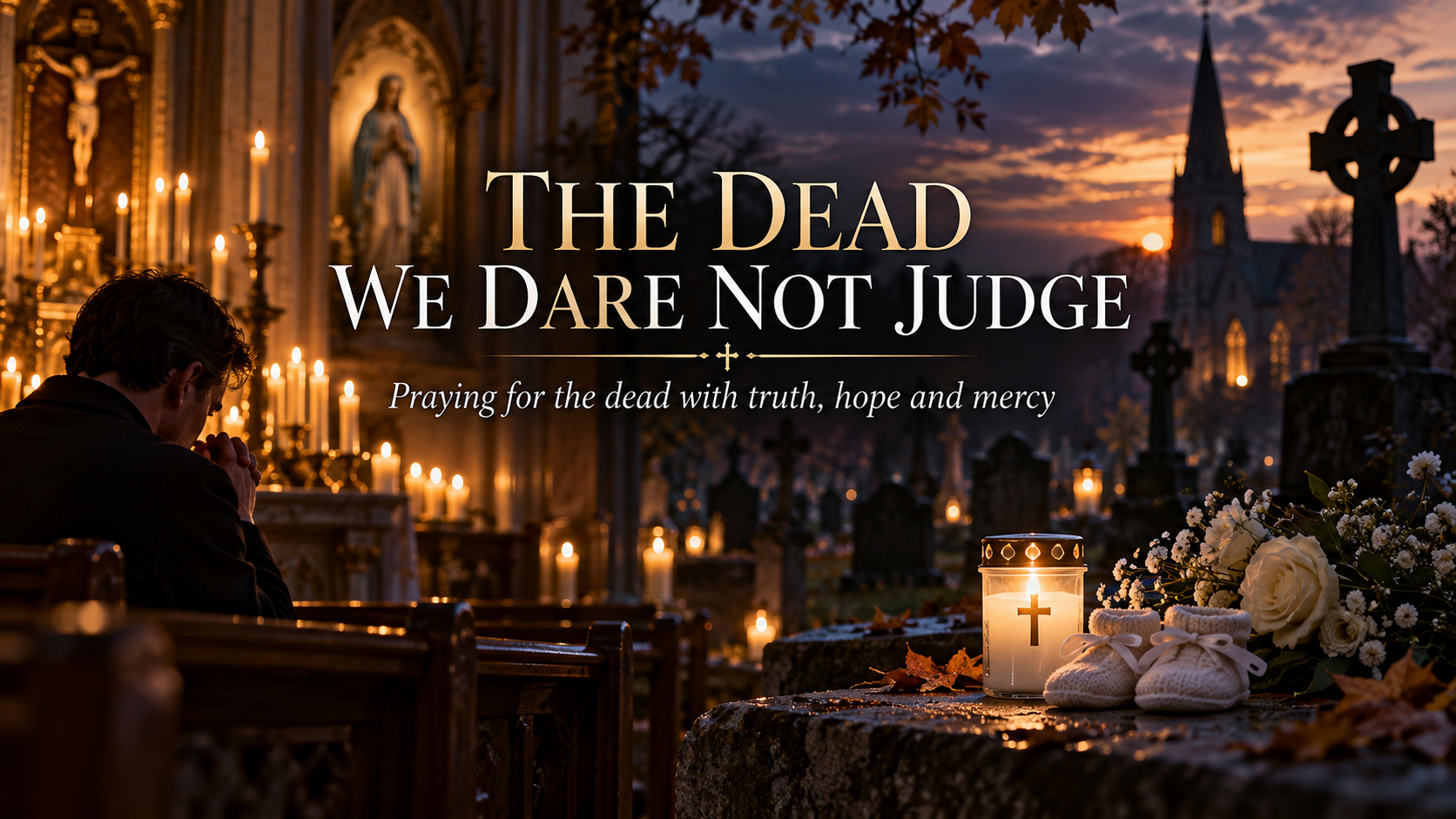
Suicide, abandonment of the Faith, death without the Sacraments, and children who die before Baptism: the perennial doctrine of the Church, the limits of human judgment, and the charity which must never be confused with presumption.
There are deaths which leave families afraid to ask what has become of those they love. A son who took his own life, a parent who abandoned the Faith, a relative who died without Confession, or a child whose life ended before Baptism. The Church cannot promise salvation where God has not promised it, but neither may we pronounce condemnation where His judgment has not been revealed. Drawing upon Scripture, the Councils of Florence and Trent, the traditional theological schools, the teachings of Pius VI, Pius IX and Pius XII, and the 1917 Code of Canon Law, this study considers what Catholics must believe, what they may legitimately hope, and how they should pray.
There are names which families hesitate to place upon the list of the departed. A son who died by suicide. A daughter who abandoned the Faith. A husband who had not approached the Sacraments for thirty years and refused to see a priest during his final illness. There may be a child lost through miscarriage or stillbirth, or an unborn son or daughter whose life ended through abortion. Sometimes the circumstances of death are spoken of openly; sometimes they remain a painful family secret. When November comes, and the Church calls her children to remember the dead, another question may arise alongside the familiar sorrow of bereavement. Can we still pray for them? And what may we reasonably hope concerning their eternal condition?
For some, the difficulty has been intensified by memories of ecclesiastical discipline. An older relative remembers when those who took their own lives were refused Catholic burial. Someone recalls being taught that an unbaptised infant could never enter heaven. Another has heard that a person who died without the last Sacraments must necessarily have been lost. Such recollections are not always accurate, but neither are they entirely without foundation in Catholic doctrine and law. The Church has always taught the seriousness of mortal sin, the necessity of sanctifying grace, the reality of judgment and the obligation to receive the Sacraments. Her traditional funeral discipline reflected those convictions. The difficulty arises when general principles are converted into particular judgments which the Church herself has never claimed the authority to pronounce.
There is no kindness in pretending that salvation is automatic. Our Lord warned repeatedly of the possibility of eternal loss, and no pastoral desire for consolation can justify concealing His teaching. Yet neither does Christian charity require us to assume damnation whenever the outward circumstances of a death are troubling. The Catholic tradition has always distinguished the objective gravity of an action from the culpability of the person who committed it, public ecclesiastical discipline from the particular judgment, and defined doctrine from theological explanations which have not received definitive approval. These distinctions are necessary if we are to speak with both fidelity and compassion. They require more than the familiar assurance that God is merciful. They require us to understand what His mercy does, what it does not do, and why no human being may presume to know every secret of another’s soul.
Death concludes the period of earthly probation. At the particular judgment, the soul’s eternal destiny is fixed. Those who die in God’s grace are saved, although some must undergo purification before entering the Beatific Vision. Those who die in unrepented mortal sin are eternally separated from Him. There is no conversion after death by which a soul definitively lost may reverse that judgment, and the prayers of the living cannot deliver the damned from hell. The Council of Florence, in Laetentur caeli of 1439, taught that those who depart this life truly penitent and in God’s charity, but before making adequate satisfaction, undergo purification and are assisted by the suffrages of the faithful. It also taught that souls departing in actual mortal sin, or in original sin alone, undergo different punishments. The Council of Trent subsequently reaffirmed Purgatory and the efficacy of prayer for the departed, principally through the acceptable Sacrifice of the Altar. These are settled principles of Catholic eschatology, not matters to be revised according to the emotional circumstances of a funeral.¹
Their application to individual souls, however, requires a humility which is sometimes conspicuously absent from discussions of death. God knows the degree of intelligence, freedom, knowledge and responsibility with which every action was performed. He knows whether a person’s rejection of religion proceeded from deliberate malice, culpable negligence, confusion or ignorance. He knows what occurred in the mind of a dying person when speech was no longer possible and whether repentance took place before the soul departed the body. The Church can identify an act as gravely sinful without possessing complete knowledge of the person who committed it. She may regulate public worship according to visible facts without thereby receiving an infallible revelation of the deceased person’s eternal condition. This distinction is especially important when the manner of death itself seems to invite a judgment.
Suicide is an obvious example. Catholic moral theology has consistently regarded deliberate self-killing as a grave violation of the Fifth Commandment. Man receives life from God and holds it in stewardship; he is not its absolute owner. St Thomas Aquinas explains the wrongfulness of suicide through the natural inclination towards self-preservation, the duties owed to the human community and God’s sovereignty over life and death. The seriousness of the act cannot be diminished simply because modern society has acquired a fuller understanding of psychological suffering. Yet traditional moral theology also requires sufficient knowledge and deliberate consent for mortal culpability. A person suffering from severe mental illness, delirium, profound depression or overwhelming disturbance of judgment may lack the freedom ordinarily necessary for a fully deliberate act. The possibility of diminished responsibility is not a post-conciliar invention. It arises from the Church’s longstanding understanding of the human will and the conditions of mortal sin.²
The 1917 Code of Canon Law recognised this distinction in its discipline concerning ecclesiastical burial. Canon 1240 §1, 3° excluded those who took their own lives deliberato consilio — by deliberate counsel — unless they had given some sign of repentance before death. That qualification was not accidental. The law did not simply equate every death described as suicide with a fully culpable rejection of God’s authority. Nor did it require uncertainty to be resolved automatically against the deceased. Canon 1240 §2 provided that, where doubt arose concerning the exclusion, the Ordinary should be consulted if time permitted; if doubt remained, ecclesiastical burial was to be granted, provided scandal could be avoided. The older discipline was undoubtedly strict, but it required prudent judgment and expressly acknowledged the significance of doubt. It should not be represented as though the Church had instructed her priests to condemn every person who died by suicide.³
Even where ecclesiastical burial was legitimately refused, the restriction did not constitute a declaration that the soul had been damned. Canon 1241 extended the exclusion to funeral Masses, including anniversary funeral Masses, and other public funeral offices. Such provisions concerned the Church’s public worship and the witness given by her rites. They could not disclose with certainty the interior state in which a person had died. This distinction is particularly important because a refusal of public funeral rites has sometimes been understood by grieving relatives as a prohibition of all prayer. The pre-conciliar Catholic Encyclopedia, in its treatment of prayers for the dead, explains that private prayer may extend to deceased persons outside visible Catholic communion who may have died in grace. It further records the common theological allowance for the private application of Mass in certain circumstances where public funeral rites were forbidden, provided the necessary conditions were met and scandal avoided. The prohibition of a public Requiem was not automatically a prohibition of every private suffrage.⁴
The 1917 Code contains related distinctions concerning excommunication. Canon 2262 §2 permits the faithful to pray privately for an excommunicated person and allows priests, subject to the stated restrictions and the avoidance of scandal, to apply Mass privately on that person’s behalf. In the exceptional case of an excommunicatus vitandus, the permitted Mass intention is restricted to conversion. Since the canon principally concerns persons living under censure, it must not be treated as an indiscriminate permission concerning every deceased person. Canon 809 separately governs the application of Mass for the living and for the departed undergoing purgatorial purification. These provisions require careful interpretation together with the funeral canons. Their importance lies in the distinction they preserve between public ecclesiastical communion, the canonical effects of a penalty, and the possibility of appropriate private intercession. A priest must observe the law; he need not enlarge its prohibitions into declarations which the law does not make.⁵
There remains the mystery of the final moments of life. We do not know everything which may occur within a soul before death, especially when the circumstances involve mental disturbance or a sudden loss of consciousness. The Council of Trent taught that perfect contrition, arising from the love of God above all things and including the desire to receive the Sacrament of Penance, can reconcile a sinner before actual sacramental absolution. This does not make Confession unnecessary. It means that the mercy of God is not rendered powerless merely because death prevents a genuinely contrite penitent from completing an act which he sincerely desires. We cannot assert that such repentance occurred in any particular case of suicide, nor should we invent it to ease a family’s grief. But its possibility cannot be excluded simply because no outward expression was witnessed. The last movements of the will, the condition of the person’s reason and the operation of grace are known perfectly to God alone.⁶
Nuntiatoria previously considered this tragedy in its reporting of the death of Father Rafael Ciro, a priest of the Diocese of Paterson who died by suicide in August 2025 following a struggle with mental illness. The case exposed the particular loneliness which may accompany psychological suffering within the priesthood, where the expectation that a priest should remain constantly strong can discourage him from admitting his vulnerability. The Church’s response to such suffering must begin during life, through attentive pastoral care and appropriate medical and psychological assistance. After death, the needs of the bereaved remain considerable. They may struggle with unanswered questions, anger or the belief that some neglected warning might have prevented the tragedy. The priest who ministers to them must not add speculative judgments about the deceased person’s guilt. He should explain the Church’s teaching, observe the applicable discipline and encourage whatever prayerful charity is permitted, without pretending to know what occurred in the hidden depths of the soul.⁷
The plight of families whose relatives abandoned the Faith presents different questions. Many Catholics know the sorrow of a parent who gradually stopped attending Mass, a son who openly rejected the Church, or a spouse who died after decades without Confession. Some estrangements are deliberate and notorious; others arise through neglect, personal disappointment, inadequate instruction, scandal or an intellectual struggle which was never resolved. These circumstances cannot all be treated as morally equivalent. Formal apostasy is a grave offence against faith, and deliberately neglecting the obligations of divine worship may constitute mortal sin. But a Catholic who has ceased practising is not necessarily a formal apostate. He may retain belief in Christ while failing seriously to live according to that belief. Another may be confused about doctrine, resentful towards particular clergy, or uncertain whether he can return after years away. None of this excuses culpable neglect. It does mean that the outward absence of religious practice cannot by itself reveal every disposition of the soul.
Baptism leaves an indelible character, which even grave sin does not erase. That character does not guarantee salvation or preserve sanctifying grace independently of the person’s moral condition, but it remains a permanent sacramental reality. Pius XII, in Mystici Corporis Christi of 1943, distinguished visible membership in the Church from the possession of supernatural charity. A baptised Catholic may remain visibly within her communion while having lost grace through mortal sin. A person who has publicly separated himself from her may likewise present questions of knowledge, culpability and interior disposition which cannot be settled merely by observing his external condition. The Church must defend her visible unity and the necessity of Catholic faith without claiming that every element of the divine judgment is thereby accessible to human observers.⁸
This was already clear in pre-conciliar teaching concerning salvation outside the Church. Pius IX, in Quanto conficiamur moerore of 1863, condemned religious indifferentism while acknowledging that those who are invincibly ignorant of the true religion, and who respond to divine grace according to their condition, may attain salvation through God’s assistance. The Holy Office’s letter Suprema haec sacra of 8 August 1949 reaffirmed that there is no salvation outside the Church, while explaining the possibility of belonging to her through desire, including implicit desire in particular circumstances of invincible ignorance. Such desire must be informed by supernatural faith and charity. Neither Pius IX nor the Holy Office suggested that sincere adherence to any religion possesses an independent saving efficacy, or that ignorance is itself a means of salvation. All salvation comes through Jesus Christ and requires the necessary relation to His Church. Yet the manner in which grace acts may not always be fully visible to others. This is a pre-conciliar distinction, not a theological novelty introduced after Vatican II.⁹
The teaching is relevant to those who die outside visible Catholic communion, but it must not be employed carelessly. A person who knowingly and obstinately rejects revealed truth is not in the same condition as someone whose ignorance was genuinely invincible. The priest must take such differences seriously, particularly when considering ecclesiastical burial or the public application of Mass. Nevertheless, the mere fact that someone was estranged from the Church does not automatically establish the degree of culpability involved, nor does the absence of the last Sacraments establish that no repentance occurred. Sudden death may prevent Confession; a priest may be unavailable; a sick person may become unconscious after having begun to turn towards God. Trent’s doctrine of perfect contrition is especially consoling here, provided it is understood correctly. The possibility of reconciliation before sacramental absolution cannot be used as an excuse to neglect the Sacrament while life remains. The proper pastoral response is to encourage conversion and Confession now, rather than rely upon a final opportunity which God has not promised. When death has already intervened, however, the family should not be encouraged to confuse the absence of visible sacramental reconciliation with certain knowledge of the soul’s damnation.
The questions surrounding children who die without Baptism require a different theological approach, and one in which the authority of the pre-conciliar schools must be acknowledged without exaggerating what has been solemnly defined. The Church teaches that all mankind inherits original sin, that sanctifying grace is necessary for entrance into the Beatific Vision, and that Baptism is the ordinary means instituted by Christ for the remission of original sin and incorporation into His Mystical Body. Infants who die before the use of reason have committed no personal sin. Neither, however, can they make the personal act of faith, charity or desire for Baptism which may be possible for an adult. The difficulty concerns the supernatural destiny of a soul which has not received the ordinary means of regeneration, rather than punishment for a deliberate personal offence. It is this question which gave rise to the traditional theology of the Limbo of Infants.
St Augustine, strongly emphasising the necessity of Baptism, took a severe position concerning the condition of infants who died without it. Later scholastic theologians sought to distinguish the deprivation of supernatural happiness from the punishment inflicted for actual mortal sin. St Thomas Aquinas and other medieval theologians developed the position that infants dying in original sin alone would be deprived of the Beatific Vision, the poena damni, without undergoing the positive pains of sense, the poena sensus, associated with personal guilt. Many held that such souls could possess a form of natural happiness while remaining excluded from supernatural beatitude. The distinction was intended to preserve the justice of God, the reality of original sin and the gratuitous character of heaven. Limbo was therefore a serious theological explanation, not a casual speculation or an attempt to diminish the value of Baptism. By the nineteenth and early twentieth centuries it had become the common teaching of Catholic theological manuals and catechisms. The Baltimore Catechism, in Question 632, explicitly described Limbo as the common belief concerning infants who die without Baptism and without actual sin: a condition free from suffering, but deprived of the happiness of heaven.¹⁰
Pius VI gave this theological tradition important magisterial protection in Auctorem fidei of 1794. Proposition 26 condemned the Jansenist characterisation of Limbo as a Pelagian fable, a charge which confused the scholastic distinction between the deprivation of the Beatific Vision and positive punishment with the Pelagian denial of original sin. The condemnation did not define the existence of Limbo as an article of faith, nor did it oblige Catholics to accept every detail proposed by individual theologians. It did establish that the traditional explanation could not justly be dismissed as Pelagian. The distinction is essential. Limbo was never solemnly defined as a dogma in the same manner as original sin or the necessity of grace, but its historical standing as the common teaching of the approved theological schools deserves respect. It would be misleading to suggest that the Church once dogmatically imposed Limbo and subsequently abolished it. It would be equally misleading to present the traditional position as a marginal opinion of little authority.¹¹
Pius XII spoke with particular urgency about infant Baptism in his address to Italian midwives on 29 October 1951. He declared that, in the present economy of salvation, there is no other way of communicating supernatural life to a child who has not attained the use of reason than Baptism. He emphasised that the state of grace is absolutely necessary at death for the Beatific Vision and that the personal act of charity which may supply for the absence of sacramental Baptism in an adult is not available to an unborn or newborn child. His immediate concern was pastoral and practical. Infants in danger of death must receive Baptism wherever possible; their salvation must not be entrusted to conjectural extraordinary means while the Sacrament instituted by Christ remains available. These words are central to any faithful exposition of pre-conciliar doctrine. They make it impossible to present Limbo and the expectation of heavenly salvation for every unbaptised infant as though they were equally established positions in the theology of Pius XII’s pontificate.¹²
Nevertheless, the exact limits of what has been defined must still be respected. Florence taught the condition of souls which actually depart this life in original sin alone. The separate question whether God could communicate sanctifying grace extraordinarily to an infant before death, through a means not revealed to us, is not settled simply by repeating what follows if the soul dies without that grace. The pre-conciliar common teaching did not provide grounds for assuming such an extraordinary intervention, and no Catholic may rely upon it as an alternative to Baptism. But the Church has not issued an individual judgment concerning the eternal condition of every child who has died without the Sacrament. The International Theological Commission’s 2007 study, The Hope of Salvation for Infants Who Die Without Being Baptised, explored possible grounds for hope while acknowledging the historical authority of Limbo. Its conclusions were theological rather than dogmatic. The study did not abolish Limbo, establish universal infant salvation or change the necessity of sanctifying grace. Its more hopeful proposals belong to a later discussion and should not be retroactively presented as the prevailing teaching of the pre-conciliar schools.¹³
The pastoral implications are considerable. A priest should explain to grieving parents that their child committed no personal sin and that God is perfectly just and merciful. He should teach the necessity of grace, the ordinary necessity of Baptism and the traditional understanding of Limbo. He may acknowledge that the Church has not definitively described every possible operation of divine providence in such circumstances. What he should not do is offer a guarantee of heavenly beatitude which revelation has not supplied. Nor should he speak as though the child were being punished for a personal offence. In the traditional theological account, Limbo is not Purgatory. Its proposed inhabitants are not undergoing temporary purification in preparation for heaven, nor are they subjected to the torments due to actual mortal sin. The deprivation of the Beatific Vision remains a real loss in the supernatural order, but the scholastic distinction was expressly intended to recognise the absence of personal guilt. Such an explanation requires care, particularly when the family is newly bereaved. Theological precision is necessary; delivering it without regard to the hearer’s suffering is not a virtue.
The loss of a child through miscarriage or stillbirth should never be treated as an insignificant event because the child lived only briefly, or never survived outside the womb. The child was a human being possessing an immortal soul, known to God and possessing a dignity independent of earthly accomplishments or the recognition of others. Parents may have prepared a nursery, chosen a name and imagined years of family life which will never occur. Others may have suffered an early loss before they could tell anyone of the pregnancy. Their grief may be private, but it is no less real for that. The Church’s doctrine must not be altered to offer consolation, yet neither should its presentation suggest indifference towards a life which was entrusted, however briefly, to parental love.
The 1917 Code reflected the traditional sacramental distinction in its treatment of ecclesiastical burial. Canon 1239 §1 excluded those who died without Baptism. Section 2 recognised catechumens who died without Baptism through no fault of their own as equivalent to the baptised for this purpose, but that provision did not extend to infants unable to make a personal desire for the Sacrament. The later Code, in canon 1183 §2, introduced the possibility of ecclesiastical funerals for children whose parents intended Baptism but who died before receiving it, subject to the permission of the local Ordinary. These are differences of public liturgical discipline, not declarations that the child’s eternal destiny has changed. The older restriction did not amount to a sentence concerning the child’s personal guilt, while the later concession does not establish that the child certainly enjoys the Beatific Vision.¹⁴
Parents may remember a child who died before Baptism by name, seek the counsel of their priest and commend that child privately to divine providence. They may ask that God has bestowed whatever grace His wisdom and mercy permit, without asserting that such an extraordinary intervention necessarily occurred. They may also request Masses for their own perseverance, consolation and spiritual welfare, and discuss with the priest any appropriate private intention. What should be avoided is the assumption that an unbaptised infant is simply another soul in Purgatory, awaiting release through the ordinary suffrages of the Church. Purgatory is the purification of those who have died in sanctifying grace. The traditional Limbo hypothesis concerns souls dying in original sin alone, and prayers offered after death cannot create a state of grace retrospectively. Nor can Baptism be administered to someone who has already died. The Sacrament requires a living subject, proper matter and form, and the necessary intention. The uncertainty surrounding a child’s final condition must not be used to promote supposed posthumous baptisms or substitute ceremonies without sacramental foundation.
The lives of children ended through abortion present the same question concerning original sin and Baptism, accompanied by the additional gravity of deliberate human wrongdoing. The Church has consistently condemned the direct destruction of innocent human life before birth. A child’s humanity does not depend upon whether the pregnancy was intended, whether the child could survive independently, or whether the surrounding society recognised the child’s right to live. Yet the victim bears no personal guilt for the act by which life was taken. The moral responsibility of adults cannot be transferred to the child. The theological question concerning that child’s eternal destiny is therefore the same question which arises wherever an infant dies without Baptism.
Some have attempted to resolve the difficulty by describing all children killed through abortion as martyrs, invoking the Holy Innocents slain by Herod. The analogy is understandable, for both concern innocent children whose lives were violently taken. But the Holy Innocents are honoured as martyrs because their deaths were directly associated with the persecution of Christ Himself. The Church has not taught that every violent death of an unbaptised infant constitutes Baptism of blood. Traditional theology connects martyrdom with death endured on account of Christ or the Faith, and the category cannot simply be extended to every innocent victim of homicide. To assert that all aborted children necessarily enjoy the Beatific Vision through martyrdom would go beyond established doctrine. Their innocence, humanity and dignity remain beyond question. Their supernatural destiny should not be settled by a theological claim which the Church has not defined.
Particular tenderness is required towards those who have participated in abortion and subsequently come to recognise its gravity. Some women and men carry sorrow for many years without speaking of it, convinced that their actions have placed them permanently beyond divine forgiveness. Others acted under substantial pressure, fear, abandonment or coercion. Such circumstances do not change the objective evil of abortion, although they may affect personal responsibility. The duty of the priest is to preach the sanctity of human life while opening the path of repentance and reconciliation to those who seek it. Grave sin can be forgiven. The Sacrament of Penance exists precisely because the Redeemer came to reconcile sinners. Questions of canonical penalties must be addressed according to the applicable law, faculties and circumstances, without public humiliation or discouragement from approaching Confession. St John Paul II, in Evangelium vitae, urged women who had undergone abortions to face what had happened, seek God’s forgiveness and entrust their children to His mercy. His appeal did not diminish the moral gravity of abortion; it refused to allow that gravity to become a reason for despair.¹⁵
The same charity extends to fathers and relatives whose children died through abortion without their consent, or who were powerless to prevent it. Their grief should not be confused with culpability. They may remember the child, undertake works of charity and seek spiritual guidance. Yet the Church’s pastoral concern must remain truthful about what prayer can accomplish. No act performed after death can retrospectively confer Baptism or change a judgment already rendered. To commend the child to God’s providence is an act of trust, not a declaration that the theological difficulty has somehow disappeared. Parents should not be made to feel that their child is forgotten by the Church because the proper public liturgical rites are unavailable. They should receive the care owed to those who have suffered a real bereavement, with the doctrine explained according to its proper distinctions.
These cases also illuminate the Church’s treatment of deceased non-Catholics. The pre-conciliar theological tradition permitted private prayers and good works for persons outside visible Catholic communion who might have died in grace. It did not thereby establish a right to the public funeral rites of the Church or suggest that religious adherence was irrelevant to salvation. Such prayer presupposes the possibility that the person was united to Christ through grace in a manner not fully known to others. The Holy Office’s teaching concerning invincible ignorance and implicit desire for union with the Church is relevant here, but it cannot be transformed into religious indifferentism. The salvation of anyone who is saved comes through Christ and His Church. The fact that the conditions of that union may sometimes be hidden does not make Catholic doctrine optional.
The practical responsibilities of the priest are therefore more demanding than simply deciding whether a funeral can be celebrated. He must examine the circumstances, explain the doctrine, observe the law and recognise the grief of those seeking his assistance. A family affected by suicide may need help understanding diminished culpability and the older canonical provisions. The relatives of a lapsed Catholic may need to distinguish religious neglect from formal apostasy, while recognising that either can involve serious spiritual danger. A family whose loved one died without Confession may need to hear the Church’s teaching concerning perfect contrition, without being encouraged to presume that repentance necessarily occurred. Parents grieving an unbaptised child require a different explanation, grounded in original sin, the necessity of Baptism and the traditional theological account of Limbo. No single reassuring formula can adequately serve all these circumstances.
The Old Roman Apostolate’s Guild of Holy Souls, approved in November 2022 by the Titular Archbishop of Selsey, offers a practical means of sustaining the Church’s ancient obligation towards the faithful departed. Its purposes include encouraging suffrages, maintaining Chantry Books, arranging regular Requiem Masses and assisting those seeking traditional Catholic burial. The Guild understands prayer for the dead as a spiritual work of mercy and burial as a corporal work of mercy. Both arise from the conviction that death does not render the obligations of Christian charity meaningless. Yet the Guild must also preserve the doctrinal distinctions which govern the Church’s public worship. Those who may properly benefit from the suffrages of the faithful departed are not simply interchangeable with unbaptised infants whose eternal condition raises a different theological question. The appropriate response to each family should be determined with pastoral discretion and fidelity to the received discipline.¹⁶
Nuntiatoria’s earlier treatment of All Souls and the Domestic Church has encouraged Catholics to recover the practice of arranging Requiem Masses, submitting the names of departed relatives, maintaining family memorials and teaching children to pray for the dead. These customs deserve restoration, not least because remembrance is becoming increasingly detached from the supernatural realities which once gave it purpose. Yet there are families for whom a name in the memorial book brings painful uncertainty. They may have avoided speaking to a priest because the deceased died in circumstances of scandal or estrangement. They may fear that a child who died before Baptism has no place in the Church’s concern. Such families should be encouraged to seek sound pastoral guidance rather than allow private anxieties to become settled conclusions. The Church’s doctrine does not answer every question which grief may raise, but it supplies the principles by which those questions can be considered without inventing certainty.¹⁷
There remains an obligation towards the living which should not be lost amid discussion of the dead. The possibility of repentance before death is no reason to postpone Confession. The recognition that psychological illness can affect culpability does not relieve us of the duty to assist those struggling with suicidal thoughts or serious mental distress. The traditional teaching concerning Limbo makes the prompt Baptism of infants more urgent, not less. A relative who has abandoned the Faith should be encouraged towards reconciliation while there remains time. The seriously ill should be offered the Sacraments before consciousness and speech are lost. The spiritual and corporal works of mercy belong together, and the charity which prays for the departed must also do what it can for those whose earthly lives have not yet ended.
In this respect the traditional Roman Requiem remains a necessary teacher. Its black vestments, solemn chant and searching Dies irae refuse to disguise the seriousness of death. Yet its petitions continually invoke the merits of the Redeemer. The Church does not stand before the altar to celebrate a life already declared blessed by human affection. She offers the Holy Sacrifice for those who may still require its fruits. There is a profound difference between commending a soul to God and announcing God’s judgment upon that soul. The first belongs to the priestly ministry of intercession; the second, except where the Church has received the necessary authority and grounds for recognising sanctity, lies beyond ordinary human knowledge.
St Augustine understood this when he prayed for his mother Monica. He had witnessed her extraordinary virtue and the holiness of her death, yet he still begged God to forgive whatever faults she might have committed. Monica herself had asked to be remembered at the Lord’s altar, caring little where her body would be buried provided that the Eucharistic Sacrifice was offered for her soul. Augustine did not treat affection as proof of immediate heavenly glory. He entrusted his mother to the mercy of God and invited others to join him in prayer. The episode remains a model of Catholic filial piety, combining confidence in the Redeemer with humility before the mysteries of judgment and purification.¹⁸
The Church’s teaching concerning the dead is sometimes regarded as severe because it refuses to promise heaven indiscriminately. But the refusal to promise what God has not promised is not cruelty. The priest who assures every grieving family of immediate salvation may offer temporary comfort while weakening the very motive for suffrages. Conversely, the person who declares a soul damned because of a particular manner of death may impose a burden which neither revelation nor ecclesiastical law authorises him to impose. Both presume knowledge which does not belong to us. Catholic charity is more exacting. It asks us to believe what has been revealed, to take mortal sin and the necessity of grace seriously, and to exercise whatever intercession the Church permits without claiming to have seen the particular judgment.
This is especially important in the case of those whose deaths seem furthest from the consolations of religion. A father who refused Confession for many years may nevertheless have turned towards God before his death; we cannot say that he did, but neither can we know that he did not. A person who died by suicide may have acted under circumstances which gravely impaired responsibility; the fact of death does not reveal the whole state of the will. Parents whose child died before Baptism cannot supply that Sacrament retrospectively, but may commend the child to the providence of the God who is infinitely just. Those who have participated in grave wrongdoing may seek reconciliation while they live, and their families should be encouraged to pray appropriately after death where their final condition is unknown. These are different circumstances, governed by distinct theological considerations, but each requires humility before divine judgment.
There is an old temptation to imagine that compassion consists in removing every difficult doctrine from the conversation. Yet a mercy detached from truth cannot give lasting spiritual consolation. The Church teaches the necessity of grace because heaven is a supernatural destiny. She teaches the possibility of eternal loss because human freedom and mortal sin are real. She preserves her sacramental and funeral discipline because public worship must express the Faith she has received. And she prays for the dead because the Sacrifice of Christ is efficacious for those who depart this life in His friendship. These convictions are not rival principles between which a priest must choose. They form a coherent understanding of redemption, judgment and the communion of saints.
During November, Catholics will remember parents, children, relatives and friends whose earthly lives have ended. Some will have received every consolation of religion. Others may have died suddenly, after years of estrangement, or in circumstances which remain a source of sorrow. The faithful should not allow fear or embarrassment to prevent them from seeking the guidance of their clergy. Nor should they assume that every deceased person can be treated identically in the Church’s public rites. The proper response is to acknowledge the circumstances, preserve the relevant doctrinal distinctions and undertake such prayers and works of charity as Catholic teaching permits.
One day our own names will be among those remembered by others. Our earthly opportunities for repentance will have passed, our possessions will have changed hands, and whatever reputation we enjoyed will gradually fade. Those who remain may know little of our final dispositions, just as we now know little of the last interior movements of those who have gone before us. That prospect should encourage repentance while we live, fidelity to the Sacraments, charity towards our neighbours and a sober gratitude for every opportunity God gives us to prepare for death.
St Augustine’s mother asked to be remembered at the altar. She knew where the greatest assistance for the departed was to be found. We should learn from her both to seek the Sacrifice for those capable of benefiting from its fruits and to prepare our own souls so that death may find us reconciled to Christ.
The Church can teach us what is necessary for salvation. She can identify sin, administer the Sacraments, offer the Holy Sacrifice and regulate the public rites by which her Faith is professed. She cannot disclose to us every hidden movement of a dying soul, nor may we demand from her a certainty which God has not revealed.
The final judgment belongs to Christ. Our responsibility is to live in His grace, to seek reconciliation while time remains, and to exercise towards the departed the charity which His Church permits.
Domine, secundum magnam misericordiam tuam, miserere.
O Lord, according to Thy great mercy, have mercy.
- Council of Florence, Laetentur caeli, 6 July 1439, decree concerning the last things; Council of Trent, Session XXV, Decree Concerning Purgatory, 3–4 December 1563.
- St Thomas Aquinas, Summa Theologiae, II–II, q. 64, art. 5.
- Codex Iuris Canonici (1917), canon 1240 §§1–2.
- Arthur P. MacMahon, “Prayers for the Dead,” The Catholic Encyclopedia, vol. 12 (1911), section on Church laws regarding public offices for the dead; Codex Iuris Canonici (1917), canon 1241.
- Codex Iuris Canonici (1917), canon 809; Codex Iuris Canonici (1917), canon 2262 §§1–2.
- Council of Trent, Session XIV, Chapter IV, On Contrition, 25 November 1551.
- Nuntiatoria, “Catholic Priest Commits Suicide: The Weight of Clerical Loneliness,” in Nuntiatoria LX: Haec Est Via, 5 September 2025.
- Pius XII, Mystici Corporis Christi, 29 June 1943, §§21–24.
- Pius IX, Quanto conficiamur moerore, 10 August 1863; Supreme Sacred Congregation of the Holy Office, Suprema haec sacra, 8 August 1949.
- St Thomas Aquinas, Summa Theologiae, Supplement, q. 69; Baltimore Catechism, no. 3, Question 632 (1891).
- Pius VI, Auctorem fidei, 28 August 1794, proposition 26.
- Pius XII, Address to Italian Midwives on the Nature of Their Profession, 29 October 1951, section “Supernatural Life”.
- International Theological Commission, The Hope of Salvation for Infants Who Die Without Being Baptised, 19 April 2007, §§26–41 and 66–103.
- Codex Iuris Canonici (1917), canon 1239 §§1–3; Codex Iuris Canonici (1983), canon 1183 §2.
- John Paul II, Evangelium vitae, 25 March 1995, §§58–59 and 99.
- Old Roman Apostolate, “Guild of Holy Souls,” 21 November 2022.
- Nuntiatoria, “All Souls’ Day – The Commemoration of the Faithful Departed,” 3 November 2025; “The Domestic Church: A Home with Room for Heaven,” 23 October 2026.
- St Augustine, Confessions, Book IX, chapters 11–13.





Leave a Reply