
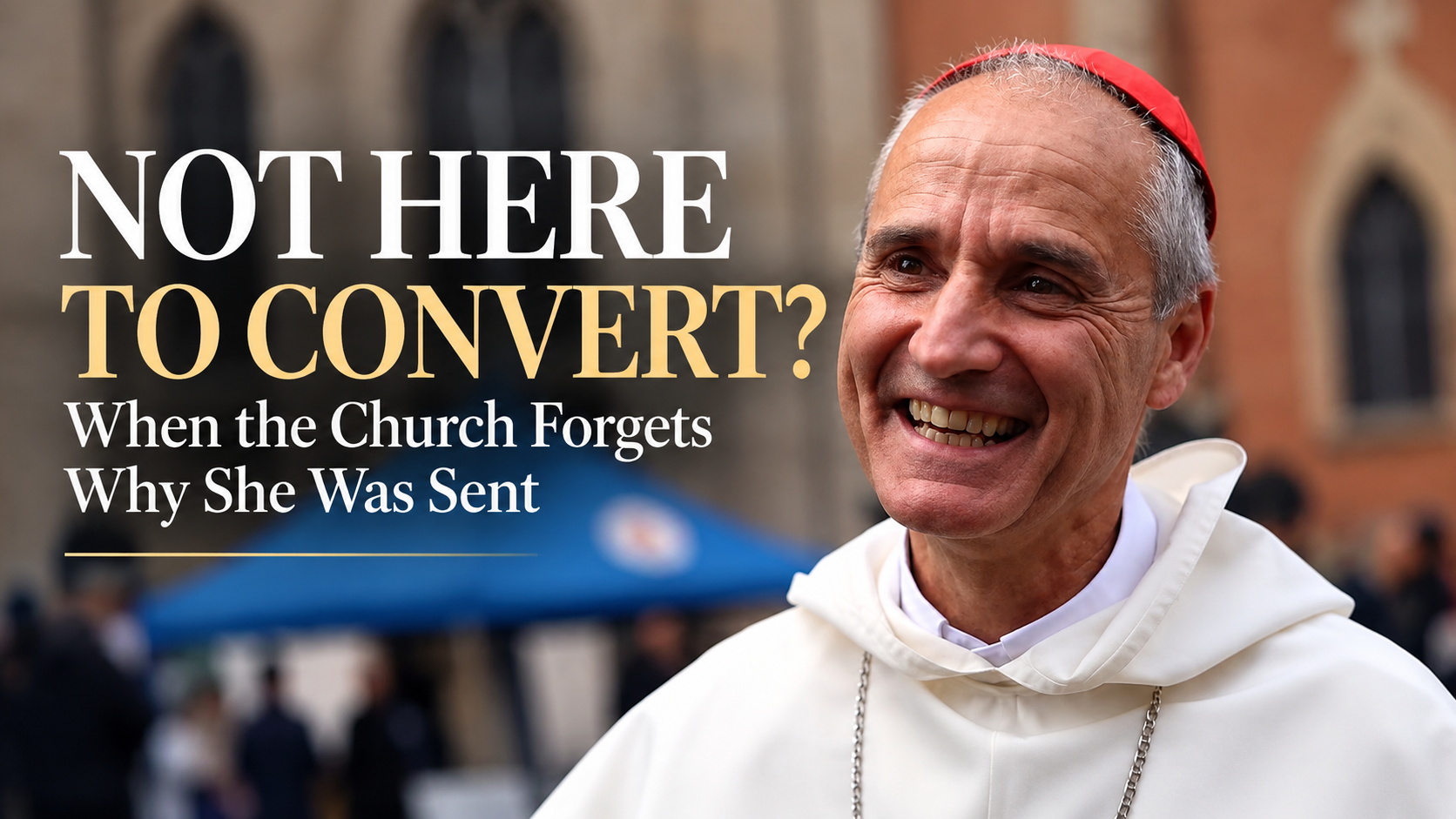
Cardinal Jean-Paul Vesco’s declaration that the Church in Algeria is not there to convert has revived a controversy which first erupted around World Youth Day in Lisbon in 2023. Bishop Robert Barron’s intervention, and the subsequent defence of the Cardinal by the journalists who interviewed him, have exposed a deeper disagreement about the very purpose of Catholic evangelisation. The circumstances of the Church in Algeria demand prudence, charity and respect for religious freedom. But they also raise a question which cannot be resolved through an appeal to fraternity alone: does the Church still believe that bringing souls to Jesus Christ belongs to the mission for which He established her?
Cardinal Jean-Paul Vesco, Archbishop of Algiers, has occasioned a controversy which deserves considerably more serious attention than the exchange of indignation and accusation it has so far produced. In an interview conducted by Christophe Herinckx at the Dominican convent in Brussels on 25 September and published by the Belgian Catholic newspaper CathoBel on 23 October 2026, the Cardinal described his understanding of the Church’s place within predominantly Muslim Algeria: “We are the Church of this people. Not a proselytising Church, not a Church that is there to convert, but a Church that aspires to be one of the components of this people.” The remarks have since been reported internationally, drawing criticism from Bishop Robert Barron of Winona-Rochester and prompting CathoBel to publish a defence of the Cardinal’s intentions. The resulting dispute concerns something much more substantial than the interpretation of one sentence. It raises the question of what Catholic evangelisation is supposed to accomplish, and whether the increasingly familiar language of religious fraternity has begun to obscure an essential part of the Church’s supernatural mission.¹
The immediate circumstances of the interview matter. Vesco was answering a question about the Catholic community in Algeria, which he described as a small but internationally diverse population comprising people of some thirty nationalities. The Church there must maintain its Catholic universality while becoming genuinely rooted in Algerian society, respecting the country’s history and avoiding the appearance of a foreign community permanently detached from the people among whom it lives. He spoke of the need to participate fully in the country’s civic life rather than retreat into an ecclesiastical enclave. These are legitimate pastoral concerns, especially in a country where the relationship between Christianity, Islam and European colonial history remains sensitive. A bishop whose ministry depends upon relationships of trust with Muslim neighbours and civil authorities has every reason to reject aggressive religious competition. The question is whether that responsibility requires him to declare that the Church is not there to convert. The two propositions do not necessarily follow from one another, and it is precisely their apparent identification which makes Vesco’s statement troubling.
The distinction becomes clearer when the full interview is considered. Discussing Christian-Muslim relations, the Cardinal asked whether Christians should regard themselves as a besieged fortress or choose fraternity. He rejected the former approach and criticised attempts to restore a political Christendom. He then described proselytism among the monotheistic religions as poisonous because, in his understanding, it involves judging another person’s religion false. He illustrated his concern by describing the effect of a Muslim telling a Christian that he was personally admirable but that his religion was worthless. Such a confrontation, he argued, destroys the possibility of genuine human dialogue. There is a sound pastoral observation beneath this account. To insult another person’s religion, particularly as a means of humiliating the person himself, is not an expression of Christian charity. Religious disagreement should never excuse contempt. But the Cardinal’s reasoning appears to move from condemning an insulting manner of expressing disagreement to questioning the legitimacy of judging another religion doctrinally mistaken. That is a very different matter. Christianity necessarily makes claims about God which contradict central Islamic teachings. The Catholic who professes the Blessed Trinity, the divinity of Jesus Christ and His saving death and Resurrection cannot simultaneously maintain that their denial is equally true. He may respect the Muslim, recognise his sincerity and admire the genuine virtues present in his life without conceding that religious truth is a matter upon which neither person may legitimately judge the other mistaken.¹
On 29 October, CathoBel published a response to Bishop Barron’s criticism, written by Clément Laloyaux and Christophe Herinckx, the journalist who had conducted the original interview. Their principal objection was that Vesco’s words had been removed from their particular Algerian context and treated as though he had repudiated the missionary obligation of the universal Church. They also identified a genuine error in Barron’s intervention. Alongside the authentic remark about the Church not being there to convert, Barron had attributed to Vesco a second sentence concerning the preference for fraternity over seeking conversions. That sentence was not a direct quotation from the interview, but a journalistic paraphrase published by Advaticanum. The distinction should be acknowledged without qualification. A bishop’s criticism of another bishop ought to rest upon what the latter actually said, and an editorial which purports to defend Catholic truth has a particular responsibility to preserve accuracy in quotation and attribution.²
Yet correcting the attribution does not dispose of the underlying theological difficulty. Vesco did say that the Church in Algeria was not there to convert. He did associate proselytism with judging another religion false. Nor were these entirely new or isolated expressions. The position had appeared, in substantially similar terms, in interviews conducted years before the present controversy. The original context prevents an exaggerated accusation that the Cardinal has formally renounced the missionary vocation of the universal Church; it does not make the repeated opposition between fraternity and conversion disappear. Indeed, the defence offered by CathoBel introduces another question. Herinckx argued that evangelisation should not be confused with converting another person, since individuals undergo conversion themselves. This is true insofar as faith cannot be compelled and conversion requires the free response of the person moved by divine grace. It becomes misleading if taken to mean that Christians have no responsibility to invite others towards that response. The distinction between the principal agency of grace, the freedom of the convert and the instrumental ministry of the evangelist is elementary to Catholic theology. The fact that a missionary cannot personally manufacture conversion does not mean that he should cease desiring it or directing his work towards it.²
There is, moreover, a history to Vesco’s remarks which makes the present dispute more consequential. In April 2018, while Bishop of Oran, he gave an interview to Le Point in which he emphasised that the Gospel was communicated through witness, social engagement and friendship. The publication highlighted his contention that the significant matter was not whether a Muslim became Christian, but whether a person underwent a spiritual experience.³ This is a formulation which requires careful theological distinction. The Church recognises that divine grace can be at work in those who do not yet profess Christianity, and that the spiritual movement towards faith may begin long before an individual recognises its supernatural source. A personal experience may awaken conscience, challenge inherited assumptions, encourage prayer or lead someone to examine the claims of revelation. But such experiences cannot be their own criterion of truth. Religious sincerity does not establish that every belief sincerely held is correct, nor does the fact that a person has undergone a profound spiritual experience make its doctrinal content irrelevant. The Catholic missionary may welcome evidence of grace at work within another person while continuing to hope that the movement will lead towards the fullness of revealed truth.
The Cardinal returned to the subject in February 2022, shortly before taking possession of the Archdiocese of Algiers. Interviewed by Laurence D’Hondt for Dimanche, in a conversation published by Cath.ch, he described the Church’s presence among Muslims and explained his understanding of the fraternity encouraged by Pope Francis. His words were particularly significant: L’évangélisation se fait dans la fraternité et non dans la conversion — evangelisation takes place in fraternity, not in conversion. He presented this as a revolutionary development, suggesting that Christians needed to free themselves from the assumption that they were obliged to bring others to their religious truth, while remaining open to the possibility that Islam contained truths insufficiently appreciated by Christians. The interview appeared under the headline Il faut nous défaire de l’idée que nous devons évangéliser — “We must rid ourselves of the idea that we must evangelise.”⁴ These statements were made years before the current controversy, and their recurrence suggests a sustained pastoral philosophy rather than a momentary lapse of expression. Vesco’s intention was to defend the sincerity of Christian fraternity against religious instrumentalisation, but he repeatedly expressed that concern through a contrast between fraternity and conversion which Catholic missionary doctrine does not require.
The problem, therefore, is not that Cardinal Vesco wishes the Church to love Muslims or to serve Algerian society without calculation. He is right to insist that the hungry should be fed because they are hungry, that charitable institutions should not make their assistance conditional upon religious adherence, and that friendship should never be cultivated as a disguised recruitment technique. A person treated merely as a prospective convert has not been treated according to his full human dignity. Yet there is no contradiction between offering genuine friendship without conditions and desiring that one’s friend should come to know Jesus Christ. A Catholic may recognise the goodness, generosity and devotion of a Muslim neighbour while believing that the Incarnation and Redemption are truths which that neighbour ought freely to embrace. The desire for conversion becomes objectionable only when it is pursued through methods contrary to charity or when the other person’s religious freedom is disregarded. The Church’s moral obligation to respect conscience governs how the Gospel is proposed; it does not remove the reason for proposing it.
The concern is not restricted to Algeria. Three years earlier, before World Youth Day in Lisbon, Bishop Américo Aguiar, then auxiliary bishop of Lisbon and president of the foundation organising the event, had made an equally remarkable declaration. Speaking to Portugal’s RTP television on 6 July 2023, he explained that the gathering should allow young people of different religious affiliations to meet, express their beliefs and recognise their common humanity. He wanted Catholics, Muslims, Jews, adherents of other religions and those professing no religious faith to feel equally welcome. Then he stated: “We don’t want to convert the young people to Christ or to the Catholic Church or anything like that at all.” Three days later, Pope Francis announced that Aguiar would be created a cardinal at the forthcoming consistory. The coincidence brought his remarks international attention and prompted questions about the purpose of an event which had been established specifically to strengthen young people’s relationship with Jesus Christ and His Church.⁵
Aguiar subsequently clarified his meaning. Speaking to ACI Digital on 11 July, he explained that World Youth Day was intended to provide young people with an encounter with the living Christ, and that his remarks concerned the freedom of non-Catholic participants rather than a rejection of Christian evangelisation. He distinguished the legitimate invitation to faith from coercive proselytism, emphasising the work of divine grace and the necessity of respecting conscience.⁶ These qualifications should be treated fairly, for they prevent his original statement from being presented as an unequivocal denial of conversion as a Christian good. Nevertheless, his initial formulation remains difficult to reconcile with the purpose for which World Youth Day was established. If the encounter with Christ was intended to transform lives, why describe conversion as something the organisers did not want? Why should welcoming a young Muslim or unbeliever require the organisers to disclaim any desire that he might freely embrace the Catholic Faith? Hospitality does not become less genuine because the host believes he possesses a gift which he hopes the guest may one day wish to receive.
St John Paul II had explained the purpose of World Youth Day with considerable precision. Writing to Cardinal Eduardo Francisco Pironio on 8 May 1996, he identified the central objective of the gatherings as making Jesus Christ the foundation and governing reference of young people’s faith and lives. He described World Youth Day as a continuing catechesis and an invitation to conversion, sustained by the proclamation of the Word of God, prayer and the encounter between young people from different nations.⁷ There was no suggestion that international fellowship required the abandonment of an explicitly evangelical purpose. Rather, the universality of the gathering expressed the universality of the Gospel. Young people were called to deepen their own faith and become witnesses to their contemporaries, including those who had never encountered the Church. John Paul II understood friendship and dialogue as part of the manner in which the Gospel was communicated. Aguiar’s original statement appeared to exclude the very fruit towards which that communication was directed.
Bishop Robert Barron challenged Aguiar’s remarks in July 2023 and returned to the controversy after attending World Youth Day. He questioned how a Catholic institution could cease to regard evangelisation as essential to its mission without losing the reason for its specifically Catholic existence. A school, charitable institution or youth gathering may accomplish valuable human work, but its ecclesiastical identity cannot be reduced to those achievements. Barron also disputed attempts to separate an encounter with Christ from incorporation into His Church, insisting that Catholic evangelisation involves more than providing an atmosphere in which religious experience may occur.⁸ His intervention was particularly relevant because it came from a bishop closely associated with the New Evangelisation rather than from a critic who considered the missionary teaching of Vatican II itself defective. Barron’s concern arose from his understanding of that teaching and its continuity with the Church’s earlier missionary tradition.
Responding to Vesco on 29 October 2026, Barron returned to the command of Christ in St Matthew and the preaching of St Paul. His argument was that the Apostles had been sent to make disciples, proclaim the Resurrection and baptise, not merely to establish relationships of mutual understanding. He ended by suggesting that if he genuinely believed the Church did not exist to bring people to Christ, he ought to resign his office. The rhetorical force of the intervention is obvious, although the error of attribution subsequently identified by CathoBel should prevent the exchange from being treated as a simple victory for either party. Barron’s substantive theological argument must be distinguished from the accuracy of every quotation in his commentary. Equally, the correction of a quotation does not establish that the missionary question he raised has been answered. Both matters deserve serious treatment, particularly when the disagreement concerns the purpose of the episcopal office itself.⁹
The position of the Church in Algeria must nevertheless remain central to any fair assessment of Vesco’s statements. Algeria’s religious and political circumstances are difficult. The Catholic population is a small minority in a country where Islam is deeply woven into national identity and where memories of French colonial rule continue to influence public attitudes towards Christianity. Religious conversion may involve serious social consequences, particularly within families. There are also legal restrictions. Algeria’s Ordinance 06-03 regulates non-Muslim religious activity and penalises certain efforts to convert Muslims. In April 2026, the United States Commission on International Religious Freedom documented continuing restrictions upon religious minorities, including administrative impediments to importing Bibles and other Christian materials and legal proceedings affecting minority communities.¹⁰ A bishop responsible for the welfare of Catholics in such circumstances cannot ignore these realities. Public missionary methods which would be legitimate elsewhere might expose vulnerable people to prosecution, intimidation or serious personal danger in Algeria.
Vesco’s emphasis upon constructive relationships with civil authorities and Muslim neighbours therefore has practical pastoral significance. The Church may be able to sustain worship, education, charitable work and the pastoral care of the faithful precisely because she has cultivated trust. A bishop who compromised those relationships unnecessarily might jeopardise people whose difficulties are remote from the circumstances of commentators in Europe and North America. The Church’s missionary history contains many examples of prudence under persecution or restriction, when public proclamation had to give way temporarily to private instruction, personal witness, hospitality and patient prayer. There is nothing cowardly about such discretion where it is exercised for the genuine good of souls. The difficulty begins when circumstances requiring prudence are presented as though they disclose a different understanding of the Church’s purpose. A missionary may be prevented from preaching openly without ceasing to desire that those among whom he lives should know Christ. A bishop may discourage imprudent attempts to obtain converts without declaring that conversion is no longer part of his Church’s vocation. The distinction between an end and the means available to accomplish it is not an academic refinement; it is indispensable to the moral judgement of missionary activity.
There is another consideration which deserves greater attention. The freedom of the Muslim who wishes to remain Muslim is rightly defended in contemporary discussions of religious liberty. Less frequently acknowledged is the freedom of the Muslim who wishes to become Christian. Both freedoms arise from the dignity and responsibility of conscience. A person who begins to question the religious beliefs in which he was raised should be free to investigate Christianity, receive instruction, participate in worship where appropriate and seek Baptism without intimidation. The Catholic Church has a responsibility to protect that freedom, particularly where the surrounding legal or social environment places converts at risk. If the Church becomes so anxious to demonstrate that she has no intention of converting Muslims that the conversion of an Algerian appears to be an awkward exception to her preferred relationship with society, something essential has been lost. The convert is not an embarrassment to religious fraternity. He is a human being exercising the very freedom of conscience which that fraternity ought to defend.
Algeria’s history gives this question an additional significance. The territory of modern Algeria belongs to the ancient heartland of Latin Christianity. St Augustine was born at Thagaste and exercised his episcopal ministry at Hippo, and the theological inheritance of Roman North Africa continues to shape Catholic understanding of grace, sin, the Church and the supernatural life. Christianity in the region is therefore considerably older than the modern colonial period. This history gives Catholics no right to disregard Algeria’s present Islamic identity or to impose the Faith through political authority, but it challenges the assumption that Christianity must necessarily remain a foreign religious presence seeking permission to belong. The Catholic Church becomes authentically local through the life of believers drawn from the people among whom she exists. The development of indigenous clergy, religious communities and Catholic families is not an act of cultural domination. Properly understood, it is one of the natural fruits of evangelisation.
The Church’s missionary Magisterium recognised this long before the contemporary controversy. Benedict XV’s Maximum Illud of 1919 condemned the confusion of missionary activity with the national ambitions of colonial powers. Missionaries were to serve Christ and the salvation of souls, not the political interests of their countries of origin. Pius XI developed the same teaching in Rerum Ecclesiae in 1926, insisting upon the formation of indigenous clergy and the establishment of genuinely local Catholic communities. Pius XII reaffirmed the importance of respecting the legitimate cultural traditions of peoples in Evangelii Praecones in 1951.¹¹ The purpose of these teachings was not to diminish the Church’s obligation to seek conversions, but to ensure that the Gospel was communicated without the political and cultural distortions which had sometimes accompanied missionary activity. The Church was not to make other peoples European. She was to bring them to Christ.
The distinction is particularly important because the Catholic Faith is universal precisely in its claim to possess a truth which concerns all mankind. Christianity does not teach that Jesus Christ is merely the religious ideal of one civilisation or the spiritual expression of one historical community. It professes that He is the incarnate Son of God, whose death and Resurrection accomplished the Redemption of the human race. Those claims may be rejected, but they cannot be reduced to the private cultural inheritance of those who accept them without fundamentally altering their meaning. The Apostles understood this from the beginning. St Peter preached repentance and Baptism; St Paul travelled among Jews and Gentiles proclaiming the Resurrection and calling his hearers to faith. At Athens, Paul recognised the religious seriousness of his audience and began from something familiar to them, their altar to the unknown God. He did not conclude that their existing religious convictions made further proclamation unnecessary. He announced the Creator, called his hearers to repentance and proclaimed the risen Christ. The apostolic method combined an awareness of cultural circumstances with a conviction that divine revelation required a response.¹²
The command which governed their work was given by Our Lord Himself. After His Resurrection, Christ declared that all power had been given to Him in heaven and on earth, and instructed the Apostles to teach all nations and baptise in the name of the Father, and of the Son, and of the Holy Ghost. The commission recorded in St Matthew 28:18–20 does not distinguish between societies in which Christian conversion would be welcomed and those in which it would occasion difficulty. Nor does it confine evangelisation to persons who have already expressed an interest in Christianity. The Apostles were sent because the nations did not yet know the Saviour. Their responsibility was to announce Him faithfully, respecting the freedom of those who heard them while recognising that the Gospel concerned their eternal salvation. St Paul’s declaration, “For woe is unto me if I preach not the gospel,” arose from his understanding that this was an obligation entrusted to him rather than a personal religious preference.¹²
Nor did the Second Vatican Council reverse that missionary purpose. Its decree Ad Gentes, promulgated on 7 December 1965, identifies the Church as missionary by her very nature and affirms the obligation to proclaim Christ and invite people to faith and Baptism. The decree recognises the importance of cultural adaptation, personal witness and dialogue, including situations in which direct proclamation cannot immediately be undertaken. These provisions are especially relevant in places such as Algeria, where missionaries must consider the consequences of public activity for those among whom they live. Yet the Council never suggests that prudential limitations upon missionary methods establish a new theological understanding of evangelisation in which conversion becomes unnecessary. Nostra Aetate likewise encourages Catholics to acknowledge the genuine spiritual and moral goods found within other religious traditions while preserving the Church’s responsibility to proclaim Christ. Dignitatis Humanae defends freedom from religious coercion without making truth subordinate to the preference of the individual.¹³
Paul VI was equally explicit in Evangelii Nuntiandi in 1975. He identified evangelisation as essential to the Church’s identity and insisted that Christian witness must, when circumstances permit, be accompanied by the explicit proclamation of Jesus Christ. The Christian life is itself a witness, but its supernatural meaning cannot always be inferred by those who observe it. Charity, integrity and service may prompt questions about the Faith, and such questions require an answer concerning the Lord whose grace inspires that conduct. John Paul II returned to the relationship between proclamation and dialogue in Redemptoris Missio in 1990. He defended interreligious dialogue as a genuine element of the Church’s missionary activity, while insisting that it could not replace the proclamation of Christ or the invitation to conversion. Dialogue must be sincere and free from manipulation; it is not a disguised technique for obtaining converts. Nevertheless, the Christian’s participation in dialogue remains informed by his faith in the unique saving significance of Jesus Christ.¹⁴
Perhaps the most decisive magisterial intervention concerning the present controversy appeared under Benedict XVI. On 3 December 2007, the Congregation for the Doctrine of the Faith published its Doctrinal Note on Some Aspects of Evangelization, approved by the Pope and issued specifically to clarify confusion concerning the relationship between religious freedom and the Church’s missionary obligation. The document observed that some Christians had come to regard attempts to persuade others in religious matters as infringements of personal liberty. According to this understanding, Christians should be satisfied with helping people remain faithful to their existing religions, fostering spiritual development and cooperating in the pursuit of justice and peace, without seeking their conversion to Christ and the Catholic Faith. The Congregation rejected this conclusion. It explained that every person possesses a right to hear the Gospel and that this right corresponds to the Church’s obligation to proclaim it. Religious freedom protects the person’s capacity to recognise and embrace truth; it does not require Christians to become indifferent towards whether others receive it.¹⁵
The resemblance between the difficulty identified in 2007 and the formulations employed by Vesco and Aguiar is striking. The Congregation was not defending coercive proselytism. It expressly condemned improper pressure, dishonesty and every attempt to exploit personal vulnerability. It insisted upon respect for conscience and recognised that evangelisation must be exercised through genuine charity. But it rejected the assumption that the desire for conversion is itself incompatible with religious freedom. The document also clarified a point raised by the defence published in CathoBel: conversion is indeed a free response to divine grace, but the fact that the missionary does not cause faith through his own power does not make his invitation unnecessary. The Holy Ghost works through the proclamation of the Gospel, the witness of Christian lives and the sacramental ministry of the Church. Those who communicate the Faith are instruments of grace, not its authors. Their inability to compel the result is no argument for abandoning the responsibility to proclaim.
The document further explains that conversion to the Catholic Faith is not the enlargement of a political association or the accumulation of institutional membership. It is entrance into communion with Christ through the Church He founded. That distinction is essential, because criticism of proselytism often assumes that the desire for converts arises principally from competition between religious organisations. Such motives would indeed be unworthy of the Church. But the Catholic desire for conversion does not depend upon numerical success, ecclesiastical prestige or the enlargement of institutional influence. It arises from the conviction that faith, Baptism and the Sacraments communicate supernatural goods which the Church has been entrusted to offer. A missionary may labour for decades without baptising a single convert and still fulfil his vocation faithfully. The absence of visible results does not mean that conversion has ceased to be the good towards which his work is ordered.
The doctrine of salvation makes the distinction still more important. The Church does not presume to know the eternal destiny of every person who dies without visible Catholic communion. She recognises that God may communicate saving grace to those who, through no fault of their own, lack explicit knowledge of Christ and His Church, according to circumstances known to divine mercy and justice. But such salvation, where it occurs, is always through the redeeming work of Jesus Christ, not through an independent saving efficacy possessed by religious errors. The Congregation for the Doctrine of the Faith reaffirmed this in Dominus Iesus in 2000, rejecting interpretations of religious pluralism which treat Christianity as one among several equivalent revelations or paths of salvation.¹⁶ The possibility of salvation without explicit Christian belief does not make ignorance of Christ spiritually preferable, nor does it diminish the value of Baptism as the ordinary sacramental means of regeneration established by Our Lord. The Church desires conversion because she understands what has been given to mankind through Christ, not because she presumes the damnation of everyone who has not yet received it.
The theological virtue of charity also places fraternity within a wider supernatural framework. St Thomas Aquinas describes charity as a friendship between man and God founded upon participation in divine happiness. It follows that the Christian’s love of neighbour concerns the whole good of the person, including his eternal destiny.¹⁷ Temporal welfare remains a genuine good. The hungry must be fed, the sick cared for, the stranger welcomed and the vulnerable protected, without making such assistance conditional upon religious allegiance. But these obligations do not exhaust the charity which the Church has received from Christ. A Catholic who sincerely believes that communion with the Redeemer is the greatest gift available to mankind should desire that others receive it. He may lack the opportunity to speak about the Faith, and prudence may sometimes require silence. What he cannot do is regard another person’s conversion as something undesirable merely because they already possess religious convictions of their own.
The witness of the Algerian martyrs illustrates how this charity can be practised without religious coercion. The monks of Tibhirine, Bishop Pierre Claverie of Oran and their fellow martyrs remained among the people whom they loved despite increasing danger. Their relationships with Muslim neighbours were sincere, and their service was offered without demanding religious agreement. They demonstrated a fraternity capable of enduring suffering and, ultimately, death. Yet their witness was inseparable from the Christian consecration which sustained it. The monks lived their religious rule, celebrated the Divine Office, offered the Holy Sacrifice of the Mass and remained faithful to their vocation when fidelity placed their lives at risk. Their charity was neither religiously anonymous nor indifferent to the supernatural truths of Christianity. They showed how the Church could love Muslims without hostility and serve them without calculation. Their example does not establish that the Church must regard the conversion of Muslims as outside her mission.
There is a revealing coincidence in the timing of Vesco’s latest interview. It was published during the week of the traditional Feast of Our Lord Jesus Christ the King, celebrated this year on Sunday, 25 October. Pius XI instituted the feast through Quas Primas in 1925 to proclaim the universal sovereignty of Christ over individuals and societies. His concern was the growing tendency to treat Christianity as a private religious preference whose claims upon public morality and social life could be disregarded. The feast recalls that Christ’s authority does not originate in the consent of nations or the approval of civil institutions. It belongs to Him as the Incarnate Word and Redeemer of mankind.¹⁸ That doctrine does not authorise coercive religious government, nor does it justify treating Christianity as the possession of a particular nation or culture. It does, however, establish that the Church’s responsibility to proclaim Christ extends beyond the boundaries of societies which already profess His name.
The traditional Consecration of the Human Race to the Sacred Heart of Jesus gives the same doctrine a particularly moving expression. Its petitions embrace those who have never known Christ, those who have abandoned His commandments and those separated from Catholic unity. The Church prays that they may come to acknowledge His reign and receive the benefits of His Redemption. As Nuntiatoria explained in its recent examination of “The Consecration of the Human Race to the Sacred Heart of Jesus,” the prayer expresses neither contempt for unbelievers nor a desire for their political subjugation. It professes the universal significance of Christ’s saving work and the obligation of His Church to desire that mankind should share in its fruits.¹⁹ The contrast with contemporary language which treats conversion as a possible offence against fraternity is difficult to ignore. A Church which solemnly prays for the conversion of mankind cannot coherently describe the desire for conversion as something foreign to her pastoral purpose.
The question reaches beyond the relationship between Christianity and Islam. In much of Europe, Christianity is increasingly admired as a cultural inheritance, a source of charitable activity or a contributor to social cohesion while its supernatural claims are disregarded. Churches may remain valued as historic buildings, Catholic schools as educational institutions, and Christian organisations as providers of useful services even where their distinctive religious purpose has become poorly understood. Nuntiatoria addressed this danger recently in “Christian Britain Without Christianity: Faith, Fear and the Politics of National Identity,” distinguishing cultural attachment to Christianity from the actual profession and practice of the Faith.²⁰ A society may preserve Christian symbols while rejecting the authority of Christ. Similarly, an ecclesiastical community may enjoy public recognition for its contribution to the common good while becoming uncertain about the supernatural purpose which distinguishes it from other institutions.
The increasingly familiar language of ecclesiastical consultation and synodality raises related questions. In his recent interview, Vesco discussed the sharing of responsibility within the Church and the need to prevent episcopal authority from becoming detached from the people it serves. Some of his concerns are legitimate. Bishops must govern justly, take counsel and remain accountable for their decisions. The laity possess genuine responsibilities within the apostolate, and consultation can assist ecclesiastical authority in understanding the circumstances of the faithful. But these procedures cannot determine the content of divine revelation or revise the purpose for which the Church was established. As Nuntiatoria has argued in “When Listening Has a Predetermined Answer” and “The Gospel Is Not a Consultation Exercise,” the Church must distinguish between listening in order to apply her received doctrine prudently and treating consultation as though it possessed authority to modify that doctrine.²¹ The same principle governs interreligious dialogue. The Church may learn much about the circumstances of those whom she serves, but she does not derive her mission from their expectations.
There is a pastoral danger in allowing words such as encounter, welcome, accompaniment, fraternity and dialogue to become substitutes for the more demanding language of repentance, conversion, Baptism, grace and salvation. The former expressions can describe entirely legitimate aspects of Christian ministry. A priest must listen to the penitent, a missionary must understand the people among whom he lives, and a Catholic school should offer genuine hospitality to pupils from different backgrounds. Yet these activities are ordered towards goods which they do not themselves exhaust. A confessor listens so that he may assist the sinner towards reconciliation with God. A missionary cultivates friendship because charity demands it and because the Gospel must be made intelligible through the witness of Christian life. A Catholic school exists not merely to educate decent citizens but to communicate the Faith entrusted to the Church. Once the means are treated as sufficient ends, the supernatural purpose of the institution begins to recede.
This is especially relevant to Catholics who regard the present controversy as a problem belonging only to senior churchmen. Parents who wish their children to remain faithful must teach them more than the social benefits of Christianity. They must communicate its doctrine, encourage prayer, foster sacramental life and explain the moral obligations arising from Baptism. Priests must preach the whole Gospel, including repentance, divine judgement and the necessity of grace, rather than confining themselves to those themes least likely to offend contemporary sensibilities. Catholic schools and charitable organisations should ensure that their Christian identity is more than an historical association. Lay Catholics must practise kindness and courtesy towards unbelieving neighbours and colleagues while remaining prepared, when an appropriate opportunity arises, to explain why they believe in Jesus Christ. None of this demands aggressive religious confrontation. It requires confidence that the Faith is true and that communicating it is a work of charity.
Such confidence must be sustained by personal conversion. The Catholic who desires others to embrace the Gospel must examine whether his own life demonstrates its power. A missionary who speaks of charity while treating others with contempt compromises his witness. A priest who preaches repentance while neglecting his spiritual responsibilities undermines his ministry. A traditional Catholic who defends the ancient Roman Rite while allowing pride, bitterness or habitual uncharitableness to govern his relationships has failed to draw fully upon the supernatural riches of the worship he seeks to preserve. The credibility of Catholic evangelisation depends upon holiness, reverence, integrity, justice and compassion. Yet the necessity of personal holiness does not render explicit proclamation unnecessary. The witness of Christian life and the preaching of Christian truth belong together. The former gives the latter credibility; the latter explains the supernatural source and purpose of the former.
It would be irresponsible to accuse Cardinal Vesco or Cardinal Aguiar of formal heresy solely upon the basis of their interviews. Aguiar’s clarification must be acknowledged, and Vesco’s remarks must be considered within the actual circumstances of his ministry. Neither man should be presumed to deny every aspect of Catholic missionary doctrine merely because his chosen formulation is open to serious criticism. Nevertheless, charity towards the speaker does not require indifference towards the theological implications of his words. Vesco has repeatedly opposed fraternity to conversion, while Aguiar initially described the conversion of young people as something the organisers of World Youth Day did not seek. Such formulations are difficult to reconcile with the received understanding of evangelisation unless further distinctions are supplied. The Church’s obligation to preach Christ and invite conversion is established in Scripture, continuously affirmed by the missionary Magisterium, restated by Vatican II and expressly defended by the Congregation for the Doctrine of the Faith under Benedict XVI. A bishop may exercise considerable discretion in determining how that obligation should be fulfilled within his particular circumstances. He cannot dispense the Church from the obligation itself.
The concern, therefore, is not that Cardinal Vesco wishes the Church to belong to the Algerian people. She should belong to them in the sense that her members participate genuinely in national life, contribute to the common good and recognise their Muslim neighbours as persons possessing equal human dignity. The concern arises when this legitimate desire is presented as an alternative to conversion, rather than as part of the Church’s faithful presence among a people whom she is commanded to love. The same difficulty appeared at Lisbon, where the desire to welcome young people of differing religions was initially expressed through a disclaimer of any intention to convert them. Yet the Church does not have to choose between genuine hospitality and the hope that those who encounter her may freely embrace the Faith. The freedom of the hearer and the missionary obligation of the Church are not opposing principles. Both arise from an understanding of the human person as capable of recognising truth and responding to divine grace.
The Church’s identity does not originate in the place which society permits her to occupy. She belongs to Jesus Christ, from whom she has received her doctrine, her Sacraments and her mission. She must remain attentive to the circumstances of the peoples among whom she lives, and she must never confuse the proclamation of the Gospel with political domination or cultural superiority. But she cannot allow the desire for social acceptance to obscure the supernatural purpose of her presence. The Apostles were not sent merely to demonstrate that Christians could become agreeable members of society. They were commanded to proclaim Christ crucified and risen, to call men to repentance and to baptise those who freely embraced the Faith. That commission remains in force wherever the Church is present, whether her members constitute a majority or a persecuted minority, whether her institutions are publicly admired or merely tolerated.
There is no contradiction between loving the Algerian people and desiring that they should know Jesus Christ. Nor is there any contradiction between welcoming Muslims, Jews and unbelievers to a Catholic gathering and hoping that their encounter with the Church might lead them towards the fullness of Christian faith. Such desires do not authorise coercion, contempt or the exploitation of personal vulnerability. They arise from the conviction that the gifts received through Christ are intended for the good of all mankind. If His Incarnation is truly the definitive revelation of God, if His sacrifice upon Calvary truly accomplished the Redemption of the human race, and if His Church truly possesses the means of grace which He established, then inviting others to receive those gifts cannot be an offence against their dignity. It is an expression of the charity which recognises their supernatural vocation.
The deepest danger exposed by these controversies is not that the Church might become excessively charitable, but that charity might gradually be detached from redemption. A Church admired for its humanitarian service, its contribution to social harmony and its willingness to participate in interreligious dialogue may continue to accomplish considerable good. But those achievements cannot replace the mission for which she exists. Her task is not exhausted by becoming an accepted component of the world. She has been established to bring the world to Christ, through the faithful proclamation of the Gospel and the communication of the Sacraments. Her methods may change according to time and place; her commission does not. The freedom of the person must always be respected, and the work of conversion belongs ultimately to divine grace. But the obligation to invite that conversion remains an essential part of the apostolic mission.
When a bishop declares that the Church is not there to convert, the faithful are entitled to ask what he believes she has been sent to accomplish. The answer cannot be supplied adequately through an appeal to social belonging, religious fraternity or the rejection of coercive proselytism, however important these matters may be. It must begin with the command of Our Lord: Euntes ergo docete omnes gentes — Going therefore, teach ye all nations. The Church has no authority to revise that commission, and no pastoral circumstance can transform the desire for conversion into something contrary to Christian charity. She must love every people among whom she lives, recognise goodness wherever it is found, defend the freedom of conscience and reject every method unworthy of the Gospel. Yet she must never cease to desire that those whom she serves should know the Redeemer whose love inspires that service.
For the greatest gift the Church possesses is not her institutions, her cultural inheritance or the respect she has earned from society. It is Jesus Christ Himself, and the supernatural life which He has entrusted to her to communicate. To forget that would be to forget why she was sent.
- Christophe Herinckx, “Pour le cardinal Jean-Paul Vesco, archevêque d’Alger, la fraternité offerte à tous a une dimension prophétique”, CathoBel, 23 October 2026; “A ‘Prophetic’ Fraternity: Cardinal Vesco’s Dream”, authorised English translation, Where Peter Is, 29 October 2026.
- Clément Laloyaux and Christophe Herinckx, “L’évêque Robert Barron reproche au cardinal Vesco de ne pas vouloir ‘convertir’”, CathoBel, 29 October 2026; “Cardinal Vesco’s Words Were Taken Out of Context”, authorised English translation, Where Peter Is, 29 October 2026.
- Hassina Mechaï, “Mgr Jean-Paul Vesco: ‘On nous ment quand on nous dit que la religion est une frontière’”, Le Point, 6 April 2018.
- Laurence D’Hondt, “Il faut nous défaire de l’idée que nous devons évangéliser”, Cath.ch/Dimanche, February 2022.
- Walter Sánchez Silva, “Portuguese Cardinal-designate on WYD: ‘We Don’t Want to Convert Young People to Christ’”, ACI Africa, 10 July 2023.
- Walter Sánchez Silva and Natalia Zimbrão, “WYD Is an Invitation to Young People to Experience God, Explains Future Portuguese Cardinal”, National Catholic Register, updated 11 July 2023.
- John Paul II, Letter to Cardinal Eduardo Francisco Pironio on the Occasion of the Seminar on World Youth Days in Częstochowa, 8 May 1996, §§1–4.
- Robert Barron, “World Youth Day and Converting Everyone to Christ”, Word on Fire, July 2023; “When Did ‘Conversion’ Become a Dirty Word?”, Word on Fire, 22 August 2023.
- Robert Barron, Statement on Cardinal Vesco and Evangelisation, X, 29 October 2026; Clément Laloyaux and Christophe Herinckx, “Cardinal Vesco’s Words Were Taken Out of Context”, Where Peter Is, 29 October 2026.
- United States Commission on International Religious Freedom, “Algeria’s Ongoing Barriers to Religious Freedom”, 24 April 2026.
- Benedict XV, Maximum Illud, 30 November 1919; Pius XI, Rerum Ecclesiae, 28 February 1926; Pius XII, Evangelii Praecones, 2 June 1951.
- Matthew 28:18–20; Acts 2:37–41; Acts 17:16–34; 1 Corinthians 9:16, Douay-Rheims Bible.
- Second Vatican Council, Ad Gentes, 7 December 1965, §§1–7, 11–15; Nostra Aetate, 28 October 1965, §§2–3; Dignitatis Humanae, 7 December 1965, §§2–4.
- Paul VI, Evangelii Nuntiandi, 8 December 1975, §§14–24; John Paul II, Redemptoris Missio, 7 December 1990, §§44–46, 55–57.
- Congregation for the Doctrine of the Faith, Doctrinal Note on Some Aspects of Evangelization, 3 December 2007, §§1–4, 7–11.
- Congregation for the Doctrine of the Faith, Dominus Iesus, 6 August 2000, §§4–8, 13–15, 20–22; Second Vatican Council, Lumen Gentium, 21 November 1964, §§14–16.
- St Thomas Aquinas, Summa Theologiae, II–II, q. 23, a. 1.
- Pius XI, Quas Primas, 11 December 1925, §§11–20, 28.
- Nuntiatoria, “The Consecration of the Human Race to the Sacred Heart of Jesus”, 23 October 2026.
- Nuntiatoria, “Christian Britain Without Christianity: Faith, Fear and the Politics of National Identity”, 23 October 2026.
- Nuntiatoria, “When Listening Has a Predetermined Answer”, 21 August 2026; “The Gospel Is Not a Consultation Exercise”, 23 October 2026.





Leave a Reply