
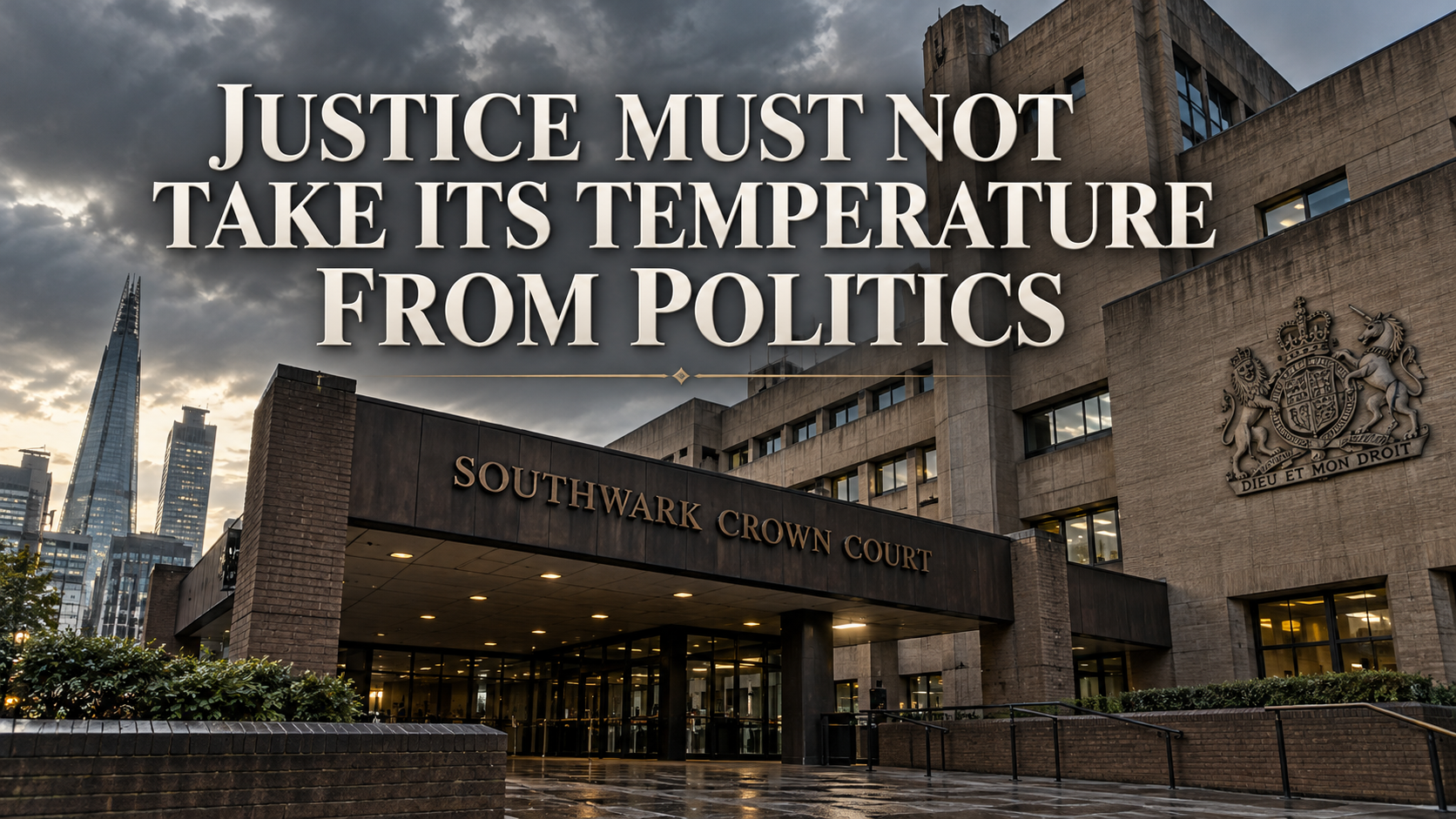
The suspended sentencing of child sexual offenders, the extraordinary judicial response to the Southport riots, the grooming-gang scandals and the contrasting treatment of political demonstrators have exposed a profound crisis of confidence in British justice. The question is no longer simply whether particular sentences are too severe or too lenient, but whether the institutions responsible for administering justice have become susceptible to political pressures, ideological orthodoxies and institutional self-preservation. Judicial independence is indispensable. It is not, however, a substitute for impartiality, accountability or the courage to confront uncomfortable truths.
There is something profoundly wrong with a criminal justice system in which the public must struggle to understand why a repeat offender convicted of possessing and distributing images of child sexual abuse can remain at liberty, while another person may be sent to prison for years following a politically charged episode of public disorder. The cases are not legally identical, nor does the severity of one crime automatically determine the appropriate punishment for another. Yet the unease persists, and it cannot be dismissed as ignorance of the law. Beneath it lies a much more serious question: what does the British State now regard as the greatest threat to the common good, and are its courts administering justice according to the gravity of wrongdoing or the political importance attached to suppressing it?
The question has acquired renewed force following correspondence submitted by the campaigning organisation Predator Awareness to the Lady Chief Justice of England and Wales, Dame Sue Carr. Its letter identifies numerous cases involving offenders convicted of sexual crimes against children, including offences concerning Category A child sexual abuse material, who received suspended custodial sentences or community orders. The organisation seeks disclosure of sentencing records, examination of statutory powers, clarification of judicial reasoning and consideration of whether wider scrutiny of sentencing practice is warranted. Importantly, it does not claim to have established that the judges concerned acted unlawfully. The cases require verification against court records, and it would be irresponsible to treat a compilation of reported outcomes as proof of judicial misconduct. Nevertheless, its central concern is legitimate. When the courts determine that offences are sufficiently serious to cross the custodial threshold, the public is entitled to understand why immediate imprisonment is sometimes considered unnecessary, particularly where an offender has previous convictions or has breached restrictions imposed to protect children.¹
Stephen Paddock provides an especially disturbing example. On 17 September 2026, Norwich Crown Court sentenced the 59-year-old registered sex offender to three years’ imprisonment, suspended for three years. Police had discovered more than 3,000 indecent images and videos of children, some depicting children as young as four. He admitted offences including distribution, making indecent images, breaches of a Sexual Offences Prevention Order and failure to comply with notification requirements. Paddock had previously been convicted of child sexual abuse image offences in 2012. Restrictions imposed following that conviction were intended to prevent further offending. He nevertheless breached those restrictions, attempted to delete his internet search history and initially suggested that somebody else had downloaded the material. The investigating officer, DC Paul Atkinson, observed that Paddock had knowingly ignored restrictions specifically designed to prevent further offences, and reminded the public that behind every image was an abused and exploited child. The officer’s words matter because they identify something frequently obscured by the terminology of digital offending: these images document the sexual exploitation of actual children.²
The difficulty is not that suspended imprisonment is automatically unlawful or that rehabilitation has no place in criminal sentencing. A suspended sentence is a custodial sentence carrying enforceable requirements, and further offending can result in its activation. The difficulty is that Paddock had already demonstrated his disregard for judicial restrictions. If previous offending and deliberate breaches do not make immediate imprisonment necessary, the sentencing court owes the public a particularly persuasive explanation of why another opportunity to remain in the community can adequately protect children. A finding that an offender might benefit from rehabilitation must be accompanied by convincing evidence that the public can safely bear the risk of providing it.
Consider, too, Peter Pottle. In September 2025, Norwich Crown Court sentenced him to two years’ imprisonment suspended for two years after sexual offences involving a girl whom he had groomed from shortly before her thirteenth birthday. He had encouraged her to provide indecent images, progressed to physical sexual abuse and later used an alias to solicit further images. The victim described lasting damage to her ability to trust others and maintain relationships. The Solicitor General considered the original sentence unduly lenient and referred it to the Court of Appeal. On 22 January 2026, the appellate court overturned the suspended sentence and imposed four years and six months’ immediate imprisonment. The difference between the two outcomes was not a minor adjustment. The first permitted Pottle to remain at liberty; the second required his incarceration for years.³
Here, at least, the appellate system corrected what it determined to be an unduly lenient sentence. But the correction invites another question. How many equally troubling sentences have not been referred, whether because their details attracted insufficient attention, the necessary referral was not made within the statutory time limit, or the offences were ineligible for review? The Attorney General’s Unduly Lenient Sentence scheme is an important safeguard, but it is not a comprehensive mechanism for examining every controversial sentence. The limited period within which qualifying cases must be referred means that an error which escapes immediate attention may remain uncorrected. Public confidence cannot depend upon the fortunate coincidence that an individual case attracts sufficient publicity to reach those empowered to challenge it.
The former BBC presenter Huw Edwards offers a different illustration. In September 2024, he received six months’ imprisonment suspended for two years after admitting three offences involving indecent images of children, including Category A material. The sentencing remarks carefully addressed his guilty plea, previous character, personal circumstances, rehabilitation and the judge’s assessment of future risk. Those considerations are not inventions of a permissive judiciary; they form part of the established sentencing framework. Nevertheless, it is entirely legitimate to ask whether the balance between mitigation and the inherent seriousness of child sexual exploitation has been correctly struck. A defendant’s previous public standing, professional achievements or personal disgrace must never obscure the suffering embodied in the material he has obtained.⁴
There is a further complication which criticism of individual judges must confront. Parliament itself has expanded the availability of suspended imprisonment. The Sentencing Act 2026 increased the maximum custodial term capable of suspension from two to three years and introduced a presumption in favour of suspending qualifying sentences of twelve months or less for convictions falling within the new provisions. Exceptions permit immediate imprisonment in circumstances including relevant breaches of court orders, further offending during existing sentences and significant risks of physical or psychological harm. The legislation therefore preserves important judicial safeguards. But it also reveals a deliberate political choice: to reduce reliance upon short custodial sentences and place greater emphasis upon punishment and rehabilitation in the community. The Government has defended that policy by reference to reoffending research and the unsustainable pressures upon prison capacity.⁵
The argument for reducing reoffending is not frivolous. Short prison sentences can disrupt employment, accommodation and family relationships without achieving lasting rehabilitation. Yet evidence concerning average outcomes across populations cannot settle the proper punishment of every offender. The circumstances of a repeat sexual offender who has defied protective orders are not interchangeable with those of a person imprisoned for a relatively minor, isolated offence. If legislation encourages suspension, Parliament must accept responsibility for the consequences. Ministers cannot advocate policies intended to reduce imprisonment and subsequently retreat behind judicial independence when particular sentencing outcomes provoke public indignation.
This is where the wider controversy over two-tier justice becomes unavoidable. For the State has demonstrated, under different circumstances, that it can mobilise the criminal justice system with remarkable determination.
The murders of Bebe King, Elsie Dot Stancombe and Alice da Silva Aguiar in Southport on 29 July 2024 were followed by appalling violence. Police officers were assaulted, mosques and asylum hotels were attacked, property was destroyed and communities were terrorised. Those responsible for violence deserved punishment. Neither anxiety about immigration nor anger towards public authorities can justify throwing missiles at police officers, setting fire to occupied buildings or threatening innocent people. A just society must protect public order because the innocent depend upon it.
The response, however, was extraordinary. The Prime Minister publicly denounced the violence as “far-right thuggery” and declared, “I guarantee you will regret taking part in this disorder.” The Government deployed additional resources, more than one hundred extra prosecutors supported accelerated charging arrangements, courts made time for urgent hearings and approximately five hundred additional prison places were made available. By 22 January 2025, the disorder had produced 1,804 arrests and 1,072 charges. The House of Commons Home Affairs Committee subsequently praised the police response and rejected allegations that the rioters had been treated more severely merely because of their political opinions. It identified the actual violence, including assaults, arson and missile-throwing, as the explanation for the scale of policing.⁶
That parliamentary finding deserves acknowledgement. It does not, however, settle every question about the administration of justice. The decision to deploy police officers, the choice of criminal charges, the prioritisation of court hearings and the determination of sentences are separate exercises. Each requires examination on its own evidence. More fundamentally, the exceptional mobilisation demonstrated what the State can accomplish when it identifies an urgent threat to public order.
Within eight days of the first Southport disorder, offenders had already been imprisoned. Some cases arising from subsequent disturbances proceeded to sentence within seventy-two hours. Contrast that urgency with the experience of victims of rape and child sexual exploitation who may wait months or years for their cases to reach trial. Evidential complexity, disclosure obligations and the fact that many disorder defendants pleaded guilty explain some of this difference. They do not explain away the broader question of priorities. When public order became a national emergency, resources, court time and prison accommodation were found. The country is entitled to ask why comparable urgency cannot be sustained for the investigation and prosecution of offences involving the most vulnerable victims.
Nuntiatoria examined this problem in September in its editorial From Southport to Portsmouth: When Deterrence Becomes Exemplary Justice. That analysis concerned Del Somerville, sentenced on 24 September 2026 to two years’ imprisonment for violent disorder arising from an anti-migration demonstration at Eastney Marina, Portsmouth. Somerville had confronted police officers, pushed through their line and thrown a plastic bottle towards them during a disturbance involving approximately two hundred demonstrators. The sentencing judge acknowledged his relatively limited involvement but stressed the need to deter further disorder. Somerville was not imprisoned merely for throwing a bottle; he admitted the more serious offence of violent disorder. Yet the case raised the legitimate question of whether the punishment attached to his particular conduct had become disproportionately influenced by the perceived need to send a message to a wider political constituency.⁷
English sentencing law expressly permits deterrence. The Court of Appeal’s decisions following the 2011 riots established that widespread disorder may justify particular severity because individual participation contributes to collective danger. Similar reasoning was reaffirmed following the disturbances of 2024. None of this is inherently illegitimate. Nevertheless, the individual offender must not disappear into the political significance of the event. A judge is required to sentence the person before the court for his culpability and the harm caused or risked by his conduct. When deterrence assumes exceptional prominence, the defendant can begin to resemble an instrument through whom the State seeks to discipline others. That danger exists irrespective of whether the demonstrators are described as right-wing, left-wing, environmentalist, nationalist or revolutionary.
Lucy Connolly’s case demonstrates how difficult these distinctions can become. Following the Southport murders, she published an inflammatory social-media message calling for hotels accommodating asylum seekers to be set alight. It was viewed approximately 310,000 times before its deletion. She pleaded guilty to publishing material intended or likely to stir up racial hatred and received thirty-one months’ imprisonment. In May 2025, the Court of Appeal refused permission to appeal against her sentence, finding that the sentencing judge had properly considered the seriousness of the language, its timing, the risk of violence and the available mitigation.⁸
Connolly was not imprisoned simply for opposing immigration, and serious analysis must not pretend otherwise. She had advocated violence against people living in those hotels. Yet recognition of the criminality of her conduct does not prohibit examination of proportionality. Her sentence can properly be compared with those imposed upon other defendants convicted of materially similar offences, provided the comparison accounts for culpability, intent, likely harm, guilty pleas and aggravating circumstances. The fact that an appellate court has upheld a sentence establishes its legal sustainability. It does not render discussion of wider sentencing policy illegitimate.
Former Labour councillor Ricky Jones became a focus of precisely this controversy. At an anti-racism demonstration in Walthamstow in August 2024, Jones called those he described as fascists people whose throats should be cut, accompanying his remarks with a throat-slitting gesture. He was prosecuted for encouraging violent disorder but denied intending to encourage violence. In August 2025, a jury acquitted him. Unlike Connolly, he did not plead guilty; unlike Connolly, he was not convicted. The difference is legally decisive. His acquittal cannot accurately be described as judicial leniency, and jurors were entitled to assess whether the prosecution had proved the statutory offence beyond reasonable doubt.⁹
Nevertheless, the public reaction illustrates something important. Citizens heard threatening language from two politically opposed figures and observed radically different outcomes. Lawyers can explain the distinction between the charges, the evidential requirements and the verdicts. Those explanations must be given, not simply demanded as articles of faith. An independent jury’s verdict must be respected, but a justice system which wishes to command confidence must communicate why conduct which appears comparable to the public may not be comparable in law.
The distinction becomes still more important when allegations of preferential treatment for pro-Palestinian demonstrators are introduced. In April 2026, Ben Jamal of the Palestine Solidarity Campaign and Chris Nineham of the Stop the War Coalition were convicted of offences arising from breaches of police conditions imposed upon a January 2025 demonstration. Jamal received an eighteen-month conditional discharge and Nineham a twelve-month conditional discharge, with substantial prosecution costs. To observers accustomed to immediate imprisonment following the Southport disorder, the contrast may appear striking. Yet breaching demonstration conditions is not the same offence as violent disorder, and a comparison which ignores that distinction is legally unsound.¹⁰
The more serious weakness in a blanket allegation of preferential treatment is that pro-Palestinian activists have themselves received substantial custodial sentences. In June 2026, four Palestine Action activists were imprisoned following an attack on an Elbit Systems facility near Bristol which caused approximately £1.2 million in damage. One defendant, Samuel Corner, was convicted of grievous bodily harm after seriously injuring a police officer with a sledgehammer. He received seven years and eight months’ imprisonment; the other defendants received sentences of five years or four years and eight months. Mr Justice Jeremy Johnson identified a terrorist connection to the offending. The sentences were severe, and the political cause professed by the defendants did not prevent their imprisonment.¹¹
The controversy surrounding Palestine Action’s proscription goes further still. In June 2026, the Court of Appeal upheld the Home Secretary’s decision to proscribe the organisation, reversing an earlier finding that the proscription was unlawful. In doing so, it recognised the serious interference with freedom of expression and peaceful assembly but concluded that the decision fell within the lawful powers of the executive. The case demonstrates that the courts may defer substantially to governmental assessments of national security, even where controversial political expression and protest rights are affected.¹²
These examples complicate the popular picture of a judiciary which invariably punishes the political right and protects the political left. That proposition cannot be sustained in such absolute terms. But the failure of a simplistic theory does not dispose of the underlying question. It may be that the most important dividing line is not always between left and right, or even between different ethnic or religious groups, but between conduct which the State perceives as an immediate challenge to its authority and conduct which, however gravely it harms individuals, does not command the same political urgency.
The Harehills disorder of July 2024 offers another necessary comparison. Serious disturbances in Leeds involved attacks upon police and the destruction of a bus. Claims that the participants were simply permitted to escape punishment are contradicted by subsequent prosecutions. On 15 October 2026, West Yorkshire Police confirmed that Claudiu Gangal had received two years’ imprisonment for violent disorder, becoming the fortieth person convicted and sentenced in the investigation. By that date, ninety-two people had been arrested and fifty-eight charged.¹³
These facts matter. Serious criticism of unequal treatment must be capable of surviving inconvenient evidence. Yet they also underline the need for proper comparative research. The number of arrests, the proportion charged, the offences selected, the conduct established, the interval between arrest and conviction, and the eventual sentences are all measurable. A genuinely independent inquiry could determine whether differences between Harehills, Southport and other disorders are explained by evidential circumstances and the severity of offending, or whether inconsistent operational and prosecutorial priorities played a part. The public should not have to choose between competing political narratives when the relevant information could be examined systematically.
The grooming-gang scandals present a deeper and, in many respects, more damning question about ideological influence upon justice. Here the issue is not primarily whether a convicted offender received an unduly lenient sentence. It is whether the prevailing assumptions within police forces, local authorities and safeguarding agencies contributed to children being abandoned before their abusers ever reached a courtroom.
Baroness Louise Casey’s national audit, published in June 2025, established that the response to organised child sexual exploitation had been compromised by serious institutional failures. She identified “blindness, ignorance, prejudice, defensiveness” among the factors contributing to the failure to protect children and prosecute offenders. Her investigation found that organisations had avoided examining the ethnic characteristics of particular offending networks for fear of appearing racist, creating community tensions or undermining cohesion.¹⁴
That finding ought to have ended the pretence that ideological considerations are incapable of influencing the administration of justice. We are not dealing here with a speculative accusation that a judge privately favoured one political party over another. We are dealing with an officially documented reluctance by public authorities to confront evidence because its implications were politically and culturally uncomfortable.
Casey’s audit also identified the consequences of inadequate national data. In the more detailed local investigations examined, men of Asian and Pakistani heritage were substantially over-represented among suspects in particular organised exploitation networks. In Operation Stovewood, the investigation concerning Rotherham, nearly two-thirds of 323 designated suspects were recorded as being of Pakistani ethnic background. The same was true of the forty-two convicted offenders within the dataset then examined. These findings are significant, although they cannot legitimately be extrapolated into a national offender profile where the necessary representative data do not exist. To suppress them would be dishonest; to present them as establishing collective guilt would be equally unjust.
There is no contradiction between rejecting racial prejudice and insisting that evidence of particular offending patterns be investigated. Indeed, genuine equality demands both. A child’s right to protection cannot depend upon whether identifying her abuser might create political embarrassment. Nor should innocent members of any ethnic or religious community bear suspicion because institutions failed to distinguish individual criminality from collective identity. The responsible course is to investigate accurately, prosecute impartially and report truthfully. Concealment serves neither victims nor communities.
As Nuntiatoria examined in March in Courts, Citizens, and the Demand for Truth: Three Fronts in Britain’s Grooming Gangs Reckoning, institutional failures have generated a movement for accountability extending beyond official inquiries. Survivors and campaigners have challenged the implementation of safeguarding recommendations, independent investigations have been organised, and public pressure has compelled the Government to confront the possibility that previous responses were inadequate. The statutory Independent Inquiry into Grooming Gangs was formally established on 13 April 2026, with powers to investigate institutional failures, while Operation Beaconport was tasked with examining potential criminal wrongdoing. The inquiry’s terms of reference explicitly recognise the need to prevent public bodies from escaping scrutiny of their own conduct.¹⁵
The Crime and Policing Act 2026 has meanwhile introduced a statutory aggravating factor concerning grooming in specified child sexual offences, effective from 29 June 2026. Courts must now treat qualifying grooming behaviour as an aggravating circumstance and state that finding openly when sentencing. This is a welcome recognition of the calculated exploitation involved, but it also invites reflection upon why such reforms have become necessary after decades of revelations, investigations and promises that lessons would be learned.¹⁶
The essential failure was moral before it became administrative. Children were treated as unreliable, troublesome, sexually experienced or somehow complicit in their exploitation. The language of safeguarding was employed by institutions which failed to safeguard. Social cohesion became a reason to avoid difficult truths rather than a consequence of protecting every member of society equally. The authorities were often more alert to the reputational implications of acknowledging abuse than to the suffering of the children themselves. When an institution becomes preoccupied with protecting its own standing, the vulnerable are very often the first to be sacrificed.
This is not a mere historical curiosity. In 2025, the Sentencing Council proposed guidance under which a pre-sentence report would normally be considered necessary for certain categories of offender, including those from minority ethnic, cultural or faith backgrounds. Such reports can be important in determining whether an offender receives immediate imprisonment, a suspended sentence or a community order. The proposal was defended in terms of ensuring that sentencers possessed sufficient information to address disadvantage and inequality. The Government nevertheless concluded that the approach risked differential treatment based upon personal characteristics. Parliament intervened, and the Sentencing Guidelines (Pre-sentence Reports) Act 2025 prohibited sentencing guidance on such reports from being framed by reference to those characteristics.¹⁷
This was no invented controversy. The Government itself warned of the possibility of a two-tier justice system. Nor was the objection that judges should be prevented from examining individual disadvantage, disability, pregnancy, trauma or other relevant circumstances. They remain entitled to obtain reports where the facts justify doing so. The constitutional problem was the proposed identification of whole categories of offender by characteristics unrelated to the seriousness of their particular crime. Equality before the law requires individual justice, not collective assumptions masquerading as compassion.
Here we encounter a distinction of the greatest importance. There is nothing improper about a judge considering facts which genuinely affect culpability, the prospects of rehabilitation or the impact of a sentence. Justice has never required the mechanical imposition of identical punishments upon people whose circumstances differ materially. But a defendant’s race, religion, political affiliation or social standing must not become a proxy for deserving greater leniency or greater severity. Equally, the political identity of a victim must not influence the seriousness with which an offence is investigated.
That is why the independence of the judiciary, though essential, is insufficient by itself. Judges do not operate in an intellectual vacuum. They are formed by their professional education, institutional conventions and prevailing legal culture. They receive training, work within appellate precedents, interpret guidelines and absorb assumptions about risk, equality, harm and the public interest. None of these influences is necessarily improper; indeed, some are indispensable to consistent adjudication. The danger arises when the assumptions cease to be examined, when ideological preferences are treated as self-evident moral truths, or when legitimate questions about unequal treatment are dismissed as evidence of prejudice rather than investigated on their merits.
Judicial independence protects the court against improper interference. It does not guarantee that every exercise of judgement will be free from error, fashion, prejudice or institutional conformity. Nor does security of tenure confer an exclusive right to define the public interest. Judges are entrusted with authority precisely because they are expected to apply the law without fear or favour. That trust necessarily carries an obligation to give reasons capable of withstanding scrutiny.
The same applies to the prosecution service. Parliament defines the offences and available penalties; police officers investigate; prosecutors decide whether the evidential and public-interest tests for prosecution are satisfied; probation services assess offenders and risks; judges determine sentence. It is therefore inaccurate to attribute every disputed outcome to the judiciary alone. But it would be equally inaccurate to conclude that, because responsibility is distributed among institutions, no institution can be held accountable for the cumulative results.
There is another form of institutional failure which requires no political conspiracy, no ideological prejudice and no improperly motivated judge: the failure to provide justice at all. At the end of June 2026, the Crown Court had 80,829 outstanding cases, the highest figure in the published series. Of these, 23,706 had been open for at least a year. Sexual offences accounted for twenty per cent of the outstanding Crown Court caseload, while the volume of open rape cases had increased by twenty-six per cent over the preceding year. Cases involving sexual offences and violence constituted more than half of those waiting at least twelve months.¹⁸
For a victim, those figures describe months of uncertainty, anxiety and repeated preparation for proceedings which may be postponed. For an innocent defendant, they represent prolonged exposure to unresolved allegations and potentially devastating personal consequences. For witnesses, they mean fading recollections and the burden of repeatedly revisiting distressing events. Delayed justice can become a second injury inflicted by the very system established to provide a remedy.
The existence of such delays ought to temper official celebrations of swift justice following episodes of public disorder. If extraordinary efforts can be undertaken to process hundreds of politically sensitive cases rapidly, there should be a sustained national determination to ensure that allegations of rape, child exploitation and serious violence receive the resources necessary for timely adjudication. Not every case can proceed at the speed of an uncontested prosecution supported by clear video evidence. But a State which repeatedly invokes the rule of law while permitting serious criminal proceedings to languish for years must confront the gap between its declarations and its performance.
There is, moreover, a profound distinction between justice administered to protect the common good and justice deployed chiefly to demonstrate the authority of government. Public order is a genuine good, and those who attack police officers or endanger innocent people must be restrained. Yet the State exists for the sake of the community, not the community for the sake of the State. Its authority is legitimate because it serves justice; justice does not become legitimate merely because the State has exercised its authority.
A court must therefore be particularly vigilant whenever its decisions are likely to be interpreted as supporting an immediate political campaign. The demands of public safety may warrant decisive action. The temptation to make examples of defendants, however, becomes dangerous when the wider political message begins to outweigh the precise culpability of the individual. The same warning applies in the opposite direction: an institution anxious to avoid allegations of discrimination may be tempted to understate offending, favour mitigation or neglect uncomfortable evidence. Neither excessive severity nor misplaced indulgence becomes just because its purpose is described as socially beneficial.
The Catholic understanding of justice offers a useful measure against which these tendencies may be examined. Saint Thomas Aquinas, considering the vice of acceptio personarum, or respect of persons, explains that a just judge must attend to the cause rather than irrelevant characteristics of the individual. The distinction is not between treating everybody identically and recognising no personal circumstances. It is between circumstances genuinely relevant to justice and those which merely confer advantage or disadvantage because of who a person is. Aquinas expressly observes that judgement is corrupted when consideration of the person disturbs the proportion required by justice.¹⁹
The principle is older still. In Leviticus the command is given: “Respect not the person of the poor, nor honour the countenance of the mighty. But judge thy neighbour according to justice” (Leviticus 19:15). The prohibition is striking because it rejects partiality in either direction. The judge may neither flatter the powerful nor favour the poor merely because they are poor. He must decide according to what is right. The same chapter demands just weights and equal measures, making impartiality an obligation rather than a matter of public presentation.²⁰
This is the moral standard against which a Christian society must judge its institutions. Compassion is a virtue, but sentimentality is not justice. Rehabilitation is desirable, but the offender’s prospects cannot be considered independently of the safety of those whom he may harm. Deterrence has a legitimate place in punishment, but it must not become an excuse to sacrifice an individual defendant to a political demonstration of strength. Equality demands respect for every human person, not a system of favours and disadvantages determined by fashionable categories of identity.
It is perfectly possible to defend the independence of judges while demanding radical improvement in the administration of justice. Indeed, one should lead to the other. The courts cannot remain independent in any meaningful sense if public confidence collapses and the population increasingly believes that outcomes are governed by political sympathies. Nor can they retain moral authority if serious concerns are met chiefly with institutional defensiveness.
What is needed is a properly constituted, independent examination of sentencing consistency, drawing upon actual court records rather than selected newspaper headlines. Cases should be compared by offence, statutory provision, culpability, harm, previous convictions, guilty pleas, mitigation, assessment of risk, breach history and sentence. Sentencing patterns involving comparable public disorder should be examined across demonstrations of differing political character. The treatment of repeat sexual offenders should be assessed with particular attention to previous court orders and subsequent offending. The relationship between the Sentencing Act 2026, prison capacity and public protection deserves parliamentary scrutiny, while the findings of the grooming-gang inquiry must lead to identifiable institutional and, where warranted, individual accountability.
The public should also be able to obtain intelligible explanations of consequential sentencing decisions without prohibitive expense or unnecessary procedural obstacles. Published sentencing remarks, accessible court records and meaningful data are not luxuries of an inquisitive press. They are necessary conditions of confidence in a system which exercises the power to deprive citizens of their liberty. If a sentencing decision is both lawful and proportionate, proper explanation should strengthen confidence in it. If the explanation exposes an error, the system must possess effective means of correction.
These are not demands for political control of the judiciary. They are demands that judicial independence fulfil its purpose. Judges must be protected from ministerial intimidation, public harassment and attempts to dictate individual outcomes. Equally, the judiciary must not become a self-regarding institution whose independence is invoked whenever citizens ask difficult questions. Accountability and independence are not opposites. Properly understood, each safeguards the other.
The same standards should be applied to the police, the Crown Prosecution Service, probation services and government departments. The grooming-gang scandals demonstrated the danger of allowing institutions to investigate their own shortcomings without effective external scrutiny. Southport demonstrated the scale of resources which can be mobilised when ministers regard a situation as sufficiently urgent. The 2025 Sentencing Council dispute demonstrated that assumptions concerning identity can enter the formation of sentencing policy. The suspended sentences highlighted by Predator Awareness demonstrate the importance of examining how judicial discretion is exercised where children are concerned. The expanding court backlog demonstrates the consequences of failing to provide sufficient capacity for justice to be administered within a reasonable period.
Taken together, these circumstances do not establish that every judge, or even the judiciary collectively, has consciously adopted a partisan political programme. Such an allegation would require evidence which has not been demonstrated. But neither do they permit the comfortable conclusion that institutional impartiality can be presumed simply because the constitutional arrangements declare it. There is sufficient evidence of political pressure, institutional failure, disputed sentencing policy and documented ideological reluctance within the wider justice system to make independent scrutiny necessary.
Britain should resist the temptation to divide this controversy into those who defend the courts unquestioningly and those who condemn them indiscriminately. A free society requires something better. It must be possible to respect the office of judge, insist upon obedience to lawful judgements, defend the right to a fair trial and still ask whether the administration of justice is serving its proper ends. Indeed, those who care most seriously about the rule of law should be among the first to demand its faithful application.
A child whose abuse was ignored because officials feared accusations of racism was not protected by equality. A repeat offender who disregards restrictions designed to safeguard children does not become harmless because further rehabilitation is considered desirable. A defendant whose sentence is inflated chiefly to intimidate a wider political movement has not received proportionate justice. A peaceful protester subjected to disproportionate state power is no less deserving of protection because his political views are unpopular. The principle is the same in each case: justice must answer to truth, culpability and the common good, not to the convenience of institutions or the demands of the political moment.
The question facing Dame Sue Carr and the wider institutions of justice is therefore not merely whether any particular judge exceeded statutory powers in one of the cases identified by Predator Awareness. It is whether the administration of justice has developed habits of mind, priorities and practices which produce outcomes that are difficult to reconcile with the public’s reasonable expectation of impartiality. It is whether the judiciary possesses not simply the legal authority to decide, but the institutional humility to examine why so many citizens have begun to distrust its decisions.
A society can endure occasional judicial error. It can correct mistakes, refine legislation and improve procedures. What it cannot safely endure is a growing conviction that justice is predictable only when the political complexion of the offender, the victim or the circumstances is known. Once that belief takes root, legal authority may remain intact upon paper while moral authority withers in public life.
The answer cannot be to subordinate judges to popular anger or political direction. That would destroy the very independence which must be preserved. The answer must be to demonstrate, through evidence and consistent practice, that no political cause is entitled to indulgence, no unpopular opinion warrants exemplary punishment beyond the demands of law, no institutional reputation takes precedence over the safety of children, and no offender is placed above or beneath another by considerations irrelevant to justice.
The blindfold upon Justice is not a declaration that she must be blind to suffering. It is a promise that she will not look first to the wealth, status, race, religion, politics or influence of the person standing before her. Her scales must measure what has been done, what harm has followed, and what is owed in consequence.
If Britain’s courts cannot demonstrate that those scales are held steadily, regardless of the political weather, the question of whether the judiciary remains fit for its purpose will no longer be a provocative accusation. It will be a question the country is entitled to insist upon having answered.
- Predator Awareness, Formal Public-Interest Enquiry Concerning Sentencing of Sexual Offenders, Facebook correspondence.
- Norfolk Constabulary, Man Sentenced for Possessing Indecent Images of Children, 18 September 2026.
- Attorney General’s Office, Sexual Predator Jailed after Solicitor General Intervenes, 23 January 2026.
- Courts and Tribunals Judiciary, Rex v Huw Edwards: Sentencing Remarks, 16 September 2024.
- Parliament of the United Kingdom, Sentencing Act 2026; Sentencing Council, Imposition of Community and Custodial Sentences.
- House of Commons Home Affairs Committee, Police Response to the 2024 Summer Disorder, 14 April 2025.
- Nuntiatoria, From Southport to Portsmouth: When Deterrence Becomes Exemplary Justice, 25 September 2026.
- Court of Appeal, Connolly v R [2025] EWCA Crim 657, 20 May 2025.
- Sky News, Ricky Jones Found Not Guilty of Encouraging Violent Disorder, 15 August 2025.
- Metropolitan Police, Organisers Found Guilty over January 2025 Protest Breaches, 1 April 2026.
- ITV News, Four Palestine Action Activists Jailed over £1.2m Factory Raid, 12 June 2026.
- Court of Appeal, Secretary of State for the Home Department v Ammori [2026] EWCA Civ 721, 15 June 2026.
- West Yorkshire Police, Man Sentenced for Violent Disorder in Harehills, Leeds, 15 October 2026.
- Baroness Louise Casey, National Audit on Group-Based Child Sexual Exploitation and Abuse, Home Office, 16 June 2025.
- Nuntiatoria, Courts, Citizens, and the Demand for Truth: Three Fronts in Britain’s Grooming Gangs Reckoning, 5 March 2026; Home Office, Independent Inquiry into Grooming Gangs: Terms of Reference, 31 March 2026.
- Parliament of the United Kingdom, Crime and Policing Act 2026, Section 83.
- Ministry of Justice, New Law to Ensure Fairness for All in Court, 19 June 2025; Parliament of the United Kingdom, Sentencing Guidelines (Pre-sentence Reports) Act 2025.
- Ministry of Justice, Criminal Court Statistics Quarterly: April to June 2026, 24 September 2026.
- Saint Thomas Aquinas, Summa Theologiae, II-II, Question 63, Articles 1 and 4.
- Douay-Rheims Bible, Leviticus 19:15, 35–36.





Leave a Reply