
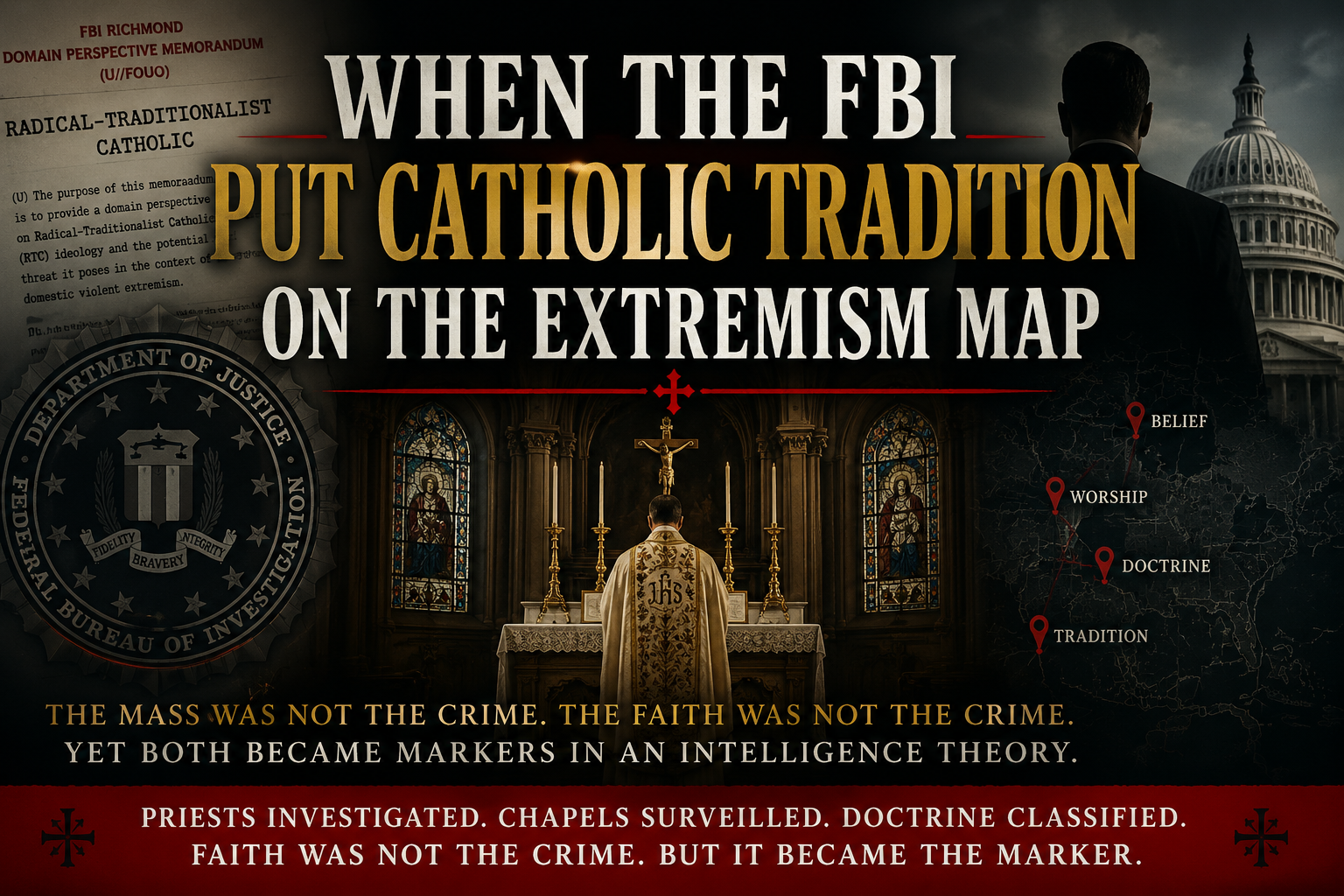
The Mass was not the crime. The Faith was not the crime. Yet both became markers in an intelligence theory.
The newly released United States Department of Justice report on the FBI’s notorious “radical-traditionalist Catholic” memorandum confirms that the scandal was more serious than an ill-judged phrase in a badly written intelligence paper. The documentary record now shows how a legitimate investigation into one genuinely violent and dangerous individual expanded beyond that man and his crimes until priests were being investigated and surveilled, traditional Catholic chapels were being treated as potential intelligence environments, Catholic doctrine and moral teaching were being used to define an extremism category, and the Richmond Field Office was considering whether the theory should be elevated into a nationally significant intelligence product. The disturbing fact is not merely that an FBI memo mentioned traditional Catholics. It is that, for a time, traditional Catholic belief and worship themselves became part of the analytical framework through which violent extremism was being understood.¹
The Department of Justice’s Richmond Domain Perspective Report, published on 28 August 2026 by the Weaponization Working Group pursuant to Executive Order 14147, reconstructs the affair from internal FBI memoranda, emails, assessments, presentations and reviews. Its conclusion is severe. The report states that history will judge the Richmond memorandum as a “grave failure” of the FBI Richmond Field Office to protect the First Amendment rights of Americans and records that the FBI personnel involved in creating the memorandum have now been terminated from their positions.² Yet the significance of the report lies less in that retrospective condemnation than in the evidence showing how the failure developed.
The original investigation was justified. The individual anonymised as “Target 1” was not a Catholic victim of political policing. He had expressed grotesque racial views, committed violence, attempted to acquire or manufacture weapons and ammunition, constructed Molotov cocktails, encouraged violence against minorities and police and advocated a mass shooting at a school for children with special needs. He was eventually sentenced to more than eight years in federal custody for possessing destructive devices.³ Any serious account must begin there, because the lesson of Richmond depends upon distinguishing legitimate law enforcement from what followed.
What followed began when investigators discovered that Target 1 had attended Our Lady of Fatima Chapel, associated with the Society of St Pius X. The priest told the FBI that Target 1 was not a member of the church, was not Catholic, had never been to confession and had attended only three or four catechism classes. More importantly, the priest recognised that the man’s racial and political views were objectionable and said that his positions needed to be modified before he could join the Church.⁴ That evidence should have suggested that Catholic formation was acting as a corrective to the man’s extremism. Instead, suspicion migrated from the individual to the religious milieu with which he had briefly associated.
The FBI opened Guardian assessments concerning two priests. One sought to determine whether the priest serving the chapel had been “recruiting and/or radicalizing” Target 1. Another examined whether a second priest was involved in the recruitment and radicalisation of violent religious extremists. His sermons, speeches and public appearances were scrutinised; his travel was examined; and the FBI obtained information concerning his movements. On 31 January 2023, the Boston Field Office conducted surveillance of him at Logan International Airport. He and a travelling companion were subjected to secondary inspection by Customs and Border Protection; the FBI watched them leave the airport, followed them to a residence and later conducted surveillance at another residence associated with the priest. Within weeks, the assessments were closed. In relation to the first priest, the FBI recorded that no identified threat to national security and no allegation of a federal violation had been found.⁵
This is already serious. But the Richmond analysts were simultaneously constructing a broader theory concerning what they called “radical-traditionalist Catholic” ideology. The evidential basis was remarkably thin. In September 2022 an analyst proposed a Domain Perspective concerning an allegedly increasing intersection between “rad-trad” Catholics and domestic violent extremists while acknowledging the need to find sufficient additional evidence beyond Target 1. A subsequent search of FBI databases identified only two further cases considered relevant. Yet before any substantial body of corroborating evidence existed, analysts were discussing whether the project should become a Strategic Perspective: Executive Analytic Report, or SPEAR, a product intended for senior FBI leadership with national implications. One analyst described the subject as something that “seems like something with national application.” At that point the FBI had identified only three individuals in its databases with purported connections to the SSPX and “radical-traditional Catholicism,” including Target 1 and a deceased subject.⁶
That chronology matters because it exposes the analytical inversion at the heart of the affair. The investigators did not first discover a broad phenomenon and then develop language to describe it. They developed a hypothesis and then searched for additional cases capable of supporting it. One analyst explicitly sought material that could become an “evidence bullet” in the proposed intelligence product. Intelligence work necessarily involves testing hypotheses, but where constitutionally protected religious belief is involved, the evidential threshold must be especially exacting. Otherwise belief, worship and association can become substitutes for conduct.
The process of defining “radical-traditionalist Catholicism” then drew the FBI directly into Catholic theology and moral teaching. An internal presentation entitled “Traditionalist Catholicism Overview” identified support for the Traditional Latin Mass, conservative family roles, rejection of modernity, opposition to religious neutrality, criticism of religious liberty, belief in the subordination of the State to Catholic principles, “hardline positions” concerning abortion and LGBTQ matters and disputes over Vatican II and the post-conciliar Church. Most remarkably, the presentation described traditional Catholic notions of a confessional state and the subordination of political authority to Catholic principles as “comparable to Islamist ideology.”⁷
Here the category ceased to be merely political and became doctrinal. Opposition to abortion is not an eccentric characteristic of a fringe Catholic subculture; it is Catholic moral teaching. The doctrine that political authority is subject to the moral law did not originate with Archbishop ✠Marcel Lefebvre. The social kingship of Christ was taught solemnly by Pope Pius XI in Quas Primas. The condemnation of religious indifferentism runs through the pre-conciliar papal Magisterium. The Traditional Latin Mass was the received Roman liturgy for centuries. Whatever theological distinctions must be made concerning Vatican II, the SSPX, the post-conciliar Magisterium or contemporary political application, the central fact remains: historically recognisable Catholic doctrines and practices had become descriptors within an intelligence taxonomy of radicalisation.
The Richmond memorandum attempted to distinguish ordinary traditional Catholics from supposedly “radical-traditionalist Catholics,” but the DOJ found the distinction inadequately grounded. The memo described the latter partly by rejection of Vatican II and criticism of post-conciliar popes and partly by attaching anti-Semitic, anti-immigrant, anti-LGBTQ and white-supremacist beliefs to the category. Yet it failed to provide a coherent evidential method showing where traditional Catholicism ended and the supposedly dangerous variant began. The effect was to make the degree of theological and liturgical traditionalism itself appear relevant to the degree of suspicion.⁸
The consequences were not merely theoretical. The memorandum identified traditional Catholic chapels and a seminary and proposed approaches to religious leadership so that congregations could become “tripwires” for radicalisation. It proposed engaging the Diocese of Richmond Pastoral Center to enlist diocesan leadership in sensitising parishes. More seriously still, the document contemplated leveraging existing sources or developing new ones with sufficient “placement and access” to report on violent extremists frequenting traditional Catholic websites and social-media forums, attending traditional Catholic places of worship or expressing interest in doing so.⁹
That is the point at which the religious-liberty issue becomes unmistakable. A traditional Catholic chapel was no longer simply a place a criminal suspect happened to attend. It became a possible intelligence environment. A congregation became a possible tripwire. Clergy became potential interlocutors for counterterrorism investigators. Sources might be developed with access to persons attending traditional Catholic worship. This does not prove that the FBI adopted a nationwide programme of infiltrating Latin Mass congregations, and it would be irresponsible to claim that it did. The proposed SPEAR was never published, and FBI headquarters repudiated the Richmond analysis once the memorandum became public. But the absence of a nationwide programme does not diminish the seriousness of what the documentary record shows actually occurred.
The most sobering aspect is that normal internal safeguards failed before the leak forced the issue into public view. The draft underwent legal and peer review. An analyst who had formerly been a seminarian was consulted for “all things Catholic.” Yet the DOJ records that no reviewer raised the constitutional problem. The Richmond Chief Division Counsel found “no issues if this is internal,” though he raised questions about identifying individuals if the document were externally circulated. A supervisor even suggested proposed Virginia legislation restricting abortion after fifteen weeks as a possible “catalyzing event” around which “radical traditionalist” Catholics and violent extremists might find common cause. Abortion, immigration, affirmative action and LGBTQ protections were all identified as fields in which such convergence might supposedly occur.¹⁰
This is why Richmond cannot be dismissed as a simple failure to follow rules. The FBI already had rules. Its own presentation included the proper disclaimer that the Bureau does not investigate or collect information on Americans solely because they exercise rights protected by the First Amendment. Lawyers and supervisors reviewed the product. The problem was deeper: an analytical framework had developed in which religiously protected beliefs could be formally acknowledged as protected while simultaneously being used as descriptors in an extremism model. A constitutional disclaimer at the bottom of a presentation cannot repair the assumptions shaping the presentation above it.
After the memorandum leaked on 8 February 2023, FBI headquarters rejected the Richmond analysis. The Counterterrorism Division stated that it did not use “radical traditionalist Catholic” as a domestic-terrorism category and did not use religious affiliation to identify violent extremists. It also stated that it did not assess any significant linkage between racially or ethnically motivated violent extremists and the religious ideology described by Richmond sufficient to justify further FBI interest, analysis or intelligence collection. The Directorate of Intelligence’s subsequent review found that the Richmond memorandum implied an alignment between violent-extremist ideology and “RTC” ideology without sufficient evidence and had failed even to establish the baseline necessary to substantiate its claim that extremist interest was increasing.¹¹
The FBI’s own Inspection Division later concluded that the memorandum had erroneously equated the religious ideology of domestic-terrorism subjects who self-identified as “Radical Traditional Catholic” with violent-extremist ideology without sufficient support; had failed adequately to consider the bias and credibility of open-source information; had conflated Target 1’s interest in religion with his violent-extremist activities; and had thereby created “the appearance that the FBI conducts investigative activity based on religious affiliation.” The review also found that the terms “RTC” and “far-right” were inconsistent with FBI standards. It found no evidence of malicious intent, but concluded that those involved lacked professional judgement and had failed to adhere to FBI standards. Initially the response consisted largely of admonishments, performance consequences and additional training.¹² The 2026 DOJ report now records that the FBI personnel involved in creating the memorandum have been terminated.¹³
Richmond also reveals the danger of importing ideological categories from activist organisations into law enforcement. The analysts drew upon material from groups including the Southern Poverty Law Center and Anti-Defamation League. There is nothing inherently improper in consulting open-source material from advocacy bodies, but an advocacy organisation’s classification of a religious group as “extreme,” “far-right” or hateful cannot simply become criminal-intelligence evidence by repetition. FBI headquarters itself later criticised the Richmond product for failing properly to evaluate the quality, credibility and potential bias of such sources. Once ideological labels are treated as analytical facts, the State risks replacing evidence of conduct with reputational classification.
That danger is particularly acute for traditional Catholics because the cultural vocabulary necessary to produce the Richmond category already existed. For years Catholics attached to traditional doctrine and worship have routinely been described as “rigid,” “reactionary,” “integrist,” “radical,” “far-right” or “extreme.” Traditional Catholic sexual morality is increasingly described in secular discourse as hatred. Opposition to abortion is treated as ideological militancy. The social kingship of Christ becomes “theocracy.” Attachment to the traditional liturgy becomes a sociological marker requiring explanation. Criticism of post-conciliar developments becomes evidence of alienation or psychological resistance. Richmond demonstrates what can happen when such cultural labels migrate from commentary and activism into the conceptual machinery of the security state.
There is an ecclesiastical lesson here as well. Traditional Catholics have too often been described within the Church herself in psychological rather than theological terms: “rigid,” “backward,” ideologically motivated, fearful of change, attached to forms rather than substance. None of this makes ecclesiastical authorities responsible for what occurred in Richmond, and it would be tendentious to suggest otherwise. But it does illustrate the danger of replacing doctrinal argument with categories of pathology. Once intense attachment to inherited Catholic doctrine and worship is habitually described as suspicious, it becomes easier for secular institutions to construct their own secularised versions of the same suspicion.
Traditional Catholics must also refuse the equal and opposite error of romanticising genuine extremists merely because secular authorities sometimes misuse the word. Racism, anti-Semitism, revolutionary violence and the idolatry of race or nation are incompatible with the Catholic Faith. Catholic Tradition is not white nationalism with incense. It is not political violence accompanied by Gregorian chant. It is not a right-wing ideology baptised by traditional aesthetics. The Church possesses her own social doctrine, moral theology and supernatural end, and those who attempt to subordinate the Faith to racial or political ideology corrupt precisely the Tradition they claim to defend.
Indeed, Target 1’s encounter with Catholicism illustrates the point vividly. He arrived with racial and political obsessions. The priest did not embrace them. He considered them sufficiently objectionable that they had to change before the man could become Catholic. The religious community was not adapting Catholic doctrine to the extremist; it was demanding that the extremist adapt himself to Catholic doctrine. Yet the investigative hypothesis eventually asked whether the priest had radicalised the man. The inversion is complete.
There is also a warning here for bishops and clergy who assume that cooperation with every new apparatus of “counter-extremism,” “hate prevention” or “radicalisation monitoring” is necessarily benign because it arrives clothed in the vocabulary of safeguarding or social cohesion. Catholics must cooperate with legitimate law enforcement against genuine threats of violence. That obligation is obvious. But reporting credible evidence of crime is categorically different from allowing parishes to become auxiliary observation posts within an ideological classification system. The Church must never permit the State to redefine orthodoxy as a risk factor and then recruit ecclesiastical institutions to police the orthodox.
That warning extends well beyond the United States. The terminology differs across jurisdictions, but the conceptual temptation is increasingly familiar: “extreme,” “radical,” “harmful,” “hateful,” “far-right,” “misinformation,” “radicalisation.” Such words can describe genuine threats. They can also become elastic political categories. The essential safeguard is therefore not simply another administrative promise to respect religious freedom. It is the maintenance of a rigorous distinction between belief and conduct. The State may investigate violence, conspiracy, criminal incitement and preparation for terrorism. It must not begin with disfavoured beliefs and search among their adherents for evidence capable of vindicating suspicion.
That is why Richmond matters. The modern administrative state does not always persecute by prohibition. Sometimes it classifies. It need not outlaw Quas Primas if belief in the social kingship of Christ becomes an indicator of “anti-pluralist” radicalism. It need not suppress Catholic teaching on abortion if pro-life conviction becomes a marker around which violent extremists supposedly find common cause. It need not prohibit the traditional Roman liturgy if attendance at it becomes one variable in an intelligence profile. Bureaucratic suspicion can precede legal repression by a very long distance. But the first step is often the same: a belief becomes a category.
The Catholic response cannot therefore be to become less Catholic in order to appear harmless. “For God hath not given us the spirit of fear: but of power, and of love, and of sobriety.”¹⁴ The answer is neither militancy nor accommodation, but clarity. Catholics must reject racial hatred, political violence and revolutionary ideology precisely because they are incompatible with the Faith, while refusing equally to accept the premise that inherited Catholic doctrine becomes suspect merely because contemporary culture finds it difficult or offensive. The Church does not exist to reassure secular institutions that authentic Catholicism has become safely indistinguishable from liberal modernity.
Nor does criticism of Richmond imply hostility to legitimate civil authority. The FBI has a grave responsibility to investigate genuine threats to innocent life. The scandal lies not in exercising that responsibility but in losing the distinctions necessary to exercise it justly. A law-enforcement agency which cannot distinguish between the man constructing Molotov cocktails and the priest telling him that his worldview must change has, at that point, ceased to understand the object of its own investigation.
The DOJ report should nevertheless be read accurately. It was produced by the Trump Administration’s Weaponization Working Group, and its interpretative judgements belong to that administration. The underlying documentary record must be distinguished from the political framework in which it is now presented. Nor does the evidence show that the FBI as an institution adopted a nationwide programme targeting traditional Catholics. Headquarters repudiated the Richmond product after its disclosure, and the proposed national SPEAR was never published. Those qualifications strengthen rather than weaken the argument because they prevent the evidence from being asked to prove more than it does.
And what the evidence does prove is serious enough. A legitimate criminal investigation expanded into investigations of priests. Clergy were surveilled. Traditional Catholic communities were considered potential intelligence environments. Catholic doctrine, Catholic moral teaching and attachment to the traditional liturgy entered an analytical taxonomy of extremism. Sources with access to traditional Catholic milieus were contemplated. Lawyers and supervisors initially failed to recognise the constitutional danger. Analysts considered taking the theory national despite possessing only three purported examples. FBI headquarters later concluded that the underlying linkage had not been demonstrated.
Three years ago Catholics were told that the Richmond memorandum was an aberration and that fears surrounding it were exaggerated. The new DOJ report makes one thing impossible: pretending that nothing substantial happened.
The Mass was not the crime. The Faith was not the crime. The priests were not shown to be criminals. But once investigators began constructing a theory capable of connecting one violent man to a wider phenomenon, the Mass became a marker, Catholic doctrine became a category, and priests became subjects of investigation.
That is the scandal of Richmond.
And that is why it must not be forgotten.
¹ U.S. Department of Justice, Weaponization Working Group, The Richmond Domain Perspective Report (28 August 2026), Introduction. The DOJ records that the 2023 Richmond intelligence product grew from a single investigation and linked certain traditional Catholic ideologies with violent extremism; subsequent FBI reviews found the asserted linkage inadequately supported and recognised the appearance of investigation based upon religious affiliation.
² Ibid., Conclusion. The report describes the Richmond memorandum as a “grave failure” concerning First Amendment protections and states that the personnel involved in creating it have been terminated.
³ Ibid., section II, “The Beginning: One Criminal Investigation Unrelated to a Catholic Church.”
⁴ Ibid., section III, “Target 1’s Connection to a Nonmainstream Catholic Church and the FBI’s Initial Contact With His Priest.”
⁵ Ibid., sections III–IV. The report records the Guardian assessments, surveillance and subsequent closure, including the finding that no identified national-security threat or federal violation had been established in relation to Priest 1.
⁶ Ibid., section V.A. The DOJ records that analysts had identified only three individuals with purported connections to SSPX and “radical-traditional Catholicism” while considering a SPEAR with national implications.
⁷ Ibid., section V.B.1, discussing the Richmond Field Office presentation Traditionalist Catholicism Overview.
⁸ Ibid., section V.B.3.
⁹ FBI Richmond, Richmond Catholic Memo, reproduced among the DOJ report exhibits. The memorandum proposed leveraging existing sources and potentially developing new sources capable of reporting upon violent extremists attending traditional Catholic places of worship or participating in traditional Catholic online environments.
¹⁰ DOJ, Richmond Domain Perspective Report, section V.B.2.
¹¹ Ibid., section VI.A.
¹² Ibid., Inspection Division review.
¹³ Ibid., Conclusion.
¹⁴ 2 Timothy 1:7, Douay-Rheims.





Leave a Reply