
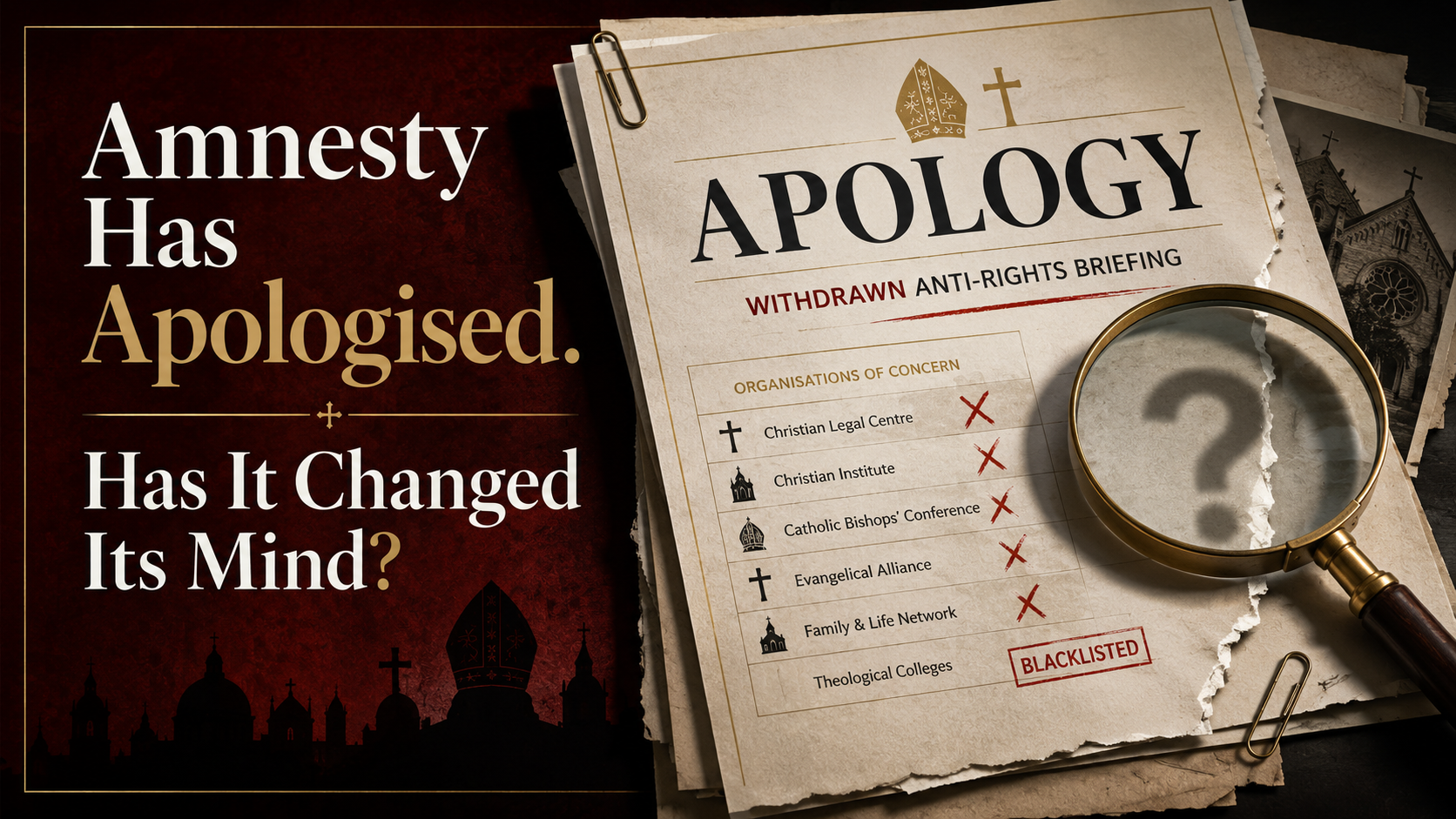
Amnesty Has Apologised. Has It Changed Its Mind?
Amnesty International UK now says its notorious “anti-rights” briefing should never have been published and promises an independent external review. Yet Amnesty’s own website continues to describe an organised “anti-rights movement”, specifically identifies “ultra-conservative Christian groups” within it, and characterises that movement as a deliberate and coordinated attack on human rights. An apology for the publication is welcome. Whether Amnesty has repented of the judgement which produced it is another matter.

On 31 July Amnesty International UK finally apologised for A Growing Threat: the Anti-Rights Movement in the UK. Published on 8 July, the briefing had placed 117 organisations within what it presented as an organised threat to human rights. It disappeared from Amnesty’s website within forty-eight hours.
The new statement is considerably stronger than Amnesty’s first explanation. “This document should never have been published,” it says. Amnesty accepts “full responsibility”, concedes that the briefing fell “significantly short” of its standards of research, evidence and editorial oversight, and promises an independent external review. It specifically apologises to Beira’s Place and other gender-critical organisations for having collectively labelled them “anti-rights”.¹
All of that is welcome.
But Amnesty’s wording contains a distinction which deserves rather more attention than the apology itself is likely to receive. It says the document should never have been published. It does not say that the intellectual premise behind the document was wrong.
That difference goes to the heart of whether this is an act of institutional contrition or an exercise in reputational repair.
Amnesty says that labelling the organisations in the withdrawn briefing “anti-rights” does not represent its institutional position. Yet, as of 31 July, Amnesty International UK’s own website continues to publish material describing precisely such an “anti-rights movement”.
A page headed The anti-rights movement, published on 30 June 2025 and still available, announces that Amnesty has mapped 65 “anti-rights groups” operating in Britain. The categories identified include “ultra-conservative Christian groups”, alongside anti-abortion organisations and bodies accused of promoting conversion therapy. Amnesty describes the movement as “real, organised and growing” and characterises its activities as a “deliberate and coordinated attack on human rights”.²
A second Amnesty page, under the organisation’s own “Our Impact” section, remains blunter still. Headed Uncovering a growing anti-human rights movement, it says Amnesty’s research has exposed organisations working to undermine human-rights protections and again specifically includes “ultra-conservative Christian groups” among those it has mapped.³
These are not hostile summaries written by Amnesty’s critics. They are Amnesty International UK describing its own work.
The problem with the apology is therefore immediate.
If categorising organisations as “anti-rights” does not represent Amnesty International UK’s institutional position, what exactly are the 65 organisations which Amnesty’s own surviving material continues to call “anti-rights groups”?
If describing organisations as belonging to an “anti-rights movement” was an unacceptable collective label in July 2026, why does Amnesty continue to advertise its 2025 research under that very heading?
And if A Growing Threat fell so seriously below Amnesty’s standards that it “should never have been published”, how much of the earlier work from which it developed has now been reconsidered?
The apology does not say.
This matters because the withdrawn briefing did not emerge in an intellectual vacuum. It expanded an existing Amnesty project. The organisation had already decided that there existed a coherent anti-rights movement in Britain, had already mapped organisations within it, had already identified conservative Christian organisations as a significant component, and had already attributed to that movement a coordinated purpose of undermining established rights.
The July briefing took that logic further. It named 117 organisations, among them the Catholic Bishops’ Conference of England and Wales, the Evangelical Alliance, Christian Concern, the Christian Institute, CARE, Christian Medical Fellowship, the Catholic Medical Association, the Anscombe Bioethics Centre, Lawyers’ Christian Fellowship, Premier Christian Radio and Christians in Parliament.⁴
It did more than criticise them. The report recommended that the Charity Commission examine the awarding of charitable status to organisations whose activities were considered to undermine human-rights protections. It urged institutional donors to exercise due diligence so as to avoid funding such bodies.⁵
That was why Nuntiatoria described the document as a blacklist. Amnesty possessed no legal power to proscribe the organisations concerned, but it publicly classified lawful organisations as part of a threat to human rights and then encouraged regulators and funders to consider consequences arising from that classification.
Our editorial of 14 July also drew attention to an anomaly which Amnesty’s apology still does not address.
Among the 117 organisations were numerous Christian bodies. Not one Muslim or Islamic organisation appeared. The report contained no mosque, Islamic professional organisation, Muslim umbrella body or Islamic educational organisation. The words “Muslim”, “Islam” and “mosque” did not appear at all.⁶
Nuntiatoria did not suggest then, and does not suggest now, that Amnesty ought to correct this imbalance by compiling a Muslim blacklist. Such a response would merely reproduce the original injustice.
The significance lies in Amnesty’s method.
Its analysis treated opposition to abortion, traditional teaching on marriage and sexuality, and resistance to contemporary gender ideology as evidence capable of placing Christian organisations within an “anti-rights” ecosystem. Yet comparable religious convictions elsewhere were apparently insufficient even to attract examination.
The question for Amnesty was therefore straightforward: were the criteria neutral?
The apology gives no answer.
Nor is that a peripheral issue. If Amnesty genuinely wishes to discover why the July briefing went so badly wrong, it must examine why its researchers found Christian organisations readily classifiable within a threatening ideological network while comparable Islamic positions disappeared from view altogether.
Perhaps there is an evidential explanation. Amnesty should produce it.
If there is not, then what failed was more substantial than editorial oversight.
The chronology also deserves notice, though it cannot by itself establish motive.
The briefing appeared on 8 July. Amnesty removed it within forty-eight hours, saying later that management acted as soon as it became aware of its existence. On 14 July a parliamentary Early Day Motion condemned its “unevidenced characterisations” and called for a formal apology. Lawyers for Beira’s Place threatened proceedings unless the document was permanently withdrawn, an apology issued and an external investigation commissioned. Amnesty subsequently referred the matter to the Charity Commission. Christian organisations have since taken complaints to the Charity Commission and Equality and Human Rights Commission.⁷
Then, on 31 July, came the fuller apology and the promise of an independent external review.
There is nothing improper about changing course under criticism. Sometimes criticism is precisely how an institution discovers that it has behaved badly. Nor would it be fair simply to declare Amnesty’s apology insincere because lawyers, parliamentarians, regulators and former supporters were applying pressure.
But those circumstances make the substance of what comes next especially important.
Sincerity will not be demonstrated by stronger adjectives of regret. It will be demonstrated by the scope of the investigation.
Amnesty says the document was removed “as soon as management were notified of its existence”.¹ That phrase is itself extraordinary. A Growing Threat was not a stray social-media post. It was a substantial research briefing, with methodology, findings, financial analysis, recommendations and an extensive appendix. It presented itself as part of Amnesty’s established work on the alleged anti-rights movement.
If senior management truly did not know of its existence, who commissioned it? Who supervised the research? Who selected the organisations? Who approved the methodology? How long had the work been under way? At what level within Amnesty was the existing 2025 research authorised? And how did a polished institutional document reach Amnesty’s public website before somebody in management discovered that it existed?
An external review capable of answering only “who pressed publish?” will answer the least interesting question.
The real investigation must move backwards.
It must examine the programme from which the briefing grew. It should establish the evidential criteria Amnesty uses when it calls an organisation “anti-rights”; whether individual organisations were assessed according to their own conduct or by association with broader political and religious categories; whether those organisations were given any opportunity to answer allegations before publication; and why the criteria produced such an extraordinary religious disparity.
It should also ask whether the category “anti-rights” is intellectually defensible when applied to parties engaged in disputes about the content and hierarchy of rights themselves.
The Catholic position on abortion illustrates the problem. Amnesty regards access to abortion as a right. Catholic teaching begins with the right to life of the unborn child. Amnesty may reject that position, campaign against it and argue vigorously for its own. What it cannot reasonably do is define its contested conclusion as “human rights” and then classify disagreement with that conclusion as hostility to human rights. That is argument by nomenclature.
The same difficulty appeared when women’s organisations were placed within the July briefing. A woman seeking a female-only service after sexual violence may invoke privacy, dignity and safety grounded in sex. Another claimant may assert rights grounded in gender identity. The existence of competing claims requires serious argument about how rights are reconciled. Calling one party “anti-rights” simply awards victory to the other before the argument has occurred.
And Christianity itself is entitled to the religious liberty which Amnesty has historically claimed to defend.
Christian organisations may hold doctrines Amnesty dislikes. They may campaign against abortion, defend marriage as the union of a man and woman, reject gender ideology or seek conscience protections for doctors, teachers and other professionals. None of those positions becomes opposition to human rights simply because Amnesty has adopted the contrary side of a contemporary political dispute.
The danger for Amnesty is greater than one embarrassing report.
Its authority was built by documenting things which governments and powerful institutions preferred not to have documented: prisoners of conscience, torture, arbitrary detention, executions, persecution and disappearances. Its accusations carried moral weight because the organisation was expected to distinguish evidence from propaganda and genuine violations of rights from political disagreement.
That reputation cannot indefinitely survive a practice in which adherence to unfashionable opinions becomes evidence of participation in a threatening ideological network.
Which brings us back to the apology.
Amnesty International UK deserves credit for saying that A Growing Threat should never have been published. It deserves credit for apologising explicitly, for removing the associated Like a Snowball briefing and for promising external scrutiny.
But the sincerity of that apology cannot yet be assumed, because Amnesty has not identified what it now believes was actually wrong.
Was the mistake simply the inclusion of certain organisations?
Was the evidence inadequate?
Was the language excessive?
Was the list insufficiently reviewed?
Or was there something fundamentally wrong in the project of treating lawful Christian, feminist, medical and political disagreement as evidence of an organised movement against human rights?
Those are very different admissions.
At present Amnesty is apologising for a document which called organisations “anti-rights” while its own website continues to describe an “anti-rights movement”, continues to identify “ultra-conservative Christian groups” within it, and continues to say that those organisations form part of a coordinated attack upon human rights.
That contradiction cannot be cured by saying the July briefing failed editorial review.
The promised independent review is therefore the real test. Its remit should be published. Its independence should be genuine. The organisations named should be permitted to provide evidence. Its inquiry should extend to the 2025 research which preceded the withdrawn briefing. Its findings should be made public. And it should address directly the question Amnesty has so far avoided: why Christian organisations were selected under criteria which, applied consistently, could scarcely have produced a religiously one-sided list.
If the review does those things, Amnesty may yet demonstrate that the apology marks a serious institutional reconsideration.
If it confines itself to discovering how an embarrassing document escaped the approvals process, the conclusion will be difficult to avoid. Amnesty will have investigated the publication of the blacklist without investigating the judgement that created it.
An organisation which has spent decades demanding accountability from others should understand the distinction.
- UK Parliament, Early Day Motion, “Amnesty International UK report on the anti-rights movement in the UK”, tabled 14 July 2026; The Guardian, “Amnesty UK self-reports to watchdog after calling JK Rowling women’s centre ‘anti-rights’”, 16 July 2026; The Times, reporting on complaints by Christian organisations to the Charity Commission and Equality and Human Rights Commission, 31 July 2026.
- Amnesty International UK, “An Apology for A Growing Threat briefing, published on 8 July 2026”, 31 July 2026.
- Amnesty International UK, “The anti-rights movement”, 30 June 2025.
- Amnesty International UK, “Uncovering a growing anti-human rights movement”, Our Impact, accessed 31 July 2026.
- Amnesty International UK, A Growing Threat: the Anti-Rights Movement in the UK, 8 July 2026, appendix; see also Nuntiatoria, “Amnesty’s Selective Blacklist: Christians Named, Islam Ignored”, 14 July 2026.
- Amnesty International UK, A Growing Threat: the Anti-Rights Movement in the UK, recommendations section; see also Catholic Herald, “Amnesty calls bishops a ‘growing threat’ in withdrawn report”, 14 July 2026.
- Nuntiatoria, “Amnesty’s Selective Blacklist: Christians Named, Islam Ignored”, 14 July 2026.
RELATED ARTiCLES


LATEST ARTICLES
- Today’s homily: Wednesday Michaelmas EmberThe homily reflects on the significance of fasting and prayer in the Christian faith, emphasising their role in spiritual growth and self-mastery. By juxtaposing scripture from Amos and the Gospel of Mark, it highlights the need for gratitude and humility during abundance, urging believers to recognise their dependence on God. True repentance transforms and restores one’s relationship with Him.
- Today’s Mass: September 16 Wednesday Michaelmas EmberThe post commemorates the Ember Days, originally aligned with Roman agricultural festivals. The Catholic Church adopted these days early in its history to honour true worship and avoid disrupting Roman converts’ practices. The Ember Days promote fasting, prayer, and gratitude towards God for nature’s gifts while assisting the needy.
- SEPTEMBER EMBERTIDEThe September Ember Days, rooted in ancient Roman liturgy, are a time of reflection, fasting, and thanksgiving, coinciding with the autumn harvest. Marked by communal penance and prayers for clergy sanctification, these observances connect biblical themes of creation and sacrifice, urging Christians to evaluate their spiritual fruitfulness.
- Today’s homily: Seven Sorrows of the Blessed Virgin MaryOn the Feast of the Seven Sorrows, the Church contemplates not merely Mary’s grief but her fidelity beneath the Cross. Through the liturgy, St Bernard, St John Damascene and St Thomas Aquinas, the homily shows that Christian resignation does not mean calling suffering good, but remaining faithful to God when suffering cannot be removed or understood. Mary’s stabat becomes the model of a faith which the sword can pierce, but cannot conquer.
- Today’s Mass: September 15 The Seven Sorrows of the Blessed Virgin MaryThe Feast of the Exaltation of the Holy Cross, celebrated on September 14, commemorates the historical finding of the True Cross by Saint Helena, the dedication of churches by Constantine, and its restoration by Heraclius II. It honours the cross as the symbol of salvation, transforming a method of execution into a source of life and hope.
CURRENT EDITION


Today’s Mass Propers
- Today’s Mass: September 16 Wednesday Michaelmas Ember
 The post commemorates the Ember Days, originally aligned with Roman agricultural festivals. The Catholic Church adopted these days early in its history to honour true worship and avoid disrupting Roman converts’ practices. The Ember Days promote fasting, prayer, and gratitude towards God for nature’s gifts while assisting the needy.




Leave a Reply