
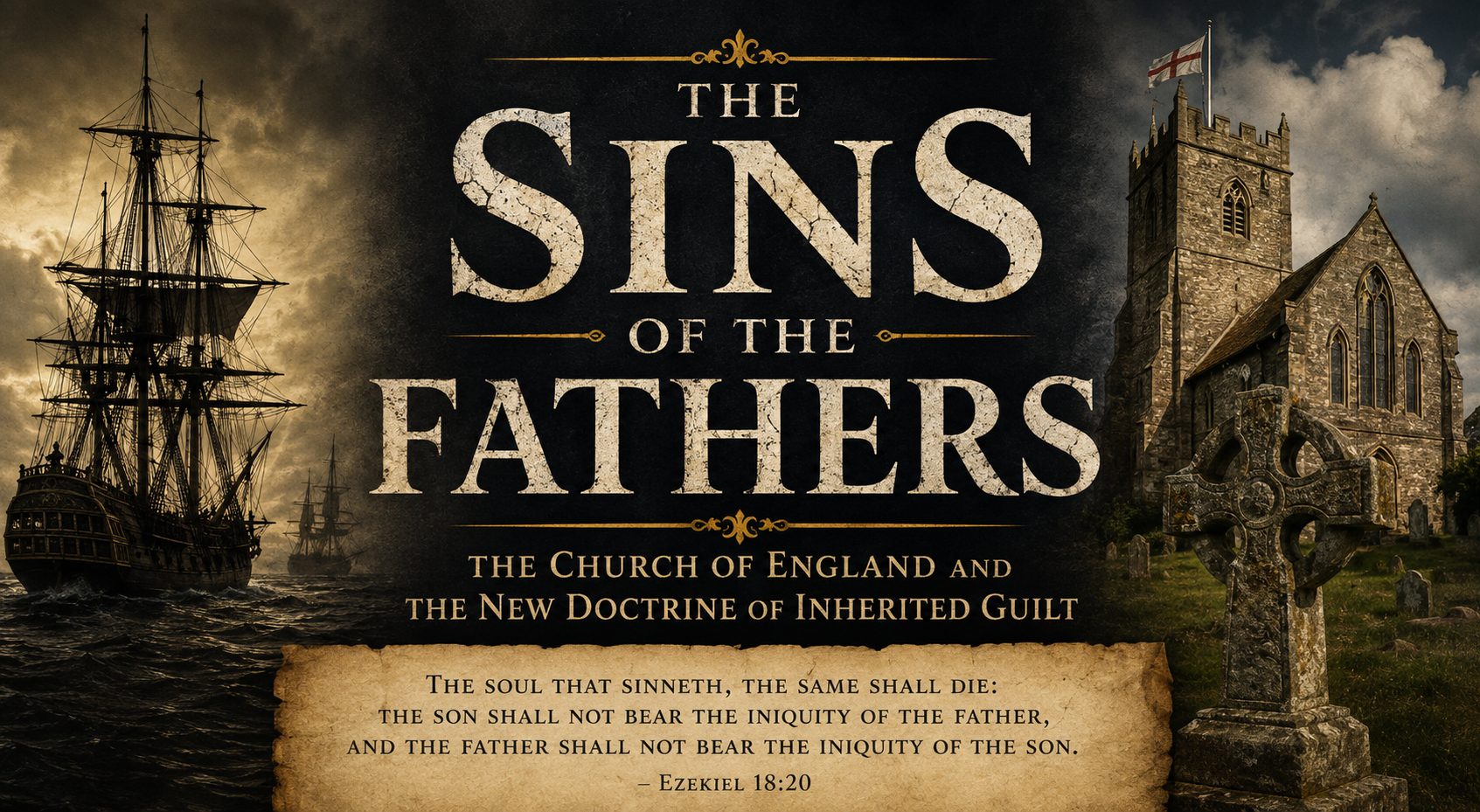
THE SINS OF THE FATHERS: The Church of England and the New Doctrine of Inherited Guilt

There is an uncomfortable irony in a politician having to remind the holder of England’s highest Anglican office of an elementary principle of Christian moral theology. Yet that is essentially what Nick Timothy, the Conservative MP for West Suffolk, has done in his letter of 3 August to Dame Sarah Mullally, Archbishop of Canterbury. His immediate subject is the Church Commissioners’ commitment of £100 million to address their historic links with African chattel slavery, but the real issue is considerably larger. It concerns the difference between remembering the sins of the past and assuming the guilt of those who committed them; between restitution and charity; between institutional responsibility and personal culpability; and, ultimately, between Christian repentance and the increasingly fashionable doctrine of inherited collective guilt.
The controversy was renewed by Dame Mullally’s visit to Cape Coast Castle in Ghana at the end of July. The symbolism could hardly have been more powerful. Cape Coast was one of the principal places through which enslaved Africans were held before transportation across the Atlantic, and nobody could reasonably object to the holder of a prominent Christian office standing there and lamenting the participation of Christians and Christian institutions in that wicked commerce. The difficulty lies elsewhere. Dame Mullally reaffirmed the £100 million commitment and explicitly connected it with repentance, saying that “part of the Christian belief in repentance is about action”.¹ It was this language that Timothy challenged. He did not deny the horror of slavery; on the contrary, he described it as a blight upon humanity. His objection was theological: “We cannot repent the sins of others. Forgiveness is not conditional on the behaviour of different people and generations.”²
The history behind the Commissioners’ decision is not imaginary and ought not to be minimised. Research commissioned in 2019 into the origins of their endowment established that Queen Anne’s Bounty, founded in 1704 and incorporated into the Church Commissioners in 1948, had invested substantial sums during the eighteenth century in the South Sea Company, which traded in enslaved Africans. Queen Anne’s Bounty also received benefactions from individuals connected with, or enriched by, the plantation economy.³ In January 2023 the Commissioners responded by committing £100 million over nine years to a programme of investment, research and engagement, particularly directed towards communities affected by the legacy of African chattel slavery.⁴ These facts deserve acknowledgement without qualification. The question is not whether slavery was evil, or whether Christians profited from it. The question is what moral obligations follow for people living three centuries later.
Here the distinction which Timothy invokes is not merely convenient; it is biblical. “The soul that sinneth, the same shall die,” says the prophet Ezekiel: “the son shall not bear the iniquity of the father, and the father shall not bear the iniquity of the son.”⁵ The passage occurs precisely in a discussion of intergenerational responsibility. Ezekiel does not deny that children suffer the consequences of their fathers’ actions. Scripture is full of such consequences, as is ordinary human experience. A father can impoverish his descendants, a ruler can leave his successors a disastrous war, and one generation can bequeath to another debts, institutions and social disorders which take decades to remedy. What Ezekiel rejects is something more specific: the transfer of the personal culpability of the sinner to somebody who did not commit his sin.
Catholic theology has always been capable of maintaining that distinction because it distinguishes culpa, the guilt attaching to a morally imputable act, from the consequences and obligations which may survive the person who committed it. The Catechism states plainly that “sin is a personal act”. A person may indeed become responsible for another’s sin, but only through some morally attributable participation of his own: by cooperating directly and voluntarily, ordering or advising it, approving it, failing to prevent it when obliged to do so, or protecting those who commit it.⁶ That is a demanding doctrine of responsibility, but it is not hereditary culpability. One does not acquire the personal guilt of a slave trader by being English, Anglican, white, the holder of an ecclesiastical office once occupied by somebody implicated in slavery, or the beneficiary of an institution whose predecessors made morally compromised investments.
This must also be distinguished from restitution, because otherwise two quite different obligations become confused. St Thomas Aquinas treats restitution under commutative justice. Its purpose is to restore the equality of justice where another has been deprived of what is his.⁷ The obligation can sometimes survive the original wrongdoer because the relevant question is not simply who committed the original sin? but who now possesses what belongs in justice to another? A man who innocently receives stolen property does not thereby become guilty of the theft, but neither does his innocence necessarily give him a right to retain what belongs to somebody else. This is precisely why Catholic moral theology has no difficulty recognising continuing consequences of historical injustice without inventing inherited personal guilt.
The distinction is decisive for the Church Commissioners. If their £100 million constitutes restitution, then the ordinary questions of restitution must be answered: what precisely is owed, by whom, to whom, and by what title? If it is charity, it should be defended as charity and judged according to the genuine needs of its beneficiaries. If it is an impact investment, its prudence and effectiveness can be assessed in those terms. If it is intended to remedy identifiable contemporary injustices, those injustices should be identified and the remedies evaluated. The Commissioners themselves say that the initiative is not a scheme for paying individual compensation to descendants of enslaved people. It is intended to combine impact investment, grant-making, research and engagement, and they have endorsed an ambition that the fund might eventually attract sufficient outside participation and investment returns to grow towards £1 billion or more, while their own commitment remains £100 million.⁸
All of those purposes may be debated on their merits. But once Dame Mullally describes the programme as an expression of Christian repentance, another question necessarily arises: who is repenting, and for what personal sin? Repentance cannot be detached from the moral agent who has something of which to repent. Contrition is sorrow for one’s own sins. Confession requires the penitent to accuse himself. Satisfaction seeks, as far as possible, to repair the injury flowing from those sins. Zacchaeus restores what he has unjustly taken; St John the Baptist commands those before him to bring forth fruits worthy of their repentance. Christianity certainly allows us to lament the sins of our ancestors, to condemn them, to learn from them, to repair their continuing effects and, where justice requires, to restore property unjustly retained. What it does not allow us to do is repent an act that we did not commit.
The point may sound scholastic until one notices how radically the alternative changes Christian anthropology. Contemporary political culture increasingly speaks as though moral status were attached not principally to acts but to membership of historical categories. A person may inherit the position of victim or perpetrator from events preceding his birth; institutions may possess a continuing moral personality capable of bearing culpability independently of the people who actually acted; and present generations may consequently be summoned to acts of contrition for offences of which none of them could possibly have been the agent. The resemblance to the Christian doctrine of original sin is superficial. Original sin is a fallen condition of human nature inherited from Adam; it is not the personal fault of Adam imputed to each descendant as though each had individually eaten the forbidden fruit. The Catechism expressly warns that original sin “does not have the character of a personal fault in any of Adam’s descendants”.⁹
The modern doctrine is in one respect considerably harsher. Christianity places inherited human brokenness within a theology of redemption. The contemporary politics of ancestral culpability offers no comparable absolution. Its characteristic movement is therefore not from sin through repentance to forgiveness, but from investigation to confession, from confession to institutional commitment, and from that commitment to another investigation capable of discovering a still deeper liability. An apology seldom closes the account because closure itself risks being interpreted as evidence that the institution has not sufficiently understood the magnitude of its guilt. Thus Christianity’s vocabulary of sin and repentance survives, but the Christian destination of absolution quietly disappears.
It is against this background that Timothy’s apparently mundane examples of Suffolk parish churches acquire their force. He points to All Saints at Gazeley, where expensive roof works have been required to preserve historic fabric; St Peter and St Paul at Kedington, another ancient church confronting the burden of maintenance; and St Margaret of Antioch at Cowlinge, where the restoration requirement runs beyond half a million pounds.² These examples are repeated throughout England. Medieval roofs leak, masonry decays, heating systems fail, organs become unusable and congregations diminish, while small groups of parishioners struggle to maintain buildings inherited from generations who assumed that Christian worship would continue in them.
The Commissioners have a legitimate answer to one version of that criticism. The £100 million has not been taken from parish collections. They have explicitly stated that “not a penny donated to a parish church” is being used to establish the fund, and they placed the commitment alongside approximately £3.6 billion which they expected to distribute to the Church over the corresponding three funding periods.¹⁰ That fact belongs in any fair account. It would be inaccurate to suggest that money placed in a collection plate at Evensong has simply been removed and transferred to a reparations scheme.
Yet the answer does not resolve the question of priorities, because endowed money is still money and expenditure has an opportunity cost. The relevant question is not whether the £100 million was physically collected from parishioners, but whether this particular use of institutional resources is sufficiently compelling to take precedence over other possible uses. An organisation cannot announce a discretionary expenditure of £100 million and simultaneously maintain that the decision has no relationship whatever to what else might have been done with £100 million. Timothy’s parish churches therefore remain relevant, not because their collection plates financed the scheme, but because they represent competing claims upon the stewardship of a Church whose inherited fabric and parochial presence are under extraordinary strain.
There is, moreover, a historical irony which ought to make the Church of England unusually cautious about theories of inherited institutional guilt. Many of the churches now maintained by Anglican congregations were built centuries before the Church of England’s separation from Rome. They were erected for Catholic worship, endowed for Catholic purposes and filled with altars, chantries, images and foundations established for the Mass and prayers for the dead. The Reformation brought the dissolution of the monasteries and the sale of their lands; under Edward VI the colleges and chantries were likewise dissolved, while the Prayer Book was imposed in place of the Catholic Mass. Elizabethan legislation subsequently imposed fines and other penalties upon Catholics who refused conformity, with later measures subjecting Catholic worship and recusancy to still harsher disabilities.¹¹
No sensible Catholic therefore concludes that the Anglican pensioner presently trying to repair the roof of his medieval parish church is personally guilty of the Dissolution of the Monasteries. He did not suppress an abbey, seize a chantry or fine a recusant. Nor would it be reasonable to demand that Dame Mullally personally repent of the actions of Thomas Cromwell or Elizabeth I. The reason is the same principle which Timothy has invoked in the slavery controversy: moral guilt belongs to the person who commits, commands, assists or culpably permits the act. Yet once institutional continuity itself becomes a vehicle for inherited culpability, the question becomes unavoidable. Why should the moral genealogy of the Church Commissioners be traced backwards through Queen Anne’s Bounty to the South Sea Company, while the institutional genealogy of the Church of England is not traced backwards to confiscated Catholic endowments and the suppression of the old religion?
This is not an argument for Catholic “reparations”. It is an argument against the indiscriminate historical logic which would make such claims possible. History contains too many conquests, confiscations, persecutions, inheritances and changes of regime for collective guilt to be passed indefinitely from generation to generation without producing absurdity. The English Reformation is useful here precisely because it exposes the selectivity of contemporary retrospective morality. Certain historical inheritances are treated as morally active and demanding present penance; others, no less real, are regarded as settled history. The distinction seems to owe rather more to the preoccupations of twenty-first-century politics than to any coherent principle of Christian moral theology.
The same selectivity is visible in the wider treatment of Britain and slavery. Britain participated deeply and shamefully in the Atlantic slave economy, and no serious account should minimise it. But slavery was neither invented by Britain nor peculiar to Europeans. It is an ancient and near-universal human evil, practised in different forms by civilisations across Africa, Asia, Europe and the Middle East. What became historically remarkable was not that Britain entered a trade which already existed, but that Britain eventually turned substantial national power against it. Parliament abolished the British slave trade in 1807, after which the Royal Navy’s West Africa Squadron spent more than half a century suppressing trafficking. Royal Navy figures record approximately 1,600 slave ships captured and around 150,000 Africans liberated between 1808 and 1860.¹²
That achievement does not acquit the slave trader who preceded it. Neither should it. The sins of one generation are not cancelled by the virtues of another any more than the virtues of one generation excuse the sins of its successors. But precisely the same principle must operate in both directions. If later Britons cannot inherit the merit of Wilberforce or the sailors of the West Africa Squadron as personal virtue, neither can they inherit the personal culpability of men who invested in slave voyages. Historical memory may properly encompass both shame and honour; moral responsibility remains attached to the people who actually acted.
Indeed, the Royal Navy’s campaign illustrates the inadequacy of reducing national history to a permanent identity of perpetrator and victim. The suppression campaign was dangerous and costly. Britain also used diplomacy, treaties and coercive power in an attempt to suppress trafficking conducted by others.¹² None of this requires sentimental patriotism. It requires only that history be allowed to remain history rather than being edited into a prosecution brief whose verdict has been decided in advance.
Timothy’s objection therefore reaches considerably deeper than whether £100 million is too much money. The question is whether a Church increasingly uncertain about the doctrines of its own inheritance has adopted, almost without noticing, a substitute doctrine of sin. Christian repentance begins with the examination of my conscience. I accuse myself of what I have done and what I have failed to do. I may be required to make restitution. I may have duties arising from injustices in which I presently participate. I may inherit circumstances created by other men’s sins and be morally obliged to remedy them where I can. But I do not become morally culpable for another man’s act simply because history has placed me downstream from him.
That principle matters especially because England hardly lacks sins requiring repentance by the living. The country is undergoing an extraordinary collapse of Christian belief and practice. Churches close, congregations age, marriage and family life weaken, pornography and addiction destroy lives, loneliness consumes many of the elderly, children grow up without elementary knowledge of Christianity, and millions of baptised people have little conception of the Faith into which they were baptised. In such circumstances it is difficult not to notice the strange inversion by which ecclesiastical institutions can become hesitant about calling living men to repentance for their own conduct while displaying remarkable confidence in organising repentance for the conduct of dead men.
The Church should certainly tell the truth about its past. It should do so precisely because Christianity has nothing to fear from truth. If property presently possessed is demonstrably owed to another in justice, it should be restored. If an institution is perpetuating an injustice, that injustice should cease. If charitable investment can genuinely assist people in need, it should be judged according to its effectiveness and the demands of Christian charity. If historical research reveals shameful conduct by Christians, there is no reason to conceal it. None of these things requires the confusion of historical memory with personal guilt, charity with restitution, or reparation with repentance.
There is another reason for insisting upon the distinction. Christian repentance is ordered towards forgiveness. “If we confess our sins,” writes St John, God “is faithful and just, to forgive us our sins, and to cleanse us from all iniquity.”¹³ The sacramental economy expresses the same truth: confession is followed by absolution; satisfaction follows forgiveness; the penitent is restored rather than condemned to perpetual self-accusation. A moral system in which guilt may be inherited but never finally absolved has retained Christian language while abandoning the Gospel’s conclusion.
That is why Timothy’s simplest sentence is also his strongest: “We cannot repent the sins of others.”² We can remember them, condemn them, learn from them and repair consequences which genuinely remain. We can refuse to benefit knowingly from continuing injustice. We can make restitution where justice establishes a debt. We can pray for those who suffered and ensure that their history is not forgotten. What we cannot do is manufacture personal culpability in people who did not commit the offence and then call the resulting institutional performance Christian repentance.
Dame Mullally should therefore reconsider not merely the expenditure but the theology by which it is being justified. If the Commissioners believe the £100 million is a prudent charitable or social investment, let them make that case. If they believe restitution is owed, let the debt and its beneficiaries be established according to justice. If contemporary communities suffer identifiable injustices requiring remedy, let those injustices be addressed directly. But if the claim is that today’s Church must repent because people connected with its institutional predecessors participated in slavery three centuries ago, then the objection from Ezekiel remains unanswered.
“The soul that sinneth, the same shall die: the son shall not bear the iniquity of the father, and the father shall not bear the iniquity of the son.”⁵ Christianity does not command historical amnesia, still less indifference to the consequences of injustice. It commands truth and justice while refusing to confuse the sinner with his descendants. The sins of the fathers should be remembered because history matters. They should not be transferred to the sons, because moral responsibility matters too.
The Church already possesses a doctrine capable of holding those truths together. It has the concepts of sin, cooperation, restitution, satisfaction, charity, forgiveness and grace. It does not need the harsher substitute offered by the politics of ancestral guilt: culpability without personal action, repentance without personal sin, and penance without any possibility of final absolution. The tragedy would not merely be that £100 million had been badly spent. It would be that, in attempting to repent of the sins of men long dead, the Church of England had forgotten what repentance means.
¹ Eromo Egbejule, “Archbishop of Canterbury vows to support £100m pledge helping communities affected by enslavement,” The Guardian, 31 July 2026.
² Nick Timothy MP, letter to Dame Sarah Mullally, Archbishop of Canterbury, 3 August 2026.
³ Church Commissioners for England, “Church Commissioners’ research identifies historic links to transatlantic chattel slavery,” 16 June 2022; Church Commissioners for England, Church Commissioners’ Links to Historic Transatlantic Slavery: Report into Past Investments in the South Sea Company and Links to Transatlantic Slavery, 2023.
⁴ Church Commissioners for England, “Church Commissioners publishes full report into historic links to transatlantic chattel slavery and announces new funding commitment of £100m in response to findings,” 10 January 2023.
⁵ Ezechiel 18:20, Douay-Rheims Bible.
⁶ Catechism of the Catholic Church, §§1868–1869.
⁷ St Thomas Aquinas, Summa Theologiae, II-II, q. 62, aa. 1–2, 5–7.
⁸ Church Commissioners for England, “Frequently Asked Questions: Historic Links to Enslavement”; Church Commissioners for England, “Our Response: Historic Links to Enslavement.”
⁹ Catechism of the Catholic Church, §§404–405.
¹⁰ Church Commissioners for England, “Learning from the past, to invest in a better future,” 18 June 2024.
¹¹ UK Parliament, “Religion and Belief: Key Dates 1275 to 1592”; UK Parliament, “The Reformation”; UK Parliament, “Persecution.”
¹² Royal Navy, “Protector honours sailors who helped end African slave trade,” 20 October 2021; Anthony Sullivan, Britain’s War Against the Slave Trade: The Operations of the Royal Navy’s West Africa Squadron, 1807–1867 (Barnsley: Frontline Books, 2020).
¹³ I John 1:9, Douay-Rheims Bible.
RELATED ARTICLES


LATEST ARTICLES
- Saint Gertrude the Great: The Heart Made Ready for GodThe article explores St Gertrude the Great’s 15 November feast in the Traditional Roman Rite, explaining its liturgy, history and theological significance. It presents Gertrude’s Helfta spirituality as centred on Scripture, the Divine Office, Eucharistic devotion and the Sacred Heart. Her sanctity illustrates divine indwelling, persevering charity, intercession and readiness for eternal union with Christ.
- Today’s Mass: November 14 St Erconwald of LondonSt Erconwald, gentle monastic bishop of London, built the early English Church through holiness, prayer, and stability, strengthening St Paul’s and founding monasteries that shaped the land. St Josaphat, fiery Archbishop of Polotsk, defended unity with Rome and sealed it with his martyrdom. One built, the other bled—both faithful stewards of Christ’s flock.
- 15.11.26 Nuntiatoria CXXXII: Depositum custodiThe editorial reflects on stewardship within the Church and society, inspired by Archbishop Héctor Aguer’s legacy of ordaining forty-nine priests. It defends fidelity to received doctrine and tradition while distinguishing legitimate authority from overreach. The author urges accountability, parental rights, safeguarding, and faithful domestic practice, reminding Catholics to preserve and transmit the Faith entrusted to them.
- ORDO w/c 05.11.26The week of 15–22 November 2026 concludes the ecclesiastical year with feasts of St Gertrude, the Apostles Peter and Paul, St Elizabeth of Hungary, St Felix of Valois, the Presentation of Mary and St Cecilia. It emphasises contemplation, apostolic unity, charity, redemption and preparation for judgement, while noting English calendar variations and Advent’s approaching beginning.
- DONEC FERMENTATUM EST TOTUM: The Sixth Sunday after Epiphany (Resumed)The Sixth Sunday after Epiphany presents the mustard seed and leaven as images of Christ’s Kingdom and divine grace. Though beginning humbly, the Church grows through Christ’s power, while grace transforms believers interiorly. The Mass calls Catholics to unite faith with charity, holiness and sacramental life, persevering faithfully as they await Christ’s return.





Leave a Reply