
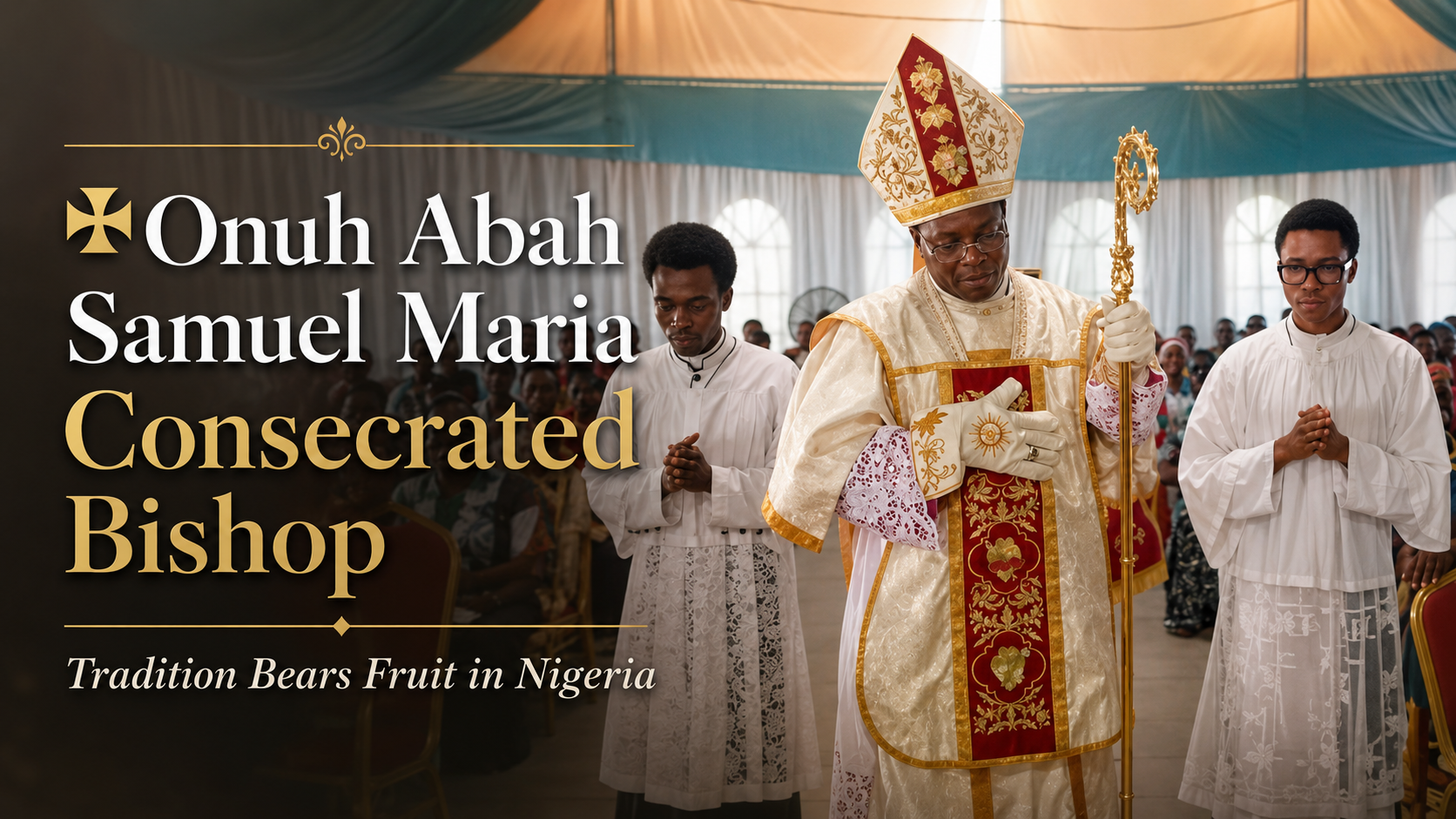
Tradition Bears Fruit in Nigeria: ✠Onuh Abah Samuel Maria Consecrated Bishop
The episcopal consecration of ✠Onuh Abah Samuel Maria on the Feast of the Assumption marks a significant development in an indigenous Nigerian Traditional Catholic apostolate whose roots lie in more than two decades of Roman Catholic priestly ministry, an early association with the Society of St Pius X, and a striking growth of priestly and religious vocations.

On Saturday, 15 August 2026, the Feast of the Assumption of the Blessed Virgin Mary, ✠Onuh Abah Samuel Maria, founder of the Sons and Sisters of the Sacred and Immaculate Hearts, received episcopal consecration in Nigeria at the hands of ✠D. Edward Meikle. The traditional rite contained in the Pontificale Romanum was employed, and Samuel Maria made the profession of faith and oath of fidelity prescribed by the rite before receiving the fullness of Holy Orders.¹
The significance of the occasion lies not simply in another episcopal consecration according to the ancient Roman form, but in the history which preceded it: twenty-three years of Catholic priesthood, a documented movement towards the Traditional Roman Rite, and an indigenous Nigerian apostolate already producing a remarkable body of priestly and religious vocations.
Samuel Maria’s priesthood did not originate within the traditionalist movement which he now serves. He was ordained to the Catholic priesthood on 25 October 2003 for the Roman Catholic Diocese of Otukpo in Benue State, where he was incardinated and exercised priestly ministry. The official Nigerian Catholic record lists “Rev. Fr. Samuel Abah” among the priests of Otukpo with that ordination date. ✠Michael Ekwoyi Apochi had been appointed to Otukpo in December 2002 and was consecrated and installed there on 23 February 2003, eight months before Samuel Maria’s ordination. The same record later lists him as Very Rev. Fr. Sam-Maria Abah, entrusted with the considerable responsibilities of Finance Administrator, Vocations Director and Communications Director.² His status as a Roman Catholic priest of Otukpo is therefore firmly established in the published clerical record.
That provenance matters. Samuel Maria was neither formed nor ordained within an independent traditionalist body before establishing an African apostolate of his own. His attachment to the older Roman liturgy developed within an already established Catholic priestly life, after years of pastoral ministry and substantial responsibilities within Otukpo.
An especially revealing episode occurred in May 2011. A contemporary newsletter of the Society of St Pius X, subsequently reproduced by Rorate Cæli, described Samuel Abah as a priest of Otukpo who had decided to associate himself with the Society’s work for Catholic Tradition. SSPX priests visited those he served, and the district superior celebrated Mass for more than two hundred faithful at Nwedoga. The report records that Samuel Maria’s bishop met the visiting priests, gave verbal approval for Fr Abah to join the Society, welcomed the SSPX clergy and accommodated them at his cathedral. The bishop governing Otukpo at the time was ✠Michael Ekwoyi Apochi.³
This places Samuel Maria’s early development towards Tradition in a rather different light from that of a priest who simply abandoned his previous ministry and acted clandestinely against his bishop. At that stage, at least, his association with the SSPX was open and proceeded with episcopal knowledge and approval. Whatever difficulties developed subsequently, the historical beginning was considerably more complex than a simple narrative of rupture.
By July 2023, Samuel Maria’s work had developed sufficiently to attract international attention. In an extended interview with John-Henry Westen, LifeSiteNews still identified him explicitly as a priest of the Roman Catholic Diocese of Otukpo, devoted to Catholic Tradition and the Traditional Latin Mass. LifeSite reported that he had learned the older rite from the Society of St Pius X with his bishop’s permission and that, despite later restrictions upon its public celebration, Catholics continued seeking him for spiritual direction, traditional teaching and sacramental life.⁴
More striking still was what had begun to gather around him. LifeSite reported in 2023 that Samuel Maria was overseeing an unofficial pre-seminary of more than twenty young men seeking priestly formation, while Catholic women had begun living a common religious life.⁴ That evidence predates the present episcopal consecration by three years. The vocational phenomenon now associated with Samuel Maria was already sufficiently developed to attract independent attention long before the events of August 2026.
From these beginnings developed the Sons and Sisters of the Sacred and Immaculate Hearts, dedicated particularly to the Sacred Heart of Jesus and the Immaculate Heart of Mary. SSIH presently reports Samuel Maria and two other priests serving fifteen mission chapels and more than 10,000 faithful, together with fifteen sisters and twenty-three seminarians. Its published account describes seminarian and religious formation, chapels, schools, an orphanage and other apostolic works at several locations across Nigeria.⁵ Those contemporary figures are supplied by SSIH itself, but the broader pattern they describe is strengthened by the independent 2023 report of more than twenty young men already seeking formation for the priesthood.
The continuity is perhaps the most compelling fact in the story. What was visible as an emerging vocational movement in 2023 has not disappeared. It has endured and developed.
And it is unmistakably African.
Samuel Maria is Nigerian. The young men presenting themselves for priestly formation are overwhelmingly African. The religious sisters are African. The faithful sustaining the apostolate are African. This matters because attachment to the Traditional Roman Rite continues to be caricatured in some quarters as an exercise in European nostalgia — an attempt to reconstruct the Catholic world remembered by those who lived before the reforms of the 1960s.
That explanation becomes increasingly implausible when applied to Catholics born decades after those reforms and positively absurd when applied to young Nigerians with no personal memory of pre-Conciliar European Catholic life. They are not remembering the old Mass. They are discovering it.
Nor is the attraction merely aesthetic. These young men are contemplating celibacy, obedience and a lifetime of priestly service. The women entering religious formation contemplate poverty, chastity, obedience and the renunciation implicit in common consecrated life. Such choices demand something more substantial than ceremonial preference. What they appear to encounter is a coherent supernatural vision in which worship is manifestly directed towards Almighty God, priesthood possesses a recognisable sacrificial identity, religious life demands actual renunciation, doctrine is received rather than perpetually renegotiated, and the salvation of souls remains the purpose of apostolic activity.
The developing work also attracted significant encouragement from ✠Carlo Maria Viganò, whose relationship with Nigeria was not incidental. Viganò served as Apostolic Nuncio there from 1992 until 1998 and subsequently wrote personally to Samuel Maria after learning of the apostolate. He recalled Nigeria as a country he continued to carry in his heart and expressed his happiness at learning of priests and religious committed to traditional Catholic teaching and the Tridentine Mass. Having considered Samuel Maria’s account and photographs of the developing work, he regarded its growth amid considerable material difficulties as evidence of divine blessing.⁶
Viganò immediately identified the importance of the vocations. He described the formation of young men for the traditional priesthood as being “of utmost importance”, alongside the contemplative and intercessory vocation of consecrated women. He sought assistance among his contacts for the material support of Samuel Maria’s work, asked to be kept informed of its progress, and imparted his fatherly blessing to the priests, seminarians, religious and faithful.⁶ His encouragement therefore concerned not simply the celebration of an older liturgical form, but the formation of future priests and religious capable of carrying traditional Catholic life into another generation.
The chronology is striking. Samuel Maria was ordained and incardinated for Otukpo in 2003. By 2011 his movement towards the SSPX and the traditional Roman liturgy was sufficiently developed for Society priests to visit those he served and for his own bishop to approve his association with them. By 2023 LifeSite was documenting more than twenty young men seeking priestly formation and the beginnings of a women’s religious community. ✠Viganò encouraged and blessed the work. By 2026 SSIH was reporting twenty-three seminarians, fifteen sisters and thousands of faithful. Only after this substantial pastoral reality had already developed did Samuel Maria receive episcopal consecration.
There is nevertheless a clear canonical consequence to the events of 15 August. Samuel Maria was ordained and incardinated for the Roman Catholic Diocese of Otukpo, and his episcopal consecration now places him in an irregular position with Rome. Canon 1387 provides for a latae sententiae excommunication, reserved to the Apostolic See, for both the bishop who confers episcopal consecration without pontifical mandate and the man who receives it.⁷ No public declaration concerning Samuel Maria had been issued by Rome at the time of writing. The penalty prescribed by the canon concerns his canonical status; it does not of itself determine the sacramental validity of the episcopal consecration.
The consecrator, ✠D. Edward Meikle, transmitted to Samuel Maria an Old Roman episcopal succession received through the late ✠John Joseph Humphreys and the historic succession associated with the Old Roman tradition. Its importance lies not in genealogical curiosity. Apostolic succession exists so that apostolic ministry may continue: bishops consecrating bishops, bishops ordaining priests, and priests offering the Holy Sacrifice and administering the sacraments for another generation. A succession proves its worth not by the length of a chart but by fidelity to that which it exists to transmit.
There could scarcely have been a more fitting day for Samuel Maria’s consecration than the Feast of the Assumption. The spirituality of the apostolate he founded is explicitly centred upon the Sacred Heart of Jesus and the Immaculate Heart of Mary, while his episcopal motto is Esse Cor Jesu et Cor Mariae — “To be the Heart of Jesus and the Heart of Mary.”¹
The symbolism is deeper than the coincidence of a Marian feast. Our Lady is the supreme created model of faithful reception. At the Annunciation she receives the Word of God; she does not revise Him. She keeps what she has received rather than treating Revelation as material for reconstruction. At Cana her instruction directs the servants entirely towards obedience to Christ: Whatsoever he shall say to you, do ye. The Assumption is the glorious consummation of that life of receptivity, fidelity and supernatural obedience.
The episcopal office demands the same fundamental disposition. A bishop does not invent the deposit entrusted to him. He receives it in order to transmit it. He receives Holy Orders so that Holy Orders may continue. He receives the Church’s sacramental and liturgical inheritance as steward rather than proprietor. In an ecclesiastical age fascinated by processes, novelty and reconstruction, there remains something profoundly Catholic in the simpler principle: hand on what you have received.
That will be the proper test of ✠Samuel Maria’s episcopal ministry. Its enduring fruit will be measured in priests soundly formed and worthily ordained; religious women persevering in genuine consecrated life; children properly catechised; families strengthened in the Faith; Masses reverently offered; sacraments faithfully administered; sinners converted; vocations fostered; and souls brought to Christ.
There is nevertheless something deeply striking in what has already occurred. Twenty-three years after Samuel Maria was ordained to the Catholic priesthood for Otukpo, a priest once entrusted with responsibility for fostering vocations now finds himself surrounded by a remarkable body of young Africans seeking priestly and religious formation. More than a decade before his episcopal consecration, his movement towards Tradition was sufficiently developed for SSPX clergy to visit those he served and for his Roman bishop to approve his association with the Society. Three years before the consecration, LifeSite was already documenting the resulting vocational movement.
This is uncomfortable evidence for those who have spent decades insisting that traditional Catholic worship, unambiguous doctrine, distinctive priestly identity and demanding religious discipline are barriers to evangelisation. Latin was supposed to alienate. The old Mass was supposed to belong to another culture and another age. The cassock was supposed to create distance. Traditional religious life was supposed to discourage modern women. Strong priestly identity was supposed to repel young men.
Nigeria offers another possibility.
There, young Catholics are not merely attending the traditional Mass: some are asking to give their lives to the priesthood because of the Catholic world they encounter through it. Women are not merely admiring traditional religious life: they are embracing it. Faithful are seeking traditional sacramental and devotional life in numbers sufficient to sustain a rapidly developing apostolate. And at the centre of that work stands a Nigerian priest whose own history joins the Roman Catholic priesthood into which he was ordained in 2003, an early association with the SSPX undertaken with his bishop’s approval, more than two decades of pastoral experience, and now episcopal consecration according to the ancient Roman Pontifical.
On the Assumption of 2026, that priest knelt before ✠D. Edward Meikle and received the fullness of Holy Orders.
What follows will determine the ultimate significance of that moment. Episcopal consecration is a beginning rather than a conclusion. It confers powers which exist to be exercised for others and imposes obligations more formidable than any outward dignity can suggest. ✠Samuel Maria now carries responsibility not simply for preserving the work already gathered around him, but for ensuring that those young men and women who have entrusted their vocations to it receive the Catholic Faith whole and entire.
That is where the Nigerian story meets the fundamental law of Tradition itself:
Not invention, but transmission. Not reconstruction, but reception. Not possession, but stewardship.
A Catholic priest ordained and incardinated for Otukpo in 2003 has become a bishop in 2026. Between those two moments lie the rediscovery of the traditional Roman Mass, the encouragement of his Roman bishop, contact with the SSPX, the blessing of a former Apostolic Nuncio, thousands of faithful, religious sisters and a remarkable body of young men seeking priesthood.
Whatever canonical consequences now follow from the events of 15 August, another fact is already difficult to avoid:
Tradition has taken root in Nigeria — and it is bearing fruit.
Esse Cor Jesu et Cor Mariae.
¹ Sons and Sisters of the Sacred and Immaculate Hearts, “Historic Consecration of Bishop Onuh Abah Samuel Maria on the Feast of the Assumption,” 15 August 2026. https://ssihmission.org/breaking-news-historic-consecration-of-bishop-onuh-abah-samuel-maria-on-the-feast-of-the-assumption
² Nigeria Catholic Network, Catholic Secretariat of Nigeria, published record for the Roman Catholic Diocese of Otukpo, recording Samuel Abah’s priestly ordination on 25 October 2003 and his subsequent responsibilities as Finance Administrator, Vocations Director and Communications Director.
³ Catholic Tradition in Africa, SSPX newsletter, 2011; report of the visit to Fr Samuel Abah and his bishop’s verbal approval of his association with the Society, reproduced by Rorate Cæli, 27 October 2011. https://rorate-caeli.blogspot.com/2011/10/report-from-sspx-catholic-bishop-in.html
⁴ The John-Henry Westen Show, LifeSiteNews, “Heart of Africa desires Traditional Latin Mass | Fr. Abah Onuh Samuel Maria,” 26 July 2023.
⁵ Sons and Sisters of the Sacred and Immaculate Hearts, published account of Samuel Maria and the Nigerian apostolate, including current figures for priests, faithful, sisters and seminarians.
⁶ ✠Carlo Maria Viganò, letter to Fr Onuh Abah Samuel Maria concerning the Nigerian traditional apostolate, reproduced by SSIH.
⁷ Codex Iuris Canonici, Canon 1387, Holy See.
RELATED ARTiCLES


LATEST ARTICLES
- The Catholic Girl’s Guide, III: Whose Is This Image?Chapter III of the 1906 Catholic Girl’s Guide: the image of God, the immortal soul and the desire for eternal happiness, with a contemporary reflection on human dignity and Christian hope.
- The Young Man’s Guide, III: The Music of the SoulChapter III of the 1910 Young Man’s Guide: the rational soul, thought, the image of God and the responsibilities of Christian manhood, with a contemporary reflection on neuroscience and artificial intelligence.
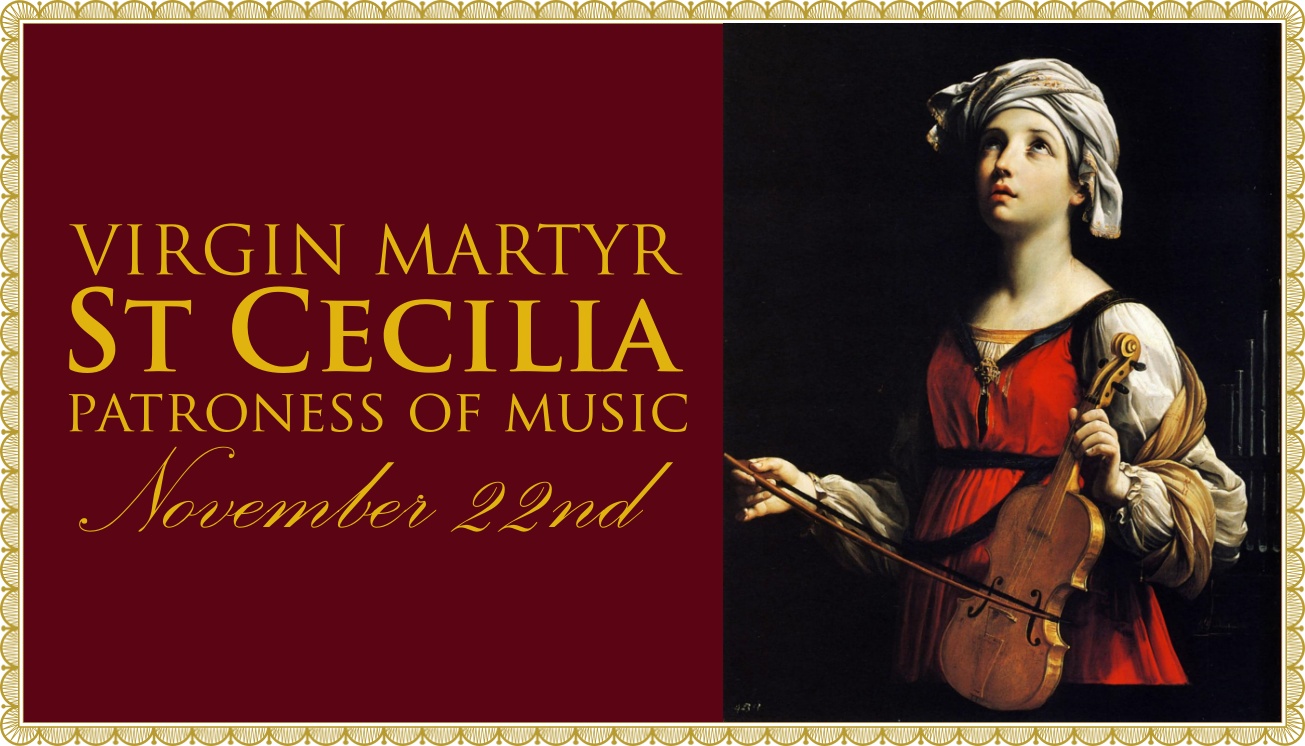
- Today’s homily: St Cecilia, Virgin & MartyrTradition tells us that Cecilia was a Roman girl of a patrician family who had been brought up as a Christian. She fasted often and wore a coarse garment beneath her rich clothing. Although she had consecrated her virginity to God, her father betrothed her to a young pagan named Valerian.
- Today’s Mass: November 22 St Cecilia, Virgin & MartyrTradition tells us that Cecilia was a Roman girl of a patrician family who had been brought up as a Christian. She fasted often and wore a coarse garment beneath her rich clothing. Although she had consecrated her virginity to God, her father betrothed her to a young pagan named Valerian.
- Sermon for St Cecilia / Sunday Before AdventThe life of St Cecilia follows a pattern similar to many other Christian virgins who became martyrs, such as St Agnes, St Agatha and St Lucy. They were Christian virgins pressurised into marrying pagan husbands, and suffered persecution and martyrdom because they would not consent to losing their virginity and compromising their faith.
CURRENT EDITION


Today’s Mass Propers
- Today’s Mass: November 22 St Cecilia, Virgin & Martyr
 Tradition tells us that Cecilia was a Roman girl of a patrician family who had been brought up as a Christian. She fasted often and wore a coarse garment beneath her rich clothing. Although she had consecrated her virginity to God, her father betrothed her to a young pagan named Valerian.




Leave a Reply