
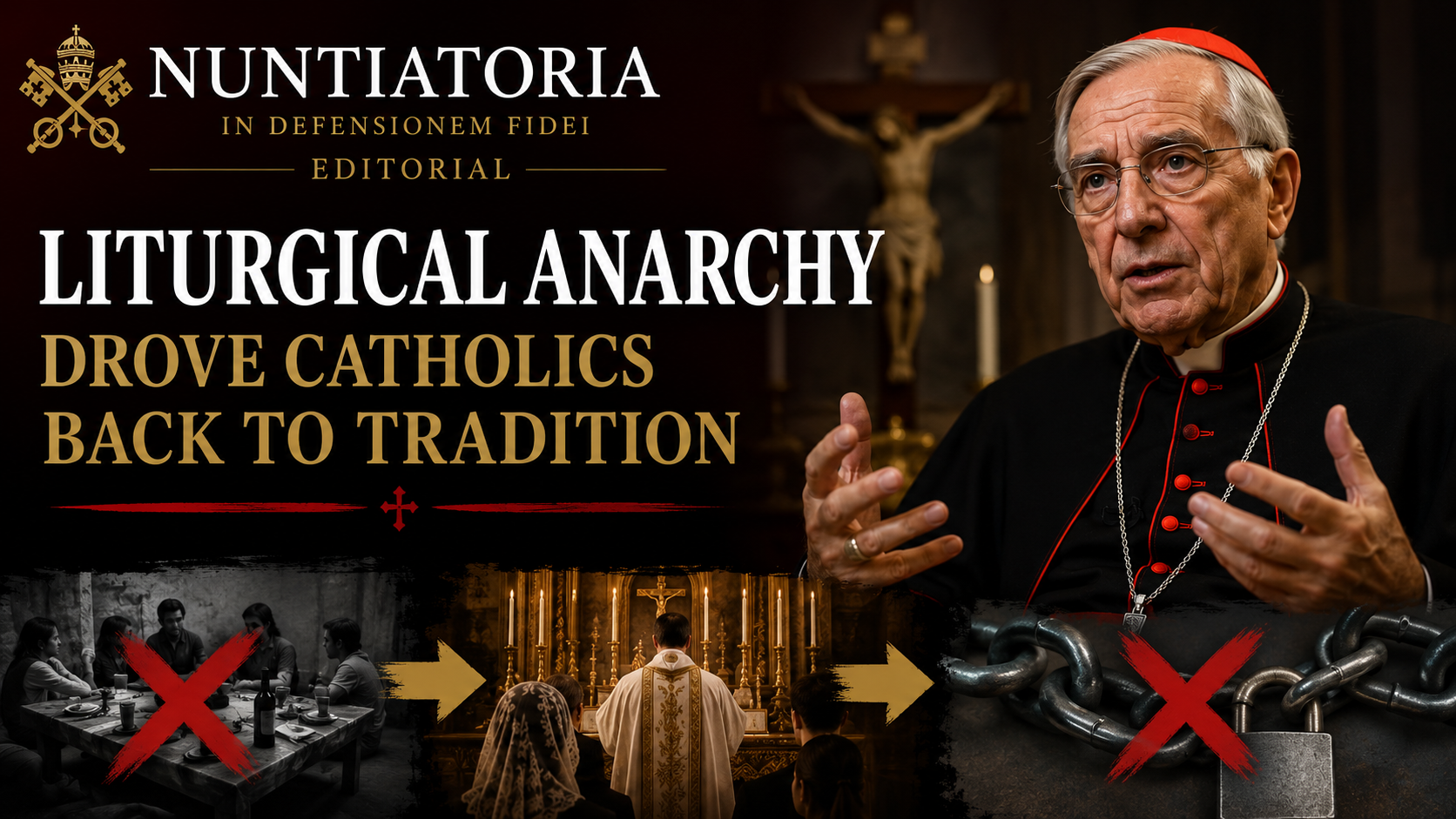
Cardinal Rouco’s Admission: Liturgical Anarchy Drove Catholics Back to Tradition
The former Archbishop of Madrid has acknowledged that widespread post-conciliar abuses reduced the Mass to a parody and sent Catholics in search of the older Roman rite. His testimony leaves the hierarchy with a question it has avoided for decades: why were those who fled the disorder treated more severely than those who caused it?

A low table in a sitting room replaced the altar. The wine came from the refrigerator; the bread was whatever had been found for the occasion. Priests, seminarians and religious sat or squatted together while the celebration proceeded by improvisation. Cardinal Antonio María Rouco Varela remembers occasions on which little remained recognisably Catholic beyond the words of consecration.
Rouco was not describing an anti-clerical revue, nor repeating the accumulated grievances of a traditionalist society. Ordained in 1959, the former Archbishop of Madrid celebrated the traditional Roman Mass before living through the reform and its aftermath. In an interview published by El Debate on 21 July, he recalled the “almost anarchic indiscipline” that entered seminaries and religious houses during the 1970s. In many places, he said, the reformed liturgy became a “parody”; the Holy Sacrifice risked becoming a “game among friends”.¹
The cardinal’s language is severe because the offence was not principally one of taste. He says that the disorder reached the truth of the sacraments, disturbed the consciences of the faithful and violated even the natural human sense of beauty. That judgement deserves more attention than the usual dispute over guitars, vestments or unfortunate church furnishings. Rouco is speaking about a practical deformation of what Catholics were being taught to believe the Mass to be.
The Mass is the sacramental re-presentation of the Sacrifice of Calvary. Christ is its principal Priest and Victim. The ordained priest does not preside by delegation from the congregation, but acts sacramentally in the person of Christ the Head. The faithful participate by uniting themselves to the offering made upon the altar; they do not compose the sacred action according to the mood or preferences of those present.
Once that order is obscured, the outward forms of the liturgy are soon treated as disposable. The altar becomes a domestic table because sacrifice has yielded to fellowship as the governing idea. The priest faces the group as its chairman. Silence is emptied out by explanation, sacred language by immediacy, inherited prayer by spontaneity. Each alteration may be defended as pastoral, but together they teach a different account of worship.
Rouco’s recollections show how far that process went. The scenes he describes occurred not merely in isolated parishes but in places of formation. Men preparing for the priesthood and women living the religious life encountered experimentation under the authority of superiors and teachers. What might otherwise have been dismissed as the eccentricity of one priest acquired institutional approval and passed into the habits of another generation.
To call all this “abuse” is correct, but insufficient. An abuse is usually imagined as an exceptional departure from an established norm. Rouco describes something widespread enough to influence the religious instincts of large numbers of Catholics. It survived because novelty had acquired moral prestige, while inherited practice was treated as an obstacle to renewal. The law remained in the books, but those charged with enforcing it often preferred to manage the objections of the faithful rather than restrain the clergy who were provoking them.
The Second Vatican Council did not command any of this. Sacrosanctum Concilium stated plainly that no one, “even if he be a priest”, might add, remove or alter anything in the liturgy on his own authority. It required that innovations should arise only where the good of the Church genuinely demanded them and should grow organically from existing forms. The same constitution retained Latin in the Roman rites and accorded Gregorian chant pride of place.²
Rouco therefore distinguishes the Council from what was done after it, and the distinction is necessary. A coffee-table Eucharist cannot fairly be attributed to a conciliar text which expressly prohibited private liturgical invention. Yet the distinction cannot bear the entire weight that is commonly placed upon it. Catholics may reasonably ask how practices forbidden by the Council became common in precisely those institutions responsible for implementing it.
The answer cannot be that a few excitable priests misunderstood an otherwise orderly transition. The abandonment of inherited worship was too rapid, too extensive and too consistently favoured by those who claimed to represent the future of the Church. Latin disappeared where the Council said it should remain. Gregorian chant was displaced where the Council said it should hold pride of place. Organic development was invoked while altars, rites, calendars, ceremonies and devotional customs were subjected to an upheaval without precedent in ordinary Catholic life.
None of this proves that every provision of the reform was illegitimate, nor that every celebration according to the reformed Missal is irreverent. Many priests have offered it with fidelity, solemnity and manifest belief in the Real Presence. Some have restored chant, silence, traditional vestments and celebration directed visibly towards God, often amid resistance from those who once spoke most loudly of legitimate diversity. Their work has borne good fruit.
It also confirms that liturgical recovery has commonly required the restoration of things removed during the years of experimentation. The reform was said to make the mysteries more accessible. In practice, many priests have discovered that the sacred must first be made perceptible again.
Rouco is especially valuable because he acknowledges the consequence that official accounts usually minimise. Liturgical anarchy, he says, drove groups of Catholics back towards the tradition preceding the reform. Their attachment to the older rite did not necessarily begin with rejection of Vatican II or hostility towards ecclesiastical authority. It began when the worship offered in ordinary Catholic institutions had become unstable, banal or theologically obscure.
This admission changes the moral history of the traditionalist dispute. Catholics did not require obscure canonical theories before recognising that something precious had been taken from them. They saw sanctuaries cleared, ceremonies abandoned and priests encouraged to behave as though the liturgy belonged to whoever happened to be celebrating it. When they later encountered the older Roman Mass, they found a rite whose prayers, gestures and silences placed the priest and congregation alike beneath an authority neither had invented.
Many were refugees before they became controversialists.
Rouco warns that some reacted by going too far in the opposite direction. He is right to say that devotion to the traditional liturgy cannot excuse pride, factionalism or disobedience. The antiquity of a rite does not validate every judgement made by those attached to it. Nor can a Catholic erect his own theological opinion into a tribunal above every exercise of ecclesiastical authority.
The difficulty lies in the unequal way authority was exercised. Priests who improvised the sacred mysteries were often regarded as imaginative pastors whose excesses required patience. Priests who retained or recovered the older rite were suspended, marginalised or required to seek exceptional permission. The first group altered the public worship of the Church; the second continued to use forms that had nourished Catholic life for centuries. Yet suspicion settled chiefly upon the second.
That imbalance has never been adequately confessed. The hierarchy could summon great urgency when an old Missal appeared upon an altar, but years of liturgical fabrication were answered with documents that went unenforced. Experimental communities received indulgence. Traditional congregations were asked to prove their doctrinal reliability before being permitted the worship of their forebears.
Pope Benedict XVI understood the injustice. In the letter accompanying Summorum Pontificum, he insisted that what earlier generations held sacred could not suddenly be considered harmful. He recognised that young Catholics, with no personal memory of the pre-conciliar Church, were discovering the older liturgy and finding in it a fitting encounter with the mystery of the Eucharist. He also confirmed that the 1962 Missal had never been juridically abrogated.³
Pope Francis reversed that settlement. Traditionis Custodes declared the books promulgated after the Council to be the unique expression of the Roman Rite’s lex orandi, restricted the places in which the older Mass could be offered and directed bishops not to authorise new groups. The accompanying letter stated that communities attached to the former rite should return in due time to the reformed books.⁴
Rouco notes that Francis did not abolish the traditional rite altogether and correctly describes the question of ritual use as disciplinary rather than doctrinal. The Church lived with that rite for centuries, he observes; its celebration is not in itself a defect of faith. But this makes the present policy harder to defend. A liturgy acknowledged to be orthodox, venerable and causally connected to the failures Rouco describes is nevertheless subjected to gradual containment.
The contradiction is no longer concealed. Catholics were driven towards the old Mass by abuses committed in the new, but the old Mass is restricted because their attachment to it is said to endanger unity. The refuge bears the penalty for the fire.
Rouco’s comments on Archbishop Marcel Lefebvre arise from the same history. He speaks of Lefebvre as a learned and spiritually cultivated bishop, while maintaining that his refusal of the Council’s teaching on religious liberty led to rupture with the Council as a whole.¹ That judgement cannot be dismissed, but it requires greater theological precision than the interview allows. The Church does not teach that every conciliar proposition possesses the same theological note or has been proposed with the same degree of authority. Defined doctrine, definitive teaching, non-irreformable magisterium, disciplinary judgement and prudential application cannot simply be merged into a single demand.
Neither does that distinction vindicate every decision taken by Lefebvre or the Society of Saint Pius X. A doctrinal difficulty does not confer unlimited authority to act, and an appeal to necessity must itself be judged. It does mean that the traditionalist crisis cannot be understood by beginning with the acts of resistance and omitting the ecclesiastical upheaval that preceded them.
Rouco’s wider remarks strengthen this point. He warns that German Catholicism has undergone a degree of Protestantisation. He rejects the description of the College of Bishops as a parliament controlling its head and calls false the claim that baptism is the source of every ecclesial ministry. Holy Orders, he insists, is constitutive of the Church in a manner that cannot be reduced to functions delegated by the baptised community. Without faith in God and in Jesus Christ, the Church becomes little more than a social organisation concerned with religious matters.¹
The liturgical parody belongs to that same weakening of Catholic form. When the Mass is treated as the production of the assembly, the priesthood is reduced to presidency. When ecclesiastical government is imagined through parliamentary categories, apostolic authority is recast as representation. When doctrine is subjected to an indefinite process of communal reconsideration, the Church begins to speak as though she were seeking truths she had once claimed to have received.
Rouco diagnoses these errors with considerable clarity, but his proposed return to Vatican II remains incomplete. He describes the Council as the clear and immediate source for the Church’s future and says that much of its application still lies ahead.¹ After more than sixty years, that familiar answer is no longer enough. The Council must certainly be read according to the Church’s tradition rather than through the revolutionary programme attached to its “spirit”. Yet the Church must also examine why the revolutionary reading proved so institutionally powerful and why the corrective reading so often remained confined to documents.
No council is fairly judged by abuses it expressly condemned. Neither can a council’s reception be discussed as though the events conducted under its name were historically irrelevant. The texts, the subsequent reform, the men appointed to implement it and the practical experience of the faithful belong to the same history, even when careful distinctions must be made among them.
Rouco has supplied an unusually candid part of that history. The liturgical disorder was widespread. It entered seminaries and religious houses. It damaged sacramental understanding and the consciences of the faithful. It drove Catholics towards the traditional rite. These are not the accusations of a man hostile to Vatican II, but the recollections of a cardinal who continues to defend it.
Pope Leo XIV now inherits both the injury and the opportunity to address it. A serious beginning would be to remove the presumption of guilt from Catholics attached to the traditional Roman liturgy. Their priests should not require repeated proof that they accept the validity of sacraments they have never denied. Their congregations should not be treated as temporary remnants awaiting absorption. Their children should not inherit restrictions imposed to settle disputes that began before their parents were born.
This would not resolve every doctrinal or canonical dispute associated with traditionalism. It would restore some honesty to the order of responsibility. The older liturgy did not cause the devastation Rouco witnessed, and the faithful who sought it did not create the conditions from which they fled.
The cardinal has said more than he perhaps intended. For decades, Catholics were told that the liturgical crisis consisted chiefly in their refusal to accept reform. His testimony records another crisis: shepherds permitted the Mass to be made into a parody, then regarded the flight from that parody as a problem of obedience.
Until that history is faced without euphemism, restrictions will deepen the grievance they were supposed to cure. The Church does not need another attempt to make traditional Catholics forget why they sought Tradition. She needs the justice to remember with them.
¹ Álex Navajas, interview with Cardinal Antonio María Rouco Varela, El Debate, 21 July 2026; English report and translation of the principal remarks in Advaticanum, 23 July 2026.
² Second Vatican Council, Constitution on the Sacred Liturgy Sacrosanctum Concilium, 4 December 1963, nn. 22–23, 36 and 116.
³ Benedict XVI, Apostolic Letter Summorum Pontificum and Letter to the Bishops accompanying it, 7 July 2007. The latter’s account of young Catholics discovering the older liturgy is also reproduced in Francis’s 2021 letter accompanying Traditionis Custodes.
⁴ Francis, Apostolic Letter Traditionis Custodes and Letter to the Bishops accompanying it, 16 July 2021, especially arts. 1–5 and the directions concerning the eventual return to a single form of celebration.
RELATED ARTiCLES


LATEST ARTICLES
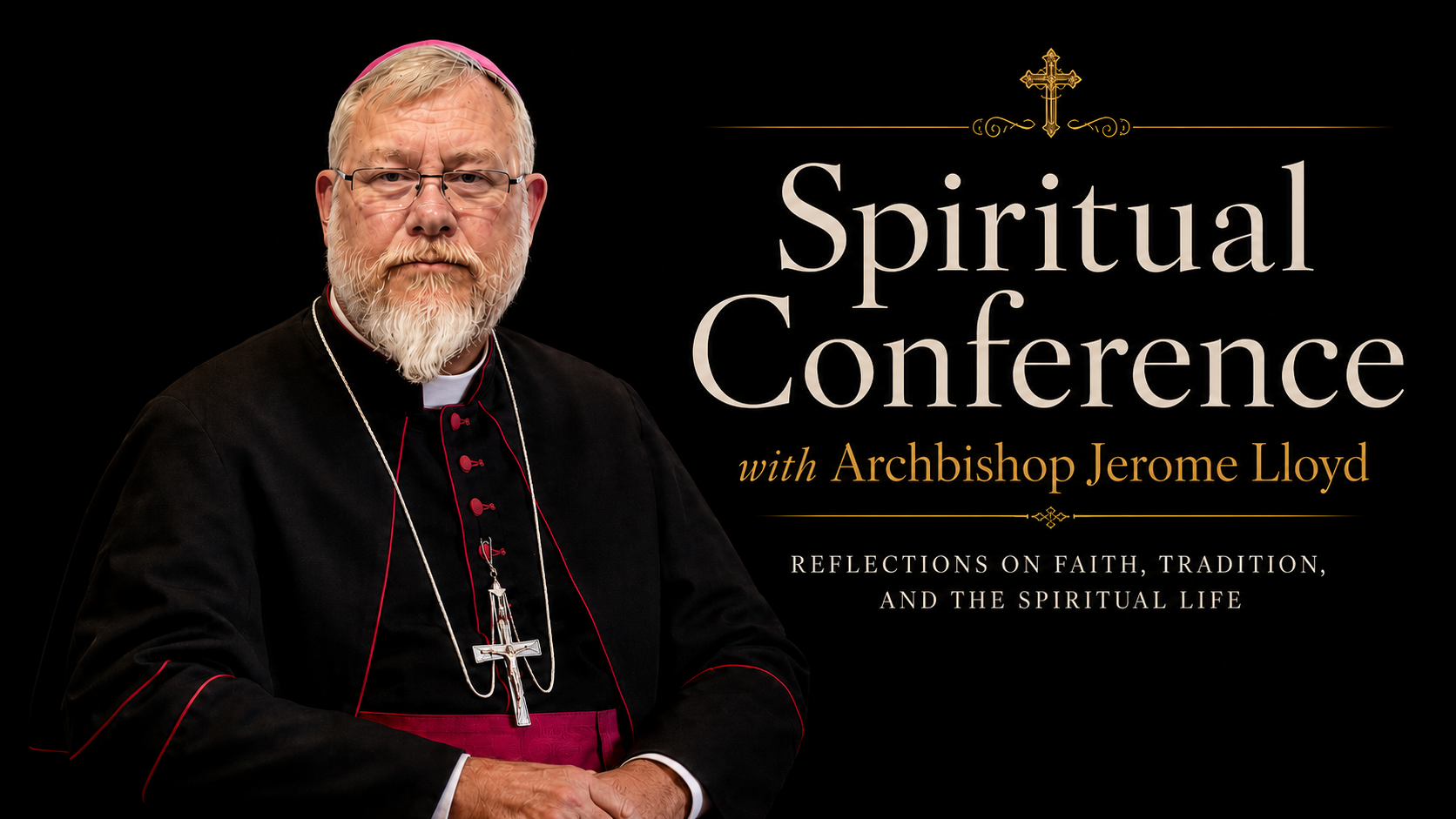
- QUI BENE DISTINGUIT, BENE DOCET ~ He who distinguishes well, teaches well: Spiritual Conference for Nuntiatoria CXXIIIIn a series of Tuesday conferences, the speaker explores themes about recognising reality, receiving divine gifts, and understanding spiritual truths. He highlights the importance of making careful distinctions to maintain sound judgment, especially in an age consumed by distractions and superficial assessments. True wisdom lies in distinguishing truth from perception and nurturing an authentic inner life centred on Christ.
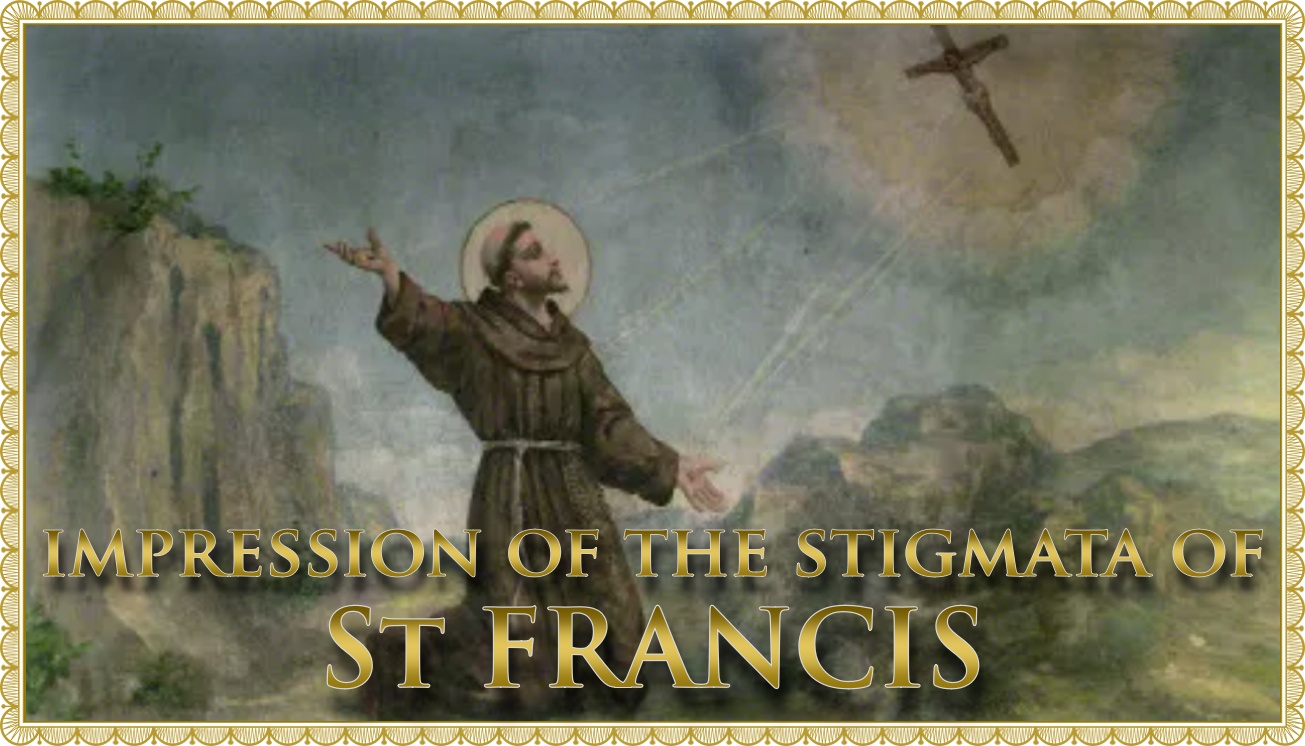
- Today’s homily: Impression of the Stigmata upon St FrancisFrom serving the lepers he once shunned to receiving Christ’s wounds upon Mount Alvernia, Saint Francis shows how grace transforms a soul through obedient love. His stigmata call us to let the Cross shape our lives, beginning with the particular act of mercy or sacrifice we have been reluctant to offer.
- Today’s Mass: September 17 Impression of the Stigmata of St Francis of AssisiSaint Francis received the stigmata because he had first allowed the Cross to transform his soul. His wounds were not a spectacle, but God’s answer to a world growing cold: the visible sign of a life consumed by crucified love. We may never bear Christ’s wounds in our flesh, but we must bear their likeness through penance, fidelity, patience, mercy and sacrificial love.
- Sermon for Stigmata of St. FrancisToday marks the feast of St. Francis’ stigmata, celebrating his transformation from a wealthy merchant’s son to a devoted preacher of poverty and humility. He founded the Franciscan order, emphasising evangelisation and simplicity. His experience of receiving the stigmata exemplifies the Christian doctrine of redemption through suffering, distinguishing it from other faiths.
- Today’s homily: Wednesday Michaelmas EmberThe homily reflects on the significance of fasting and prayer in the Christian faith, emphasising their role in spiritual growth and self-mastery. By juxtaposing scripture from Amos and the Gospel of Mark, it highlights the need for gratitude and humility during abundance, urging believers to recognise their dependence on God. True repentance transforms and restores one’s relationship with Him.
CURRENT EDITION


Today’s Mass Propers
- Today’s Mass: September 17 Impression of the Stigmata of St Francis of Assisi
 Saint Francis received the stigmata because he had first allowed the Cross to transform his soul. His wounds were not a spectacle, but God’s answer to a world growing cold: the visible sign of a life consumed by crucified love. We may never bear Christ’s wounds in our flesh, but we must bear their likeness through penance, fidelity, patience, mercy and sacrificial love.



Leave a Reply