
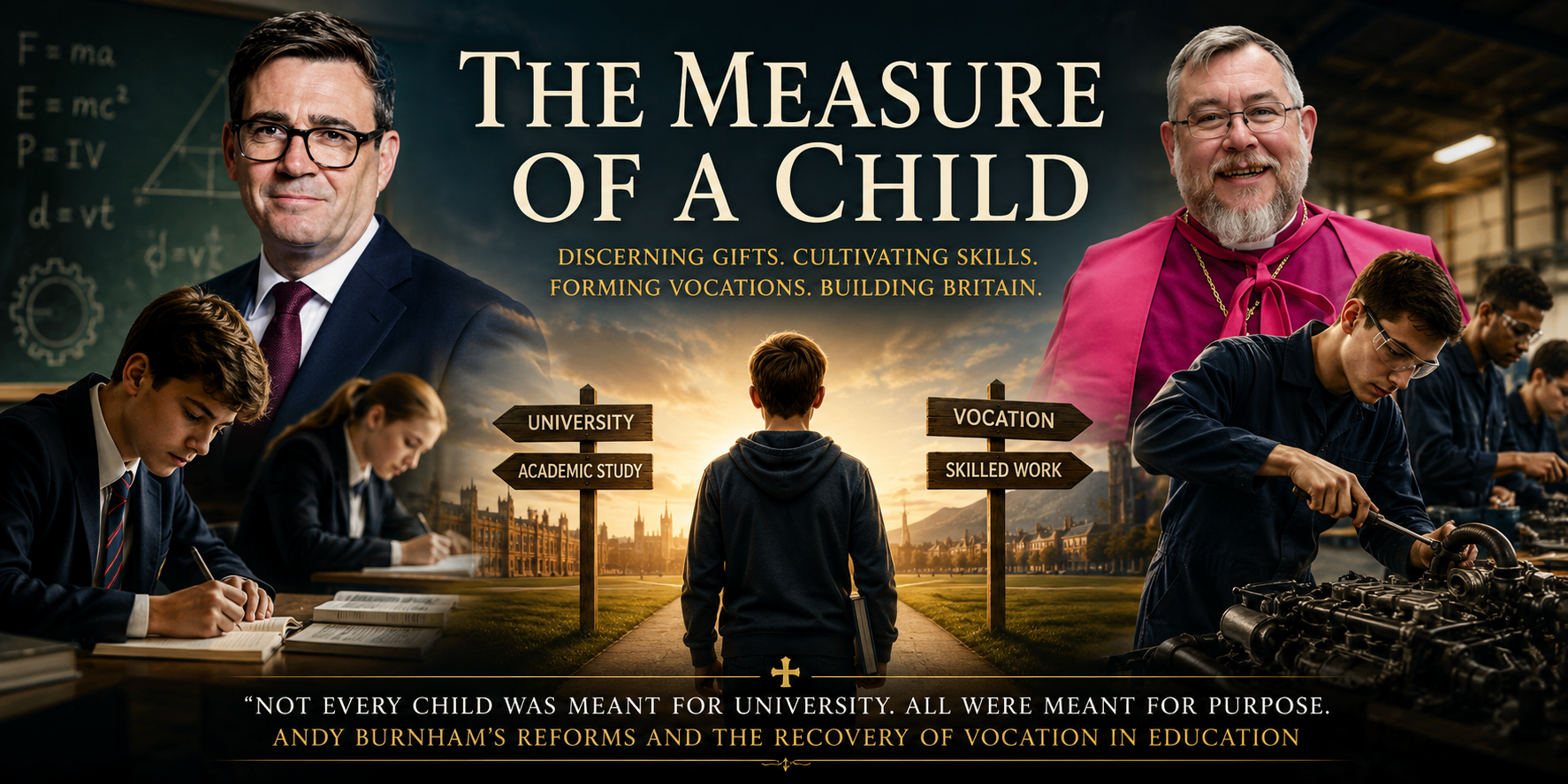
The Measure of a Child: Andy Burnham’s reforms and the recovery of vocation in education
Britain has spent decades mistaking one form of achievement for intelligence itself. Andy Burnham’s technical-education reforms offer an opportunity to correct that error. For HE ✠Jerome Lloyd, who has argued this case for decades, the first duty of education is to discern the gifts God has placed within each child, cultivate them through discipline and direct them towards a purposeful life.

A child can understand an engine before he can explain a metaphor. He may hear the slightest irregularity in its movement, trace a fault through parts he has never seen before and discover, by a mixture of reason and touch, why the machine will not run. Put the same child before an examination paper and he may appear unremarkable. Keep him there long enough and he may begin to believe it.
British education has done this to countless children. It has measured them by the abilities most easily demonstrated in classrooms, rewarded in examinations and certified by universities. Those who excelled under those conditions were called able. Those whose intelligence disclosed itself through materials, mechanisms, movement, care or practical judgement were often left waiting for the system to notice.
Some are still waiting.
Andy Burnham’s announcement at Alstom’s railway works in Derby on 28 July therefore deserves more than the usual guarded approval offered to another educational initiative. His Government proposes technical pathways from the age of fourteen, combining English, mathematics and science with specialist teaching, work experience and contact with local employers. Schools, colleges, regional authorities and businesses are to shape routes connected with the industries and needs of their areas. The first national provision is intended to begin in September 2028.¹
Burnham said that Britain must value “the hard hat every bit as much as the graduation cap”. It is a political slogan, but a good one. Behind it lies an admission that the country has not valued them equally, however often ministers have praised apprenticeships and posed for photographs in hard hats.
HE ✠Jerome Lloyd is one hundred per cent behind the reform. For decades, he has maintained that education should discern the skills, abilities and predispositions God has given to each child; cultivate them through knowledge, practice and discipline; and enable their application in a purposeful and meaningful life.
That proposition is simple enough to be overlooked. It contains, however, a complete philosophy of education.
It begins with the child as a particular person, not as a standard unit passing through an administrative system. Children do not arrive with identical minds, temperaments or aptitudes. One possesses an unusual command of language. Another sees patterns in numbers. Another understands machines, materials or spatial relationships with an immediacy that cannot be taught. Some are naturally patient with the sick, elderly or very young. Others possess a craftsman’s precision, an engineer’s curiosity or the calm judgement required when something has gone wrong.
These distinctions are not defects in equality. Equality of human dignity never required uniformity of ability. God does not distribute His gifts by national curriculum.
The work of education is therefore partly one of discovery. A teacher must ask not only what a pupil has failed to learn, but what sort of intelligence he possesses, what awakens his attention and where his natural capacities might be brought under discipline. The question is not whether every inclination should be indulged. Children may dislike what they need, overestimate what they can do and resist the labour by which ability becomes competence. Discernment is neither flattery nor surrender.
A gift is only a beginning.
The child with an instinct for machinery must learn mathematics, tolerances, safety and method. The naturally compassionate child must acquire the knowledge and steadiness demanded by professional care. The gifted musician must practise when inspiration has deserted him. Education honours a talent by requiring something of it.
This is why the recovery of vocational education must involve far more than allowing pupils to escape lessons they find difficult. Proper technical formation is exacting. An electrician cannot persuade a circuit to overlook his error. A structure does not remain standing because an engineer meant well. A nurse’s inattention cannot be repaired by generous marking. Practical work is answerable to realities that do not adjust themselves to confidence, theory or fashionable opinion.
There is an austere honesty in learning to make something work.
For years, however, Britain arranged its educational prestige around a different principle. University became the expected destination of the able and ambitious. Schools were judged by the proportion of pupils they sent there. Parents were encouraged to treat admission as proof that their children had succeeded. Employers began requiring degrees for occupations previously entered through aptitude, training and experience.
Technical education remained available, but often as the route mentioned after the preferred one had become impractical. The vocabulary betrayed the assumption. University was an aspiration; vocational training was an alternative. The distinction was not lost on pupils.
This did not occur because anyone formally decreed that electricians were inferior to graduates. The hierarchy was established more quietly, through funding, institutional status, careers advice and social expectation. A pupil could hear endless praise of skilled work while observing that the school reserved its greatest pride for university offers.
The message was absorbed at home as well. Parents who relied daily upon mechanics, builders, nurses and electricians might still worry that a child entering one of those occupations had somehow fallen short. They wanted the best for him, but had been taught to recognise the best in a particular costume.
Britain came to admire skilled work while discouraging its own children from doing it.
The political history is not wholly Labour’s responsibility. The Further and Higher Education Act 1992, passed under John Major’s Conservative government, ended the formal division between universities and polytechnics and permitted the latter to assume university titles.² The former polytechnics were serious institutions providing higher technical, professional and applied education, often in close association with regional industry.
Many became successful universities. Yet the change carried an unintended confession. Britain did not raise the standing of polytechnics while preserving their distinctive purpose. It gave them greater dignity by turning them into universities.
The country lost not only a name, but an institutional idea: that higher technical education might possess its own traditions, demands and prestige without imitating the academy.
Tony Blair then made university expansion one of the governing symbols of national advancement. Addressing the Labour Party Conference on 28 September 1999, he set a target of 50 per cent of young adults entering higher education.³ Strictly understood, higher education included technical and vocational qualifications as well as degrees. In public policy and public imagination, however, the target became inseparable from university attendance.
A House of Lords committee later observed that the expansion had been achieved overwhelmingly through full-time undergraduate study, while technical provision remained comparatively weak and employers continued to report shortages of technical skills. “Higher education”, it concluded, had become virtually synonymous with university.⁴
Blair’s ambition was not ignoble. Wider access gave opportunities to young people whose families had previously been excluded from university. Many lives were enlarged by it. The error lay in permitting one valuable route to become the national measure of aspiration.
Britain widened the road to university until the other roads looked like failures to join it.
The consequences have accumulated. Young people have undertaken expensive degrees without any clear connection between their studies and the work available afterwards. Employers have used degree requirements as convenient filters even where graduate-level knowledge was unnecessary. Colleges and apprenticeships have struggled for status and resources. Meanwhile, businesses complain that they cannot recruit the technicians, engineers and skilled workers upon whom their operations depend.
The country did not suffer from too much learning. It suffered from a narrow account of what learning looks like and an impoverished idea of what education is for.
Burnham’s reform is significant because it begins before the damage has become final. By fourteen, many pupils have already learnt whether school considers them successful. A young person repeatedly measured by his weaknesses may withdraw effort from the whole enterprise. Technical study can reveal that mathematics, science and literacy are not arbitrary hurdles but instruments through which his own abilities become effective.
A measurement must be exact because the component must fit. Physics matters because weight, pressure and current have consequences. Written instructions matter because ambiguity may be dangerous. The pupil does not abandon academic knowledge; he encounters its authority in use.
That may restore more than his interest. It may restore his self-respect.
The reform nevertheless carries serious risks. Technical education has too often been promised with great ceremony and delivered through changing qualifications, inadequate workshops and courses employers scarcely recognise. Parity of esteem cannot be legislated into existence. It will be decided by what the Government funds, what schools recommend to their strongest pupils, what employers contribute and where the qualifications actually lead.
Engineering requires machinery. Construction requires materials and appropriate spaces. Healthcare training requires specialist facilities and supervision. Skilled instructors may command salaries outside education that schools and colleges cannot match. A technical course taught principally from worksheets will advertise its inferior status more eloquently than any minister can deny it.
Employers must also accept that training is part of their responsibility. Firms cannot lament skills shortages while expecting the state to deliver finished workers at no cost to themselves. An apprenticeship requires time, patience and the deliberate transmission of standards. It is a relationship in which one generation hands on its accumulated competence to the next.
Where that transmission is taken seriously, an apprentice acquires more than a certificate. He learns how a skilled person approaches a task, notices an error, respects materials, keeps his word and takes responsibility for the finished work. Such habits belong to character as much as employment.
Technical pathways must not, however, become a discreet means of removing inconvenient pupils from academic classrooms. A system in which affluent children continue to receive a broad education while poorer children are channelled towards narrow training would merely give an older social division a modern administrative form.
The real test of esteem will be whether a pupil with excellent grades can choose an engineering apprenticeship without being asked why he is wasting his ability.
Nor should a decision at fourteen settle a life. Gifts develop unevenly. Interests change; maturity arrives at different speeds. Some pupils who appear practical will later discover academic strengths, while others will tire of an abstract course and find their vocation elsewhere. The new routes must remain permeable, allowing movement into advanced qualifications, university, management, research or self-employment.
To discern a gift is not to confine its possessor.
A technical education must also remain an education. The electrician is not merely a pair of hands hired to connect wires. He is a citizen, neighbour, husband, father and moral agent. The nurse needs humane judgement as well as clinical technique. The engineer may one day bear responsibility for employees, public safety or decisions whose consequences cannot be reduced to calculation.
History, literature, ethics and religious understanding are not ornaments reserved for academic pupils. They belong to the formation of human beings. Vocational education becomes degrading when it treats the young person merely as labour under preparation, just as university education becomes sterile when it produces credentials without wisdom, judgement or useful competence.
The human person is more than an economic resource. Yet meaningful work is among the principal means by which a person exercises responsibility, supports others and contributes to the common good. There is no contradiction between educating the whole person and preparing him to do something well.
Indeed, competence possesses a moral quality. Something is safe because a worker refused to be careless. A patient is comforted because a nurse noticed what others missed. A family has light and heat because an electrician knew his trade. A building stands because people obeyed standards that no occupant will ever see.
Much of civilisation rests upon work performed properly by people whose names are unknown.
The Christian language of vocation gives this reality its depth. A vocation is not confined to the sanctuary or religious life. God calls men and women to sanctity through the duties proper to their state, and those duties ordinarily include work. Natural gifts indicate possibilities within that calling, though they do not dispense with sacrifice, prudence or circumstance.
To discover that one can build, heal, teach, repair, design or organise is to discover a capacity that carries obligations. The gift is personal, but its purpose is not private. It is brought to maturity so that it may bear fruit beyond the self.
This understanding differs sharply from the culture of credentialism. Credentialism asks what status a qualification confers. Vocation asks what a person has been given and whom it may serve. The former easily encourages young people to accumulate certificates while postponing the question of purpose. The latter places education within an account of responsibility.
For decades, HE ✠Jerome Lloyd has argued that education should begin there. It should help children recognise their God-given skills, abilities and predispositions; subject those gifts to the discipline without which they remain immature; and enable their fruitful exercise in lives of service and purpose.
That principle does not dictate a single educational structure. It does provide a standard by which structures may be judged. A school succeeds when the bookish child is stretched rather than bored, the practical child is instructed rather than patronised, and neither is taught to despise the other. A university succeeds when it serves knowledge rather than merely selling credentials. A technical college succeeds when its qualifications correspond to genuine mastery. An apprenticeship succeeds when it forms a worker whose competence can be trusted.
The measure is not how many young people pass through the most prestigious door. It is how many are helped to recognise the door through which they ought to pass.
Burnham’s announcement may mark a genuine change, provided the Government resists the temptation to confuse naming a pathway with building one. Workshops must be funded. Teachers and instructors must be found. Employers must accept apprentices as persons to be formed, not cheap labour to be exploited. Parents must be persuaded that a skilled trade is not a consolation prize. Schools must cease treating vocational education as somewhere to send the children who disturb their statistics.
Most difficult of all, Britain must abandon the vanity by which academic success is taken as the principal evidence of intelligence.
The graduation cap deserves honour. So does the hard hat. So do the nurse’s uniform, the mechanic’s overalls, the craftsperson’s bench and the technician’s tools. Their equality does not consist in pretending that every occupation is identical. It consists in recognising that different forms of skilled and honest work answer different needs within the same common good.
Some children will go to university and flourish there. Others will discover that the classroom in which they first appeared ordinary was simply the wrong place to reveal what they could do.
Education should not spend their childhood proving that they are poor versions of somebody else. It should discern what God has placed within them, teach them to master it and send them into the world capable of doing something necessary and doing it well.
That is the reform Britain needs. Burnham has at least begun to name it.
- House of Lords Economic Affairs Committee, Treating Students Fairly: The Economics of Post-School Education, Second Report of Session 2017–19, Chapter 1; House of Lords, ‘Education: Treating Students Fairly’, debate of 16 January 2019.
- Prime Minister’s Office, ‘PM: “From today Britain will value the hard hat as much as the graduation cap”’, 28 July 2026. The announcement provides for technical pathways from fourteen, combining core academic subjects with specialist teaching, work experience and employer links; national implementation is intended to begin in September 2028.
- Further and Higher Education Act 1992, 1992 c. 13, especially Part II and the provisions governing the higher-education corporations formerly maintained as polytechnics.
- Tony Blair, address to the Labour Party Conference, 28 September 1999: ‘So today I set a target of 50 per cent of young adults going into higher education in the next century.’
RELATED ARTiCLES


LATEST ARTICLES
- QUI BENE DISTINGUIT, BENE DOCET ~ He who distinguishes well, teaches well: Spiritual Conference for Nuntiatoria CXXIIIIn a series of Tuesday conferences, the speaker explores themes about recognising reality, receiving divine gifts, and understanding spiritual truths. He highlights the importance of making careful distinctions to maintain sound judgment, especially in an age consumed by distractions and superficial assessments. True wisdom lies in distinguishing truth from perception and nurturing an authentic inner life centred on Christ.
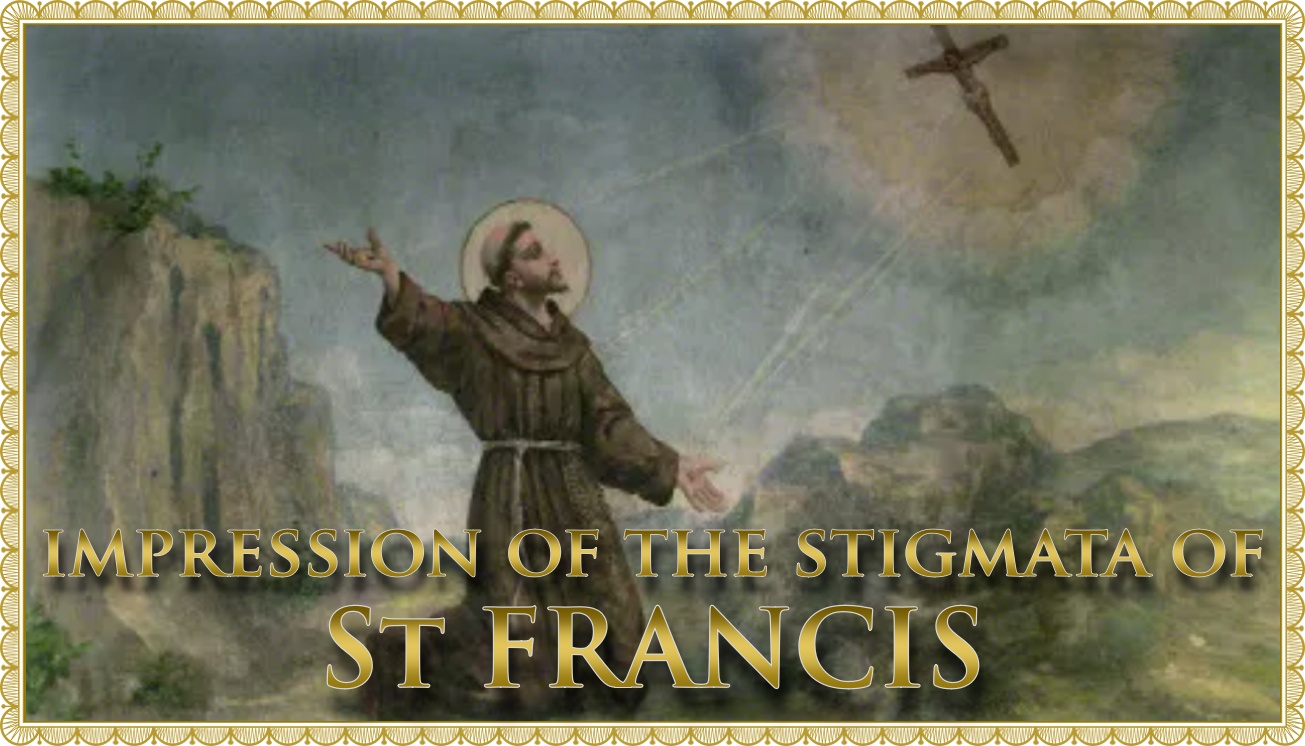
- Today’s homily: Impression of the Stigmata upon St FrancisFrom serving the lepers he once shunned to receiving Christ’s wounds upon Mount Alvernia, Saint Francis shows how grace transforms a soul through obedient love. His stigmata call us to let the Cross shape our lives, beginning with the particular act of mercy or sacrifice we have been reluctant to offer.
- Today’s Mass: September 17 Impression of the Stigmata of St Francis of AssisiSaint Francis received the stigmata because he had first allowed the Cross to transform his soul. His wounds were not a spectacle, but God’s answer to a world growing cold: the visible sign of a life consumed by crucified love. We may never bear Christ’s wounds in our flesh, but we must bear their likeness through penance, fidelity, patience, mercy and sacrificial love.
- Sermon for Stigmata of St. FrancisToday marks the feast of St. Francis’ stigmata, celebrating his transformation from a wealthy merchant’s son to a devoted preacher of poverty and humility. He founded the Franciscan order, emphasising evangelisation and simplicity. His experience of receiving the stigmata exemplifies the Christian doctrine of redemption through suffering, distinguishing it from other faiths.
- Today’s homily: Wednesday Michaelmas EmberThe homily reflects on the significance of fasting and prayer in the Christian faith, emphasising their role in spiritual growth and self-mastery. By juxtaposing scripture from Amos and the Gospel of Mark, it highlights the need for gratitude and humility during abundance, urging believers to recognise their dependence on God. True repentance transforms and restores one’s relationship with Him.
CURRENT EDITION


Today’s Mass Propers
- Today’s Mass: September 17 Impression of the Stigmata of St Francis of Assisi
 Saint Francis received the stigmata because he had first allowed the Cross to transform his soul. His wounds were not a spectacle, but God’s answer to a world growing cold: the visible sign of a life consumed by crucified love. We may never bear Christ’s wounds in our flesh, but we must bear their likeness through penance, fidelity, patience, mercy and sacrificial love.



Leave a Reply