
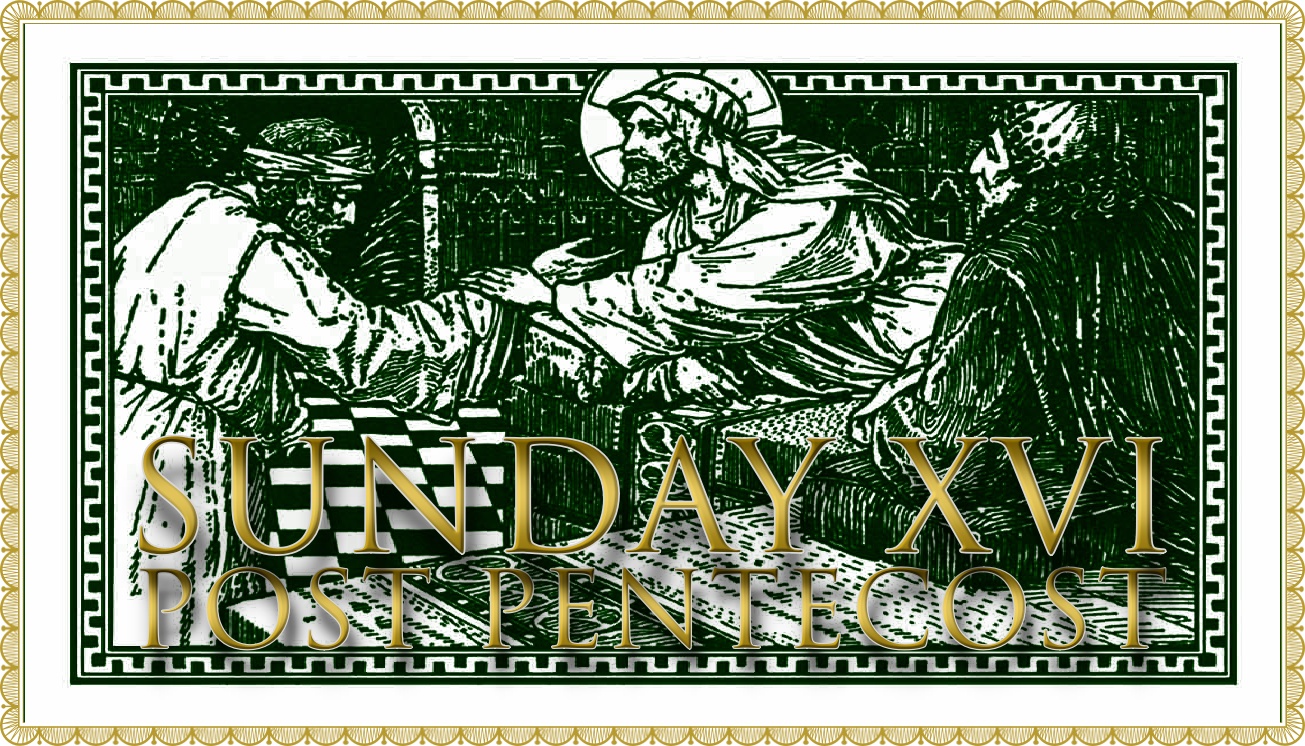
Sixteenth Sunday after Pentecost
In today’s epistle from St. Paul to the Ephesians the apostle exhorts them not to faint at his tribulations for them, which are their glory. He states: “For this cause I bow my knees to the Father of our Lord Jesus Christ, of whom all paternity in heaven and on earth is named, that he would grant you, according to the riches of his glory, to be strengthened by his spirit with might unto the inward man. That Christ may dwell by faith in your hearts; that being rooted and grounded in charity, you may be able to comprehend with all the saints, what is the breadth and length and height and depth.” He prays that they may know the charity of Christ which surpasseth knowledge that they may be filled with all the fullness of God. “Now to him who is able to do all things more abundantly than we desire or understand, according to the power that worketh in us: to him be glory in the Church and in Christ Jesus, unto all generations, world without end.”
But what was the context in which St. Paul wrote these words? St. Paul’s epistle to the Ephesians has been called the crown of Paulinism, in which the apostle reflects on the nature of the Church as a new creation in Christ, and how Christians are called to live as members of the Body of Christ. Whereas St. Paul wrote to the Colossians to combat a specific error that had arisen in the Church, the epistle to the Ephesians is more like a general encyclical that could be read in any church. St. Paul is able to rise above the controversy that occasioned his other writings to reflect on the nature of those who have been chosen in Christ from before the foundation of the world and have been freely accepted in the Beloved, in whom we have redemption by his blood, the forgiveness of sins. This was the fulfilment of the divine purpose in creating the universe, to sum up all things in Christ. Formerly the Gentiles were outside the covenant people of God, without hope and without God in the world, but now they have been brought into the chosen people of God through the blood of Christ, the new man who has broken down the barriers that separated them from the people of God, and incorporated them into himself. In a world marked by division and separation, Christians have been made one in Christ through the regenerating waters of baptism and must now strive to become by grace what he is by nature.
The Gospel from St. Luke (which we heard today) records that Jesus spoke a parable on an occasion when he was invited to eat bread in the house of one of the chief Pharisees. He noted those who chose the first seats at the table, saying to them: “When thou art invited to a wedding, sit not down in the first place, lest perhaps one more honourable than thou be invited by him; and he that invited thee and him, come and say to thee: Give this man place; and then thou begin with shame to take the lowest place.” It was better when invited to take the lowest place “that when he who invited thee cometh, he may say to thee: Friend go up higher: then shalt thou have glory before them that sit at table with thee: because every one that exalteth himself shall be humbled and he that humbleth himself shall be exalted.”
The parable was a stark rebuke to those whose first instinct at a social gathering was to grasp the best place for themselves, regardless of the needs of others. Their behaviour showed that their priorities were purely worldly. When God’s will would finally be done on earth as it is in heaven the first would be last and the last first, those who exalted themselves would be humbled and those who humbled themselves would be exalted. The Kingdom of God, future in its fullness, was now breaking into history in Jesus’ own person and ministry. Hence, his followers should no longer govern their lives by the standards of the present age that was passing away, but rather by the absolute standards of the Kingdom of God. For where there treasure is there would there heart be also.
But, we might say, we no longer live in an age of unquestioning defence to social superiors and consequently these words are no longer relevant now. On the contrary, though our society may superficially seem less rigidly hierarchical than it used to be, if we look beneath the surface the same problems still exist, though often in more subtle ways than before. The world of advertising and entertainment and the media encourages people to be obsessed by their image and appearance. They are taught to buy things that they do not need with money that they do not have in order in impress people who are not worth knowing. Everyone is encouraged to be constantly competing against everyone else. Those who lack material possessions are angry and frustrated that they are deprived of the benefits that those who are wealthier than them have. But those who have successfully “played the game” and have great wealth and status are also often unhappy and frustrated because they can never relax because they need to stay ahead of any competitors who might in the long term be rivals to their positions of power and status. The public relations industry encourages people to do anything that looks good, rather than what truly matters, which is doing good. It has been rightly termed an age in which people know the price of everything, and the value of nothing.
What is the answer to this seemingly insoluble situation? It lies in Jesus’ words about the importance of humility. Our age has made pride, which used to be seen as the cardinal sin, into a virtue. People are encouraged to cultivate “self esteem” and “self worth” at every possible opportunity and to create their own virtual reality which flatters their sense of pride. By contrast, humility arises from the truth, of recognising our own strengths and weaknesses and being content with what is realistically possible in a situation. The truth of matter is that we have no power of ourselves to help ourselves and need to rely on God’s grace to think, will and do that which is good. When we let go of our pride in our own virtual reality we can then begin to learn what truly matters, first love of God and then love of neighbour.
Let us make our own the words of today’s collect:
O Lord, we pray thee that thy grace may always prevent and follow us, and make us continually intent on all good works.
by the Revd Dr Robert Wilson PhD (Cantab), Old Roman Apostolate UK




Leave a Reply