
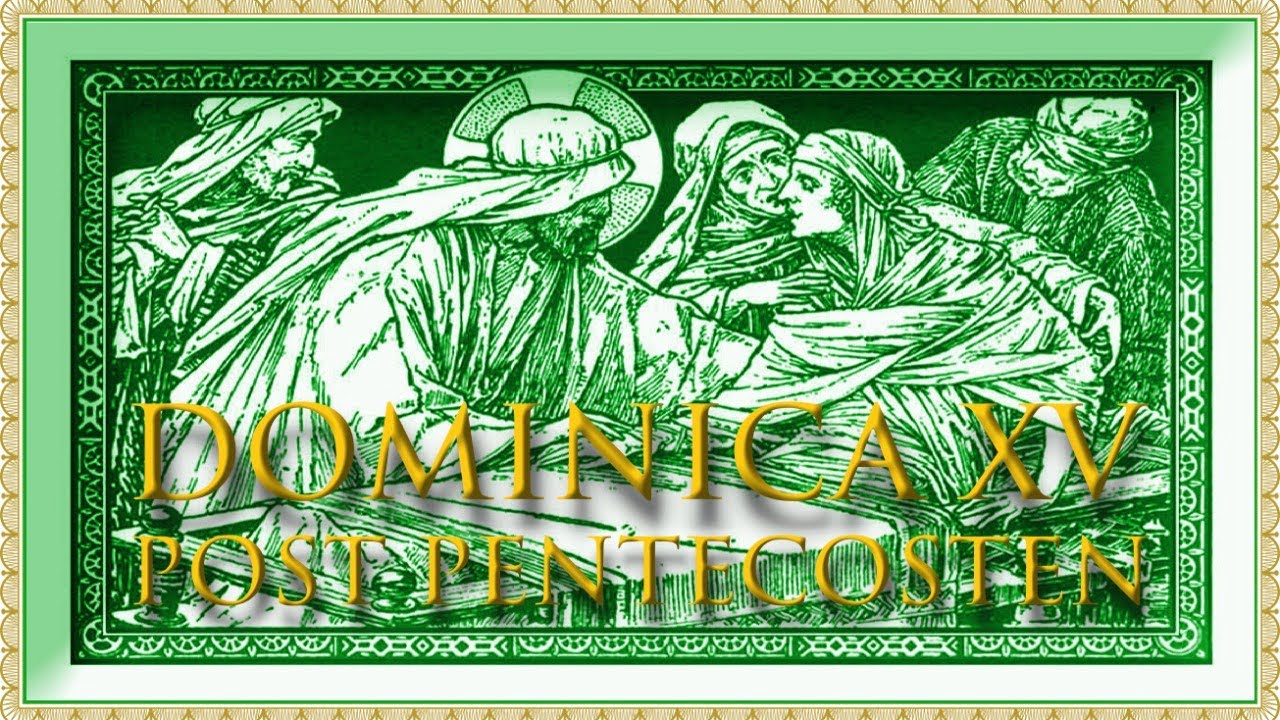
Fifteenth Sunday after Pentecost
“Brethren, if we live by the Spirit, let us walk in the spirit. Let us not be made desirous of vain glory, provoking one another, envying one another.”
In today’s epistle St. Paul exhorts the Galatians to practice charity in their lives, for the love of God has been poured into their hearts by the Holy Spirit which has been bestowed upon them. They are not to envy one another, but to speak the truth in love. If they need to correct someone who has fallen into sin they are to do so in a spirit of meekness, since they too are fallen and sinful and subject to temptation. They are to bear one another’s burdens, and so fulfil the Law of Christ, which is charity. “For if any man think himself to be something, whereas he is nothing, he deceiveth himself.” Others may be deceived by their behaviour, but God is not mocked. “For what things a man shall sow, those also shall he reap. For he that soweth in his flesh, of his flesh also shall reap corruption: but he that soweth in the spirit, of the spirit shall reap life everlasting. And in doing good, let us not fail; for in due time we shall reap, not failing.” They are called to do good to all, “but especially to those who are of the household of faith.”
But what was the context in which St. Paul wrote these words? St. Paul wrote to the Galatians to combat the first great heresy that arose in the history of the Church. This was the belief that it was necessary for a Gentile (that is, a non-Jew) to be circumcised (in other words convert to Judaism) in order to be within the Church, the Body of Christ. St. Paul’s opponents argued that Abraham, the founding father of the Jewish nation, had been given the covenant of circumcision, and that it was this that marked membership of the people of God. St. Paul replied that the promise to Abraham that in his seed all the nations of the earth would be blessed was given to all who believed, whether they were Jews or Gentiles. The people of God were defined, not by race, but by faith. It was baptism, not circumcision, that marked membership of the Church. “For as many of you who have been baptised into Christ have put on Christ. There is neither Jew nor Greek, there is neither bond nor free, there is neither male nor female: for ye are all one in Christ Jesus. And if ye be Christ’s, then are ye Abraham’s seed, and heirs according to the promise” (Galatians 3:27-29).
The Old Testament prophets had looked forward to a coming messianic age, in which sin and death would be finally dealt with, and Israel and the rest of the world would be redeemed. The Gentiles would renounce their idols and come to Jerusalem to join the redeemed of Israel in the worship of the one true God. However, it was not suggested that they would become Jews- all that was necessary was for them to renounce their idols and worship the one God.
St. Paul believed that the hope of Israel had now been fulfilled in the life, death and resurrection of Jesus. “But when the fullness of time was come, God sent forth his Son, made of a woman, made under the law, in order to redeem them that were under the law, that we might receive the adoption of sons. And because ye are sons God has sent forth the Spirit of his Son into your heart crying, Abba, Father” (Galatians 4:4-6). He alone was the truly faithful Israelite who had finally dealt with sin and death and inaugurated the new covenant in which sins are forgiven. Hence, it was now time for the Gentiles to come to worship the true God. They did not need to convert to Judaism and be circumcised. All that was necessary was for them to repent and be baptised, and they would receive the gift of the Holy Spirit. They must then walk by that same spirit, and not by the works of the flesh that characterised their former life.
Later Christian thought drew a distinction between moral and ceremonial law. It was said that Christians were not bound to follow the rites and ceremonies of the Law of Moses, but they were bound to follow the moral precepts of the Law. However, St. Paul upheld the Jewish assumption that the Law is unitary. That is why he states that if any man be circumcised it is necessary that he keep the whole law (Galatians 5:3). Rather than using the later Christian distinction between ceremonial and moral law he contrasts the works of the flesh with the works of the spirit. “Now the works of the flesh are manifest, which are fornication, uncleanness, immodesty, luxury, idolatry, witchcrafts, enmities, contentions, emulations, wraths, quarrels, dissentions, sects, envies, murders, drunkenness, revellings and such like” (Galatians 5:19-21). “But the fruit of the spirit is charity, joy, peace, patience, benignity, goodness, longanimity, mildness, faith, modesty, continency, chastity. Against such there is no law” (Galatians 5:22-23).
None of us lives fully in accordance with the fruits of the spirit in this life. We still have this treasure in earthen vessels and none of us is able to fully realise this vision. St. Paul wrote that long suffering was one of the fruits of the spirit, but he was not himself of a very long suffering disposition. All of us are still fallen and sinful, even though in each of us this expresses itself in different ways. We have no power of ourselves to help ourselves, but our sufficiency is of God, who comes to us in the person of Jesus Christ. We can be transformed by following him who did for us what we could not do for ourselves, and so inaugurated the new covenant in which sins are forgiven. We are following not simply precepts written on tablets of stone, but a living person. We must pray that we may grow in holiness and live in accordance with the fruit of the spirit
by the Revd Dr Robert Wilson PhD (Cantab), Old Roman Apostolate UK




Leave a Reply