

The Crown That Cannot Be Taken Away
MASS Os justi
LESSON Ecclus. 31: 8-11
GOSPEL St Luke 12: 35-40
HOMILIST Mt Revd Jerome Lloyd OSJV

In the Name of the Father, and of the Son, and of the Holy Ghost. Amen.
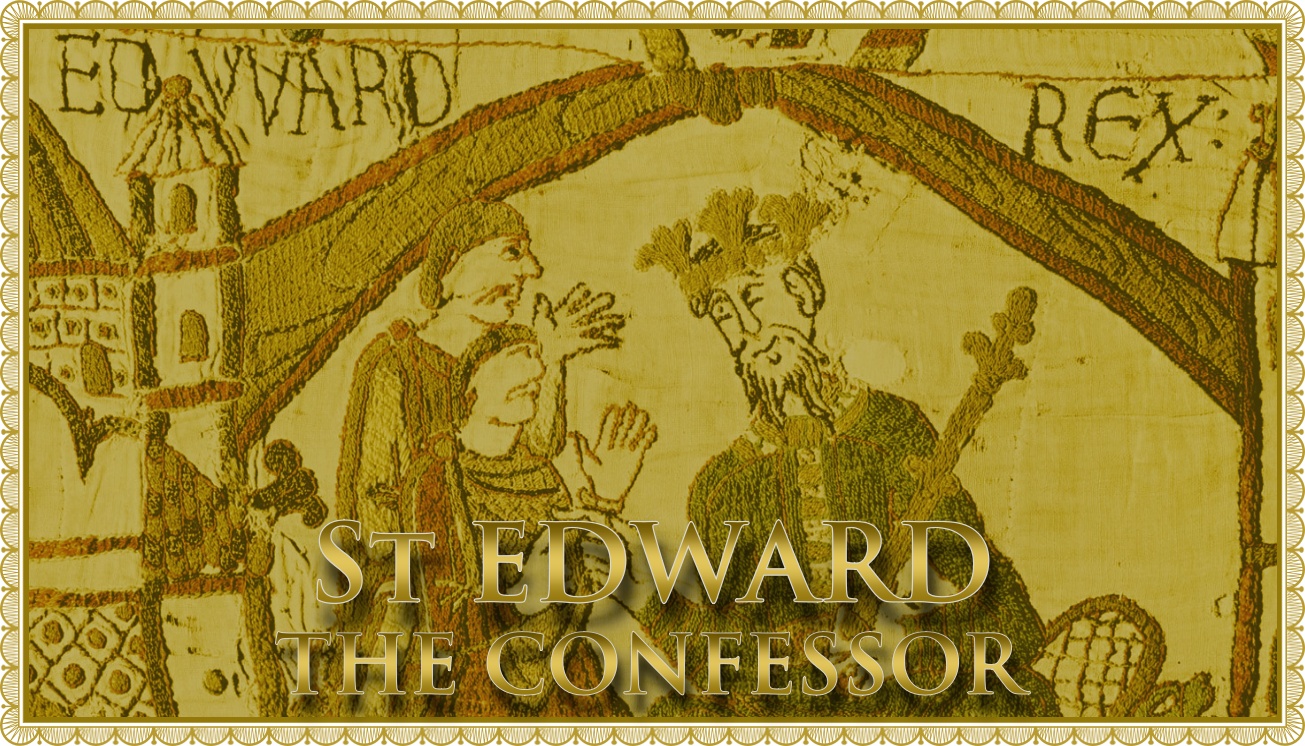
A king lies dying in Westminster in January 1066. His great abbey church has been consecrated only days earlier, but he has been too ill to attend. He has no child to succeed him. Powerful men dispute the future of England, and before the year is out a battle near Hastings will transform the kingdom. By the standards of political history, the end of Edward’s reign is overshadowed by what followed. Yet the Church places his name upon her altars and calls him a saint.
Why should Catholics in every country honour an English monarch who died nearly a thousand years ago? Today’s Mass supplies an answer that goes beyond the circumstances of his kingdom. Its Epistle praises the man who had riches without trusting in them; its Gospel commands servants to keep their lamps alight while awaiting their master. Edward’s particular vocation was kingship; the virtues by which he sought to sanctify it belong to every Christian.
Edward was born around 1003, the son of Æthelred and Emma of Normandy. Danish conquest drove him into long exile on the Continent. He returned to England and became king in 1042, governing amid the rivalries of powerful earls, particularly the family of Godwine, whose daughter Edith became his wife. Accounts of his reign differ, as historical judgements properly may. But witnesses remembered his prayer, almsgiving, solicitude for justice and devotion to the Church. He was a confessor, not a martyr: one whose witness was given through a life perseveringly offered to God.
A tradition records that Edward, having vowed a pilgrimage to Rome, was unable to leave the kingdom without neglecting his people. With papal approval, his obligation was commuted into the rebuilding of the abbey dedicated to St Peter at Westminster. Notice the spiritual sense of that decision. A work undertaken for God must not become an excuse for abandoning responsibilities already entrusted to us by God. Even a pilgrimage can be ill-timed if it leaves those in our care without what we owe them.
The abbey church was consecrated on 28 December 1065. Edward died on 5 January 1066 and was buried there on the Epiphany. Pope Alexander III canonised him in 1161; his relics were translated on 13 October 1163, and again on that date in 1269 to the shrine in Henry III’s rebuilt church. The date of the translation explains today’s feast. In 1679 Pope Innocent XI extended Edward’s cult to the universal Church. Thus this is no merely English anniversary. Rome commends a king of England to the faithful of every nation because sanctity, unlike earthly sovereignty, knows no national boundary.
One story, beloved of the Middle Ages, tells how a poor stranger asked Edward for alms. Having no money to hand, the king gave him the ring from his finger; the stranger was later identified in the legend as St John the Evangelist. We need not treat every detail of that tale as established history to understand why generations treasured it. A ring upon a king’s hand signifies dignity and possession; in the story it becomes a gift to someone with no claim upon the royal treasury. The point is not the price of the jewel but the freedom of the giver.
Listen, then, to Ecclesiasticus: “Blessed is the man that is found without blemish, and that hath not gone after gold, nor put his trust in money nor in treasures.” The text does not condemn the possession of wealth in itself. A ruler must administer resources; a parent must provide for a family; a merchant may legitimately prosper. The question is whether wealth remains an instrument of justice and charity or becomes the master of the heart. What we trust in reveals what we worship.
The Epistle presses further: “He that could have transgressed, and hath not transgressed, and could do evil things, and hath not done them.” Here is virtue tested by opportunity. A king can command, threaten, reward and conceal. The powerful are often insulated from contradiction. To possess the means of doing wrong and deliberately refuse them is a more searching achievement than appearing upright simply because temptation lies beyond one’s reach.
We may never wield a sceptre, but authority enters ordinary life in smaller and no less consequential forms. A manager can humiliate an employee who cannot answer back; a teacher can overlook a struggling child; a parent can mistake impatience for discipline. A professional may be urged to approve something he believes harmful because it complies with policy and everyone else has signed. Conscience sometimes requires the quiet, costly sentence: “I cannot do that.” Neither procedure nor popularity can turn what is unjust into what is right.
But Christian integrity is more than saying no. In the Gospel Our Lord commands: “Let your loins be girt, and lamps burning in your hands.” St Gregory the Great explains that the girded loins signify chastity and restraint of disordered appetites, while the burning lamps signify the good works by which charity becomes visible. One must both renounce evil and actively do good. A clean conscience is not an empty life; it should be illuminated by mercy.
This exposes two temptations of our time. We may defend moral principles with great energy yet become ungenerous towards an inconvenient neighbour. Or we may speak warmly of kindness while refusing the discipline which genuine love demands. Charity cannot abandon truth; truth must never become a pretext for cruelty. In our homes this means making time for someone lonely, correcting a child without anger, refusing dishonest gain, visiting a sick relative, and apologising promptly when pride would prefer silence. Such acts have little public glory. They are the oil of a Christian lamp.
The Gospel makes watchfulness especially urgent: “Be ye then also ready; for at what hour you think not, the Son of man will come.” Edward did not know, when his abbey was nearing completion, how little earthly life remained. Neither do we. The point is not to speculate anxiously about death but to live without continually postponing conversion. If confession is overdue, make it. If a wrong needs repairing, begin. If the Rosary or family prayers have gradually disappeared beneath screens and schedules, restore them. We cannot keep tomorrow’s lamp burning with today’s good intentions alone.
For parents, the challenge is particularly grave. It is possible to give children opportunities, possessions and excellent schooling, yet leave them unable to pray, ignorant of the commandments and unfamiliar with the reasons for believing. Formation in the faith requires more than religious language. Children need to see adults who worship reverently, confess their faults, speak truthfully and order their choices to Christ. That will remain with them longer than many comforts purchased at considerable expense.
We should also hear a warning addressed to Christian nations. Westminster Abbey still testifies to the civilisation that formed Edward, even though the religious life of England has changed greatly. Across Europe, churches are treasured as monuments while the faith that raised them is often treated as dispensable. We cannot recover that inheritance merely by regretting the past or admiring its architecture. Christian culture is renewed when living Christians practise the faith: in worship, marriage, work, friendship, education and public responsibility.
The most astonishing words of today’s Gospel come when the master returns. Finding his servants watching, “He will gird Himself, and make them sit down to meat, and passing will minister unto them.” The Lord who judges is also the Lord who serves. At the Last Supper Christ washed His Apostles’ feet; upon Calvary He gave His life; in the Holy Eucharist He feeds His people with His own Body and Blood. Every rightful human authority must learn its measure from the King whose throne is the Cross.
That is why the Collect asks that, honouring Edward upon earth, we may reign with him in heaven. His earthly kingdom endured neither his death nor the political upheavals that followed in the form he had known. His crown has vanished; his tomb remains. Yet the Church proclaims a greater kingship: the glory conferred by grace upon those who persevere in Christ.
The places we occupy will pass to others. Our possessions will change hands; our successes may be forgotten. But a duty faithfully discharged, an injury forgiven, a temptation resisted, an act of charity done for God’s sake is not lost before Him. St Edward asks us to govern well the little kingdom committed to each of us, to keep our lamps burning, and to be ready to welcome the Master when He knocks. May He find us awake; and may we hear those blessed words: “Well done, good and faithful servant.” Amen.
In the Name of the Father, and of the Son, and of the Holy Ghost. Amen.
Homilies Archive

Mass Propers


![Today’s Mass: October 03 St Thomas [de Cantilupe] of Hereford](https://i0.wp.com/nuntiatoria.org/wp-content/uploads/2026/10/thomascantilupemasstitle.jpg?fit=1024%2C585&ssl=1)


DAILY MASS ONLINE
One of the earliest online apostolates dedicated to the Traditional Latin Mass, Old Roman TV began broadcasting the Holy Sacrifice on the Feast of the Assumption, 15 August 2008. During the COVID-19 pandemic, additional programming — devotions, catechesis, and conferences — was added to support the faithful in prayer and formation.
Support the daily Holy Mass on Old Roman TV by offering a Mass intention — for loved ones, thanksgiving, or the repose of souls. Your intention helps sustain the sacred liturgy and brings grace to those you remember before God’s altar.
SUPPORT THE DAILY MASS ONLINE
Likely the world’s longest-running daily online broadcast of the
Traditional Latin Mass, streaming faithfully since the
Feast of the Assumption 2008.

This apostolate cannot continue without immediate help
Please support us with a contribution toward
chapel rent, sacristy supplies, operating costs, and web-hosting.
Our essential monthly costs reach £1,000.


Leave a Reply