
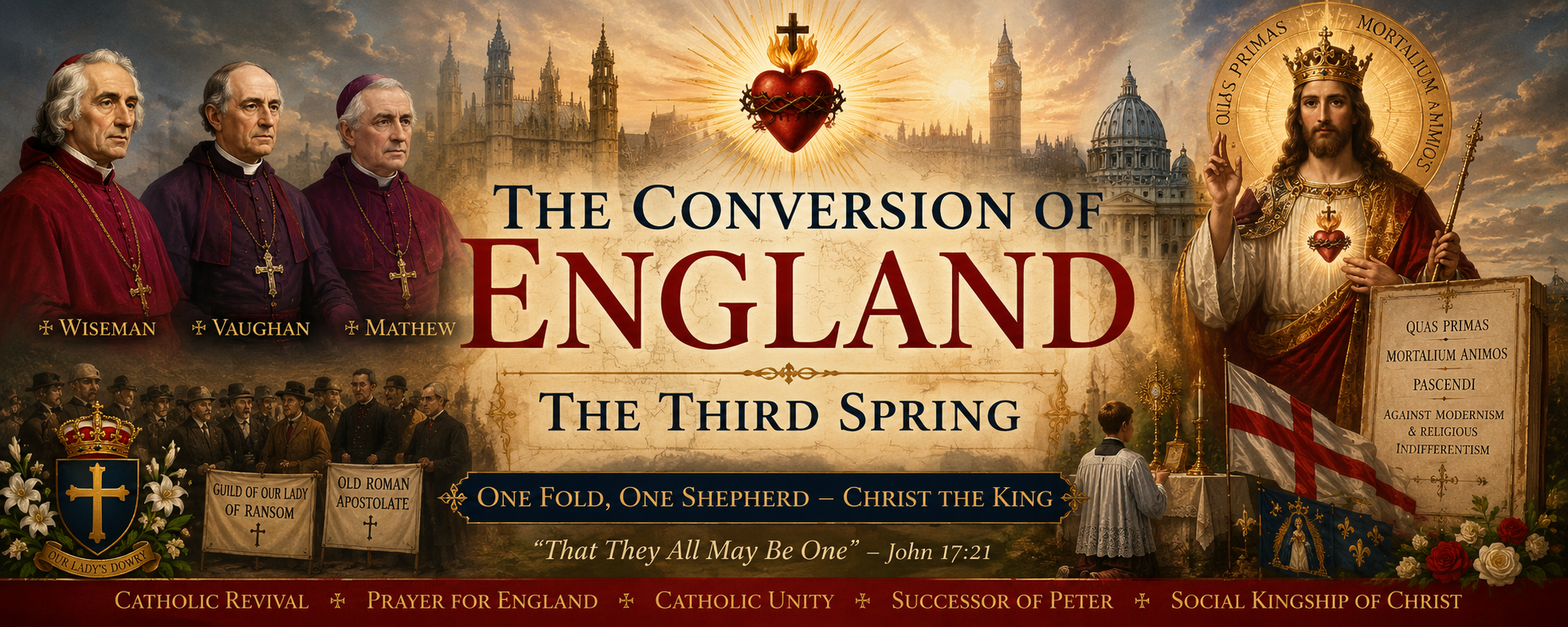
England Must Be Converted — Not Merely Re-Enchanted
A Traditional Catholic Critique of the Proposed “Third Spring”

There is an irony at the heart of the Catholic Truth Society’s new presentation of The Conversion of England by the Power of Prayer. The texts being republished belong to an age in which Catholics knew exactly what they meant by the conversion of England. Cardinal ✠Wiseman prayed for separated Christians to be brought into the one true fold. The appeal of Cardinal ✠Vaughan summoned Catholics to pray for the return of their country to the Faith. The Guild of Our Lady of Ransom was founded upon the conviction that England’s religious division was not an interesting permanent feature of national diversity but a wound to be healed. Yet, in the discussion staged to launch these texts at the WeBelieve Festival at Oscott, their object is repeatedly refracted through a recognisably contemporary vocabulary: belonging, social cohesion, favourable public attitudes, recovery of cultural identity, the emotional and communal needs of younger people, the Christian residue of British institutions and the possibility that these developments may signal a “Third Spring.”¹ The problem is not that such things are bad. The problem is that Christian survival, Christian revival and Catholic conversion are three different things, and the presentation repeatedly approaches the first two as though they were sufficient evidence of the third.
The speakers deserve to be introduced fairly, because neither is an outsider commenting casually upon Catholic affairs. Mgr John Armitage has been Master of the Guild of Our Lady of Ransom since 2020, having previously served as Rector of the National Catholic Shrine at Walsingham; he is now parish priest of St Margaret’s, Canning Town. The Guild itself states among its foundational purposes the conversion of the people of England and Wales and the return of those who have lapsed from the practice of the Catholic Faith. Fr John Bernard Church OP is a Dominican priest assigned to Holy Cross Priory, Leicester, Promotor of Dominican Young Adults and social-media coordinator for the English Dominican Province; he encountered the Dominicans while studying Classics at Oxford and entered the novitiate in 2018.² Their discussion therefore merits serious engagement. Here are two Catholic priests, one of them the present Master of an organisation created specifically for England’s conversion, attempting at Oscott to recover the missionary language of ✠Wiseman and ✠Vaughan for the twenty-first century.
That recovery ought to be welcomed. The CTS booklet, published on 21 July 2026, republishes ✠Vaughan’s nineteenth-century exhortation alongside ✠Wiseman’s 1839 prayers, while Mgr Armitage’s contribution invites renewed reflection upon England’s conversion.³ Nor should a Traditional Catholic dismiss his hope merely because optimism is sometimes unfashionable in traditional circles. There are conversions; there are vocations; there are younger Catholics searching for something more substantial than the attenuated ecclesiastical diet offered to much of their parents’ generation. There is plainly fresh public curiosity about Christianity in certain quarters. But the proper Catholic response to a green shoot is to discern what sort of plant is growing. The mistake would be to confuse renewed interest in religion, renewed appreciation of Christian civilisation, or even increased Christian observance with the specific supernatural object for which ✠Wiseman, ✠Vaughan and the Ransomers prayed.
Even the historical setting requires more care than the presentation gives it. Newman did not preach The Second Spring “at the restoration of the hierarchy,” as the conversation loosely suggests. Pius IX restored the ordinary Catholic hierarchy in England and Wales in 1850; Newman preached his celebrated sermon at Oscott on 13 July 1852, during the first Provincial Synod of Westminster. Oscott itself records the sequence.⁴ The distinction is not pedantic. Newman’s spring was recognisable precisely because something objectively Catholic had begun taking visible institutional form: bishops governed territorial sees again; seminaries trained priests; religious congregations expanded; churches, schools and convents multiplied; converts entered the Church at substantial social cost; and Catholicism, after generations of restriction and clandestine survival, was once more becoming an unmistakable ecclesial presence.
That gives us the proper standard by which any proposed “Third Spring” must be judged. A Catholic spring is not simply a season in which Christianity enjoys warmer press coverage. It is not a shift in the cultural weather, nor can it be identified merely because secularism has lost some of its intellectual glamour or because young men discover Gregorian chant, pilgrimage and Gothic architecture. If Newman’s Second Spring meant the visible re-emergence of Catholic doctrine, Catholic worship, sacramental life, episcopal government, religious orders, schools, missions, conversions and institutions, then a Third Spring worthy of the name must possess recognisably Catholic content. A country might become more religious without becoming Catholic; it might become more Christian without being reconciled to the Church; it might even recover portions of Christian moral culture while remaining constitutionally and doctrinally separated from Rome. None of those possibilities is identical with what the old Ransomers meant by conversion.
There are several further historical inaccuracies in the conversation which ought to be corrected, because an argument built upon learning from history should not depend upon a romanticised compression of it. Catholic Emancipation in 1829 did not suddenly make it lawful to be a Catholic. Relief came by stages. The Act of 1778 removed particular disabilities without granting general freedom of worship; the much broader Act of 1791 permitted Catholic worship and removed further restrictions; the 1829 settlement dismantled the principal surviving political disabilities and opened Parliament and most public offices to Catholics. The Gordon Riots, mentioned in the discussion in relation to Catholic emancipation, occurred in 1780, forty-nine years before the 1829 Act, as a violent Protestant reaction to the modest relief enacted two years earlier.⁵ Oscott itself was founded in 1794, not around 1798, and the present college opened in 1838.⁶ These are understandable slips in spontaneous conversation, but together they illustrate why historical enthusiasm needs the discipline of chronology.
The description of ✠Wiseman as “the first cardinal since the Reformation” is similarly inaccurate if taken literally. William Allen was created cardinal in 1587 and played a central role in the exiled Catholic resistance to the Elizabethan settlement. ✠Wiseman’s extraordinary distinction was different: he became the first Archbishop of Westminster of the restored hierarchy and the first cardinal resident again in England within that restored Catholic order. Even the CTS presentation of ✠Vaughan contains a harmless retrospective shorthand: in 1890, when the exhortation now republished was issued, he was still Bishop of Salford; he became Archbishop of Westminster in 1892 and cardinal in 1893. None of these corrections diminishes the stature of either man. They simply make the history more exact, and a Catholic case for historical continuity should be able to afford exactness.⁷
The early British material is likewise handled rather loosely. Mgr Armitage is entirely right to resist the popular fiction that Christianity arrived in Britain with St ✠Augustine of Canterbury in 597. An organised episcopal Church existed in Roman Britain long before the Gregorian mission, and three British bishops are recorded at the Council of Arles in AD 314. The presentation places this vaguely in the third century; Arles belongs to the fourth. The suggestion of firm first-century evidence should also be distinguished from what can actually be demonstrated. The secure point is already impressive enough: Christianity had taken institutional root in Roman Britain by the early fourth century; the mission of St ✠Augustine later brought the conversion of the Anglo-Saxon kingdoms into a decisive relation with the Roman See; and from converted England missionaries such as St Boniface and St Willibrord went forth to evangelise continental Europe.¹ The historical case requires no embellishment.
Indeed, one of Mgr Armitage’s strongest assertions is that “the history of England is the history of the Church.”¹ Properly understood, this contains more truth than some of the chronology offered in support of it. England was not merely a country in which Catholicism happened to be practised by a portion of the population. Medieval English civilisation was formed within a Catholic sacramental imagination. The parish church ordered ordinary life; Mass, saints’ days, Rogations, fasts and feasts marked the calendar; monasteries and priories punctuated the landscape; confraternities and guilds organised devotion, mutual aid and charity; chantries bound the living to the dead through prayer; pilgrimage drew Englishmen to Walsingham, Canterbury and innumerable local shrines. The Church that produced Bede, St ✠Dunstan, St Edward the Confessor, St ✠Anselm and St ✠Thomas Becket was not an exotic Roman graft upon an otherwise self-sufficient national culture. Catholicism belongs to the historical formation of England itself.⁸
That is why the Reformation cannot be described as mildly as it is in the presentation. Mgr Armitage remarks that the Church of England “came from the Catholic Church” and calls it a change of something very ancient.¹ At the level of buildings and institutions there is obvious continuity: Anglicanism inherited medieval dioceses, parish boundaries, cathedrals, endowments and much of the physical infrastructure of the old Church. But this was not merely organic adjustment within an undisturbed Catholic continuum. Parliamentary legislation severed the legal bond with Rome; the monasteries were suppressed and their property appropriated; the Mass was abolished by law; shrines and images were destroyed; Roman obedience became criminalised; Catholic sacramental doctrine was progressively rejected in official formularies; and clergy and laity suffered imprisonment, dispossession and death for fidelity to the old religion. Parliament’s own historical account acknowledges the break with Rome and the dissolution of the monasteries.⁹ England’s Catholic conversion therefore cannot mean simply allowing an ancient Christian identity to flower beneath a denominational arrangement accepted as permanently legitimate. It means the healing of an objective rupture.
Here we arrive at the central weakness of the Oscott discussion. The nineteenth-century texts being launched are more uncompromising about the nature of Catholic conversion than the twenty-first-century vocabulary used to commend them. ✠Wiseman’s prayer is explicit. He asks Our Lady to intercede for “our separated brethren” so that with Catholics they may be united in “the one true fold” under the chief shepherd of Christ’s flock. The Guild’s prayer tradition likewise places England’s desired unity under the successor of Blessed Peter.¹⁰ These are not expressions of a theology in which enduring denominational separation is itself the desired Christian settlement, provided relations become cordial. The separated brethren are loved precisely because one desires the removal of the separation.
There is a particularly illuminating Old Roman parallel. The Prayer for Catholic Unity received in Old Roman tradition as Archbishop ✠Mathew’s prayer, and still used by the Old Roman Apostolate, asks that the lost and straying sheep be gathered and that all be brought into “full and perfect unity” in the one fold of the Holy Catholic Church under the keeping of Christ’s Vicar. The historical attribution should be stated with scholarly care: surviving contemporary online sources demonstrate a long-standing received Old Roman attribution to ✠Mathew and daily use of the prayer, but these sources do not themselves provide an autograph or establish the identity of its first printing.¹¹ That qualification does not diminish its relevance. What can be demonstrated is that Old Roman tradition has for years received and prayed it specifically as Archbishop ✠Mathew’s Prayer for Catholic Unity, and that its ecclesiology is unmistakable.
The resemblance to ✠Wiseman is not merely verbal. ✠Wiseman prays for the separated brethren to enter the one true fold beneath the chief shepherd; ✠Mathew’s received prayer asks for the lost and straying sheep to be brought into full and perfect unity in the one Catholic fold beneath Christ’s Vicar. The two prelates occupied dramatically different canonical circumstances, yet the terminus ad quem of the prayers is strikingly similar. Neither treats ecclesiastical separation as a satisfactory permanent diversity; neither asks simply for friendlier relationships between communions; neither imagines Catholic unity as an invisible spiritual fellowship which leaves contradictory doctrines and jurisdictions untouched. Unity has objective content: one Faith, one sacramental communion, one visible Church, one Petrine principle of unity.
This Old Roman witness is particularly valuable because it cuts across the assumption that historic Old Roman Catholicism must necessarily have understood itself as an alternative ecclesiological destination to Rome. Whatever the complicated canonical history surrounding ✠Mathew and Utrecht, the prayer received under his name does not ask that a separate Old Roman denomination should flourish indefinitely as an end in itself. Its horizon is full and perfect Catholic unity under Christ’s Vicar. The Old Roman Apostolate’s continuing use of it therefore expresses something important: irregularity may describe a circumstance, but it need not become an ecclesiology. Catholic unity remains the desired end, without the price of surrendering what is believed to have been received from Catholic Tradition.¹¹
Pius XI articulated the same objective understanding with considerably greater magisterial authority in Mortalium Animos. The Church of Christ is a visible society endowed with unity of faith and government; contradictory confessions cannot be combined into a federation and then called Christian unity; the union of Christians is promoted by the return of those separated from the one true Church, and that visible unity includes acceptance of Peter and his legitimate successors.¹² Whatever terminology later ecumenical practice prefers, there is no serious doubt about the ecclesiology within which ✠Wiseman and ✠Vaughan prayed. To invoke their language while changing “conversion” into a general Christian awakening would be to retain the historical vocabulary while exchanging its theological object.
Mgr Armitage’s sociological observations are often perceptive. Previous generations, he says, survived appalling upheavals through “family, faith, community, neighbourhood, a sense of belonging,” whereas many people today possess none of these supports.¹ There is obvious truth here. Modern individualism has not abolished man’s need to belong; it has weakened many of the natural and supernatural communities through which that need was once ordered. Parish, family, neighbourhood, guild, confraternity and religious association can indeed provide forms of solidarity which technological modernity struggles to replace. Yet a Catholic apologetic must resist reversing cause and consequence. Catholicism is not true because it produces cohesive neighbourhoods. Christianity does not exist because lonely modern people require community. The Church is not an unusually successful technology for generating social capital.
The question must remain first of all supernatural and objective. God is owed worship because He is God; Christ must be believed because He is the Incarnate Word; His Church must be entered because He founded her; mortal sin must be abandoned because it kills the supernatural life of the soul; the Mass is offered because it is the Sacrifice of Calvary sacramentally made present, not because common ritual happens to reinforce group identity. Family cohesion, resilience, community, psychological stability and civilisational continuity may be fruits of living according to truth, but they cannot become the criterion by which truth is authenticated. The Catholic Faith does not receive its validity from its usefulness to modern man. Modern man receives his proper order by being conformed to truth.
This is where the presentation requires a careful distinction concerning Modernism. It would be unjust, and unsupported by the discussion itself, to accuse Mgr Armitage or Fr Church of formally professing the doctrinal system condemned by St Pius X. Formal Modernism is a specific theological complex, and such a charge requires evidence considerably stronger than pastoral imprecision in an informal conversation. The criticism is narrower and more serious for being narrower: portions of the presentation employ a subjectivising pastoral anthropology which moves in a direction strikingly analogous to tendencies diagnosed in Pascendi. St Pius X identified the Modernist movement from objective revelation towards religious sentiment, consciousness and experience, and specifically rejected the attempt to make the living experience of religion a test of its truth.¹³ The danger here is not necessarily explicit doctrinal Modernism but an anthropocentric rearrangement of Catholic priorities, in which religion is commended chiefly by what it does for consciousness, belonging, fulfilment and experience rather than because God has revealed objective truths demanding assent.
A revealing example comes towards the end of the discussion. Mgr Armitage says, in substance, that one knows truth because it sets one free, and that if one is not free it is because one has not accepted the truth.¹ Our Lord certainly teaches that the truth shall make us free, but He does not offer the subjective sensation of freedom as an epistemological test by which truth is discovered. The evangelical order is the reverse: the disciple abides in Christ’s word, knows the truth, and the truth liberates him. Falsehood can feel exhilaratingly liberating. The adulterer may feel liberated from his marriage vows; the apostate from the Creed; the revolutionary from legitimate authority. Conversely, divine truth can initially feel painfully restrictive because fallen desire is disordered. The martyr does not infer the truth of Catholicism from the pleasant experience of chains; he accepts the chains because Catholicism is true.
The treatment of prayer suffers from a related incompleteness. “Prayer does not change God,” Mgr Armitage says; “prayer changes me.”¹ Both statements contain truth, but as a summary of petitionary prayer they fall short of Catholic theology. St Thomas Aquinas addresses precisely this difficulty. Divine Providence is immutable, but Providence determines not only what effects shall occur but also the secondary causes through which they shall occur. We do not pray in order to persuade an uncertain God to revise His eternal decree; nevertheless, through prayer we truly impetrate what God has eternally ordained to grant through our asking.¹⁴ Prayer changes the petitioner, but it also really obtains things from God.
Nothing could be more relevant to a book entitled The Conversion of England by the Power of Prayer. ✠Wiseman was not asking Catholics to pray for England chiefly so that Catholics themselves would acquire a healthier interior disposition. Fr Ignatius Spencer did not urge a crusade of intercession merely because intercession improves the person praying. They were asking Almighty God to do something: to give grace to unbelievers, reclaim the lapsed, move separated Christians towards Catholic unity, raise up priests and religious, convert sinners and restore a nation to the Faith. If prayer becomes principally an instrument of personal transformation, the very title of the book is quietly deprived of the robust doctrine of causality which made the older apostolate intelligible.
Neither should a “Third Spring” be inferred too quickly from favourable cultural weather. The presentation recalls the much-publicised Bible Society/YouGov “Quiet Revival” research while acknowledging that its evidential basis had proved defective. The position is now clearer. NatCen’s analysis of the 2025 British Social Attitudes survey, published on 18 May 2026, reported no evidence of a Christian revival among younger people; only 4 per cent of those aged 18–34 said they attended Christian worship weekly. It also recorded YouGov’s acknowledgement that apparently fraudulent responses had compromised the earlier research and necessitated its withdrawal and repetition.¹⁵ This does not establish that grace is inactive, nor does it rule out particular Catholic growth concealed within broader national decline. It establishes something more modest: the fashionable sociological case for proclaiming a British Christian revival is not presently secure.
There are nevertheless Catholic figures worthy of thanksgiving. The Bishops’ Conference’s 2024 statistics record 6,276 catechumens and candidates receiving catechesis, 5,432 baptisms of persons over seven, 3,024 receptions into full communion, and revised average weekly Mass attendance of 575,453.¹⁶ These are not abstractions. Each genuine conversion is an act of grace; each adult preparing for Baptism, each Protestant seeking reception, each lapsed Catholic returning to Confession is more important than an encouraging newspaper trend. But the figures require sober interpretation. They are grounds for hope, not proof that England is being reconquered for the Faith. A shoot may be real without being a spring, and a spring may begin long before statisticians learn how to measure it.
Mgr Armitage also interprets friendlier media coverage surrounding Pope Francis’s funeral, the conclave and the election of Leo XIV as part of a change in public atmosphere.¹ That may be an accurate personal impression, but fascination is not conversion. A culture may enjoy the drama of a conclave while disbelieving every article of the Creed. It may find a papal funeral moving while rejecting papal teaching on marriage, abortion, sexual morality and the uniqueness of Christ. It may rediscover affection for Catholic ceremonial precisely because doctrine has been politely moved out of sight. One of the peculiar possibilities of the present moment is a Catholic aesthetic revival without Catholic submission: incense without dogma, pilgrimage without ecclesiology, sacred architecture without repentance. Traditional Catholics should welcome every doorway through which grace may enter, but they should not confuse the doorway with the destination.
The discussion of England’s constitutional Christianity illustrates the same ambiguity. Mgr Armitage approvingly recalls Lord Glasman’s contention that the fact that “Christ is King” provides the sort of inherited order within which religious minorities can live securely; he then appeals to parliamentary prayers and the Coronation as signs that Britain still acknowledges an authority above the State.¹ There is something important here. The Coronation unquestionably preserves Christian concepts of sacred kingship, oath, anointing and accountability to God; Parliament retains Christian prayer. These are not meaningless survivals. But the Traditional Catholic must ask the question the presentation leaves largely untouched: what religion does the constitutional settlement actually establish?
The answer is explicit. The Coronation Oath binds the sovereign to maintain the “Protestant Reformed Religion Established by Law”, namely the Church of England, while the statutory Accession Declaration requires the monarch to identify as a faithful Protestant; a Catholic remains prohibited by law from being sovereign.¹⁷ The existing British settlement is therefore not an extant Catholic Social Kingship of Christ awaiting only renewed appreciation. It is the constitutional descendant of the Protestant settlement which followed England’s rupture from Rome, even though it continues to carry older Christian forms inherited from the Catholic civilisation which preceded that rupture. Those older residues are worth preserving precisely because they point beyond the settlement itself.
A genuinely Catholic conversion of England would consequently have to touch the settlement itself. It is incoherent to pray for the national conversion of England while regarding as permanently untouchable a constitutional order which legally excludes a Catholic monarch and commits the Crown to the maintenance of a confession born from separation from Rome. This does not mean that constitutional revision is the first act of evangelisation; nations are normally converted through souls, families, parishes, schools and institutions before constitutions reflect what has happened beneath them. But if England ever became substantially Catholic, the Protestant establishment could not remain indefinitely untouched without exposing a contradiction between the country’s professed religion and its public law.
Pius XI’s doctrine of the Kingship of Christ is considerably more demanding than the proposition that Christian culture happens to provide a congenial framework for managing pluralism. In Quas Primas he insists that the authority of Christ extends to individuals and states and identifies the exclusion of Christ and His law from private and political life as a source of social disorder.¹⁸ Christ is not King because His religion is sociologically useful to a liberal society; He is King because He is God Incarnate, Redeemer and Lord. The State may prudently tolerate religious error where the common good requires such toleration, as Leo XIII recognised, but toleration is not religious indifferentism and freedom from coerced conversion is not equivalent to pretending that contradictory religions possess equal claims as truth.
This is the danger in reversing the traditional argument. Instead of beginning with the objective sovereignty of Christ and asking what personal, social and political life ought to become under His law, one begins with the modern pluralist settlement and commends Christianity because it supposedly makes that settlement kinder, safer and more cohesive. The supernatural claim is then domesticated into a civilisational one. Christianity becomes valuable because it sustains social trust, protects minorities, encourages family formation and supplies the moral capital upon which a liberal order depends. Those may be real benefits, but they are consequences. Quas Primas begins somewhere else: Christ possesses rights over society because He is Christ.
What, then, would the conversion of England actually require? First, and indispensably, the conversion of souls. Unbelievers must receive supernatural faith; those validly baptised but separated from Catholic unity must be brought into the visible communion of the Church; the lapsed must return to Confession, Sunday Mass and a state of grace; nominal Catholics must cease treating baptismal ancestry as a substitute for belief and obedience. Conversion means repentance from sin, profession of truth and supernatural incorporation into Christ. Without this, an increase in “Christian identity” remains sociological rather than Catholic.
Such conversion would require the recovery of Catholic doctrine as something to be taught, believed and defended. England must hear again of the Trinity, the Incarnation, Original Sin, Redemption, sanctifying grace, judgement, Heaven, Hell and Purgatory; the divine institution and necessity of the Church; the Primacy of Peter; the Holy Sacrifice of the Mass; Transubstantiation and the Real Presence; sacramental Confession; Christian marriage; the natural moral law; the Communion of Saints; the privileges and intercession of Our Lady; and the duty of man to order his temporal life towards his supernatural end. A population cannot convert to doctrines which Catholics themselves communicate only by implication, or about which the clergy speak as though clarity were somehow incompatible with charity.
It would require a recovery of Catholic worship, because England’s earlier Catholic springs did not create a religion of informal religious conviviality. They built altars, monasteries, shrines, chantries and churches; they produced processions, pilgrimages, choirs, bells, sacred art, confraternities, feasts and public devotion. The traditional Roman liturgy belongs naturally to this theocentric imagination because the Mass is first of all the propitiatory Sacrifice offered to Almighty God, not a community event whose success is measured by sociological participation. A civilisation which has forgotten transcendence will not recover it from a Church embarrassed by silence, hierarchy, sacred language, sacrifice and the objective difference between sanctuary and nave.
It would require penance and asceticism. The English martyrs belonged to a religion in which fidelity might cost property, liberty or life. A supposed Third Spring in which Catholics cannot abstain on Friday, rarely confess their sins, no longer comprehend mortification and expect Christianity chiefly to affirm their desires would be a strange spring indeed. Fasting, abstinence, regular Confession, reparation, the Rosary, spiritual reading, Eucharistic devotion and corporal and spiritual works of mercy are not antiquarian ornaments. They train fallen man to live by grace rather than appetite.
It would require the conversion of marriage and family life. Community cannot be rebuilt while Christian families reproduce the assumptions of the sexual revolution. Marriage must again be understood as the indissoluble union of one man and one woman, naturally ordered to the generation and education of children. Abortion, contraception, easy divorce, cohabitation and ideological attempts to redefine sex and marriage are not political distractions from evangelisation. They concern the created order, the natural law and therefore the salvation of souls. A Catholic civilisation cannot be reconstructed by Catholic households which have quietly accepted the anthropology of secular liberalism.
It would require Catholic education worthy of the name. Children must know the Catechism, Sacred Scripture, the Fathers and Doctors, the lives of the saints, Catholic philosophy and the history of their own country’s Faith. They ought to know why St ✠Thomas Becket died, why St Thomas More refused the oath, why St ✠John Fisher stood virtually alone among the bishops, why St Edmund Campion returned to England knowing what awaited him, why St Margaret Clitherow suffered death rather than betray priests, and why recusant families maintained chapels and priest holes at immense risk. Without this historical memory, “England’s Catholic heritage” becomes picturesque décor rather than inherited obligation.
It would require a renewed religious and contemplative life. Medieval England was covered with monasteries because men understood that worship offered to God is itself a good and that a life apparently “wasted” upon prayer might be one of the greatest services rendered to a nation. The Dissolution did not simply transfer ecclesiastical real estate; it extinguished a vast national infrastructure of prayer, learning, charity and sacred life.⁹ A converted England would once again produce monasteries, convents, contemplative houses, missionary societies and religious communities because a Catholic people naturally gives sons and daughters wholly to God.
It would require public Catholic culture. Feasts would once again be recognisable as feasts and fasts as fasts; Corpus Christi processions would appear not as exotic demonstrations by an eccentric minority but as natural public worship; Our Lady would be honoured in her Dowry not merely as an historical emblem but as Mother and Queen; Walsingham would be a national place of pilgrimage because Catholics actually believed what its title implies. Confraternities and sodalities would bind people together in prayer and charity; sacred art, church bells, processions and pilgrimage would remind the temporal order that it does not exhaust reality.
It would also require missionary clergy who actually desire conversion. A Catholic priest should be able to tell an Anglican, Muslim, Hindu, atheist or indifferent neighbour, without hostility and without embarrassment, that he desires him to become Catholic because he believes the Catholic Faith to be true and the sacramental life of the Church to be a gift intended for him. That is not contempt for the other man; it is the supernatural logic of charity. One does not love a neighbour more by hoping that, although mistaken concerning God, Christ, His Church and the means of grace, he will remain permanently where he is. The old Catholic missionary instinct prayed, preached, argued, instructed and suffered precisely because salvation mattered.
If “the conversion of England” is meant in the national sense understood by the old Ransomer apostolate, the process could not finally stop at the private threshold. A substantially converted country would eventually produce public consequences. The Crown could not remain constitutionally Protestant while England became Catholic; the Reformation settlement could not indefinitely remain the normative religious establishment of a Catholic people; civil law would again recognise its subordination to the natural moral order; innocent unborn life would be protected; the natural family would receive the privilege corresponding to its prior place in society; education would cease to proceed upon the assumption that revealed truth is intrinsically irrelevant to the common good; and public authority would once again confess, in forms appropriate to circumstances, that it stands beneath Almighty God.
None of this entails forced baptism, persecution of unbelievers or the mechanical reconstruction of every juridical arrangement of medieval Christendom. Catholic tradition distinguishes the objective rights of truth from the prudential toleration of error under particular circumstances. Supernatural faith cannot be produced by police power because faith requires free assent. But immunity from coercion does not require Catholics to pretend that the State must be metaphysically agnostic concerning God, Christ and the moral law. There is an enormous distance between coercing a man to receive Baptism and maintaining that civil society as such owes no duty whatever to revealed truth.
English history ought therefore to inspire something more substantial than nostalgia. The story is not merely one of Catholic survival but of conversion, catastrophe and restoration. Roman Britain possessed bishops. Gregory the Great sent St ✠Augustine; St ✠Theodore organised; Bede chronicled; Anglo-Saxon monasteries became centres of prayer, scholarship and mission; English missionaries carried the Gospel back across the North Sea. Medieval England constructed a Catholic civilisation of parish, monastery and shrine. The Reformation shattered its visible unity, yet St ✠John Fisher, St Thomas More, Campion, Southwell, Margaret Clitherow and their companions demonstrated that the old Faith had not vanished. Recusant families sheltered priests and preserved the Mass; the Vicars Apostolic maintained a missionary structure through the penal age; emancipation reopened public Catholic life; and Newman, Cardinal ✠Manning, Cardinal ✠Wiseman, Cardinal ✠Vaughan and the great nineteenth-century religious congregations built again. A Third Spring, if God grants one, must belong to that history rather than merely to a generational fashion for spirituality.
Mgr Armitage’s memorable assertion that Catholicism can be understood only by recognising that “nothing changes” therefore becomes, once properly qualified, one of the strongest arguments against an attenuated definition of conversion.¹ Disciplines change, customs develop, prudential arrangements alter and theology may attain greater precision; revealed truth, however, cannot become its contradiction because the century changes. Neither, therefore, can the object of the old prayers be transformed while their vocabulary is retained. ✠Wiseman did not pray that England should rediscover the social usefulness of Christianity while remaining separated from Rome; ✠Vaughan did not mean that Catholicism should receive kinder coverage from the press; Spencer did not campaign merely for a more religious public mood; Newman’s Second Spring was not a revival of Christian aesthetics; and the English martyrs did not surrender their lives so that Catholicism might eventually occupy a respected place in a permanently pluralist spiritual marketplace. The prayer received in Old Roman tradition as ✠Mathew’s is equally inconvenient to an attenuated ecumenism: it prays for the wandering sheep to be brought into full and perfect unity in the one Catholic fold under Christ’s Vicar.¹¹
The deepest problem with the proposed “Third Spring” is therefore not that hope is misplaced. Catholics should hope extravagantly in the power of grace. There may indeed be something stirring beneath the surface: a young man entering a church because secular existence has become intolerably thin may be standing at the beginning of a road to Baptism; a Protestant reading the Fathers may eventually discover Rome; a nominal Catholic encountering the traditional Mass may discover the sacrificial reality his catechesis never taught him; a family saying the Rosary for the first time may be laying foundations which no opinion poll could detect. Grace ordinarily begins before sociologists notice it. But a green shoot must not be mistaken for the harvest, and cultural reaction against secularism must not be canonised prematurely as the work of the Holy Ghost. A revival which admires Christian aesthetics but refuses Catholic doctrine is not yet Catholic conversion; belonging without repentance is not conversion; admiration for Christ as an ingredient of English identity while rejecting His Church is not conversion; crowded festivals with empty confessionals are not conversion; Catholic schools afraid of Catholic morality and Catholic households indistinguishable from their secular neighbours are not evidence that England has returned to the Faith.
The answer, then, is neither cynicism nor a refusal to recognise genuine signs of grace. It is precision about the end for which Catholics are praying. ✠Wiseman’s prayer and the prayer received from ✠Mathew are valuable precisely because neither permits “unity” to dissolve into atmosphere. The sheep are to be gathered; the separated are to become united; the Fold is one; Peter remains visible; Christ’s Vicar is not an optional symbol appended to an otherwise complete denominational pluralism. England certainly needs stronger families, deeper community, fuller churches, serious young Christians, better journalism about religion and a renewed awareness of its Christian past. Genuine Catholic conversion would produce many of those goods. But they are not its essence.
England needs the Catholic Faith: the Mass not as heritage but as Sacrifice, Our Lady not merely as cultural memory but as Mother and Queen, Peter not as one ecumenical voice among many but as the visible principle of Catholic unity, Christ not merely as the inherited foundation of English civilisation but as King, Redeemer, Judge and Lord. England needs sinners absolved, unbelievers baptised, separated Christians reconciled, the lapsed restored, families sanctified, children catechised, priests made holy, religious houses filled, doctrine preached, penance recovered and public life once more conscious that every earthly authority answers to Almighty God. That is the conversion for which ✠Wiseman prayed, to which ✠Vaughan summoned English Catholics, for which Spencer begged the prayers of Christendom, and towards whose objective unity the prayer received under ✠Mathew’s name still points. If we are going to speak of a Third Spring, let us have the courage to mean a Catholic one, and to pray without euphemism: Jesus, convert England; Mary, reclaim thy Dowry; gather the straying sheep into the one Fold, restore the Faith, restore the Mass, restore Catholic unity, and restore all things in Christ.

¹ Fr John Bernard Church OP in conversation with Mgr John Armitage, Catholic Truth Society / WeBelieve Festival presentation of The Conversion of England by the Power of Prayer, supplied transcript, especially the discussions of the “Third Spring,” England’s Christian history, public perceptions, community, the Eucharist, truth and prayer.
² Guild of Our Lady of Ransom, “About Us,” including the Guild’s present purposes and biography of Mgr John Armitage; English Province of the Order of Preachers, biographical notice for Fr John Bernard Church OP.
³ Catholic Truth Society, The Conversion of England: By the Power of Prayer, published 21 July 2026, containing ✠Vaughan’s exhortation and ✠Wiseman’s 1839 prayers.
⁴ St Mary’s College, Oscott, “A History of Oscott,” on the foundation of the college and the first Provincial Synod of Westminster in July 1852; John Henry Newman, The Second Spring.
⁵ UK Parliament, “Emancipation,” on the Catholic Relief Acts of 1778 and 1791, the Gordon Riots and Catholic Emancipation in 1829.
⁶ St Mary’s College, Oscott, “A History of Oscott,” recording the college’s foundation in 1794 and subsequent development.
⁷ Allen Hall / Westminster historical material concerning Cardinal William Allen; diocesan and historical material concerning ✠Wiseman and ✠Vaughan; Catholic Truth Society publication details for the 1890 Vaughan text.
⁸ English Heritage, “Medieval Religion,” on monastic revival and the pervasive place of the medieval Church in English life.
⁹ UK Parliament, “The Reformation,” on the break with Rome and Dissolution of the Monasteries.
¹⁰ Guild of Our Lady of Ransom, “Our Prayers,” preserving ✠Wiseman’s petition for the separated brethren to be united in the one true fold.
¹¹ Old Roman sources preserving the received attribution and continuing use of Archbishop ✠Mathew’s Prayer for Catholic Unity: the Old Roman Apostolate’s lay rule of 2010, requiring daily recitation of the prayer, and later ORA publications explicitly styling it “Archbishop Mathew’s Prayer for Catholic Unity.” These sources establish the received Old Roman attribution and usage; they do not by themselves establish the earliest printing or supply an autograph text.
¹² Pius XI, Mortalium Animos, 6 January 1928, especially §§6–12, on the visible unity of the Church, contradictory confessions, the return of the separated and the authority of Peter and his successors.
¹³ St Pius X, Pascendi Dominici Gregis, 8 September 1907, especially §§10–15, on religious sentiment, experience, dogmatic formulae and the Modernist attempt to ground religious certitude in subjective experience.
¹⁴ St Thomas Aquinas, Summa Theologiae, II–II, q.83, a.2, on prayer and Divine Providence.
¹⁵ Sir John Curtice, National Centre for Social Research, “No revival in sight: Church attendance in Britain remains below pre-pandemic levels,” 18 May 2026, including the 2025 British Social Attitudes data and the withdrawal of the original YouGov research following apparently fraudulent responses.
¹⁶ Catholic Bishops’ Conference of England and Wales, Statistics – 2024: 6,276 catechumens and candidates receiving catechesis; 5,432 baptisms over the age of seven; 3,024 receptions; revised average weekly Mass attendance of 575,453.
¹⁷ House of Commons Library, “Changes to the Coronation Oath,” on the obligation to maintain the Protestant Reformed Religion Established by Law, the declaration that the monarch is a faithful Protestant, and the statutory prohibition upon a Catholic sovereign.
¹⁸ Pius XI, Quas Primas, 11 December 1925, on the dominion of Christ over individuals and states and the consequences of excluding Christ and His law from political life.
¹⁹ Leo XIII, Immortale Dei, 1 November 1885, on civil society’s duties towards God, the true religion and the prudential toleration of religious error.
related articles


Latest articles
- Vatican III by Stealth? When “Reception” Becomes RevisionArchbishop Anthony Randazzo warns against the misuse of synodality as a means to eliminate perceived “dead wood” from the Church, stressing the importance of faithfully interpreting Vatican II. He argues that authentic renewal relies on the continuity of the Church’s doctrine, warning that unchecked synodality may lead to revisions of established teachings rather than genuine reception.
- Today’s homily: St Jerome of BethlehemThe homily reflects on St Jerome’s profound transformation from a scholar enamoured with classical literature to a devoted servant of Christ. It highlights the necessity of allowing faith to permeate one’s life, emphasising that merely possessing knowledge of doctrine is insufficient without a corresponding internal change. Jerome’s legacy urges believers to let Scripture guide their lives authentically.
- Today’s Mass: September 30 St Jerome of BethlehemSaint Jerome, born in Dalmatia in 329, was a prominent Doctor of the Church, known for his scripture translations and contributions to Catholic teachings. He emphasised monastic life and the Divine Office. Jerome died in Bethlehem on 30 September 420. Today also marks the name day of His Grace, Jerome OSJV of Selsey.
- Sermon for St. JeromeSt. Jerome, born around 342, was a pivotal biblical scholar and translator whose work established the Vulgate as the standard Latin Bible. His life reflected the tensions of early Christianity, as he struggled with controversies while advocating for orthodoxy. Jerome’s rich education and transformation from a pagan scholar to a Christian hermit marked his enduring legacy in the Church. He died in 420.
- Veritas non mutatur consensu ~ Truth is not altered by agreement: Spiritual Conference for Nuntiatoria CXXVThe text explores the theme of enduring truth amidst changing societal values, particularly within the Catholic faith. It emphasises that truth remains unchanged irrespective of popular opinion or individual feelings, urging believers to receive and embody divine teachings faithfully. The article concludes with a call to act upon this truth in daily life and relationships.




Leave a Reply