

CONVERTED — OR SIMPLY REBRANDED?
The Catholic internet is experiencing a remarkable succession of high-profile conversions and reversions. Candace Owens, Cameron Bertuzzi, Joseph Schmid, Noah McKay and others have crossed the Tiber before substantial online audiences. Their conversions may be entirely sincere. That is not the question. The more difficult questions are whether they have received the Catholic Faith whole and entire, whether that Faith has yet acquired deep roots, and whether Catholicism has converted the habits of self-promotion, instant authority and monetised personality which made some of them influencers in the first place.
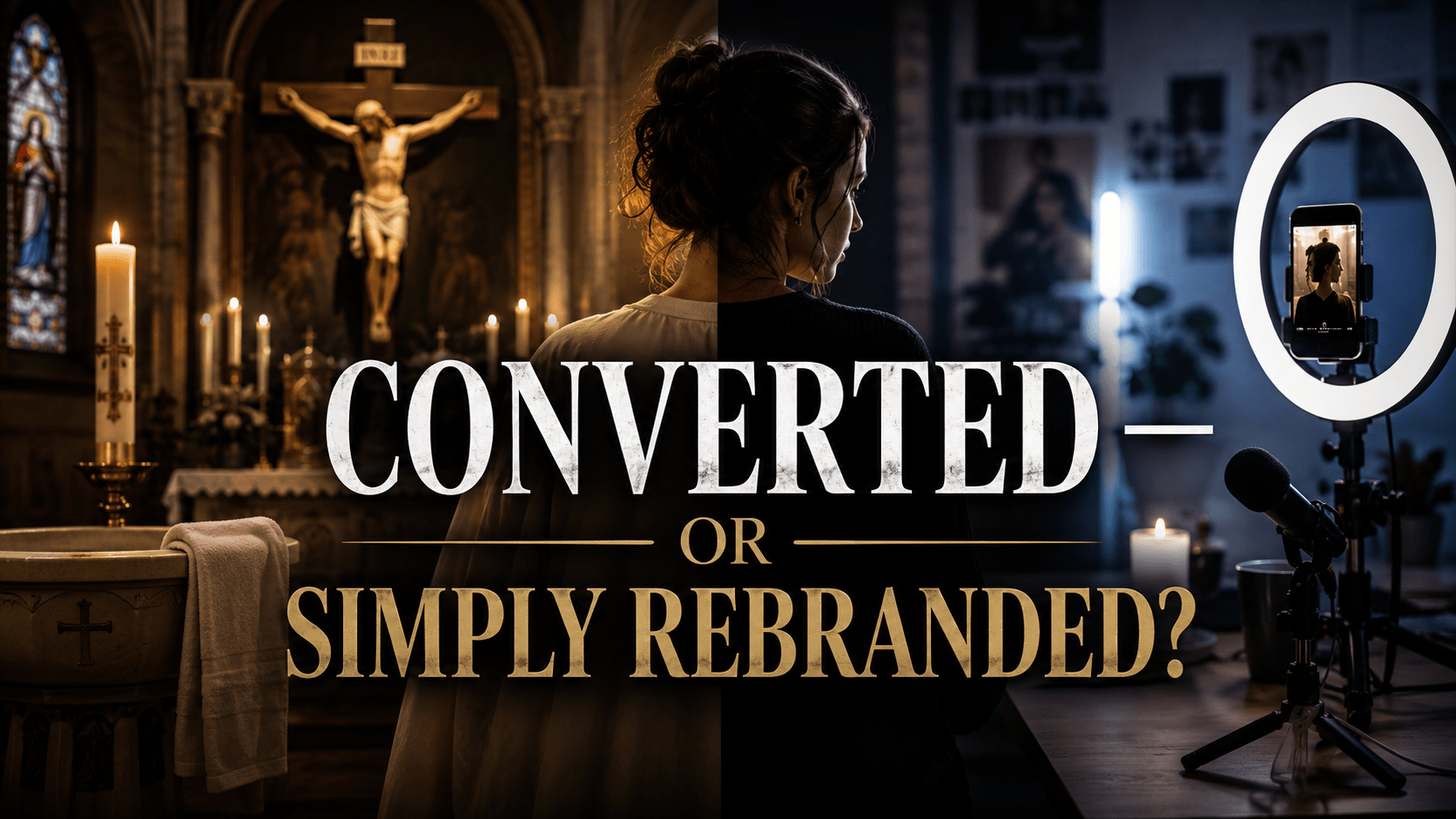
Something curious has happened to Christian conversion. Once it was principally a matter between the sinner and God. A man encountered grace, recognised the truth, repented, entered the Church, received the sacraments, acquired a confessor, learned to pray and discovered that intellectual assent was only the beginning. Becoming Catholic was not a media launch. It was the beginning of a lifelong process of sanctification, much of it hidden, repetitive and profoundly ordinary.
Today there is another possibility: the conversion announcement, the thumbnail, the premiere, the reaction video, the three-hour interview explaining “WHY I BECAME CATHOLIC”, followed by another interview explaining what Protestants misunderstand about Catholicism, another answering objections to the conversion, appearances alongside established Catholic apologists, and before very long the newly arrived Catholic explaining Catholicism himself. Somewhere nearby there is often a Patreon button, premium membership, subscriber tier, exclusive livestream, merchandise operation or members-only discussion.
None of those things, considered individually, proves anything sinister. Apostolates require money. Good media costs money. Authors sell books, lecturers receive honoraria, publishers employ staff and Catholic broadcasters require studios, cameras, hosting and electricity. St Paul defended the principle that those who preach the Gospel may live by the Gospel. The Church has never taught that financial support automatically corrupts an apostolate.
The difficulty lies elsewhere. The internet has created an economy in which the commodity is frequently not merely something a person produces. The commodity is the person. His opinions are content. His political convictions are content. His arguments are content. His relationships are content. His doubts are content. His crises are content. His intellectual journey is content. Eventually, his conversion becomes content too.
Once personality itself has become a commercial product, Catholicism enters an environment whose instincts are almost diametrically opposed to the ascetical demands of Christianity. The influencer economy says: increase your visibility. Christianity says: decrease yourself. The influencer economy requires continual disclosure; Christianity values recollection. The influencer economy rewards certainty; Catholic intellectual tradition values distinctions. The influencer must continually speak; Catholic wisdom repeatedly teaches the value of silence. The influencer requires an audience; the saint requires God.
That tension lies beneath the recent spate of celebrity Catholic conversions.
Consider Candace Owens. On 22 April 2024 Owens publicly announced that she had been received into the Catholic Church, describing the decision as coming “home”. She already possessed an enormous political-media audience, so her conversion inevitably became news. By the following month Catholics for Catholics was promoting a special “Welcome Home Mass for Candace Owens” in Phoenix, at which she would publicly recount her conversion.¹
There is nothing intrinsically improper about that. Public testimony can bring people to the Faith. St Augustine told the story of his conversion; Newman wrote the Apologia; countless converts have helped others precisely because they explained why they became Catholic. But Owens did not enter the Church as an unknown catechumen. She entered carrying a highly developed personality brand, an enormous audience and an already commercialised relationship with that audience.
Her paid media ecosystem likewise pre-existed her Catholic reception. The important point is therefore not that Owens converted in order to monetise Catholicism — there is no evidence establishing that, and it would be unjust to suggest it — but that Catholicism entered a pre-existing personality economy. The relevant question is what conversion eventually does to that economy. Does Catholicism transform the personality brand, or does Catholicism simply become another component within it?
That distinction matters because Christianity does not merely ask us to exchange false propositions for true ones. It asks for the conversion of the whole man. One can change one’s religion without yet changing one’s relationship with one’s own importance.
Cameron Bertuzzi provides an even more revealing example because his professional identity was already explicitly religious. Bertuzzi founded Capturing Christianity as a Protestant apologetics platform and developed a substantial online following before announcing in November 2022 that he had become convinced of Catholicism. His conversion immediately became Catholic media content, including highly visible interviews discussing why he had changed his position, and the platform which had previously defended Protestant Christianity increasingly became a vehicle for Catholic apologetics.²
His pre-existing subscription-supported operation continued through the transition. Today his Patreon explicitly presents his work as producing Catholic videos, written material and podcasts in defence of the Catholic Faith. Again, this is not evidence that Bertuzzi’s conversion was mercenary. It is evidence that the Protestant apologetics enterprise did not disappear. It became a Catholic apologetics enterprise. The audience remained, the platform remained, the funding mechanism remained, the creator remained, and the confessional identity changed.³
Bertuzzi himself has described the pressures created by the content economy. In January 2025 he told patrons that subjects he had covered repeatedly had contributed to serious burnout, while branching into different religious, historical and cultural themes had renewed his enthusiasm for producing content. In the same communication he appealed to existing supporters to consider increasing their monthly contributions and invited former supporters to return.⁴ Nothing about financial necessity is inherently dishonourable. But the underlying structure deserves attention. Creators require fresh material because repetition exhausts both creator and audience; novelty renews engagement; engagement sustains the enterprise; and religious controversy supplies an almost inexhaustible reservoir of novelty.
That is precisely where the influencer economy sits uneasily with Catholicism. The Christian life eventually demands repetition: Mass again, Rosary again, confession again, Office again, the same Creed, the same Commandments, the same mysteries, the same examination of conscience and frequently the same humiliating struggle against the same sins. Holiness is repetitive. Content cannot afford to be.
The phenomenon becomes still more conspicuous when we move from political and religious influencers to intellectual ones. Joseph Schmid is a particularly revealing contemporary example. Schmid is unquestionably intelligent. He is a Princeton philosophy doctoral candidate whose work has appeared in journals including Mind, Noûs and The Journal of Philosophy. His Majesty of Reason platform accumulated a substantial following through discussions of metaphysics, natural theology and philosophy of religion, and Princeton’s Aquinas Institute has described him as one of the more prominent young agnostic voices within the online philosophy-of-religion world.⁵
In August 2026 Schmid announced his return to Catholicism after more than a decade as an atheist and agnostic. On 27 August Word on Fire published an article devoted to his conversion, while Princeton’s Catholic community likewise publicised his return to the Church.⁶ This naturally raises a question which is not insulting but necessary: why should the Catholic world particularly care what Joseph Schmid believes?
His family should care. His friends should care. Those who followed his philosophical work may quite reasonably be fascinated by an unexpected change in his conclusions. Catholics should rejoice that somebody has returned to the sacraments, and his intellectual reasons may prove useful to others wrestling with similar questions. But why does the religious opinion of one graduate philosophy student become significant Catholic news?
Because Schmid was already sufficiently well known within a particular online intellectual ecosystem for his agnosticism to possess cultural value. The “prominent agnostic” becomes valuable precisely because he was prominent while agnostic. His conversion transfers reputational capital accumulated through unbelief into the service of belief. The celebrity of scepticism becomes the celebrity of Catholicism.
Schmid’s Majesty of Reason Patreon existed long before his return to Catholic practice. That chronology is important because it removes the crudest accusation. He did not discover Patreon after discovering Catholicism. The monetised platform was already there. But that fact demonstrates the structural problem more clearly, not less clearly. Yesterday people subscribed to the agnostic philosopher; today they can subscribe to the Catholic philosopher. The creator economy barely notices the conversion.⁷
Then comes Noah McKay. McKay is another Princeton philosophy doctoral student and plainly a capable academic. On 25 August 2026 McKay and Schmid jointly revealed that they were behind the previously anonymous Veritatis Splendor account. They stated plainly: “We both recently converted to Catholicism”, identifying McKay’s movement from liberal Protestantism and Schmid’s from agnosticism. They then immediately added: “We will continue to write posts defending Catholic doctrine”, and announced work dealing with Marian apparitions, Purgatory, Petrine primacy and other distinctively Catholic teachings.⁸
There, in consecutive sentences, is almost a distillation of the phenomenon: we recently became Catholics; we shall now defend Catholic doctrine.
There is nothing wrong with converts defending the Faith. Some of Catholicism’s greatest apologists have been converts. St Justin Martyr was a convert. St Augustine was a convert. In modern times Newman, Chesterton and Ronald Knox brought immense intellectual gifts into the Church. Nor does becoming Catholic require intellectual silence. The question is not whether converts may speak. The question is why contemporary Catholic internet culture appears to recognise almost no period of apprenticeship between reception and authority.
Catholic tradition possesses a useful word which the internet seems determined to forget: neophyte. Newly planted. It is not an insult. It acknowledges that intellectual conviction and spiritual maturity are not identical. St Paul warns concerning ecclesiastical office that a candidate should be “not a neophyte: lest being puffed up with pride, he fall into the judgment of the devil.” The text cannot honestly be transformed into a prohibition upon converts publicly discussing Christianity. But the apostolic warning identifies a permanent spiritual reality: rapid elevation is dangerous.
And here we encounter an even deeper problem than celebrity, monetisation or premature apologetics. Before asking whether the new convert is ready to teach Catholicism, perhaps Catholic media should ask something far less glamorous: has he actually received a sufficiently complete formation in the Faith he is now being invited to teach?
The question becomes considerably more searching when contemporary practice is set beside the ancient discipline of the Church. The early catechumenate was not conceived primarily as a short instructional programme designed to bring somebody to the next convenient Easter Vigil. It was an extended ecclesial state of instruction, probation, moral conversion, ascetical discipline and progressive preparation for baptism.
The precise duration varied according to period and place. The Apostolic Tradition, traditionally associated with Hippolytus of Rome, envisages three years during which catechumens should hear the word. Yet the same text immediately qualifies the duration: if a catechumen showed genuine zeal and perseverance, his conduct rather than the mere passage of time was to determine his readiness. Other ancient evidence attests periods nearer two years. There was therefore no universal mechanical rule that every convert must wait exactly three years. The important point is more profound: the Church expected conversion to demonstrate itself over time.⁹
The candidate’s life itself was scrutinised. His occupation, morals, domestic circumstances and willingness to abandon practices incompatible with Christianity could determine whether he was admitted and whether he advanced. The question was not simply whether the candidate had concluded intellectually that Christianity was true. The Church wanted to know whether he was beginning to live as though it were true. Baptism was not merely the ecclesiastical ratification of a successful philosophical argument. It marked entry into a supernatural life for which the candidate had been progressively prepared.
As Easter approached, those judged ready entered an even more intense period of preparation. Lent became the great final school of the competentes or elect. Their preparation was doctrinal, moral, ascetical and liturgical. They fasted, prayed, received instruction, underwent exorcisms and scrutinies, and were progressively prepared for the Creed, the Lord’s Prayer and the sacramental mysteries which would culminate in baptism at Easter.
The very word scrutiny ought to arrest us. The Church scrutinised the candidate. His dispositions were examined. His progress was tested. In the developed Roman practice there were eventually seven scrutinies, with one of the principal ceremonies associated with the Wednesday of the fourth week of Lent. Conversion therefore involved something almost entirely contrary to the instincts of contemporary celebrity culture: before the Church placed anything into the convert’s hands, she examined whether he was ready to receive it.¹⁰
And the traditional Roman liturgy still remembers this.
One of the most remarkable features of the traditional Roman Missal is that Lent continues to carry the liturgical archaeology of the catechumenate within it. The Masses of Lent are not merely a succession of generic penitential formularies. They preserve the memory of a Church preparing adult converts progressively for sacramental illumination.
Dom Prosper Guéranger identifies the Wednesday of the fourth week of Lent as the ancient Roman “Feria of the great scrutiny”. The Mass itself bears the signs of that inheritance. Unlike an ordinary Lenten feria, it possesses an unusually elaborate series of lessons and Graduals, while its Gospel is the account in St John IX of the man born blind. The catechumenal symbolism could hardly be clearer: darkness gives way to sight, ignorance to illumination, and the man who has been given light comes ultimately to confess faith in Christ.¹¹
The traditional Roman Lent repeatedly preserves similar themes. Water, illumination, healing, liberation and resurrection recur throughout its lessons and Gospels because Lent once served simultaneously as the annual penitential retreat of the faithful and the immediate school of those preparing for baptism. The liturgical movement towards Passiontide and Easter is also the movement of the catechumen towards death and resurrection with Christ in the baptismal mysteries.
Even after large-scale adult catechumenates receded as Europe became Christianised, the Roman rite retained these traces. The practical circumstances changed, but the liturgy remembered. It remembered that becoming Christian was not simply a declaration. One was instructed, examined, prayed over, purified, tested and gradually admitted to the mysteries.
That liturgical memory matters enormously to the present discussion because it reveals a Catholic instinct almost opposite to the influencer instinct. The ancient convert advanced by stages; the modern influencer announces. The ancient Church examined whether the candidate possessed roots; the internet examines whether he possesses followers. The ancient catechumen was still learning to receive the Creed; the modern convert may already be recording a podcast explaining it.
The contrast should not be distorted into a false claim that contemporary Catholicism formally abolished the catechumenal principle. It did not. The restored rites of Christian initiation deliberately recovered the catechumenate, election, scrutinies and the post-baptismal period of mystagogy. Current Catholic norms likewise envisage substantial rather than merely perfunctory preparation. In the United States, for example, the present national statutes expect the catechumenate ordinarily to encompass a significant period of formation and describe that formation as comprehensive: rooted in Sacred Scripture, Catholic doctrine, moral teaching, liturgical life, prayer, charity and participation in the Christian community.¹²
The difficulty lies in the distance which can arise between official principle and contemporary praxis.
Where initiation effectively becomes a programme beginning in the autumn and concluding at Easter, the ancient understanding of conversion as tested formation can become difficult to recognise. A calendar may have been completed, but has conversion been tested? Material may have been presented, but has a Catholic habitus been formed? Questions may have been answered, but have the intellect, will, habits and moral life actually been reordered?
The traditional Roman liturgy still asks precisely those questions in ritual form. Lent does not move directly from curiosity to initiation. It progresses through instruction, purification, scrutiny and illumination before the baptismal mysteries of Easter. The Missal itself seems to say that becoming Catholic has an order.
That order has theological significance.
Conversion begins with truth apprehended by the intellect, but it cannot end there. Doctrine must penetrate conduct. Conduct must be purified by grace. Prayer must become habitual. Sin must be renounced not merely propositionally but practically. The convert must acquire familiarity with the sacramental economy, the moral law, the virtues, the interior life and the discipline of perseverance. Time matters because time exposes whether enthusiasm possesses roots.
This is precisely why contemporary catechetical weakness becomes relevant. The present Catechism of the Catholic Church has not abandoned systematic Catholic doctrine. On the contrary, St John Paul II deliberately promulgated it according to the traditional fourfold architecture already familiar from the Roman Catechism: the Creed, the Sacraments, the moral life expressed particularly through the Commandments, and Prayer. Catholic formation is therefore officially presented as an integrated whole: the Faith believed, celebrated, lived and prayed.¹³
The problem is not that contemporary Catholicism possesses no catechetical substance.
The problem is how often that substance is successfully transmitted.
The evidence concerning actual Catholic formation has repeatedly been sobering. Pew Research reported in 2019 that only 31 per cent of surveyed American Catholics said that the bread and wine used in the Mass actually become the Body and Blood of Christ. Sixty-nine per cent instead described them as symbols. More strikingly still, 43 per cent both held the symbolic interpretation and believed that this was what their own Church teaches.¹⁴
That is not a failure concerning some obscure question of speculative theology. It concerns the Eucharist, the centre of Catholic sacramental life.
If generations of Catholics can pass through parishes, sacramental preparation, Catholic schools and years of Sunday Mass without knowing what the Church teaches concerning the Eucharist, on what basis should we automatically assume that the latest high-profile convert has received something substantially more complete?
This is not an accusation against Schmid, McKay, Owens, Bertuzzi or anybody else. Unless their complete catechetical formation is publicly known, we cannot pronounce upon it. Some intellectual converts may actually have studied Catholic doctrine with extraordinary seriousness before reception. Indeed, an intellectually rigorous Protestant or agnostic may sometimes arrive at an ordinary parish having read considerably more Aquinas, Newman and patristics than the person assigned to catechise him.
But that possibility produces its own danger. If the convert enters a formation programme less intellectually substantial than the reading which brought him to Catholicism, he may conclude — perhaps understandably — that he is already formed. If he already possesses thousands of followers, an established microphone and the demonstrated ability to argue persuasively, the transition from pupil to teacher can become almost instantaneous.
The newly received Catholic is no longer principally receiving. He begins transmitting. The learner becomes the explainer before Catholicism has had time to penetrate beyond the propositions which first persuaded him.
This matters because internet conversion is often heavily apologetical. The prospective convert discovers the papacy because somebody debates sola Scriptura. He discovers transubstantiation because somebody debates John VI. He discovers Marian teaching because somebody attacks the Rosary. He discovers the Fathers through controversy over apostolic succession. He encounters justification through debates concerning sola fide. These are legitimate gateways into Catholic truth, but they can produce an oddly shaped formation: formidable knowledge of disputed boundary questions combined with a much thinner grasp of Catholicism as an integrated supernatural life.
One might call it the algorithmic catechumenate.
The algorithm presents controversy. It supplies the objection, the rebuttal, the debate, the reaction and the counter-reaction. What it does not necessarily provide is an ordered synthesis of Catholic doctrine. A man may know twenty arguments for Petrine primacy while scarcely understanding sanctifying grace. He may defend Marian dogma while possessing little acquaintance with ascetical theology. He may demolish sola fide while having only rudimentary knowledge of the virtues, gifts of the Holy Ghost, occasions of sin, examination of conscience or the distinction between mortal and venial sin. He may defend the Real Presence brilliantly without yet possessing a properly Catholic Eucharistic spirituality.
Traditional Catholic catechesis understood that these things belonged together. The Roman Catechism issued after the Council of Trent arranged Christian doctrine beneath four great heads: the Creed, the Sacraments, the Commandments and the Lord’s Prayer. The catechetical tradition descending from it therefore offered an ordered account of God, Creation, the Fall, Original Sin, Incarnation, Redemption, grace, the Church, the Sacraments, the moral law, the virtues, sin, prayer, death, judgment, Heaven and Hell. These were not disconnected theological propositions but an integrated account of reality, man’s supernatural destiny and the means by which he reaches it.¹⁵
Nor was traditional catechesis merely informational. Catholic formation assumed sacramental discipline, examination of conscience, regular confession, Eucharistic devotion, mental prayer, fasting, abstinence, the acquisition of virtue, avoidance of occasions of sin and serious reflection upon death, judgment, Heaven and Hell. The Faith was not merely something to be defended in argument. It was something to be believed, worshipped and lived under the judgment of eternity.
It would be foolish to romanticise the past. Not every Catholic educated before the Council was a theologian, and ignorance is not a post-1960 invention. Nor is every contemporary catechetical programme poor. The present Catechism itself deliberately preserves the traditional doctrinal architecture. The contrast is therefore not simplistically between an orthodox old book and an empty new one. It is between a culture which ordinarily assumed that a definite and interconnected body of doctrine had to be explicitly transmitted, understood, retained and practised, and forms of religious education which too often substituted experience, discussion, personal reflection and generalised Christian sentiment for doctrinal precision.
The ancient catechumenate and the traditional Roman Lent make the point still more forcefully because they demonstrate that the Church historically understood formation as progressive conversion rather than information transfer. The candidate was not merely taught. He was tested. He did not merely understand. He was expected to change. He was not merely preparing to answer questions. He was preparing to die and rise sacramentally with Christ.
That makes the sudden manufacture of the convert-apologist more questionable still. If ordinary contemporary catechesis is frequently inadequate, if the convert’s education has been disproportionately acquired through podcasts and debates, and if his intellectual abilities enable him quickly to master particular controversies, then an online audience may mistake argumentative proficiency for Catholic formation.
They are not the same thing.
A Princeton philosopher may learn the arguments for Petrine primacy with extraordinary sophistication. That does not mean he has acquired a Catholic mind. He may discuss metaphysics at a level far beyond most priests while remaining a beginner in Catholic moral theology. He may understand an argument for divine simplicity while barely beginning the discipline of mental prayer. He may know the evidence surrounding a Marian apparition while still learning the virtues necessary to govern his tongue.
Becoming Catholic does not confer theological competence through sacramental osmosis. Philosophy is not theology. Philosophy of religion is not patristics. Neither is dogmatic theology, moral theology, ecclesiastical history, canon law, liturgical theology, ascetical theology or mystical theology. Catholic intellectual culture developed these distinctions because genuine learning creates awareness of how much one does not know.
The internet creates the opposite illusion. Does he have followers? Give him a microphone. Does he speak confidently? Call him an apologist. Is he at Princeton? Put “Princeton philosopher” in the thumbnail. Has he recently become Catholic? Ask him to explain Catholicism.
This is not merely unfair to Catholics who have spent decades studying the Faith. It may be spiritually unfair to the convert himself. The ancient Church did not regard baptism as graduation from formation. The period of mystagogy followed initiation precisely because the newly baptised still had to penetrate more deeply into mysteries which sacramentally they had already received. Sacramental incorporation and mature Catholic formation are not identical things.
A Catholic can therefore be entirely sincere, validly received and profoundly enthusiastic while remaining substantially immature in his understanding.
That is normal.
What is abnormal is pretending otherwise because he already possesses an audience.
Useful counter-examples demonstrate that public conversion does not inevitably produce instant religious authority. Shia LaBeouf was confirmed as a Catholic on 31 December 2023 after the spiritual transformation associated with his preparation to portray Padre Pio. His conversion attracted enormous publicity. Yet he did not immediately establish himself as an online Catholic theologian. Comedian Rob Schneider publicly announced his conversion to Catholicism in October 2023 and subsequently spoke openly about the Faith without apparently concluding that reception into the Church qualified him to become a professional Catholic apologist.¹⁶
Those cases help identify the real target of criticism. The problem is not famous people becoming Catholic. Deo gratias when they do. The problem is not public testimony; a celebrity’s witness may reach people who would never voluntarily listen to a priest. Nor is the problem earning money. The Catholic Church has always supported teachers, publishers, artists, missionaries and apostolic works.
The problem arises when fame is confused with authority, conversion with qualification, apologetical proficiency with theological formation, an audience with an imprimatur, and reception into the Church with graduation from the school of Catholic life.
There is also a spiritual problem which modern language tends to call narcissism but which Catholic tradition understood considerably earlier and more precisely: vainglory, vanagloria, the desire to be seen possessing the good. The frightening thing about vainglory is that the good may be perfectly genuine. The man may actually be intelligent, actually orthodox, actually converted, actually devoted to Christ and actually desirous of saving souls — while still enjoying enormously the fact that everybody is watching him do it.
That is why genuine conversion does not settle the question. Fraud is almost too easy an explanation. The more spiritually interesting danger is sincere conversion accompanied by an incompletely converted ego. The man changes his beliefs but does not yet cease needing an audience. He changes his Church but not his relationship with visibility. He converts his theology but not his appetite for importance.
Because the platforms reward that appetite, neither creator nor audience may recognise what is happening. Every view appears to validate the apostolate. Every subscriber appears to demonstrate fruit. Every viral interview appears to vindicate the mission. Every favourable comment becomes another little confirmation that the newly arrived Catholic has something the Church urgently needs to hear.
But numbers prove remarkably little spiritually.
Christianity possesses another criterion: “By their fruits you shall know them.”
And fruit takes time.
That is the part of conversion culture which YouTube cannot accelerate. The ancient Church understood this instinctively. Time was not valuable because bishops enjoyed making catechumens wait. Time permitted doctrine to descend from the intellect into conduct. Time exposed contradictions. Time tested enthusiasm. Time enabled moral reform. Time revealed whether conviction possessed roots.
The traditional Roman Lent still whispers that wisdom every year. Scrutiny, purification, illumination, profession, baptism and mystery belong to an order. The candidate advances by stages. He is formed progressively. He is not hurried into authority merely because his initial conviction is impressive.
The contrast with contemporary influencer culture is therefore almost painfully exact. The ancient Church might spend years determining whether a man was sufficiently prepared even to receive baptism. Contemporary Catholic media can require only days after the announcement before asking the same man to explain Catholicism to everybody else.
The ancient Church wanted to know whether the catechumen’s life had changed.
The internet wants to know when the interview drops.
Our Lord’s parable of the seed falling upon stony ground ought to make Catholics particularly cautious about confusing rapid reception with deep roots. The problem was not lack of enthusiasm. Quite the contrary: the hearer “immediately receiveth it with joy”. The problem was that “he hath no root in himself, but is only for a time”.
The issue is not initial conviction.
It is depth.
That is what we should desire above all for the internet convert: roots deep enough to survive scandal, bad clergy and foolish episcopal decisions; roots deep enough to survive intellectual fashions; roots deep enough to survive discovering that a favourite Catholic influencer was wrong; roots deep enough to distinguish Catholicism from the particular collection of podcasts through which he discovered it; roots deep enough to survive when the conversion is no longer interesting to anybody else.
And roots deep enough to survive the disappearance of the audience.
The conversion video tells us what a man believes when conversion is new. The tenth anniversary tells us considerably more. The twentieth more still. Can he remain Catholic when the audience loses interest? Can he accept correction? Can he admit publicly that he spoke beyond his competence? Can he change his mind without turning the change itself into another episode? Can he defend Catholic teaching when doing so costs followers rather than acquiring them? Can he allow another person to know more than he does?
Can he sit at Mass without producing content about Mass? Can he make a retreat without posting photographs from the retreat? Can he pray without reporting that he prayed? Can he learn without simultaneously teaching?
Ultimately, can he be Catholic without being watched?
Those questions do not apply only to Candace Owens, Cameron Bertuzzi, Joseph Schmid, Noah McKay or any other public convert. They apply to every Christian living within a culture built around self-display. That is precisely why this must not become a tribunal of personalities. We cannot see the interior life of any of these people. Their conversions may be profound. Some may become extraordinary servants of the Church. Some may bring thousands into Catholicism. Some may attain sanctity while their critics do not.
The point is not to judge their souls.
It is to judge a culture.
And contemporary Catholic internet culture increasingly appears unable to allow conversion simply to be conversion. It must become an event, an interview, an episode, a collaboration, a reaction, a brand development, an apologetical credential, a subscription opportunity and another content vertical.
That should worry us.
Perhaps the most charitable response when a prominent YouTuber, politician, philosopher or celebrity becomes Catholic is not immediately to ask for an exclusive interview. Perhaps Catholic media should resist the temptation to place a microphone into his hand and instead say: welcome home. Go to Mass. Find a good confessor. Learn the Faith systematically. Read the Catechism — and the Roman Catechism. Read the Fathers and Doctors. Learn the moral life. Learn to pray. Spend time before the Blessed Sacrament. Acquire a serious interior life. Become acquainted with obscurity. Learn that Catholicism existed before your YouTube channel and will survive perfectly well without it.
Let the neophyte be newly planted.
Let him put down roots before asking him to bear fruit for an audience.
Let him undergo something closer in spirit to the ancient catechumenate: not necessarily an arbitrary number of years, but sufficient time for doctrine to become life, intellectual conviction to become moral perseverance, and enthusiasm to become fidelity.
There will be time for apologetics later.
There should first be time to become Catholic.
For the ultimate question raised by the influencer conversion is no longer simply, “Is this conversion real?” Many of these conversions may be entirely real. Nor is it sufficient to ask, “Is this convert sincere?” Sincerity is necessary, but sincerity is not formation, perseverance or sanctity.
The more searching questions are these: has the convert actually received the Catholic Faith whole and entire? Has it acquired roots? Has Catholicism penetrated beyond the propositions which won the argument? Has the neophyte been allowed to remain a neophyte long enough to be formed? And has conversion reached that part of the modern personality which has learned to transform the self into a product?
Before Catholic media asks the newest convert to defend Catholicism, perhaps it should ask a quieter question: has he actually received a sufficiently complete Catholic formation before being invited to teach it?
And before audiences subscribe to hear what the newest Catholic celebrity thinks about the Church, perhaps they should remember that the decisive sign of Christian conversion is not that a man has found a new subject upon which to speak.
It is that he increasingly ceases to need to be the subject.
There is, finally, a conversion beyond the conversion announcement: the conversion of ego, ambition, vanity, appetite for recognition and the desire to be seen. Baptism does not magically abolish these things. Neither does reception into the Church. They must be mortified like every other disordered attachment.
A man can genuinely convert to Catholicism and still remain in need of conversion.
That may be the point the influencer age most urgently needs to hear.
The ancient Church understood that conversion needed time. The traditional Roman Lent still remembers it. Our present Catholic media culture would do well to remember it too.
St John the Baptist supplied the measure two thousand years before anyone invented the subscription button:
“He must increase, but I must decrease.”
If our Catholic influencer culture ultimately produces more of Him and less of them, then praise God for it.
If it merely produces the same personalities with rosaries in their thumbnails, Catholic terminology in their biographies and Catholic controversy filling their content schedules, we should hesitate before calling the phenomenon evangelisation.
The branding may have changed.
The deeper conversion may only just have begun.
¹ Aleja Hertzler-McCain, “Candace Owens converts to Catholicism,” National Catholic Reporter, 25 April 2024; Catholics for Catholics, event materials, May 2024.
² The Catholic Times, “Popular Protestant YouTube host announces decision to convert to Catholicism,” November 2022.
³ Cameron Bertuzzi, Capturing Christianity/Capturing Catholicism, Patreon.
⁴ Cameron Bertuzzi, Patreon post, January 2025.
⁵ Aquinas Institute for Catholic Life, Princeton University, “From Agnosticism to Catholicism: Princeton Philosopher Joe Schmid Announces His Conversion,” 27 August 2026.
⁶ Justin Kalan, “Apologetics Isn’t Dead, the Sequel: The Conversion of Joe Schmid,” Word on Fire, 27 August 2026.
⁷ Majesty of Reason, Patreon.
⁸ Joseph Schmid and Noah McKay, Veritatis Splendor, 25 August 2026.
⁹ Apostolic Tradition, XVII.
¹⁰ See the historical sources concerning the Roman catechumenate and scrutinies.
¹¹ Dom Prosper Guéranger, The Liturgical Year, Wednesday of the Fourth Week of Lent; Missale Romanum, Feria IV post Dominicam IV Quadragesimae.
¹² United States Conference of Catholic Bishops, National Statutes for the Christian Initiation of Adults.
¹³ John Paul II, Fidei Depositum, 11 October 1992; Catechism of the Catholic Church.
¹⁴ Gregory A. Smith, “Just one-third of U.S. Catholics agree with their church that Eucharist is body, blood of Christ,” Pew Research Center, 5 August 2019.
¹⁵ Catechism of the Council of Trent, Preface.
¹⁶ Contemporary reports concerning the Catholic conversions of Shia LaBeouf and Rob Schneider, 2023.
RELATED ARTiCLES


LATEST ARTICLES
- Today’s Mass: October 17 St Gall, Confessor;Saint Gall, born in Ireland in the sixth century, became a notable confessor after accompanying Saint Columban to France and later Switzerland, where he preached and converted idolaters. Despite his significant contributions, he humbly declined the position of bishop of Constance. He died in 646, leaving a lasting legacy.
- 18.10.26 Nuntiatoria CXXVIII: NON POTEST VERITAS SUBDI POTESTATIThis editorial asserts that truth should not be subjugated to authority, emphasising that legitimate power derives from truth rather than mandates it. It critiques contemporary tendencies in both ecclesiastical and societal contexts where authority prioritises institutional credibility over accountability. Ultimately, it calls for a return to truth as the foundation of authority, urging faithful adherence to moral principles.
- THE DEBTOR AT HIS BROTHER’S THROAT: The Twenty-First Sunday after PentecostThe Twenty-First Sunday after Pentecost highlights the danger of receiving divine mercy and failing to extend the same to others, exemplified by the parable of the unforgiving servant. The Church emphasises the need for genuine charity, justice without vengeance, and the importance of faith in guiding interpersonal conduct amidst spiritual struggle.
- The Roman Provenance of MonsignorThe title “Monsignor” is often misunderstood as an ecclesiastical rank or honour, whereas it is merely a style of address linked to specific ecclesiastical offices. The distinction between substantive dignity and its verbal expression is crucial. Various regulations historically defined these roles, ensuring accurate representation of ecclesiastical authority and honour.
- THE CATHOLICOS IS NOT THE PRIME MINISTER’S TO DISMISSArmenia’s government aims to remove Catholicos Karekin II, head of the Armenian Apostolic Church, amidst allegations of misconduct, leading to possible imprisonment. This interference poses significant questions regarding ecclesiastical autonomy and religious freedom under Armenia’s constitution, while the EU’s support for Armenia faces scrutiny regarding its commitment to these principles.
CURRENT EDITION


Today’s Mass Propers
- Today’s Mass: October 17 St Gall, Confessor;
 Saint Gall, born in Ireland in the sixth century, became a notable confessor after accompanying Saint Columban to France and later Switzerland, where he preached and converted idolaters. Despite his significant contributions, he humbly declined the position of bishop of Constance. He died in 646, leaving a lasting legacy.

Leave a Reply