
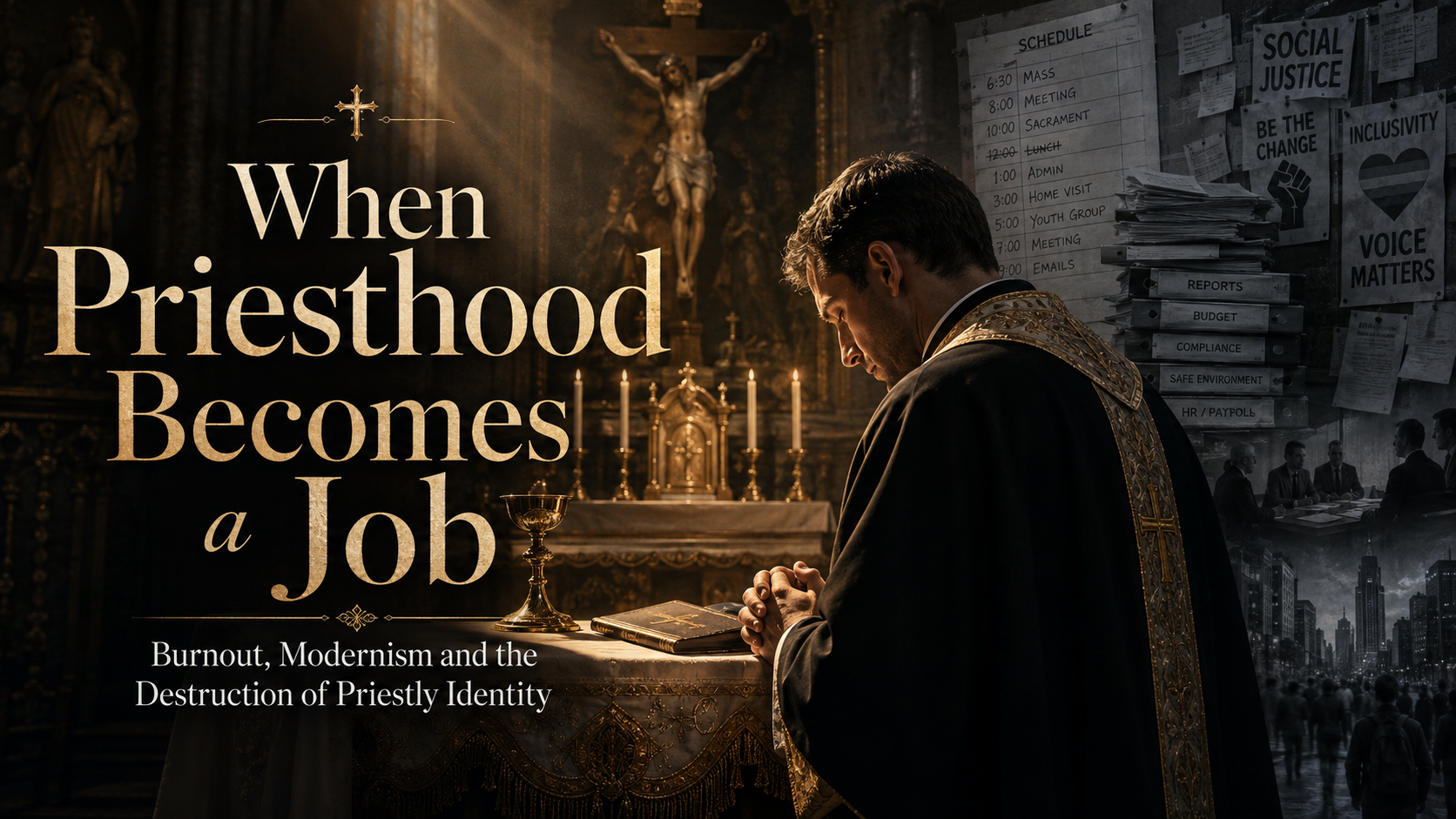
When Priesthood Becomes a Job: Burnout, Modernism and the Destruction of Priestly Identity
The resignation of ✠Karl-Heinz Wiesemann at sixty-six has again raised the question of clerical burnout and psychological illness. Professional mental-health care has an important place, and clinical depression must never simply be dismissed as deficient faith. Yet the Church will profoundly misunderstand the present crisis if she treats exhausted priests chiefly as overworked employees requiring better occupational-health provision. There is another and deeper question: what happens when the priest himself, and the Church around him, begin to lose sight of what the priesthood is actually for?

On 19 August 2026 Pope Leo XIV accepted ✠Karl-Heinz Wiesemann’s resignation from the pastoral government of Speyer. Wiesemann explained that the burden of responsibility had left serious physical and psychological traces, that he had required psychotherapeutic treatment and admission to a psychosomatic clinic for recurrent depressive disorder, and that the immediate trigger of the crisis had been the burden of confronting clerical sexual abuse within his diocese.¹ Nothing in those facts permits us to diagnose retrospectively the spiritual condition of one man. Depression is real; devout Catholics, holy priests and saints can suffer psychological illness. It would therefore be theologically crude and pastorally irresponsible simply to equate depression with deficient faith. Yet ✠Wiesemann’s resignation provides an occasion to examine the wider phenomenon of priests who speak of exhaustion, loneliness, burnout, disillusionment and inability to continue.
Increasingly, discussion of this phenomenon is conducted almost entirely in therapeutic terminology: stress, resilience, self-care, work-life balance, counselling, sabbaticals, boundaries and psychological support. Some of these things are undoubtedly necessary. But a priest is not simply an unusually overworked employee with inconvenient hours, nor is priesthood merely another caring profession in which occupational stress must be managed. Priestly burnout cannot be understood adequately without first understanding priesthood. And that is precisely where the modern crisis begins.
For more than half a century Catholic priesthood has suffered a crisis of identity whose consequences have become so familiar that they can easily be mistaken for the normal condition of the Church. Traditionally the priest knew why he existed. He was a man set apart for the things of God: to offer the Holy Sacrifice of the Mass, absolve sins, preach revealed truth, administer the sacraments, sanctify souls, teach the Faith, accompany the dying and conduct those entrusted to him towards eternal salvation. He exercised the cura animarum, the care of souls. His social and charitable activity flowed from that supernatural identity; it did not replace it. Even a 1995 Vatican symposium on the priesthood, explicitly interpreting Presbyterorum Ordinis and Pastores Dabo Vobis, insisted that the priest is “not … a delegate of the community before God, nor a functionary or employee of God before the people.” The same intervention warned specifically against “functionalism”: the reduction of priesthood to tasks and services at the expense of the sacramental reality received in Holy Orders.² The contrast with contemporary professionalised conceptions of ministry could scarcely be clearer.
Much contemporary ecclesiastical culture progressively reversed that relationship. The priest increasingly became community animator, committee chairman, safeguarding administrator, development officer, fundraiser, social campaigner, counsellor, conflict mediator, human-resources intermediary, events organiser and amateur psychologist who, among numerous other responsibilities, happened also to celebrate Mass. None of those activities is necessarily wrong. The priest must care about poverty, loneliness, mental illness, family breakdown and injustice. The corporal works of mercy belong intrinsically to Catholic life. The distortion begins when the temporal consequences of priestly charity replace its supernatural source and end. The priest feeds the hungry because he serves Christ; he consoles the afflicted because he brings Christ; he builds Christian community around the altar; he confronts injustice because men and societies remain subject to the moral law of God; and he listens to suffering not merely so that suffering may be heard, but so that it may finally be carried beneath the Cross. Remove that vertical dimension and many of the same activities remain outwardly visible, but the priest becomes increasingly indistinguishable from a particularly overworked social worker.
Priests formed during the period of post-conciliar upheaval have themselves described precisely such a redefinition. Fr Brian Hawker, recalling his seminary formation, said that the older understanding of the priest as the “Man of God” had been replaced by something radically different: “the priest is, in many ways, a social worker.” He remembered seminarians being encouraged to become “just like everybody else”, while the sacrificial conception of priesthood was displaced.³ Whatever judgement one makes about Hawker’s later association with the SSPX, his testimony is significant because he is describing the formation he says he actually received. Nor has the underlying theology disappeared. Fr Tony Flannery CSsR has written: **“I no longer believe that the priesthood, as we currently have it in the Church, originated with Jesus.”**⁴ Fr Thomas O’Loughlin, a priest of the Diocese of Arundel and Brighton and emeritus professor of historical theology, contrasts the traditional Catholic understanding of Orders with another model in which “ordination is a means to ministry”, describing the former in terms of a “sacerdotalist perception”.⁵
The significance is considerable. This is the movement from ontology to function. In the traditional Catholic conception, the priest performs a distinctive ministry because through sacramental consecration he first is something: configured to Christ the High Priest in a manner distinct from the common priesthood of the baptised. In the functional conception, ordination becomes increasingly intelligible as the community’s mechanism for authorising somebody to perform tasks which the community requires. The first begins with sacerdotium and derives ministry from it. The second begins with ministry and explains ordination through function. The Holy See itself later felt the need to answer precisely this confusion, insisting that the priest is not “a delegate of the community before God” but receives his mission from Christ through sacramental consecration rather than merely appointment to an ecclesiastical function.²
St John Paul II acknowledged the historical rupture even more explicitly. In Pastores Dabo Vobis he spoke of a “crisis of priestly identity” which had arisen in the years immediately after Vatican II, saying that it arose from erroneous understanding and sometimes conscious bias against conciliar doctrine and had contributed to the enormous number of priestly defections. His remedy was recovery of the “specific ontological bond” between the priest and Christ; indeed, he described the priest as a “living and transparent image of Christ the priest.” He also insisted that the presbyterate should constitute “a true family” rooted in the grace of Holy Orders and warned that where the supernatural meaning of vocation is lost, vocation itself can begin to be experienced as **“a crushing burden imposed upon them.”**⁶ That admission matters. The contention that something profound happened to Catholic priests’ understanding of themselves after Vatican II is not merely a retrospective traditionalist construction. The post-conciliar Magisterium itself recognised the crisis.
The connection with burnout is more direct than is usually acknowledged. The post-conciliar reconstruction of priesthood simultaneously narrowed the priest’s supernatural self-understanding and enlarged his temporal responsibilities. It weakened the spiritual architecture by which burdens were traditionally borne while giving the priest an expanding catalogue of social, political, therapeutic, organisational and administrative burdens to carry. The older priest was responsible principally for fidelity: to offer, absolve, preach, sanctify, teach, intercede and shepherd. The reconstructed minister is increasingly invited to feel responsible for outcomes: community cohesion, psychological wellbeing, social inclusion, economic justice, migration, environmental change, institutional reform and the transformation of social structures. Fidelity has limits defined by vocation; outcomes do not. A human being cannot carry an unlimited horizon.
Chicago: An Ecclesiastical Laboratory
This history becomes particularly relevant when considering the present pontificate, because it is insufficient merely to say that Robert Prevost was “formed after Vatican II”. He was formed within a highly particular ecclesiastical environment: Chicago in the late 1970s, and specifically at one of the most self-consciously post-conciliar theological institutions in American Catholicism. The Catholic Theological Union was founded in 1968 as what CTU itself describes as a “new model of seminary formation”: deliberately urban, ecumenical and collaborative, situated in Hyde Park beside the University of Chicago and other theological institutions.⁷ Robert Prevost undertook his theological studies there during his Augustinian formation.
This was not merely the geographical relocation of an old-fashioned seminary. CTU consciously represented a new understanding of formation, exposing students to women religious and lay students alongside candidates for orders, ecumenical and interreligious dialogue, contextual approaches to theology and sustained engagement with contemporary urban society. Robert Schreiter, who became internationally associated with contextual theology and with the construction of theology from particular cultural and social contexts, served as CTU’s academic dean from 1978 to 1986—the precise period of Prevost’s studies.⁸ Prevost also studied Catholic social teaching under Fr John Pawlikowski OSM, one of CTU’s founding faculty members and a prominent professor of social ethics. Pawlikowski later remembered Prevost as **“very much in the context of Vatican II.”**⁹ The phrase should not be inflated into ideological determinism, but neither should it be treated as irrelevant. Formation means something.
Still more importantly, CTU was not an isolated progressive enclave situated inside an otherwise conventionally sacerdotal archdiocese. The Archdiocese of Chicago itself had become one of the principal laboratories of twentieth-century American Catholic social activism. Histories of the archdiocese describe a Catholic culture with a reputation for political liberalism, commitment to social change and liturgical innovation, while post-conciliar priests were developing altered understandings of their relationship with parishioners and extending older traditions of labour and interracial activism.¹⁰ Cardinal John Cody, Archbishop from 1965 until 1982, was hardly the uncomplicated patron of progressive clerical democracy; his strongly centralising government brought him repeatedly into conflict with reform-minded priests. Yet that very conflict demonstrates how established the alternative clerical culture had become. It possessed institutions, clergy networks and priorities independent of the archbishop’s personal enthusiasm.
The Association of Chicago Priests, created in 1966, rapidly moved beyond questions concerning clerical conditions into extensive social involvement. By 1967 it was addressing race relations, fair housing, poverty, war and peace, labour conditions and community organisation, and was encouraging the involvement of priests and parishes in organised community action.¹¹ One of the most influential figures in this Chicago culture was Msgr John “Jack” Egan, priest of the Archdiocese and a major figure in Catholic urban social action. His language deserves to be heard directly. In 1972 he declared, “The act of social justice is organization.” Four years later, discussing changing relationships between priests and laity, Egan said that **“priests must be prepared to let their image die”.**¹² Egan remained sacramentally committed, and his contemporaries attest the centrality of Eucharist and priesthood to him, yet he nevertheless represents the moment when inherited images of sacerdotal distinction were consciously being dismantled and replaced by something more collaborative, activist and socially engaged.
Nor can the Chicago relationship with Saul Alinsky simply be dismissed as a polemical association invented by conservatives decades later. The Encyclopedia of Chicago states that it was in Chicago that the alliance between Alinsky’s community-organising movement and Catholic institutions reached its **“fullest flowering”.**¹³ Catholic clergy and institutions had been involved with community organising from Alinsky’s early Back of the Yards work onwards. This does not make Catholic social action itself suspect. Figures such as Msgr Reynold Hillenbrand had sought to unite liturgy, Catholic Action and social doctrine. The historical problem is subtler: what begins as social action flowing from supernatural Catholic identity can gradually become a dominant definition of ministry in its own right.
The chronology surrounding Prevost’s formation is therefore striking. In October 1978, almost exactly as his theological formation was beginning, Call To Action was reborn as a permanent organisation in Chicago. Its own retrospective history is candid about what was happening: Vatican II, it says, had energised American Catholics, and “social activism grew increasingly important and integral to American Catholic life” among both clergy and laity. The Chicago meeting gathered more than four hundred priests, religious, teachers and lay Catholics and continued an agenda combining reform of Church institutions with wider questions of justice and peace.¹⁴ This was the ecclesiastical ecology in which Prevost’s immediate preparation for priesthood occurred: post-conciliar theological experimentation, urban social activism, community organising, liturgical reconstruction, clerical reform movements, ecumenism, interreligious engagement and increasingly expansive notions of ministry.
To say this is not to claim that Chicago mechanically “produced” the subsequent Pope Leo XIV, still less that Prevost adopted every opinion circulating around him. Formation is influence, not determinism. Yet it would be equally unserious to pretend that a man’s formative theological environment has no bearing upon the categories, instincts and priorities through which he subsequently understands ecclesial life.
Chicago Was Not Unique
Nor should Chicago be imagined as an eccentric exception. Variations of the same reconstruction were occurring across substantial parts of Catholicism. The vocabulary differed—community organisation in Chicago, political theology in Germany, liberation in Latin America, democratisation in the Netherlands—but the underlying movement was recognisable: from a predominantly vertical and sacerdotal conception towards one increasingly defined by community, participation, social transformation and engagement with the structures of the contemporary world.
In the United States, the phenomenon was already national. Call To Action’s 1976 Detroit conference followed a national consultation involving approximately 800,000 Catholics and assembled 1,340 voting delegates drawn from 152 dioceses. Its agenda deliberately combined racism, poverty, militarism and economic justice with disputed questions concerning priestly celibacy, women, sexuality and ecclesiastical government.¹⁴ In the Netherlands, Pope Paul VI himself identified the theological problem in 1970. Writing to the Dutch bishops amid the upheavals surrounding the Dutch Pastoral Council, Paul complained that the Church was being presented “as if the mission of the Church were purely terrestrial” and that **“the priestly ministry is considered as an office conferred by the Christian community”.**¹⁵ Those words deserve their full force. This was not Archbishop Lefebvre, a traditionalist journal or a retrospective critic writing decades later. It was Pope Paul VI in January 1970. Within five years of the Council’s conclusion he was already warning that Catholic mission was being horizontalised into something “purely terrestrial” and that priesthood itself was being functionalised as an office bestowed by the community.
In Latin America, the Medellín conference of 1968 gave enormous impetus to structural analyses of poverty, base ecclesial communities and the theological currents which developed into liberation theology. This inspired courageous Catholic work among genuinely oppressed populations, but it also generated movements in which clergy became directly involved in political mobilisation and theories of structural liberation. In Argentina approximately four hundred priests joined the Movement of Priests for the Third World, while related clerical networks emerged in Chile, Colombia, Mexico and elsewhere, some developing explicit relationships with secular left-wing movements.¹⁶ The point is not that every expression of liberation theology was identical or that social action for the poor was illegitimate. It is that the conception of priestly mission was being stretched increasingly into the sphere of organised social and political transformation.
West Germany produced an intellectual equivalent through the “new political theology” associated especially with Fr Johann Baptist Metz. Metz deliberately emphasised praxis, social critique, solidarity, political responsibility and the public consequences of Christian memory. He served as a consultant to the German dioceses’ Würzburg Synod of 1971–75 and exerted substantial influence upon its text Unsere Hoffnung.¹⁷ Political theology was not simply Marxism, and Metz rejected such a reduction, but it contributed to the broader atmosphere in which political and structural transformation became increasingly prominent categories for understanding Christian mission.
Nor were England and Wales immune. Sociological studies of British Catholicism describe significant post-conciliar changes in the role of the parish priest and in priest-laity relationships, while the older enclosed Catholic subculture weakened rapidly. Catholic organisations increasingly addressed development, poverty, peace and political justice, and an identifiable Catholic New Left in Britain engaged seriously with liberationist thought during the 1970s.¹⁸ Again, many of these concerns were legitimate. The cumulative significance lies in the shift of emphasis: ministry increasingly encountered itself through the language of engagement, participation and social transformation alongside—and sometimes instead of—the older sacerdotal language of sacrifice, sanctification and salvation.
The examples could be multiplied, but their simultaneity matters. What occurred after the Council was not simply a collection of unrelated local experiments. A new model of ministry was emerging across substantial portions of Catholicism. Its characteristic instincts tended increasingly to become horizontal rather than vertical, participatory rather than hierarchical, functional rather than ontological, therapeutic rather than ascetical, and socio-political rather than primarily sacerdotal. In moderate forms it sought to supplement traditional priesthood; in radical forms it sought effectively to replace it. Paul VI’s warning about a “purely terrestrial” mission and priesthood as a community-conferred office demonstrates that the problem was already visible at the highest level of the Church while the transformation itself was occurring.
Chicago was therefore not the cause; Chicago was one particularly revealing workshop of a much wider revolution. The pattern was international and the consequences were generational. The connection with burnout is crucial because the distinctively supernatural definition of priesthood was being questioned at precisely the moment when priests were being encouraged to assume enlarged responsibility for social, political, psychological and structural problems. The traditional sacerdotal question had been, How may I faithfully bring these souls to God? The emerging ministerial question increasingly became, How may I help transform the conditions in which these people live? A Catholic priest properly asks both. The catastrophe begins when the second displaces the first, because the first has a supernatural and vocationally defined answer—preach, offer, absolve, sanctify, teach, intercede, practise charity and entrust the fruit to God—whereas the second potentially has no terminus at all.
From Social Teaching to Social Activism
Catholicism possesses a rich social doctrine. Leo XIII defended workers against exploitation while simultaneously defending private property, the family and voluntary association and rejecting socialism. Catholic priests and religious founded hospitals, schools, orphanages, credit unions and workers’ associations long before contemporary progressivism appropriated the terminology of social justice. Concern for poverty is not Modernism, and political passivity is not Tradition. The danger arises when Catholic social doctrine becomes detached from the supernatural hierarchy of ends and begins to function almost as a self-sufficient ecclesiastical programme. Charity moves imperceptibly from being the fruit of supernatural religion towards becoming an operative definition of religion itself. Structures, redistribution, inclusion, migration, environmental policy, economic inequality and political mobilisation occupy increasing ecclesiastical attention while repentance, judgement, conversion, sacramental grace and eternal salvation appear less prominently in the public register.
It is in this precise and qualified sense that one may identify within contemporary clerical culture a form of soft socialism. By this we do not mean socialism in the doctrinal sense condemned by Leo XIII: abolition of private property, Marxist class struggle or collectivisation. Pope Leo XIV cannot accurately be labelled a socialist in that technical sense. By soft socialism we mean rather a pastoral-social mentality which, while formally retaining private property and avoiding revolutionary socialism, habitually privileges structural, redistributive, collective and policy-mediated solutions to social problems and increasingly interprets the Church’s mission through those categories. Its distinguishing feature is less explicit doctrinal denial than orientation and proportion.
The public language of Leo XIV makes the question legitimate. Addressing the World Meeting of Popular Movements in October 2025, the Pope declared that “land, housing and work are sacred rights”, told his audience “I am with you!”, called the activists “social poets”, and said their initiatives could become **“new public policies and social rights.”**¹⁹ There is considerable theological information in those few phrases. Popular movements are not merely objects of pastoral concern; their political struggle is explicitly encouraged, their demands are described as sacred rights, and their initiatives are envisaged as the basis of public policy. The following day, addressing Jesuit superiors, Leo XIV criticised an economic order which subordinates human dignity to profit and urged Jesuit universities, social centres, publications and institutions to become “powerful channels to promote systemic change.” At the same time he also called the Jesuits back to personal prayer, the sacraments, Eucharistic adoration and devotion to the Sacred Heart.²⁰
In April 2026 Leo told Italy’s National Institute for Social Security that its work included “mechanisms for the fair distribution of wealth”. He contrasted the immense wealth existing in the world with continuing poverty, described the concentration of wealth amid deprivation as an unjust situation and insisted that **“we cannot fail to … commit ourselves to changing things.”**²¹ Again, none of these statements constitutes doctrinal socialism. But neither are they insignificant. A Pope, bishop or priest teaches not merely through isolated doctrinal propositions but through the subjects, categories and imperatives to which he repeatedly gives prominence.
When ecclesiastical discourse habitually emphasises redistribution, migration, popular movements, structural inequality, social rights and systemic change, while mortal sin, sacramental confession, judgement, conversion, Eucharistic sacrifice and eternal salvation occupy a less conspicuous place in the public register, an implicit hierarchy of concerns is communicated whether intended or not. The problem is not believing workers deserve justice; the problem begins when social justice becomes more immediately intelligible to the clergy than justification by grace. The problem is not concern for migrants; it is when migration policy generates enormous ecclesiastical urgency while the abandonment of sacramental life by millions of baptised Catholics generates apparently less. The problem is not alleviating material poverty; it is when material poverty receives constant institutional analysis while the spiritual impoverishment of formerly Catholic peoples is treated principally as sociology. The problem is not changing unjust structures; it is when structural transformation appears more characteristic of ecclesiastical mission than conversion of sinners.
To be fair, Leo XIV sometimes supplies his own corrective. He has explicitly insisted that Christian service must arise from prayer and return to it, and when addressing popular movements he warned that their activity must not become ideology but remain Gospel charity.¹⁹ ²⁰ That qualification makes the central question more precise rather than less important: which pole actually governs the other? Does the altar send the priest into the world, or does the world’s agenda increasingly determine what priesthood is understood to be for? Does prayer produce Catholic action, or does prayer increasingly become spiritual fuel for activism? Does social action remain ordered ultimately towards salvation, or does social transformation become, in practice, the dominant meaning of salvation? These are not semantic questions; they concern Catholic identity itself.
Why Activism Can Exhaust the Priest
Here the connection with burnout becomes particularly important. The sacerdotal priest possesses an immense vocation, but it is a defined vocation. He offers Sacrifice, absolves sins, teaches doctrine, administers the sacraments, intercedes, sanctifies, preaches and shepherds souls. He relieves poverty insofar as possible, counsels the afflicted and applies Catholic social teaching, but he knows that he is not personally responsible for engineering a perfect society. The socially reconstructed minister, by contrast, inherits a potentially unlimited portfolio: there is always another inequality to address, another marginalised constituency to accompany, another structure to transform, another psychological wound to absorb, another campaign to support, another institutional injustice to confront, another consultation to attend and another political problem upon which the Church is expected to pronounce.
This is precisely the paradox of the modern transformation of priesthood: the priest’s supernatural identity is attenuated at the same time as his temporal responsibilities multiply. He is given more burdens while losing some of the theological architecture which once explained how those burdens were to be borne. Traditional Catholicism gave human suffering a supernatural telos. The sinner was brought to repentance and absolution; the grieving were directed towards resurrection and prayer for the dead; the tempted were instructed in spiritual combat; the troubled conscience was formed according to objective moral truth; the dying were prepared for eternity. Human anguish was not simply absorbed indefinitely by the priest. He carried it to Christ.
The priest brings his people into the Divine Office. He places them upon the altar. He carries them before the tabernacle. He intercedes. He offers Mass. He absolves where absolution is required, gives spiritual counsel where appropriate and refers to competent professionals where a problem exceeds his expertise. Above all, he knows that he is not the saviour; Christ is. When that supernatural orientation weakens, a priest may unconsciously attempt something no human being can achieve: fixing everyone entrusted to him. Marital collapse, addiction, bereavement, anxiety, loneliness, family conflict and psychological distress accumulate within him. He ceases carrying other people’s burdens to Christ and begins simply carrying them inside himself. No therapeutic vocabulary can make that sustainable indefinitely.
The Forgotten Interior Life
Prayer therefore cannot be treated merely as one component of clerical “wellbeing”. Prayer is constitutive of priestly existence. The Divine Office is not clerical homework squeezed between meetings; mental prayer is not an ecclesiastical form of mindfulness; Eucharistic adoration is not decompression; spiritual reading is not continuing professional development; and the daily Mass is not merely the principal religious service delivered by the parish. These things constitute the supernatural architecture within which the priest’s life becomes intelligible.
Pius XI warned in Ad Catholici Sacerdotii that priests could become so absorbed even in apparently holy external work that their own sanctification suffered. Without genuine priestly piety, he warned, sacred actions themselves could become mechanical and **“devoid of spirit, unction and life.”**²² The paradox could hardly be more relevant: a man can exhaust himself doing the work of a priest while gradually ceasing interiorly to live as a priest. There is therefore a profound difference between fatigue and depletion.
The 2025 National Study of Catholic Priests makes the distinction unusually concrete. Forty-four per cent of diocesan priests showed at least one indicator of burnout, compared with thirty-one per cent of religious priests; high burnout was found among seven per cent of diocesan priests but only two per cent of religious priests. One religious priest expressed the experiential distinction memorably: **“After ministry, I feel worn out but not weary. It’s a happy worn out.”**²³ A priest may finish Sunday after several Masses, confessions, hospital visits and pastoral conversations physically exhausted yet inwardly peaceful. He has spent himself, but he knows why. The exhaustion has meaning.
Religious priests are not necessarily less busy, yet religious life ordinarily encloses ministry within a supernatural structure: community, rule, common prayer, shared meals, spiritual fraternity, a particular charism and a daily consciousness that life has been consecrated to God. The diocesan priest increasingly may have remarkably little of this. He can live alone, eat alone and carry several formerly independent parishes. His brother priests may be men he encounters mainly at diocesan meetings. His bishop may be experienced more through appointments, restructuring and policy than through paternal fraternity. This is why the destruction of stable parish belonging matters too.
A Priest Needs a People
The traditional parish priest exercised the cura animarum in a definite place among a definite people. He baptised their children, prepared them for Communion, married them, visited their sick and buried their dead. He knew which widow ate alone, which marriage was in trouble, which young person was drifting from the Faith and which household was struggling. They were not service users; they were his people, and he was their priest.
Modern restructuring can leave one priest responsible for four or five churches while deeply rooted in none. Parishioners become emails, rotas, safeguarding records, statistics and Mass counts. The priest may spend every day among people while remaining profoundly lonely. That is not merely psychologically unhealthy; it is ecclesiologically distorted. John Paul II’s description of the presbyterate as “a true family” therefore has practical as well as theological significance.⁶ A priest needs friendship, brother priests, parishioners capable of loving him without possessing him, a bishop who behaves as father rather than human-resources director, and a Christian community in which celibacy does not become social exile. The priest should neither be idolised nor isolated. He should belong.
Vocation or Employment?
The question of vocation then becomes unavoidable. Burnout does not prove retrospectively that a priest was never called by God. A genuinely called priest may suffer depression, exhaustion or profound spiritual trial. But the preservation of vocational consciousness determines whether sacrifice continues to possess meaning. Why did he become a priest? Does he still know why? Does he believe God called him? Does he believe Holy Orders changed him sacramentally? Does he believe Mass is truly Sacrifice? Does he believe souls can be lost? Does he believe confession restores sanctifying grace? Does he understand celibacy as consecration rather than an employment condition? Does he believe the salvation of souls remains the supreme purpose of the Church?
When those convictions weaken, everything else changes meaning. Celibacy becomes loneliness, obedience becomes managerial interference, the breviary becomes unpaid overtime, Sunday Mass becomes repetitive service provision, parishioners become clients, the presbytery becomes employer-provided accommodation, the bishop becomes a manager and transfer becomes redeployment. Priesthood becomes a job. At that point burnout is hardly surprising. John Paul II’s warning that vocation, when stripped of its true relationship with God, can be experienced as “a crushing burden imposed upon them” belongs directly within the discussion of clerical exhaustion.⁶ A vocation understood supernaturally can demand immense sacrifice without ceasing to be gift; a vocation understood merely functionally can eventually feel like nothing but burden.
The answer is not retrospective accusation. It is restoration, and restoration includes proper psychological and medical care. Depression, trauma and addiction are real. Priests sometimes require psychotherapy, psychiatric treatment, medication or extended rest. But psychology must occupy its proper place. Therapy can assist a priest. It cannot tell him what priesthood is. It cannot give supernatural faith, confer vocation, restore belief in the Real Presence, make the Holy Sacrifice the centre of a man’s existence, or substitute for confession, mental prayer, spiritual direction, priestly fraternity, paternal episcopal care or sacramental grace. A Church which weakens those realities and then responds to exhausted clergy principally by expanding therapeutic provision risks treating symptoms while refusing to diagnose the deeper disorder.
What Are We Asking Them to Burn For?
The crisis of clerical burnout therefore cannot finally be separated from the broader modernist and neo-modernist crisis of Catholic identity. The desacralisation of liturgy, attenuation of doctrinal certainty, confusion concerning sacerdotal identity, decline of confession and devotional life, bureaucratisation of dioceses, enlargement of pastoral units, therapeutic concepts of ministry and politicisation of ecclesiastical discourse are not isolated developments. They revolve around one question: What is the Church for? Paul VI saw the danger remarkably early when he warned against presenting her mission as **“purely terrestrial”.**¹⁵ If the Church exists principally to accompany humanity towards a more inclusive, socially equitable and psychologically comfortable temporal existence, the priest will inevitably become religious social worker, activist, organiser and counsellor. If the Church is the Mystical Body of Christ, divinely established to proclaim revealed truth, offer divine worship, administer supernatural grace, forgive sins and conduct souls to eternal salvation, priesthood becomes intelligible again.
This is why Chicago, the corresponding international developments and Leo XIV’s contemporary social rhetoric matter. They illustrate a historical trajectory in which authentic Catholic concern for social justice became interwoven with a wider reconstruction of ministerial identity. The danger was never compassion for the poor. The danger was horizontalisation: progressive enlargement of worldly responsibility alongside weakening of the supernatural identity which tells the priest what he uniquely exists to do. There is an instructive contrast with the Leo whose name the present Pope chose. Leo XIII certainly condemned exploitation and defended workers, but Rerum Novarum simultaneously defended private property, the rights of the natural family, personal responsibility and voluntary workers’ associations, while rejecting socialist attempts to dissolve private ownership into collective control.²⁴ Catholic social doctrine therefore orders temporal society according to moral law; it does not turn the priest into the engineer of an indefinitely perfectible social order.
The priest was never meant to carry the world. He was meant to carry the world to Christ. Once the priest understands that the sins, sorrows and crises brought before him are not finally his to solve but Christ’s to redeem; once his day is ordered around sacrifice and prayer rather than bureaucracy and activism; once the parish becomes a spiritual family rather than a service area; once the bishop becomes father rather than manager; once fraternity replaces isolation; and once the salvation of souls is restored unmistakably as the end of pastoral ministry, the priest can again understand why his life is being spent.
There will still be exhausted priests. There will still be clinical depression. There will still be men who require counselling, medication, sabbaticals or retirement. Catholicism promises neither psychological invulnerability nor freedom from suffering. But there is an immense difference between suffering without meaning and sacrifice offered for a supernatural end. The modern Church cannot indefinitely weaken the altar-centred, sacrificial and supernatural conception of priesthood; replace the cura animarum with administration, accompaniment, community organisation and social management; consume priests’ prayer lives with bureaucracy; isolate them from stable communities; burden them with responsibility for every social pathology and psychological wound; invite them to feel responsible for political and structural outcomes whose horizons are practically limitless—and then express bewilderment when some no longer possess the spiritual resources to carry the weight.
The Church therefore owes her priests more than better care after they collapse. She owes them more than counselling programmes, resilience courses, social causes and wellbeing policies. She owes them something more fundamental. She owes them their priesthood back.
¹ Holy See Press Office, Resignations and Appointments, 19 August 2026; reporting of ✠Wiesemann’s statement.
² Congregation for the Clergy, Priesthood: A Greater Love symposium materials, 1995.
³ Fr Brian Hawker, “Priest, Where is Thy Mass?”.
⁴ Fr Tony Flannery CSsR, statement on priesthood.
⁵ Thomas O’Loughlin, “Celebrating Synodality: Synodality as a Fundamental Aspect of Christian Liturgy”, New Blackfriars.
⁶ St John Paul II, Pastores Dabo Vobis, 1992.⁷ Catholic Theological Union, institutional history.
⁸ Catholic Theological Union Archives, Robert Schreiter records.
⁹ Fr John Pawlikowski OSM on Robert Prevost’s formation.
¹⁰ Encyclopedia of Chicago, “Roman Catholic Archdiocese of Chicago”.
¹¹ The Criterion, 19 May 1967.
¹² The Catholic New World, Msgr John J. Egan.
¹³ Encyclopedia of Chicago, Catholicism and community organising.
¹⁴ Call To Action, official history.
¹⁵ Paul VI, Letter to the Bishops of the Netherlands, 12 January 1970.
¹⁶ CELAM, Medellín 1968 archive; historical study of radical priestly networks in Latin America.
¹⁷ University of Würzburg, study of Johann Baptist Metz and political theology.
¹⁸ Michael P. Hornsby-Smith, “Priests, People and Parishes in Change”.
¹⁹ Leo XIV, Address to the World Meeting of Popular Movements, 23 October 2025.
²⁰ Leo XIV, Address to the Major Superiors of the Society of Jesus, 24 October 2025.
²¹ Leo XIV, Address to the Italian National Institute for Social Security, 10 April 2026.
²² Pius XI, Ad Catholici Sacerdotii, 1935.
²³ The Catholic Project, National Study of Catholic Priests, Wave II, 2025.
²⁴ Leo XIII, Rerum Novarum, 1891.
RELATED ARTiCLES


LATEST ARTICLES
- Today’s Mass: October 16 St Hedwig of SilesiaHedwig of Silesia, a member of the Bavarian comital House of Andechs, was Duchess of Silesia from 1201 and of Greater Poland from 1231 as well as High Duchess consort of Poland from 1232 until 1238. She was canonized by the Catholic Church in 1267 by Pope Clement IV.
- Today’s Mass: October 15 St Teresa of AvilaSaint Teresa of Avila, born in 1515, was the reformer of the Carmelite Order and founded the Discalced Carmelites. Renowned for her mystical writings, she faced opposition while establishing numerous convents. Teresa’s deep spiritual insights and experiences led to her canonisation in 1622, and her feast is celebrated on 15 October.
- Today’s Mass: October 14 St Callistus, Bishop of Rome & MartyrCallistus was born to a Christian slave who had a Christian master in second-century Rome. He was placed in charge of a Christian bank which went broke. He fled the city, but was caught and sentenced to the treadmill, then later to the tin mines. He was later ransomed and returned to Rome…
- Sermon for St. WilfridToday marks the feast of St. Wilfrid, who was pivotal in establishing the Roman Christian tradition in England over the Irish. Born in 634 in Northumbria, he travelled to France and Italy, eventually becoming bishop of York. Despite conflicts with kings and church leaders, he successfully evangelised Sussex and laid foundations for future missions, showcasing both determination and a contentious spirit. St. Wilfrid passed away in 709, leaving a complex legacy of leadership and zeal for evangelism.
- THE GENERATION THAT WAS TOLD TO MOVE ON Is Rediscovering What the Church Left BehindArchbishop Salvatore Cordileone’s interview highlights the challenge of reconciling Catholic Tradition with contemporary practices, warning that restrictions like Traditionis custodes may deepen existing divisions. He notes younger Catholics are rediscovering traditional worship, which contrasts with the Church’s modern adjustments and emphasizes the need for reflective continuity in liturgical development.
CURRENT EDITION


DAILY MASS ONLINE
One of the earliest online apostolates dedicated to the Traditional Latin Mass, Old Roman TV began broadcasting the Holy Sacrifice on the Feast of the Assumption, 15 August 2008. During the COVID-19 pandemic, additional programming — devotions, catechesis, and conferences — was added to support the faithful in prayer and formation.
Support the daily Holy Mass on Old Roman TV by offering a Mass intention — for loved ones, thanksgiving, or the repose of souls. Your intention helps sustain the sacred liturgy and brings grace to those you remember before God’s altar.
SUPPORT THE DAILY MASS ONLINE
Likely the world’s longest-running daily online broadcast of the
Traditional Latin Mass, streaming faithfully since the
Feast of the Assumption 2008.

This apostolate cannot continue without immediate help
Please support us with a contribution toward
chapel rent, sacristy supplies, operating costs, and web-hosting.
Our essential monthly costs reach £1,000.
MASS INTENTIONS
If your offering is for a Mass Intention, kindly complete the form below in full so we may correctly match it to your donation. For anniversary intentions — birthdays, wedding anniversaries, anniversaries of death — please be sure to include the relevant date.


Today’s Mass Propers
- Today’s Mass: October 16 St Hedwig of Silesia
 Hedwig of Silesia, a member of the Bavarian comital House of Andechs, was Duchess of Silesia from 1201 and of Greater Poland from 1231 as well as High Duchess consort of Poland from 1232 until 1238. She was canonized by the Catholic Church in 1267 by Pope Clement IV.

Leave a Reply