
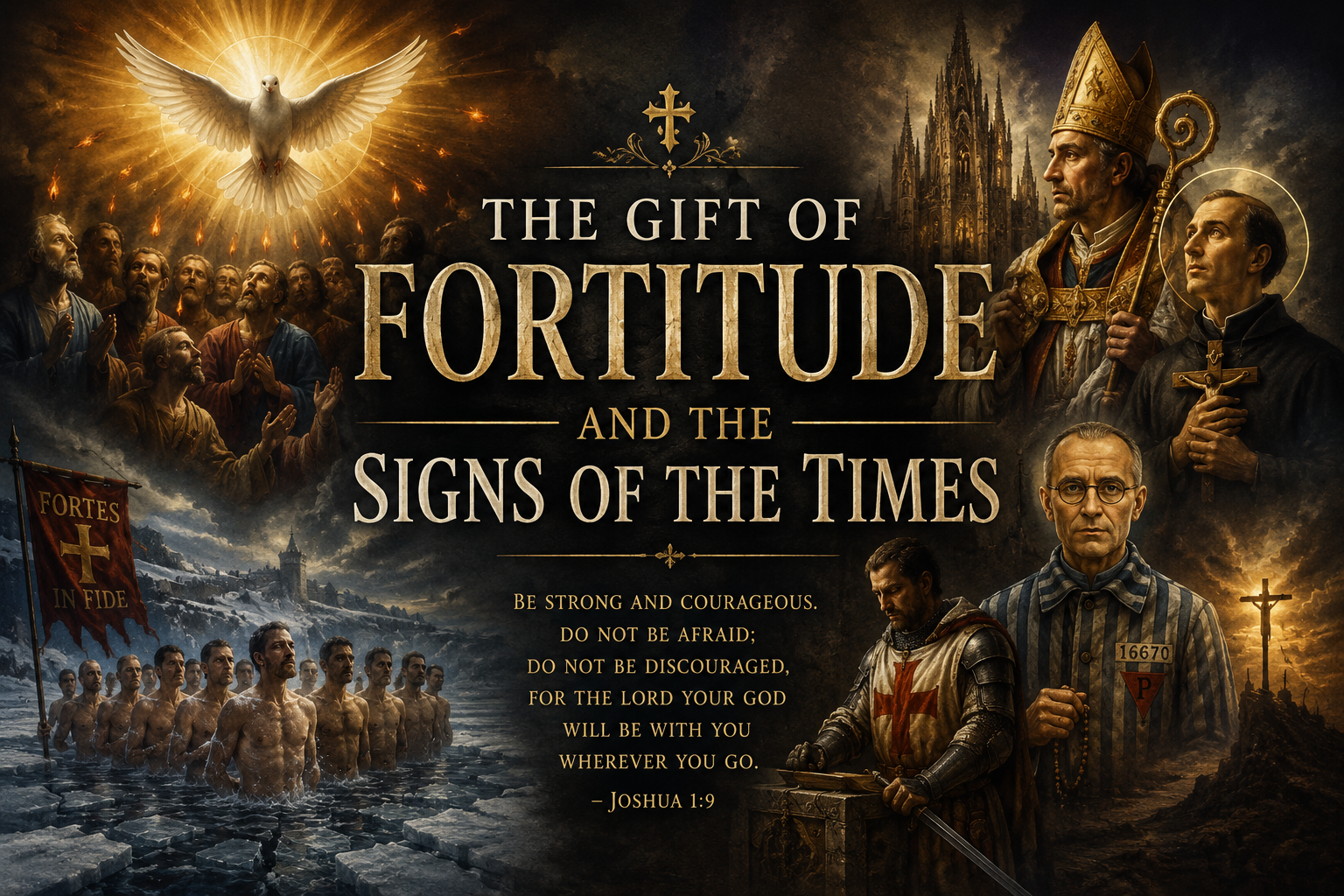
THE GIFT OF FORTITUDE, AND THE SIGNS OF THE TIMES

One of the Seven Gifts of the Holy Ghost is the gift of Fortitude. Saint Thomas Aquinas defines it as “a certain firmness of mind… and this firmness of mind is required both in doing good and in enduring evil, especially with regard to goods or evils that are difficult” (ST IIa-IIae, Q. 139, a. 1). In a word, we may say that Fortitude is the supernatural strength to stand firm amidst obstacles in order to fulfill the duty of doing good.
Another word for Fortitude is constancy, though strictly speaking, each has its own theological nuance. That is a matter for another reflection. Suffice it to say, Fortitude is supernatural bravery: not the bravado of an arrogant or foolish man, but the resolve of one strengthened by grace to withstand and endure evil so that he may accomplish the Will of God.
There have been numerous examples of the gift of Fortitude working in the human person throughout the centuries. Saints, both known and unknown, have borne witness to this truth. The early Christian martyrs faced death for their refusal to worship the emperor. The Forty Martyrs of Sebaste—those glorious Armenian soldiers who died under Licinius—endured the piercing cold of the frozen lake for the sake of their faith in Christ. Saint Thomas Becket suffered the wrath of Henry II after defending the liberty of the Church, and was slain before the very altar of Sacrifice. Saint John Nepomucene refused to break the seal of confession even when the king of Bohemia offered him riches and threatened him with death; he was ultimately cast into the river to perish. And even in our contemporary times, we recall the great Marian apostle, Saint Maximilian Kolbe, martyr of charity, who offered himself without hesitation in place of a family man condemned to die in the starvation cell of Auschwitz.
There are countless more examples of men and women, children and adults, in every state of life, standing firm for the sake of God and what is good—even unto death.
We must remember that our own age is not so different from the ages that preceded us. We commit the same foolish errors as societies of the past, errors which lead to moral decline and, eventually, to a desolate state of affairs. We see this in the current geopolitical situation, where nations refuse to live in harmony and instead seek to curtail the existence of others.
In our own society today, we are struck by both material and spiritual poverty. It is worth noting that when a society becomes materially impoverished due to the corruption of the rich and powerful, moral considerations often become secondary to the basic need of survival—feeding the hungry stomach and securing a livable life.
Yet in another sense, our times are indeed different. In former ages, men possessed a strong sense of responsibility that fortified their fortitude. This sense of duty to do what is good sustained them in building the great structures that glorify God and the Holy Sacrifice of the Mass. The beautiful works of art and architecture that are the jewels of the medieval West bear witness to this sense of responsibility and resolve inspired by the Holy Ghost.
Contemporary society obsesses itself with gratification and the loss of true accountability. Everything is instant, and while there are constant calls for accountability, many refuse to examine their own responsibility. Virtue is often performed rather than lived, as we are more inclined to signal righteousness than to practice it. These are often mere curtains concealing a deeper instability of character, marked by cowardice and inconstancy that render life less noble.
My dear brethren, the Holy Ghost descended upon the Apostles in tongues of fire in order to inflame their hearts and souls, that they might proclaim the Gospel to all nations and make disciples of all peoples. This is also the operation of the Holy Ghost in the soul: to set us aflame with the love of God, and to give us a burning zeal to accomplish His Holy Will—whatever the circumstance, whatever the trial, whatever the resistance.
The Catholic is meant to stand in contradiction to the world. In a world marked by laziness and self-gratification, we are given the grace to persevere in doing good and to discipline the flesh through self-denial. In a world of self-righteous calls for accountability and virtue-signaling, we are called instead to examine ourselves before Almighty God, to acknowledge our sins, and yet to remain always dependent on His mercy and compassion.
We are called to be different.
Let us then, my dear brethren, ask the Holy Ghost to inflame our hearts with the fire of divine love, so that we may resolve to do the Will of God even in the face of obstacles. Let us be brave—not with the arrogant bravery of a deluded fool, but with the silent and constant fortitude of the saints: those who do what is good, speak what is true, and think what is holy amid the evils of this world.
After all, we are called to be different from the world—and there is dignity in this.
Ave María purísima sin pecade concebida.
Pentecost 2026
Fr. Paolo Miguel R. Cobangbang is a priest of the Old Roman Apostolate based in Biñan City, the Philippines. He is a postulant in the Congregation for Divine Charity and promoter of the Teresian Carmelites of the Holy Face.
related articles


Latest articles
- Today’s Mass: September 11 Die IV in the Octave of the Nativity of Our LadyThe text discusses the significance of the Nativity of the Blessed Virgin Mary, highlighting her unique role in Salvation History, akin to that of St. John the Baptist. Mary’s birth signifies the fulfilment of God’s promises and heralds the arrival of her Son, Jesus Christ, thus becoming a pivotal moment in religious tradition.
- Today’s homily: St Nicholas TolentinoThe reflection celebrates Saint Nicholas of Tolentino, emphasising that holiness is achieved not through personal efforts but through grace. It highlights his life of service, prayer, and self-discipline, suggesting that his true sanctity stems from dependence on God. The message reinforces the importance of a single-hearted focus on God in one’s spiritual journey.
- Today’s Mass: September 10 St Nicholas of TolentinoSaint Nicholas of Tolentino, born around 1246 in Italy, became a devout Augustinian hermit known for his piety and dedication to preaching. He spent his later years in Tolentino, promoting virtue, and maintaining his chastity until his death in 1306. Canonised in 1446, his tomb is revered by the faithful.
- Sermon for St. Nicholas of TolentinoToday we honour St. Nicholas of Tolentino, who lived from 1245 to 1305. Abiding in Tolentino, he dedicated his life to ministry, healing, and reconciliation amidst societal discord. A member of the Augustinian order, he exemplified service without seeking fame, inspiring others to witness their faith in everyday life.
- Today’s Mass: September 09 Day II in the Octave of The Nativity of the Blessed Virgin MaryThe feast of Our Lady’s Nativity, of ancient Eastern origin and established at Rome by the time of Pope St Sergius I, celebrates Mary as the immaculate New Eve and the dawn of salvation, the chosen tabernacle from whom the Redeemer would take His flesh. Today the Church also commemorates St Gorgonius, an officer of the imperial household at Nicomedia who, with his companion Dorotheus, embraced the Faith and suffered martyrdom under Diocletian in A.D. 303; his relics were later translated to Rome.



Leave a Reply