- The Banquet of the King and the Bread of Angels: The Second Sunday after Pentecost and the Sunday Within the Octave of Corpus Christi
The Second Sunday after Pentecost and Corpus Christi highlight the significance of the Eucharist in Christian life. The Gospel invites believers to reflect on their priorities, emphasising that earthly concerns can overshadow spiritual nourishment. The celebration of Corpus Christi reaffirms Christ’s enduring presence, urging the faithful to accept His invitation to the sacramental banquet.
- From Peel to Politics: Identity, Legitimacy, and the Unravelling of Policing by Consent
The controversy over the National Association of Muslim Police (NAMP) highlights a significant shift in British policing, moving from impartial law enforcement to identity politics. This transformation threatens public trust and the legitimacy of policing, as institutions increasingly prioritise group identities over shared citizenship, compromising the foundational principle of policing by consent.
- Sermon for Pentecost Saturday Whitsuntide
The Ember Saturday after Pentecost highlights the significance of ordinations, encouraging reflection through multiple readings. The prophet Joel anticipates the Holy Spirit’s outpouring, while Moses reminds the Israelites of their covenant with God. St. Paul’s message in Romans culminates in a new covenant through Christ, uniting all nations in faith and grace.
- 31.05.26 Nuntiatoria CVIII: Editorial
Published beneath the fire of Pentecost, Nuntiatoria CVIII explores spiritual renewal amidst ecclesial confusion, institutional fragility, legal controversy, and cultural uncertainty. From liturgical theology to political crisis, this edition asks whether truth, courage, and memory might yet renew Church and civilisation through the Spirit’s fire.
- The Crown of Revelation: Trinity Sunday and the First Sunday After Pentecost in the Tridentine Rite
Trinity Sunday serves as a profound moment in the liturgical calendar, prompting the faithful to contemplate the mystery of God rather than specific historical events. The Church guides believers from understanding God’s actions to recognising His essence. This feast not only celebrates the Trinity but also emphasises the participation of the faithful in divine life through worship and the sacraments.
- When Fear Overrides Judgment: Henry Nowak, Policing, and the Collapse of Equal Justice
Henry Nowak’s murder exposed more than a violent crime—it revealed a policing culture where fear of accusation can override basic judgment. When a dying victim is handcuffed and an untested allegation is believed, equal justice itself is placed in jeopardy.
- Today’s homily: Pentecost Ember Friday
The homily emphasises the significance of divine counsel in the Christian life, highlighting the need for guidance from the Holy Spirit. It contrasts the counsel of the flesh with God’s counsel, illustrating through the example of a paralytic how true healing begins with forgiveness of sins, leading to spiritual and physical restoration.
- Sermon for Pentecost Friday Whitsuntide
The lesson from the prophet Joel encourages rejoicing in God, promising future abundance. In the Gospel of St. Luke, Jesus heals a paralysed man, asserting his authority to forgive sins, which astonishes onlookers. This act signifies the arrival of the Kingdom of God, uniquely presenting forgiveness through Christ, distinguishing Christianity from other faiths.
- Today’s homily: Pentecost Thursday
The liturgy discusses the significance of the Gift of Knowledge, emphasising its role in clarifying judgement and fostering obedience. It recounts St Augustine’s mission to convert England, illustrating how clarity of purpose, despite initial reluctance, leads to significant outcomes. Ultimately, it highlights the importance of acting on known truths rather than simply acquiring knowledge.
- Sermon for Pentecost Thursday Whitsuntide
In the Gospel reading, Jesus empowers the twelve apostles to preach the Kingdom of God and heal the sick, emphasising the urgency of their mission. His ministry initially focused on Israel but extended to Samaritans and Gentiles after resurrection, highlighting the universal call to repentance and faith. The message remains relevant today.
- Sermon for St. Augustine of Canterbury
Today marks the feast of St. Augustine of Canterbury, who led the mission to evangelise England in 596. Appointed by St. Gregory the Great, he faced initial discouragement but succeeded in converting King Ethelbert and establishing Christianity in south-east England, laying the foundation for the Roman rite in the English Church.
- Magnifica Humanitas: Man Without Measure, Christ Without Crown
A pastoral critique of Magnifica Humanitas, arguing that while it addresses artificial intelligence, its deeper focus is an anthropological re-centering that risks subordinating the Kingship of Christ to a universalised notion of human dignity. The epistle contends that by adopting a method aimed at worldly intelligibility, the encyclical weakens doctrinal clarity and the primacy of divine authority.
- Today’s homily: Pentecost Ember Wednesday
The Ember Wednesday of Pentecost focuses on the essential virtue of fortitude, emphasising the need for perseverance in faith. This day serves as a reminder that receiving grace is not synonymous with salvation; endurance is crucial. The message calls for the faithful to seek strength to remain steadfast through trial and temptation, risking everything for truth.
- Sermon for Pentecost Wednesday Whitsuntide
The Ember Wednesday after Pentecost reflects on St. Peter’s address during Pentecost, highlighting the outpouring of the Holy Spirit as a fulfilment of prophecy. The apostles performed miracles, prompting many to believe. The Gospel emphasises the necessity of being drawn to Christ for eternal life, encouraging heartfelt faith and devotion to God.
- Sermon for St Bede
Today we honour St. Bede, a Northumbrian monk who dedicated his life to study and writing. His notable work, the Ecclesiastical History of the English People, remains pivotal for understanding early English Christianity. St. Bede’s insights into unity through faith offer wisdom for contemporary divisions, urging a return to shared Christian values for cohesion.
- SSPX Names the Consecrandi for Ecône 2026
The Society of Saint Pius X has announced the consecration of four priests as bishops on 1 July 2026 at Écône Seminary. This significant move aims to sustain traditional Catholic priesthood amid a perceived crisis in the Church. The selected priests, each experienced and capable, are poised to continue sacramental life and doctrinal fidelity.
- No Revival in Sight? Empty Churches, Searching Souls, and the Spiritual Reckoning Facing Christian Britain
Britain faces a significant spiritual crisis, with declining church attendance and a growing population identifying as non-religious. The Covid-19 pandemic has accelerated this trend, revealing a nation grappling with a loss of meaning. While some express renewed spiritual curiosity, genuine commitment remains elusive, highlighting a profound need for revival and transformation.
- Today’s homily: Pentecost Tuesday
On Pentecost Tuesday, the message focuses on the necessity of understanding amid modern confusion. The descent of the Holy Ghost is highlighted as a transformative experience, urging believers to confront truth rather than embrace comfortable ambiguity. Authentic recognition of Christ’s voice is essential for discernment in a world filled with distractions and disorientation.
- Sermon for Pentecost Tuesday Whitsuntide
On the Tuesday after Pentecost, the readings highlight the apostles’ outreach to the Samaritans, who received the Holy Spirit. It discusses historical tensions between Jews and Samaritans and emphasises that the Gospel is inclusive. The teachings of Jesus as the door to eternal life are explored, reaffirming the faith’s redemptive nature.
- When Bishops Call the State: The Preventisation of Ecclesiastical Dissent and the Crisis of Christian Witness in Britain
The controversy involving Bishop Matthew Firth’s call for clergy attending protests to be investigated under the UK’s Prevent programme reveals a crisis in ecclesiastical confidence. It highlights tensions within the Church, where theological disagreements are increasingly framed as safeguarding concerns, risking the integrity of Christian witness and authority in society.
- The Return of the Sacred: Britain’s Post-Secular Moment and the Failure of Secular Certainty
Matthew d’Ancona highlights a significant cultural shift in Britain, marking the decline of secularism and the resurgence of spiritual seeking. As traditional belief structures erode, individuals gravitate towards various forms of religious sensibility. This evolving landscape invites critical reflection on the nature of truth and the potential for a renewed, authentic engagement with faith.
- Magnifica Humanitas: Between Babel and Jerusalem — Pope Leo XIV’s Encyclical on Artificial Intelligence Examined
Pope Leo XIV’s encyclical, Magnifica Humanitas, addresses the implications of artificial intelligence on human dignity while advocating for a Christological understanding of personhood. It evaluates technology against its impact on humanity and warns against the concentration of power in AI. The document promotes a dialogue-based approach to modern ethical challenges, maintaining continuity with Catholic social doctrine.
- Today’s homily: Pentecost Monday
The homily reflects on Pentecost Monday, emphasising the enduring significance of the Holy Spirit’s descent. It highlights that true wisdom, as a gift of the Spirit, is essential for living a holy life amidst modern distractions. The call to choose light over darkness resonates, urging personal transformation through faith and grace.
- Sermon for Pentecost Monday Whitsuntide
On Pentecost Monday, St. Peter conveyed that Jesus is appointed by God, leading to the Holy Spirit’s descent upon Gentiles. His vision challenged Jewish law, affirming that all can receive salvation. The Gospel emphasises belief for eternal life, contrasting light with darkness. St. Augustine underscores the need for self-denouncement and reliance on God’s grace for true goodness.
- Today’s homily: Pentecost Sunday
The homily on Pentecost emphasises the transformative power of the Holy Ghost, highlighting that His indwelling is crucial for spiritual rebirth. It urges believers to actively receive Him, moving beyond mere sacramental possession to a living, dynamic faith. The call to humility and surrender echoes throughout, urging a genuine commitment to divine transformation.
- Sermon for Pentecost Sunday Whitsun
The feast of Pentecost commemorates the Holy Spirit’s arrival, empowering the disciples to spread Jesus’ message globally. The Spirit serves as Counsellor, Advocate, and Comforter, guiding believers in truth and sustaining them through adversity. The celebration also marks the transition from the Old Covenant to a new one, open to all nations.
- The Fire That Fills: Pentecost Sunday and the Birth of the Living Church
Pentecost Sunday celebrates the descent of the Holy Ghost, marking the Church’s transformation from a mere institution to a living Body. This event signifies the internalisation of divine law and the empowerment of believers, leading to an active, dynamic Christian life. The Holy Spirit ignites personal and ecclesial renewal, urging ongoing receptiveness.
- Sermon for Vigil of Pentecost
The Vigil of Pentecost parallels Holy Saturday’s liturgy, focusing on significant biblical prophecies from Genesis, Exodus, Deuteronomy, Isaiah, Baruch, and Ezekiel. Each prophecy highlights God’s covenant with Israel and their struggles with faithfulness. The culmination in Christ’s resurrection signifies hope and the promise of the Holy Spirit, enabling the apostles to spread the gospel.
- ORDO w/c 24.05.26
The content outlines the liturgical calendar from Pentecost Sunday to Trinity Sunday, detailing specific observances, masses, and commemorations throughout the octave. Each day holds significance, marked by varying vestment colours and liturgical texts, emphasising themes of grace, sanctification, and the Holy Spirit’s role within the Church, culminating in the Trinity celebration.
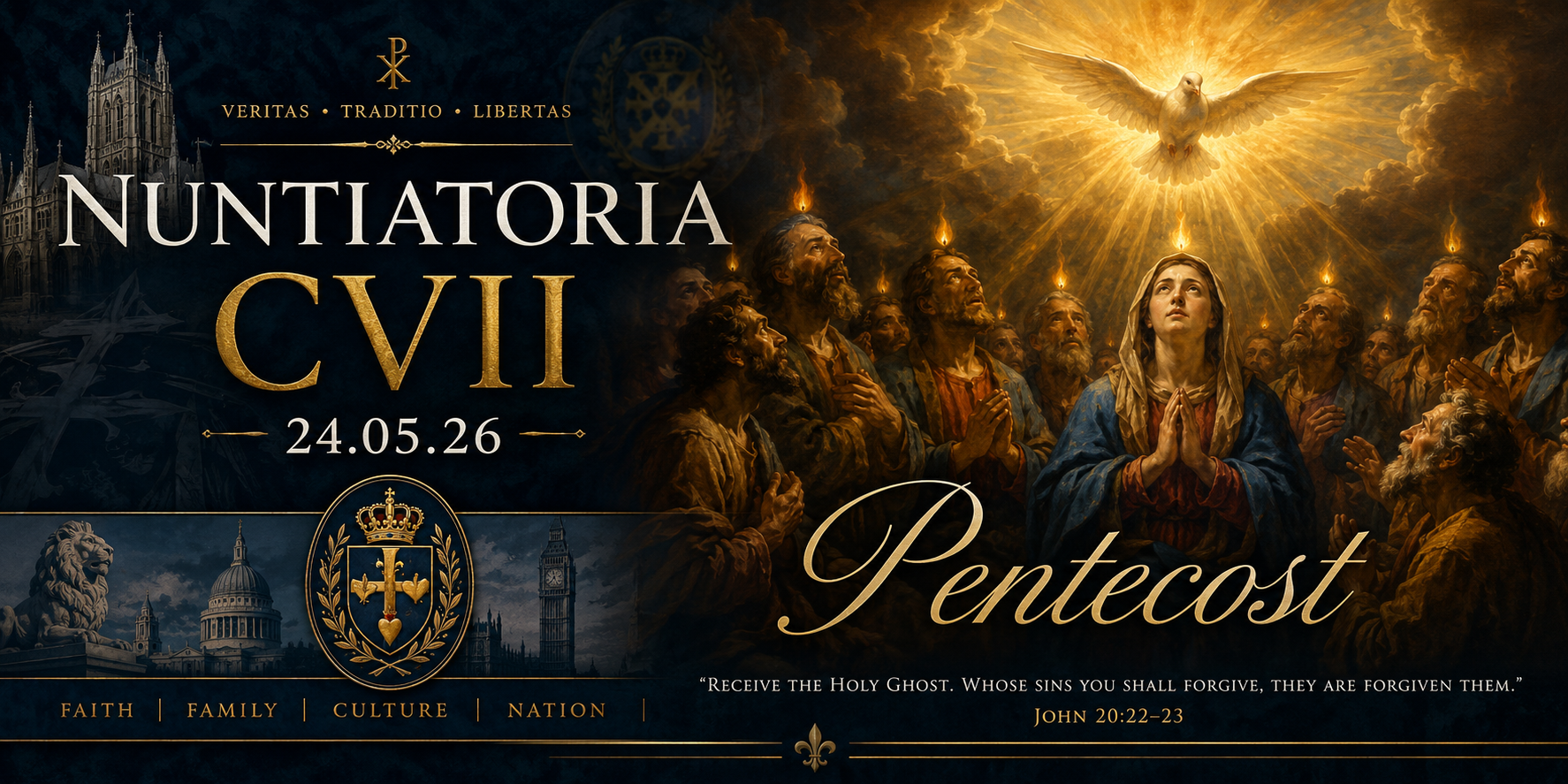
- 24.05.26 Nuntiatoria CVII: Editorial
This edition of Nuntiatoria addresses the interconnected crises facing contemporary society, particularly within the Church and broader cultural context. It explores the erosion of objective truth, institutional trust, and moral clarity, highlighting discussions on topics like safeguarding, freedom of speech, and educational decline. The call for discernment and recovery of foundational truths is emphasised.
- Fire Before the Flame: The Vigil of Pentecost in the Ancient Roman Rite and the Descent of the Holy Ghost
The Vigil of Pentecost in the ancient Roman Rite highlights the importance of preparation, waiting, and silence before the descent of the Holy Ghost. This profound liturgical practice involved multiple readings and blessings, emphasising transformation through divine indwelling, rather than mere experience. Its reduction in 1955 diminished this spiritual essence and significance.
- The Loss of Man: Historical Confidence, Spiritual Inheritance, and the Unravelling of Britain
The Peckham Podcast dialogue reveals a profound crisis in Britain, marked by a loss of historical confidence and spiritual inheritance. This anthropological shift leads to societal confusion about fundamental human concepts, resulting in a breakdown of community and meaning. The discussion underscores the urgent need for reconnection with the essence of humanity and truth.
- The Architecture of Silence: Claire Brennan and the Collapse of Northern Ireland’s Buffer Zone Prosecution
The collapse of Claire Brennan’s prosecution under Northern Ireland’s abortion “safe access zone” law highlights a troubling trend where the state seeks to govern not just actions but also moral influence in public spaces. While Brennan is acquitted, the underlying legal framework remains intact, posing serious implications for free expression and civil liberties.
- Authority, Schism, and the Crisis of Tradition: The SSPX Question Reconsidered
The SSPX’s upcoming episcopal consecrations raise questions of schism and authority within the Church, reflecting deeper tensions over Tradition. While the SSPX acknowledges papal authority, disputes arise regarding its exercise. The situation underscores a crisis not solely of discipline but of doctrinal interpretation, revealing unresolved complexities in Church governance and unity.
- The Oxford Union, Tommy Robinson, and the Collapse of Intellectual Courage: Law, Speech, and the Duty to Debate
The ongoing controversy surrounding Tommy Robinson’s invitation to the Oxford Union highlights the tension between institutional discretion and the legal obligations governing freedom of speech in UK universities. Recent legislation underlines that lawful speech must be allowed, counteracting cultural reluctance and unofficial censorship, and demanding accountability in upholding these principles.
- Cardinal Zen, Synodality, and the Constitutional Crisis of the Church
Cardinal Joseph Zen’s remarks at the January 2026 Extraordinary Consistory marked a pivotal moment in the Church, highlighting profound tensions regarding synodality and ecclesial identity. His critique suggests that the current approach risks replacing apostolic authority with bureaucratic processes, raising questions about the Church’s adherence to its traditional teachings and structure.
- The Securitisation of Thought: Universities, Surveillance, and the Quiet Death of Truth
The article discusses the transformation of universities from centres of free inquiry to institutions prioritising risk management and surveillance. The use of private intelligence firms for monitoring academic speech raises concerns over academic freedom, suggesting a shift towards controlling ideas rather than fostering truth. This threatens the essence of intellectual life.
- Can Sedevacantists Solve the Jurisdiction Issue?
Father Gabriel Lavery addresses the pressing issue of Church governance during the sede vacante condition, asserting that the Church retains its juridical continuity and authority, despite the absence of a visible head. Lavery emphasises that, while jurisdiction persists, the challenge lies in demonstrating a coherent body capable of rightful representation and governance amid the ongoing crisis.
- When a Foreign Voice Speaks a Forbidden TruthJD Vance, the Small Boats Crisis, and the Collapse of Political Candour in Britain
JD Vance’s recent comments on Britain’s small boats crisis highlight a troubling lack of political candour regarding immigration. He argues for sovereign control over borders, exposing the disconnection between governmental rhetoric and enforcement. The ongoing crisis reflects not just enforcement failures, but a deeper communication breakdown within British politics about immigration responsibilities and national identity.
- Henry Nowak and the Crisis of Equal Justice in Britain
The killing of 18-year-old Henry Nowak has become more than a criminal trial. It has exposed a deeper crisis: the erosion of public confidence in the impartial administration of justice. As courtroom evidence, parliamentary intervention, and public reaction converge, the case now forces a sharper question—does the law still operate equally for all, or has confidence in its neutrality already begun to fracture?
- The Return of Reality: Law, Sex, and the Reckoning of the Administrative State
The draft Equality Act 2010 Code of Practice reaffirms that “sex” refers to biological sex, correcting a decade of policy misalignment. Institutional practices grounded in self-identification are challenged, necessitating alignment with statutory law. This restoration clarifies the definition of single-sex services and sets a precedent for institutional compliance in the face of legal scrutiny.
- The Vatican and the Revolution: A Promise Kept
A detailed report from the Lepanto Institute, reinforced by Vatican statements and the testimony of Fr Charles Murr, raises a grave and precise question: has the Church, in her engagement with “popular movements,” blurred the line between Catholic social doctrine and revolutionary ideology? The issue is not caricature, but clarity—whether solidarity has been distinguished from endorsement, and whether the Cross has been preserved amid the language of struggle.
- Consecration and Conscience: The SSPX, Fr. Pagliarani, and the Persistence of Necessity
The ongoing crisis surrounding the Society of Saint Pius X (SSPX) and its potential episcopal consecrations highlights deep ecclesiological tensions within the Catholic Church. While Rome asserts canonical clarity regarding schism and disobedience, the SSPX contends with a state of necessity, complicating the dialogue between authority and Tradition. The unresolved issues persist nearly four decades post-Écône, indicating a broader crisis with implications for Church unity and doctrinal continuity.
- The Right to Die — or the Duty to Disappear? Brenda Hale, Rowan Williams, and the Spiritual Logic of Britain’s Assisted Dying Debate
The assisted dying debate in Britain, particularly through the work of Brenda Hale and Rowan Williams, explores profound existential questions about human dignity and autonomy. Hale advocates for individual agency in end-of-life choices, while Williams warns against the cultural implications of such decisions, suggesting it may lead society to view dependency as a burden.
- A Bosco School Without Bosco? Authority, Fear, and the Crisis of Catholic Educational Witness at St Paul’s
The allegations against St Paul’s Catholic College highlight a crisis in Catholic educational authority, questioning its adherence to foundational values. Former staff have reported a culture of fear and intimidation, prompting calls for an independent investigation. The integrity of the institution and its commitment to Don Bosco’s principles are critically at stake.
- From Ambiguity to Accountability: Safeguarding, Law, and the Duty of School Governors in an Age of Evasion
The recent developments in Brighton & Hove highlight a shift towards accountability in school governance regarding safeguarding laws. The Equality and Human Rights Commission’s draft Code clarifies that biological sex must be recognised, strengthening legal requirements around single-sex services. Governors now face increased responsibility to ensure safeguarding practices align with these legal standards.
- Monastery or Mirror of Modernity? The Milan “Ambrosian Monastery” and the Eclipse of Catholic Identity
The proposed Ambrosian Monastery in Milan raises significant theological questions about Catholic identity in a modern pluralistic context. While aiming to foster interreligious dialogue and cultural reflection, it risks diluting the Church’s unique claim as the sole bearer of divine revelation, potentially overshadowing its sacramental and worship-focused life.
- The Gift of Fortitude, and the Signs of the Times
A Pentecost reflection on the Gift of Fortitude, this article explores the supernatural courage bestowed by the Holy Ghost to endure evil and persevere in good. Drawing upon saints, martyrs, and the moral confusion of the modern age, it calls Catholics to steadfast holiness, self-discipline, and courageous fidelity amidst spiritual decline.
- Taylor Marshall Is Wrong: Vatican II Did Create a New Religion — and the Reformers Themselves Admitted It
The ongoing crisis surrounding the Society of Saint Pius X (SSPX) and its potential episcopal consecrations highlights deep ecclesiological tensions within the Catholic Church. While Rome asserts canonical clarity regarding schism and disobedience, the SSPX contends with a state of necessity, complicating the dialogue between authority and Tradition. The unresolved issues persist nearly four decades post-Écône, indicating a broader crisis with implications for Church unity and doctrinal continuity.
- Old Roman Catholicism: The Forgotten Continuity of Traditional Roman Catholicism
Old Roman Catholicism, often misunderstood, represents a historical continuity of traditional Roman Catholicism. It is distinct from broader Old Catholicism and does not reject papal primacy. Maintaining fidelity to traditional doctrine and liturgy, its practices reflect a commitment to Catholic continuity, resisting contemporary trends toward innovation in ecclesiastical identity.


 The Second Sunday after Pentecost and Corpus Christi highlight the significance of the Eucharist in Christian life. The Gospel invites believers to reflect on their priorities, emphasising that earthly concerns can overshadow spiritual nourishment. The celebration of Corpus Christi reaffirms Christ’s enduring presence, urging the faithful to accept His invitation to the sacramental banquet.
 The controversy over the National Association of Muslim Police (NAMP) highlights a significant shift in British policing, moving from impartial law enforcement to identity politics. This transformation threatens public trust and the legitimacy of policing, as institutions increasingly prioritise group identities over shared citizenship, compromising the foundational principle of policing by consent.
 The Ember Saturday after Pentecost highlights the significance of ordinations, encouraging reflection through multiple readings. The prophet Joel anticipates the Holy Spirit’s outpouring, while Moses reminds the Israelites of their covenant with God. St. Paul’s message in Romans culminates in a new covenant through Christ, uniting all nations in faith and grace.
 Published beneath the fire of Pentecost, Nuntiatoria CVIII explores spiritual renewal amidst ecclesial confusion, institutional fragility, legal controversy, and cultural uncertainty. From liturgical theology to political crisis, this edition asks whether truth, courage, and memory might yet renew Church and civilisation through the Spirit’s fire.
 Trinity Sunday serves as a profound moment in the liturgical calendar, prompting the faithful to contemplate the mystery of God rather than specific historical events. The Church guides believers from understanding God’s actions to recognising His essence. This feast not only celebrates the Trinity but also emphasises the participation of the faithful in divine life through worship and the sacraments.
 Henry Nowak’s murder exposed more than a violent crime—it revealed a policing culture where fear of accusation can override basic judgment. When a dying victim is handcuffed and an untested allegation is believed, equal justice itself is placed in jeopardy.
 The homily emphasises the significance of divine counsel in the Christian life, highlighting the need for guidance from the Holy Spirit. It contrasts the counsel of the flesh with God’s counsel, illustrating through the example of a paralytic how true healing begins with forgiveness of sins, leading to spiritual and physical restoration.
 Today marks the feast of St. Augustine of Canterbury, who led the mission to evangelise England in 596. Appointed by St. Gregory the Great, he faced initial discouragement but succeeded in converting King Ethelbert and establishing Christianity in south-east England, laying the foundation for the Roman rite in the English Church.
 A pastoral critique of Magnifica Humanitas, arguing that while it addresses artificial intelligence, its deeper focus is an anthropological re-centering that risks subordinating the Kingship of Christ to a universalised notion of human dignity. The epistle contends that by adopting a method aimed at worldly intelligibility, the encyclical weakens doctrinal clarity and the primacy of divine authority.
 Today we honour St. Bede, a Northumbrian monk who dedicated his life to study and writing. His notable work, the Ecclesiastical History of the English People, remains pivotal for understanding early English Christianity. St. Bede’s insights into unity through faith offer wisdom for contemporary divisions, urging a return to shared Christian values for cohesion.
 The Society of Saint Pius X has announced the consecration of four priests as bishops on 1 July 2026 at Écône Seminary. This significant move aims to sustain traditional Catholic priesthood amid a perceived crisis in the Church. The selected priests, each experienced and capable, are poised to continue sacramental life and doctrinal fidelity.
 Britain faces a significant spiritual crisis, with declining church attendance and a growing population identifying as non-religious. The Covid-19 pandemic has accelerated this trend, revealing a nation grappling with a loss of meaning. While some express renewed spiritual curiosity, genuine commitment remains elusive, highlighting a profound need for revival and transformation.
 The controversy involving Bishop Matthew Firth’s call for clergy attending protests to be investigated under the UK’s Prevent programme reveals a crisis in ecclesiastical confidence. It highlights tensions within the Church, where theological disagreements are increasingly framed as safeguarding concerns, risking the integrity of Christian witness and authority in society.
 Matthew d’Ancona highlights a significant cultural shift in Britain, marking the decline of secularism and the resurgence of spiritual seeking. As traditional belief structures erode, individuals gravitate towards various forms of religious sensibility. This evolving landscape invites critical reflection on the nature of truth and the potential for a renewed, authentic engagement with faith.
 Pope Leo XIV’s encyclical, Magnifica Humanitas, addresses the implications of artificial intelligence on human dignity while advocating for a Christological understanding of personhood. It evaluates technology against its impact on humanity and warns against the concentration of power in AI. The document promotes a dialogue-based approach to modern ethical challenges, maintaining continuity with Catholic social doctrine.
 The feast of Pentecost commemorates the Holy Spirit’s arrival, empowering the disciples to spread Jesus’ message globally. The Spirit serves as Counsellor, Advocate, and Comforter, guiding believers in truth and sustaining them through adversity. The celebration also marks the transition from the Old Covenant to a new one, open to all nations.
 Pentecost Sunday celebrates the descent of the Holy Ghost, marking the Church’s transformation from a mere institution to a living Body. This event signifies the internalisation of divine law and the empowerment of believers, leading to an active, dynamic Christian life. The Holy Spirit ignites personal and ecclesial renewal, urging ongoing receptiveness.
 The Vigil of Pentecost parallels Holy Saturday’s liturgy, focusing on significant biblical prophecies from Genesis, Exodus, Deuteronomy, Isaiah, Baruch, and Ezekiel. Each prophecy highlights God’s covenant with Israel and their struggles with faithfulness. The culmination in Christ’s resurrection signifies hope and the promise of the Holy Spirit, enabling the apostles to spread the gospel.
 The content outlines the liturgical calendar from Pentecost Sunday to Trinity Sunday, detailing specific observances, masses, and commemorations throughout the octave. Each day holds significance, marked by varying vestment colours and liturgical texts, emphasising themes of grace, sanctification, and the Holy Spirit’s role within the Church, culminating in the Trinity celebration.
 This edition of Nuntiatoria addresses the interconnected crises facing contemporary society, particularly within the Church and broader cultural context. It explores the erosion of objective truth, institutional trust, and moral clarity, highlighting discussions on topics like safeguarding, freedom of speech, and educational decline. The call for discernment and recovery of foundational truths is emphasised.
 The Vigil of Pentecost in the ancient Roman Rite highlights the importance of preparation, waiting, and silence before the descent of the Holy Ghost. This profound liturgical practice involved multiple readings and blessings, emphasising transformation through divine indwelling, rather than mere experience. Its reduction in 1955 diminished this spiritual essence and significance.
 The Peckham Podcast dialogue reveals a profound crisis in Britain, marked by a loss of historical confidence and spiritual inheritance. This anthropological shift leads to societal confusion about fundamental human concepts, resulting in a breakdown of community and meaning. The discussion underscores the urgent need for reconnection with the essence of humanity and truth.
 The collapse of Claire Brennan’s prosecution under Northern Ireland’s abortion “safe access zone” law highlights a troubling trend where the state seeks to govern not just actions but also moral influence in public spaces. While Brennan is acquitted, the underlying legal framework remains intact, posing serious implications for free expression and civil liberties.
 The SSPX’s upcoming episcopal consecrations raise questions of schism and authority within the Church, reflecting deeper tensions over Tradition. While the SSPX acknowledges papal authority, disputes arise regarding its exercise. The situation underscores a crisis not solely of discipline but of doctrinal interpretation, revealing unresolved complexities in Church governance and unity.
 The ongoing controversy surrounding Tommy Robinson’s invitation to the Oxford Union highlights the tension between institutional discretion and the legal obligations governing freedom of speech in UK universities. Recent legislation underlines that lawful speech must be allowed, counteracting cultural reluctance and unofficial censorship, and demanding accountability in upholding these principles.
 Cardinal Joseph Zen’s remarks at the January 2026 Extraordinary Consistory marked a pivotal moment in the Church, highlighting profound tensions regarding synodality and ecclesial identity. His critique suggests that the current approach risks replacing apostolic authority with bureaucratic processes, raising questions about the Church’s adherence to its traditional teachings and structure.
 The article discusses the transformation of universities from centres of free inquiry to institutions prioritising risk management and surveillance. The use of private intelligence firms for monitoring academic speech raises concerns over academic freedom, suggesting a shift towards controlling ideas rather than fostering truth. This threatens the essence of intellectual life.
 Father Gabriel Lavery addresses the pressing issue of Church governance during the sede vacante condition, asserting that the Church retains its juridical continuity and authority, despite the absence of a visible head. Lavery emphasises that, while jurisdiction persists, the challenge lies in demonstrating a coherent body capable of rightful representation and governance amid the ongoing crisis.
 JD Vance’s recent comments on Britain’s small boats crisis highlight a troubling lack of political candour regarding immigration. He argues for sovereign control over borders, exposing the disconnection between governmental rhetoric and enforcement. The ongoing crisis reflects not just enforcement failures, but a deeper communication breakdown within British politics about immigration responsibilities and national identity.
 The killing of 18-year-old Henry Nowak has become more than a criminal trial. It has exposed a deeper crisis: the erosion of public confidence in the impartial administration of justice. As courtroom evidence, parliamentary intervention, and public reaction converge, the case now forces a sharper question—does the law still operate equally for all, or has confidence in its neutrality already begun to fracture?
 The draft Equality Act 2010 Code of Practice reaffirms that “sex” refers to biological sex, correcting a decade of policy misalignment. Institutional practices grounded in self-identification are challenged, necessitating alignment with statutory law. This restoration clarifies the definition of single-sex services and sets a precedent for institutional compliance in the face of legal scrutiny.
 A detailed report from the Lepanto Institute, reinforced by Vatican statements and the testimony of Fr Charles Murr, raises a grave and precise question: has the Church, in her engagement with “popular movements,” blurred the line between Catholic social doctrine and revolutionary ideology? The issue is not caricature, but clarity—whether solidarity has been distinguished from endorsement, and whether the Cross has been preserved amid the language of struggle.
 The ongoing crisis surrounding the Society of Saint Pius X (SSPX) and its potential episcopal consecrations highlights deep ecclesiological tensions within the Catholic Church. While Rome asserts canonical clarity regarding schism and disobedience, the SSPX contends with a state of necessity, complicating the dialogue between authority and Tradition. The unresolved issues persist nearly four decades post-Écône, indicating a broader crisis with implications for Church unity and doctrinal continuity.
 The assisted dying debate in Britain, particularly through the work of Brenda Hale and Rowan Williams, explores profound existential questions about human dignity and autonomy. Hale advocates for individual agency in end-of-life choices, while Williams warns against the cultural implications of such decisions, suggesting it may lead society to view dependency as a burden.
 The allegations against St Paul’s Catholic College highlight a crisis in Catholic educational authority, questioning its adherence to foundational values. Former staff have reported a culture of fear and intimidation, prompting calls for an independent investigation. The integrity of the institution and its commitment to Don Bosco’s principles are critically at stake.
 The recent developments in Brighton & Hove highlight a shift towards accountability in school governance regarding safeguarding laws. The Equality and Human Rights Commission’s draft Code clarifies that biological sex must be recognised, strengthening legal requirements around single-sex services. Governors now face increased responsibility to ensure safeguarding practices align with these legal standards.
 The proposed Ambrosian Monastery in Milan raises significant theological questions about Catholic identity in a modern pluralistic context. While aiming to foster interreligious dialogue and cultural reflection, it risks diluting the Church’s unique claim as the sole bearer of divine revelation, potentially overshadowing its sacramental and worship-focused life.
 A Pentecost reflection on the Gift of Fortitude, this article explores the supernatural courage bestowed by the Holy Ghost to endure evil and persevere in good. Drawing upon saints, martyrs, and the moral confusion of the modern age, it calls Catholics to steadfast holiness, self-discipline, and courageous fidelity amidst spiritual decline.
 The ongoing crisis surrounding the Society of Saint Pius X (SSPX) and its potential episcopal consecrations highlights deep ecclesiological tensions within the Catholic Church. While Rome asserts canonical clarity regarding schism and disobedience, the SSPX contends with a state of necessity, complicating the dialogue between authority and Tradition. The unresolved issues persist nearly four decades post-Écône, indicating a broader crisis with implications for Church unity and doctrinal continuity.
 Old Roman Catholicism, often misunderstood, represents a historical continuity of traditional Roman Catholicism. It is distinct from broader Old Catholicism and does not reject papal primacy. Maintaining fidelity to traditional doctrine and liturgy, its practices reflect a commitment to Catholic continuity, resisting contemporary trends toward innovation in ecclesiastical identity.



Leave a Reply